Science Cover Letter Example & Writing Guide
Reference our science cover letter sample and follow our practical writing tips to learn how to write a cover letter that stands out.

Monday – Friday: 8:00 AM – 7:00 PM (EDT), Saturday – Sunday: Closed(866) 215-9048
Cover Letter Examples Science Cover Letter
 Written By Lauren MastroniCareer Expert & Senior Digital Content Writer
 Reviewed By Conrad BenzContent Manager & Hiring Manager
Lauren Mastroni is a Senior Digital Content Writer at Resume Genius, where she creates data-driven career content and actionable job search advice. With a background in academic research, she brings...
Reference our science cover letter sample and follow our practical writing tips to learn how to write a cover letter that stands out.
Want a different design? Download another cover letter template from our collection.
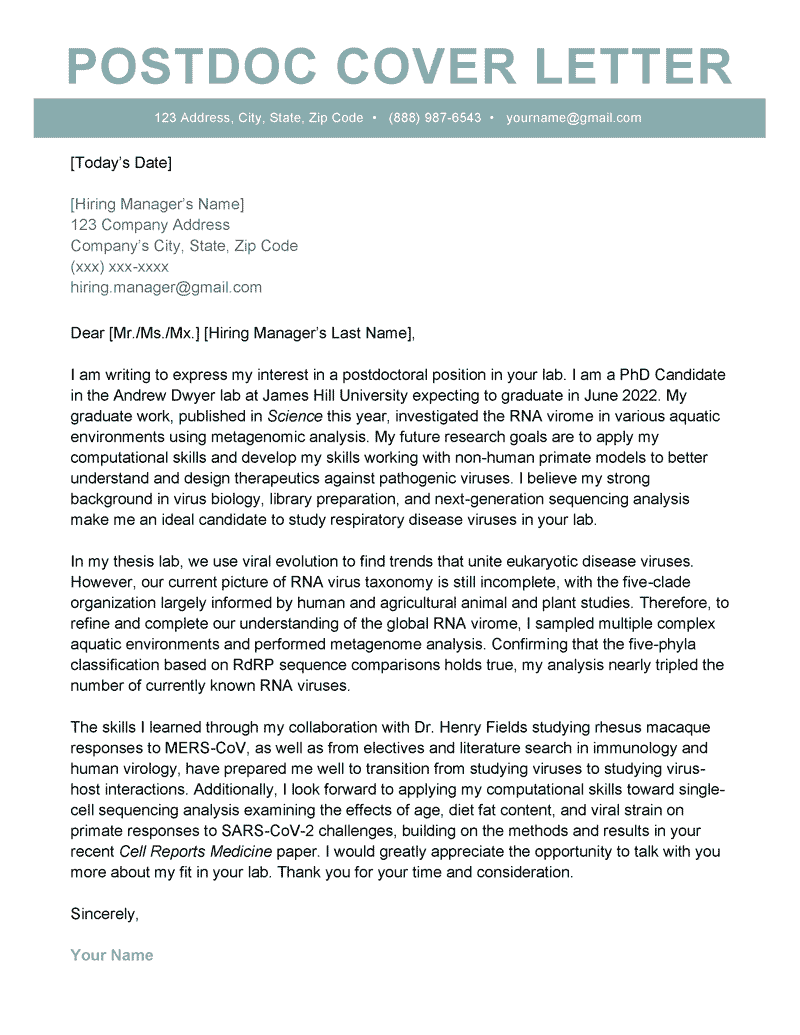
Make sure you use proper cover letter format to ensure that your cover letter is readable and professional.
FIRST AND LAST NAME
Email: your.email@email.com
Phone: (123) 456-7891
Address: Street, City, State
LinkedIn: linkedin.com/in/yourprofile
[Today’s Date]
[Hiring Manager’s Name]
[341 Company Address]
[Company City, State xxxxx]
[(xxx)-xxx-xxxx]
[hiring.manager@gmail.com]
Dear [Dr./Mr./Ms./Mx.] [Hiring Manager’s Last Name],
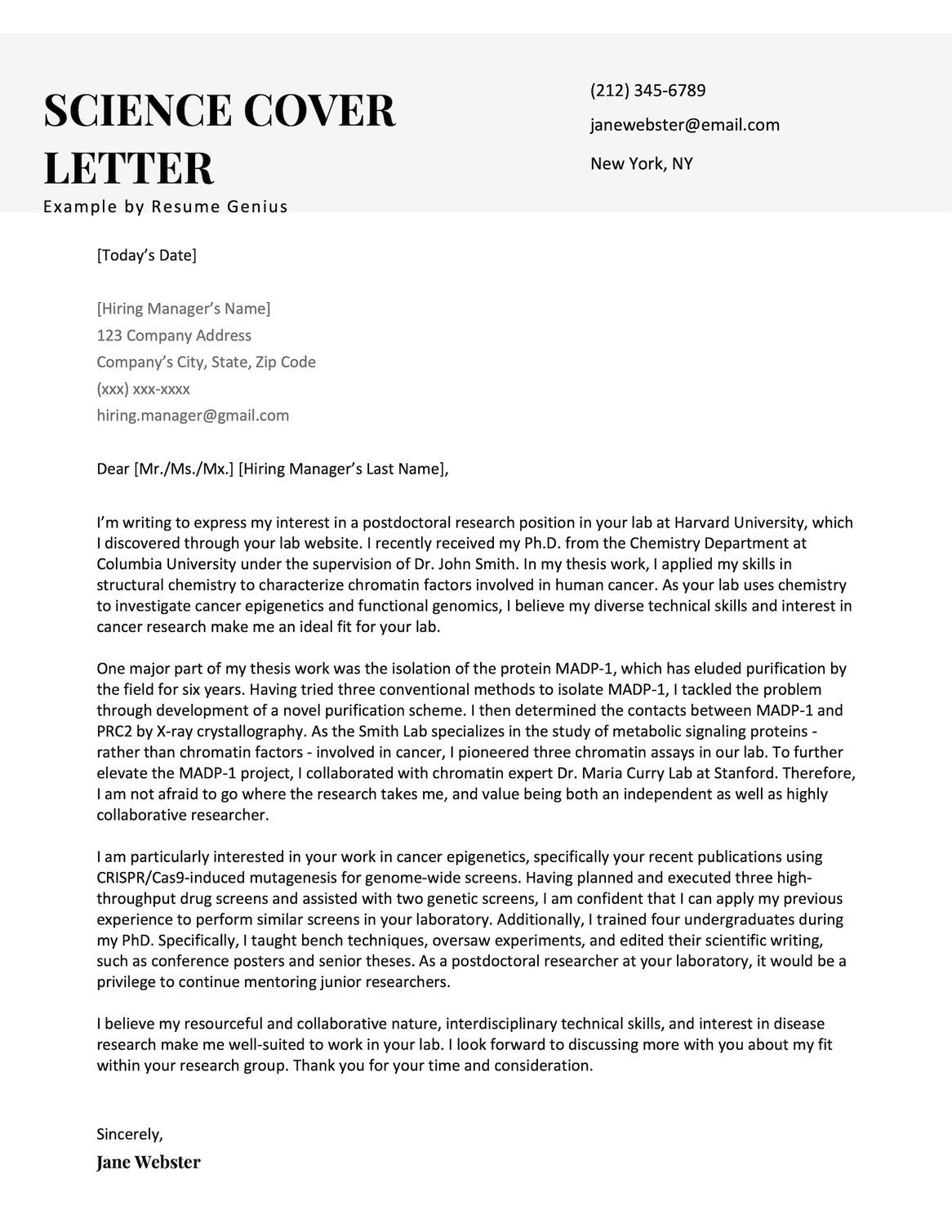
I’m writing to express my interest in a postdoctoral research position in your lab at Harvard University, which I discovered through your lab website. I recently received my Ph.D. from the Chemistry Department at Columbia University under the supervision of Dr. John Smith. In my thesis work, I applied my skills in structural chemistry to characterize chromatin factors involved in human cancer. As your lab uses chemistry to investigate cancer epigenetics and functional genomics, I believe my diverse technical skills and interest in cancer research make me an ideal fit for your lab.
One major part of my thesis work was the isolation of the protein MADP-1, which has eluded purification by the field for six years. Having tried three conventional methods to isolate MADP-1, I tackled the problem through development of a novel purification scheme. I then determined the contacts between MADP-1 and PRC2 by X-ray crystallography. As the Smith Lab specializes in the study of metabolic signaling proteins – rather than chromatin factors – involved in cancer, I pioneered three chromatin assays in our lab. To further elevate the MADP-1 project, I collaborated with chromatin expert Dr. Maria Curry Lab at Stanford. Therefore, I am not afraid to go where the research takes me, and value being both an independent as well as highly collaborative researcher.
I am particularly interested in your work in cancer epigenetics, specifically your recent publications using CRISPR/Cas9-induced mutagenesis for genome-wide screens. Having planned and executed three high-throughput drug screens and assisted with two genetic screens, I am confident that I can apply my previous experience to perform similar screens in your laboratory. Additionally, I trained four undergraduates during my PhD. Specifically, I taught bench techniques, oversaw experiments, and edited their scientific writing, such as conference posters and senior theses. As a postdoctoral researcher at your laboratory, it would be a privilege to continue mentoring junior researchers.
I believe my resourceful and collaborative nature, interdisciplinary technical skills, and interest in disease research make me well-suited to work in your lab. I look forward to discussing more with you about my fit within your research group. Thank you for your time and consideration.
Sincerely,
Jane Webster
Follow these tips to write a cover letter for a scientific position:
Before you start writing, gather as much information about the position as possible. In addition to reading the job description thoroughly, look at the employer’s:
Your research will tell you if the role is right for you and help you write a cover letter that positions you as the ideal candidate.
Convey how your technical skills and interests align with the requirements of the role. Often, showing enthusiasm for the job is just as important as having all the requisite skills.
To show excitement for the position, consider answering the following questions in your body paragraphs:
If you have other skills in addition to the prerequisites, describe how you would apply your different technical knowledge to advance the research or help the company fulfill its goals.
Whenever possible, back up your achievements with data. Here are examples of quantifiable metrics you can include in your cover letter:
Quantifying your achievements not only sounds impressive, but makes your claims more believable at face value. If the hiring manager still doesn’t take your word for it, they can easily verify the numbers.
Employers want to know that you’re motivated and forward-thinking. Use your cover letter to briefly explain how the position fits into your long-term academic or professional goals.
For example, you might mention your interest in contributing to ongoing research in a specific field, developing expertise with certain lab techniques, or pursuing graduate study related to the company’s focus area. Keep the emphasis on how your future plans align with the company or organization’s mission or current projects.
Avoid vague statements about “growing your career.” Instead, be specific about the skills you hope to deepen, the impact you want to make, or the research questions that drive your work. This shows employers that you’re intentional about your career path and genuinely interested in their opportunity.
About the Author

Lauren Mastroni is a Senior Digital Content Writer at Resume Genius, where she creates data-driven career content and actionable job search advice. With a background in academic research, she brings a research-focused approach to topics like resume writing, interviewing, and career development. Lauren is dedicated to helping job seekers at all stages navigate the hiring process and present themselves more effectively to employers.

Cover Letter Help
Cover Letter Examples for All Job Applications and SituationsLauren Mastroni
Cover Letter Help
Google Docs Cover Letter Templates
Sebastian Morgan
Cover Letter Help
How to Write a Cover Letter for a Job in 2026
Conrad Benz

Cover Letter Help
50+ Cover Letter Statistics Hiring Managers Want You to Know
Eva Chan

Cover Letter Help
Best Cover Letters of 2026 (10 Good Examples)Sebastian Morgan
Cover Letter Help
Cover Letter TemplatesSebastian Morgan

Cover Letter Help
5 Short Cover Letter Examples (And How to Write Your Own)Sebastian Morgan
Cover Letter Help
Are Cover Letters Necessary in 2026?Lauren Mastroni
Your review would mean a lot to us.
We hope our free downloadable resources will help you on your path to career success. If you have time, a quick review would really make our day (it'll only take 15 seconds). Best of luck on the job hunt!