
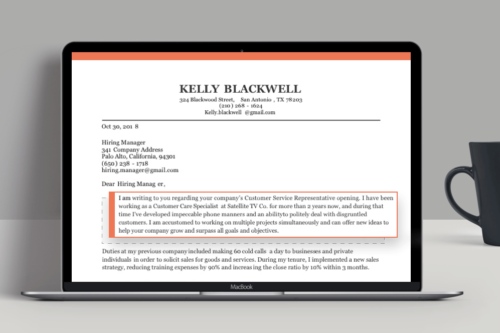
Most cover letters begin the same way: “I’m writing to apply for…” It’s acceptable, but rarely grabs attention or sets you apart.
To stand out in 2026, your cover letter introduction should immediately show value and relevance. Our cover letter statistics back this up:
- 83% of hiring managers say they always or frequently read cover letters
- 45% read the cover letter before the resume
- 36% spend less than 30 seconds on each cover letter
Read on to learn how to write a reader-focused opening that builds instant rapport with the hiring manager.
- Open your cover letter professionally with “Dear [Hiring Manager’s Name]”
- Use one of these approaches in your opening sentence to show your value or interest:
- Explain how you can solve a problem the company is facing
- Describe standout achievements
- Say why the company’s mission connects with you
- Use a casual tone only if it mirrors the company’s culture, avoid humor, and keep your cover letter concise so it’s easy to read
5 ways to start a cover letter (opening lines)
A strong opening sets the tone for your cover letter and catches the hiring manager’s attention right away. These opening sentence formulas work whether you’re writing an email cover letter, applying through a job portal, or reaching out directly.
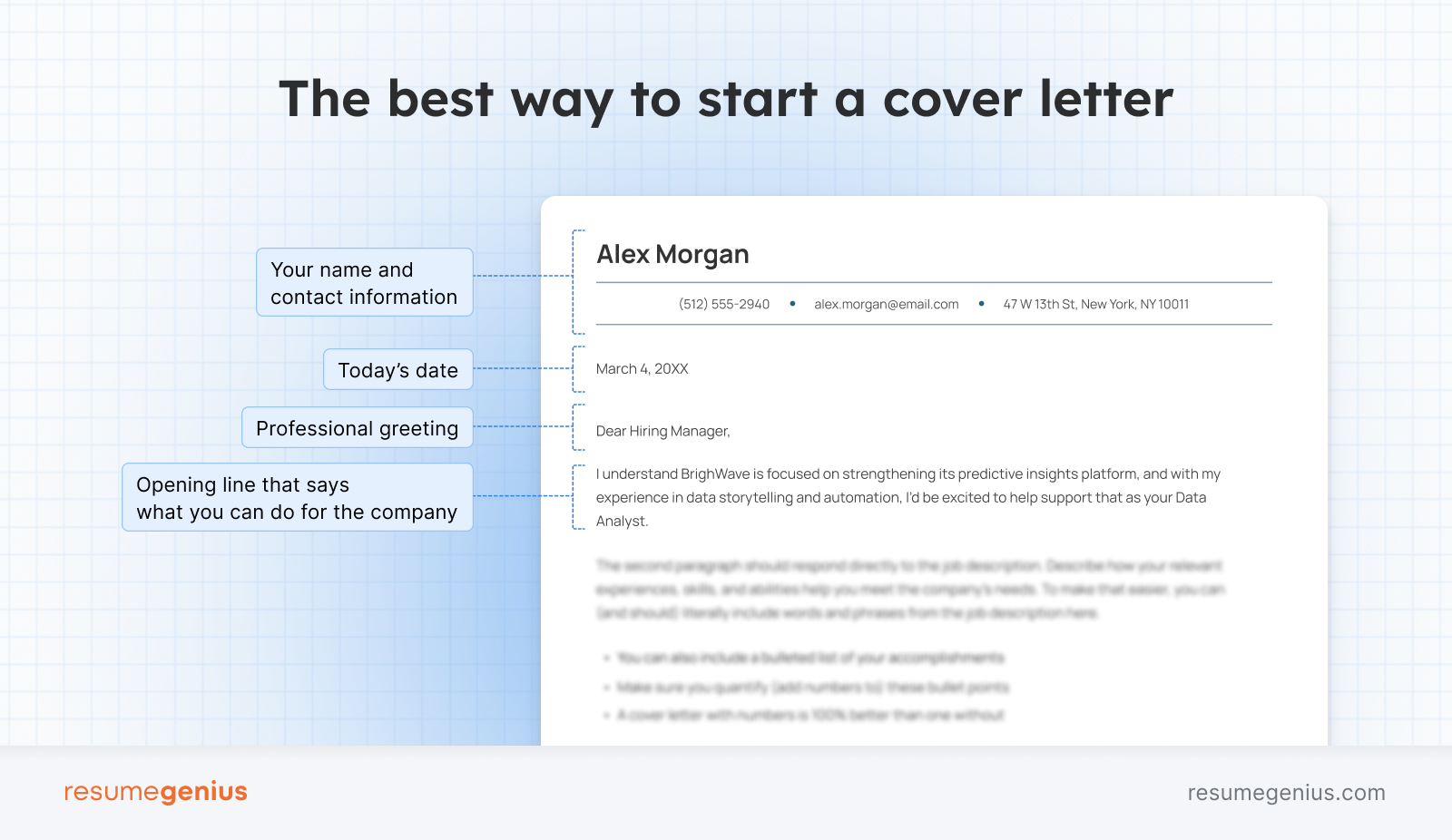
Intro #1: Say what you can do for the company
This is the most effective way to start a cover letter. Employers hire people to solve problems, whether that means increasing sales, improving processes, or leading teams. This kind of opening immediately positions you as the solution they’re looking for.
I understand [Company] is focused on [specific goal/initiative/challenge], and with my experience in [relevant skill or area], I’d be excited to help support that as your [Job Title].
Example
I understand Lumiere is expanding its social presence across new channels, and with my background in multi-platform campaign strategy, I’d be excited to help drive that growth as your next Social Media Manager.
This opening works best when you’ve researched the company’s goals and challenges. If you’re unsure what the organization’s priorities are, avoid this approach: vague, generic claims can weaken your credibility.
Intro #2: Show you understand the company
If you connect with a company’s mission, values, or recent work, start with an opening sentence that highlights that connection. This approach shows the hiring manager that you care about the role.
I’ve admired [Company’s] commitment to [mission/value], and the chance to contribute as a [Job Title] aligns with my experience in [skill/industry].
Example
I’ve followed EarthWear’s environmental initiatives for years, and your commitment to sustainable innovation is exactly why I’m excited to apply for the Product Developer role.
Intro #3: Demonstrate an accomplishment
Leading with a specific accomplishment is more impactful than a vague or overly formal intro. It immediately shows what you’re capable of and gives the hiring manager a concrete reason to keep reading.
As a [Your Role] who has [quantifiable achievement], I’m excited to bring my expertise to the [Job Title] position at [Company].
Example
As a sales rep who exceeded quarterly targets by 30% for two consecutive years, I’m eager to bring that same energy and consistency to the Sales Associate role at NorthBridge.
This opening works best when your accomplishment clearly relates to the job you’re applying for. Avoid using it if the achievement feels unrelated, as it could confuse the reader rather than impress them.
49% of hiring managers say a strong cover letter can convince them to interview an otherwise weak candidate.
Intro #4: Explain a career change
If you’re switching industries or roles, your cover letter is the perfect place to provide context. A confident opening helps the hiring manager understand your motivation and see how your background still fits the position.
As a professional transitioning from [Previous Field/Role], where I [transferable achievement or strength], I’m excited to bring my skills in [relevant transferable skills] to the [New Job Title] position at [Company].
Example
As a professional transitioning from hospitality management, where I led teams of 20+ and consistently improved customer satisfaction scores, I’m excited to bring my strengths in communication, organization, and people leadership to the HR Coordinator role at BrightPath.
Use this opening only if your career change isn’t obvious from your resume alone. Otherwise, it’s stronger to lead with your value. Keep the explanation brief and focused on what you offer the new role, not just why you’re leaving your previous one.
If you’re changing careers, review cover letter examples for your target job to see how successful candidates frame their experience.
Intro #5: Mention a connection you have at the company
If you know someone at the company or made a connection through networking, mention it early in your cover letter. Hiring managers tend to trust referrals and personal recommendations more than cold applications, so this approach can give you an immediate advantage.
After speaking with [Name] on your [Team/Department], I gained valuable insight into [specific detail you learned], which made me excited to apply for the [Job Title] position at [Company].
Example
After speaking with Jordan Lee on your Data team and learning more about your focus on building scalable, user-friendly dashboards, I became even more excited to apply for the Data Analyst role at MetricFlow.
How to write your header and greeting
Start with the following information in your cover letter’s header:
- Full name
- Job title (optional)
- Phone number
- City and state (optional)
- LinkedIn profile or personal website (if applicable)
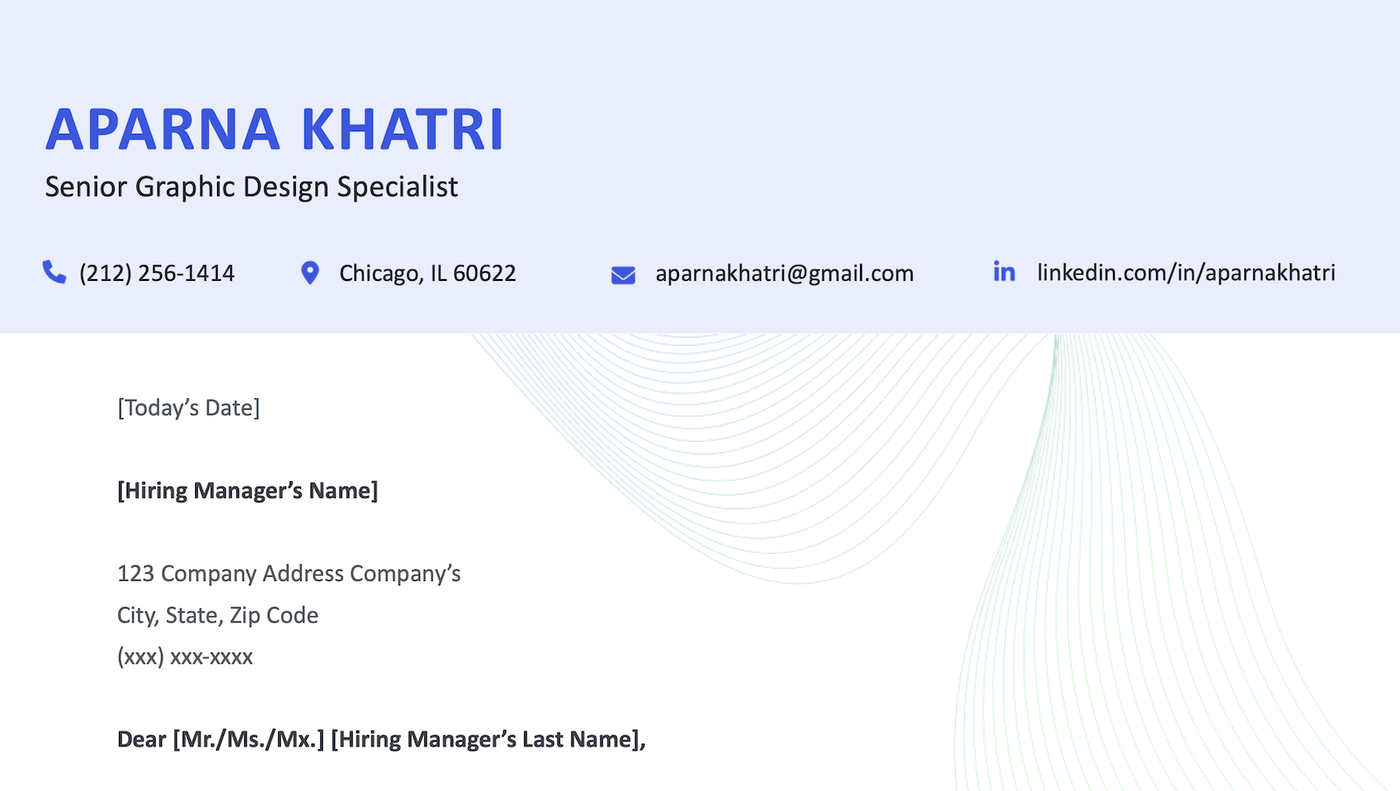
If you’re sending your cover letter by email, skip the header entirely and start directly with the greeting.
A professional cover letter salutation uses the hiring manager’s name, such as “Dear [First Name] [Last Name].” You can often find this information in the job listing or on the company’s website or LinkedIn page.
If the hiring manager’s name isn’t listed, address your letter to the relevant department head or use a respectful general greeting like “Dear Hiring Manager” or “Dear [Team Name] Hiring Team.”
Tips to get your cover letter introduction right every time
Our research shows that hiring managers use cover letters differently depending on company size.
At small companies, cover letters help assess whether a applicant seems like a good cultural fit. At mid-size companies, they’re more likely to reveal personality. Across all company sizes, hiring managers rely on cover letters to provide context a resume alone can’t.
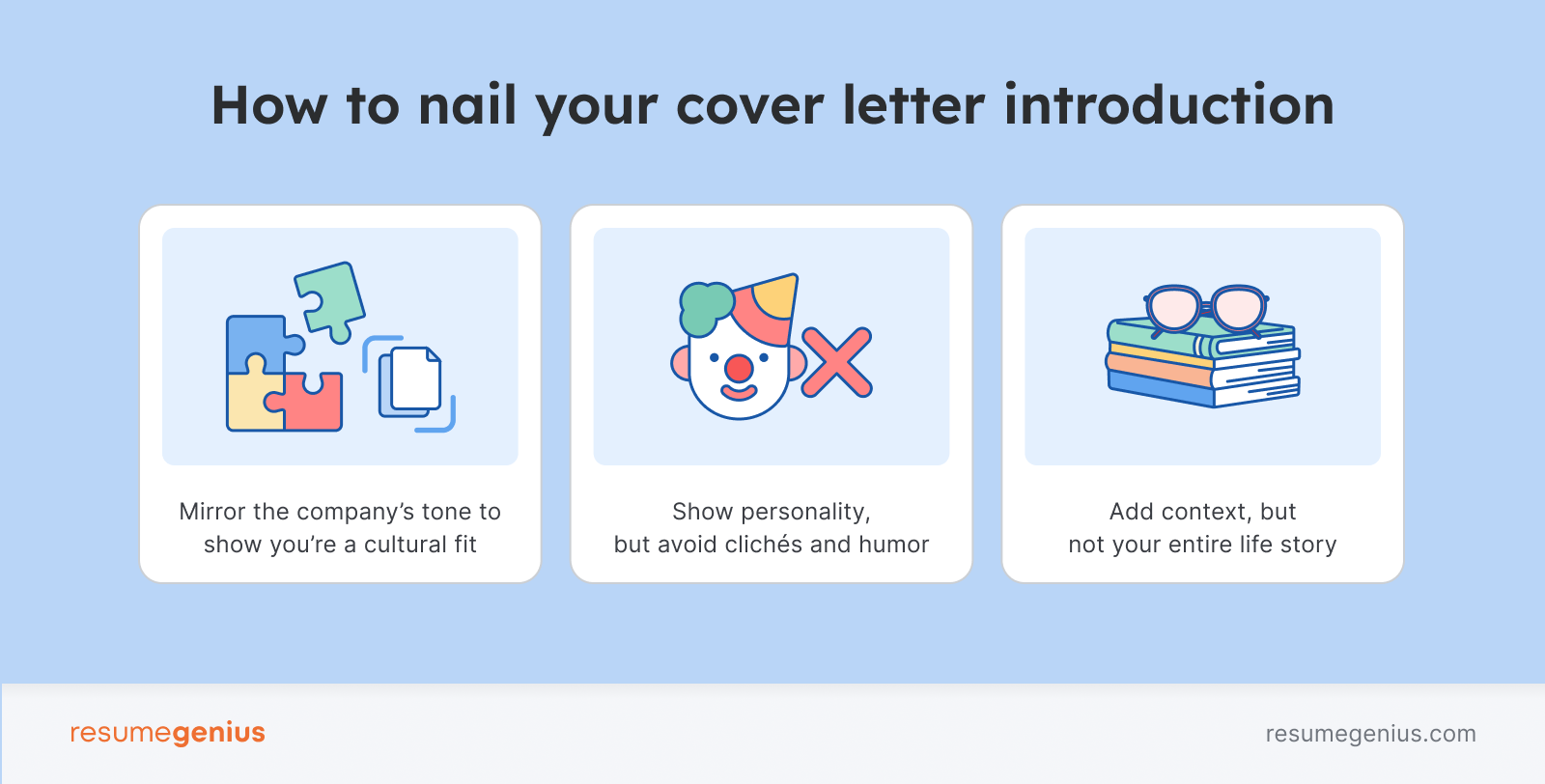
Follow these tips to tailor your cover letter introduction so it lands well with any company.
Mirror the company’s tone
Matching the company’s tone, especially at smaller companies, shows you understand their culture and could work smoothly with the team. To do this, review the company’s website, job ad, and recent LinkedIn activity to get a sense of their voice, then reflect that tone in your cover letter.
If the company uses bold language like “We don’t just think outside the box, we redesign it,” you can echo it with an opener like:
“I’m excited to bring bold ideas and fresh energy to a team that clearly doesn’t settle for ordinary.”
If they emphasize community impact and use heartfelt language, your tone can follow suit:
“Your mission to empower underserved communities strongly resonates with me, and I’d be honored to support it with my background in program development and advocacy.”
Small details count when you write your cover letter. Learn how to write each section, from your opening line to your closing paragraph.
Avoid clichés and humor
Our data shows that medium-sized companies often read cover letters to get a sense of your personality, but that doesn’t mean it’s the place for jokes.
Humor can easily fall flat, especially because cover letters are read quickly and may pass through several hands. What’s funny to one person might seem awkward or unprofessional to another.
Forced humor
“I may not have a cape, but I’m here to save your marketing strategy.”
What to write instead
“I recently led a campaign that boosted engagement by 120% and I’m excited to bring that same creativity and strategic thinking to your team.”
You should also avoid clichés like “I’ve always dreamed of working here” or “I’m a people person.” These phrases are overused, vague, and weaken your message. To stand out, focus on highlighting a relevant achievement or genuine interest.
Over-the-top flattery
“Ever since I was a kid, I knew I wanted to work at your company.”
What to write instead
“I’m inspired by your commitment to sustainability and would welcome the opportunity to contribute to that mission with my background in eco-conscious product design.”
Add context, but not your life story
At larger companies where hiring managers may review hundreds of applications, concise cover letters work best. Your cover letter is the right place to add context that doesn’t fit neatly on your resume, such as explaining a career switch or relocation.
Still, that context should stay concise. Avoid walking through a whole career journey from high school onward. Hiring managers want to quickly understand why you’re qualified and ready for an interview. In most situations, a short cover letter works better than a long, overly detailed essay.
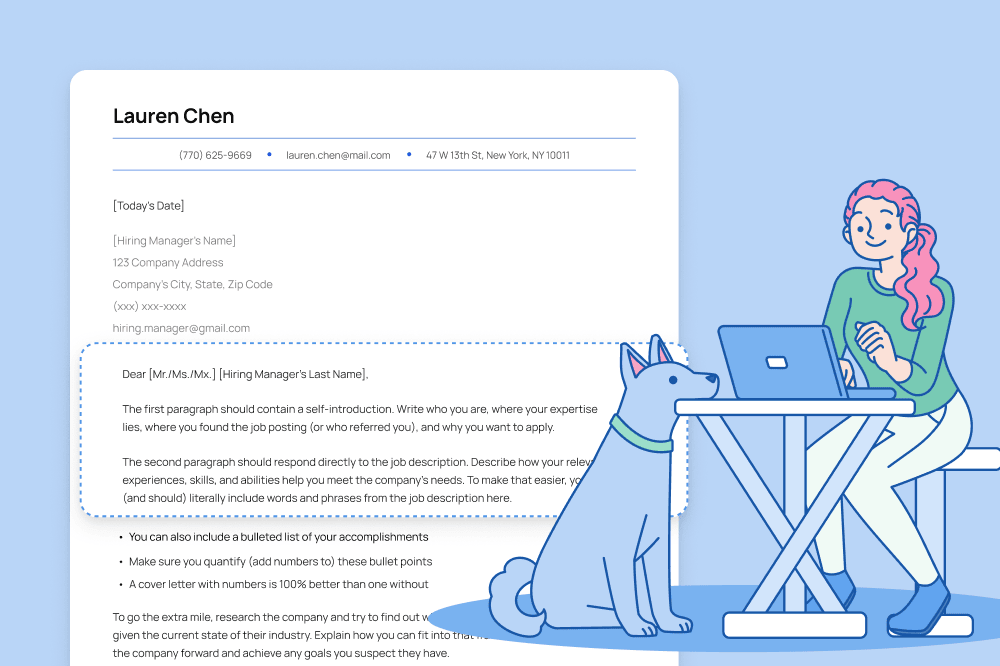
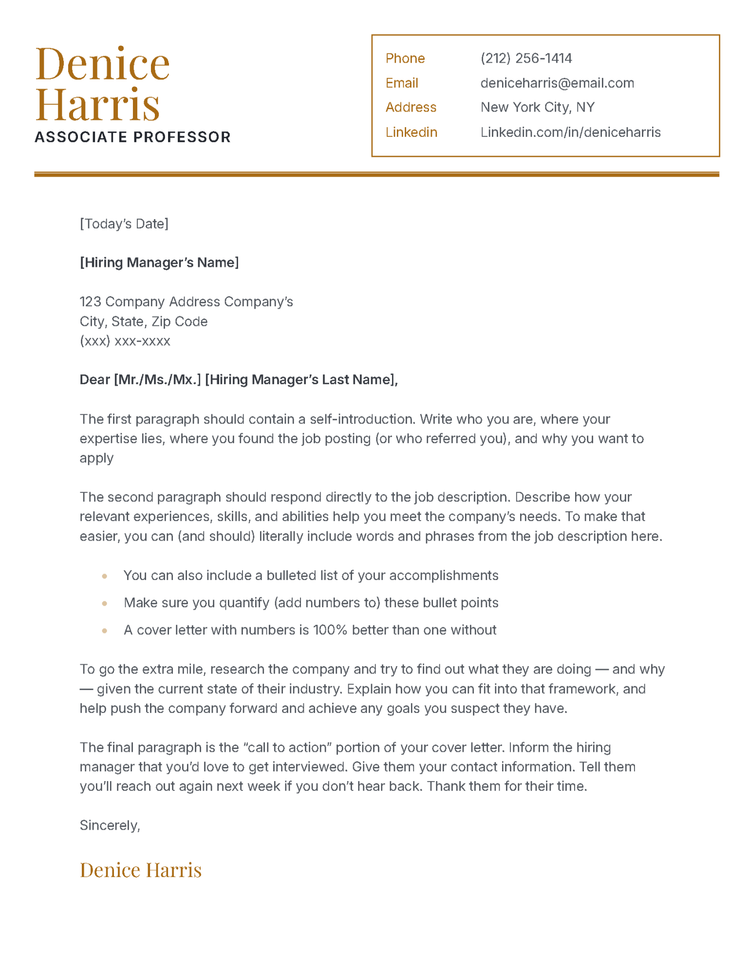
Master cover letter template (just add your introduction)
One of the fastest ways to write a cover letter is to create a reusable “master” version and customize it for each job.
By swapping out a few key sections, especially the introduction, you can quickly tailor your letter to different roles without starting from scratch every time.
[Your full name]
[Your email]
[Your phone number]
[Your City, State, ZIP Code]
[LinkedIn Profile or Portfolio URL (optional)
[Today’s date]
[Company name and address]
Dear [Hiring Manager’s Name],
Choose one of the opening strategies from above. For example:
I understand [Company] is focused on [specific goal/initiative/challenge], and with my experience in [relevant skill or area], I’d be excited to help support that as your [Job Title].
Then, briefly highlight your relevant experience:
In my previous role at [Previous Company], I [describe key responsibility or achievement], resulting in [specific outcome or measurable impact]. This experience strengthened my ability to [relevant skill or core competency] while also helping me develop [insert a secondary skill or lesson learned, such as collaborate across teams, manage shifting priorities, or lead under pressure]. I’m confident this combination would allow me to contribute effectively from day one.
Demonstrate that you’re a good culture fit:
What draws me to [Company] is your commitment to [core value, mission, or team dynamic], which closely aligns with my own professional values. I’ve been especially impressed by [recent initiative, product launch, community effort, or leadership message], as it reflects a culture of [innovation/collaboration/social impact, etc.]. I’d welcome the opportunity to support [specific team/project/goal] while contributing to a company that clearly values its people and purpose.
End with a call to action:
I’d welcome the chance to discuss how my experience in [skill/area] can support your goals for [Team/Department]. Thank you for your time and consideration.
Sincerely,
[Your Name]
Here are some tips to help you adapt a master cover letter effectively:
- Make sure each section flows naturally so your letter reads like a single cohesive story, not a set of copied-and-pasted blocks.
- Avoid repeating your resume summary. Use the cover letter to add context, motivation, or details.
- Always customize the introduction, while keeping the experience and culture-fit sections flexible for quick edits.
Once your content is ready, paste it into one of our free cover letter template designs, save it as a Word document or PDF, and submit it with your application.
Send better cover letters, faster
Looking to apply for more jobs without starting from scratch each time? Our cover letter builder lets you create unlimited, personalized cover letters in minutes, so you can focus on interview prep instead of writing and revising your cover letter.
About the Author

Lauren Mastroni is a Senior Digital Content Writer at Resume Genius, where she creates data-driven career content and actionable job search advice. With a background in academic research, she brings a research-focused approach to topics like resume writing, interviewing, and career development. Lauren is dedicated to helping job seekers at all stages navigate the hiring process and present themselves more effectively to employers.