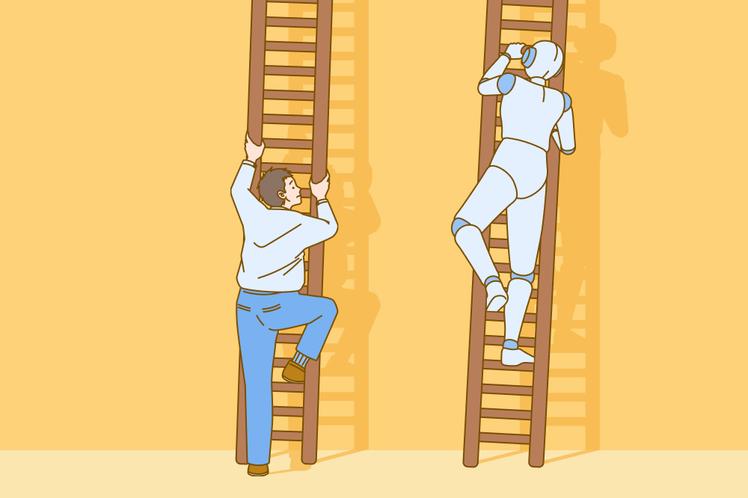

As AI and automation reshape the workplace, layoffs are leaving many workers uncertain about why their roles were eliminated and what comes next.
Resume Genius’ 2026 AI Layoffs Report surveys 1,000 U.S. workers who had experienced a layoff to explore AI’s perceived role, how employers handled the process, and how job loss is changing career plans and trust in employers.
Methodology: Survey of 1,000 laid-off U.S. workers
Resume Genius partnered with Pollfish to survey 1,000 U.S. workers on July 29, 2026. Respondents were between the ages of 18 and 64 and had involuntarily left a job because of company downsizing, restructuring, or budget cuts within the previous two years. Of the respondents, 39% had been laid off within the previous six months, 31% seven to 12 months earlier, and 30% 13 to 24 months earlier.
Resume Genius analyzed responses overall and by age group and former employer industry. Generational comparisons included Gen Z, ages 18–29 (n=260); Millennials, ages 30–45 (n=506); and Gen X, ages 46–61 (n=214). The 20 respondents ages 62–64 were included in overall results but excluded from generational comparisons because the subgroup was too small to support reliable comparisons.
Percentages were weighted using Pollfish respondent weights and rounded to the nearest whole number. Totals for questions allowing multiple responses may exceed 100%, and findings based on smaller industry groups should be interpreted with additional caution.
- 53% of laid-off workers believe AI or automation played a role in their layoff.
- 22% claim their employer directly said automation replaced their role.
- 31% suspect AI contributed to them being laid off but can’t confirm it.
- 41% received no severance or other support (counseling, financial assistance, etc.).
- This number jumps to 62% in retail, hospitality, food, and consumer services.
- 40% are considering switching to a different field or industry after the layoff.
- 26% are considering starting a business.
- 86% say their layoff changed how they view job security and employer loyalty.
- 40% plan to keep watching for other opportunities while employed.
What workers were told about AI (and what they believe)
Laid-off workers suspect companies aren’t being honest about AI’s role in their layoffs.
Workers are split on AI’s role in their layoffs
More than half of laid-off workers (53%) believe AI or automation played a role.
- 22% employer directly told employee automation replaced them.
- 31% suspect AI was involved but received no confirmation.
- 47% do not believe AI played a role.
| Response | % | % of respondents | |
|---|---|---|---|
| Employer directly told employee automation replaced them | 22.0% | 22 | |
| Employee suspected AI was involved (no confirmation) | 31.0% | 31 | |
| Do not believe AI played a role | 47.0% | 47 |
Workers who suspect AI was involved outnumber those who received direct confirmation by 9 percentage points.
Employers most commonly cited “cost cutting” to justify layoffs
When employers actually explained why layoffs were happening, they most frequently mentioned wider business pressures:
- Company-wide cost cutting or budget cuts (37%)
- Restructuring or reorganization (31%)
- Downsizing because of economic conditions (27%)
- Their department or team being eliminated (25%)
- Direct confirmation their role was replaced by AI (15%)
75% of laid-off tech workers believe AI contributed
Nearly three-quarters of workers in tech and finance believe AI and automation played a role, compared with fewer than half in several other major industries.
- 75% of laid-off technology workers believe AI played a role.
- 39% say they were directly told AI or automation replaced their role.
- 73% of finance workers.
- 37% received direct confirmation.
- 72% of workers in business and professional services.
- 46% of healthcare workers.
- 44% of manufacturing and construction workers.
- 42% of retail and hospitality workers.
- 42% of education workers.
Gen Z most likely to believe AI played a role
The gap narrows steadily with age: 66% of Gen Z respondents believe automation contributed to their layoff, compared with 52% of Millennials and 46% of Gen X workers.
- 27% of Gen Z respondents say they were directly told AI or automation replaced their role.
- Direct confirmation was similar among Millennials (21%) and Gen X workers (21%).
- The wider generational gap is driven mainly by suspicion: 39% of Gen Z workers believe AI was involved without being told.
- 31% of Millennials believe AI was involved without being told.
- 25% of Gen X workers believe AI was involved without being told.
Layoffs are exposing a major trust gap between workers and employers
Losing the job was only part of the problem. For many workers, limited warning, impersonal communication, and little financial support made an already difficult experience feel even worse.
1 in 4 workers received no advance warning
More than a quarter of laid-off workers (26%) said they had no advance warning at all, while only 33% were personally told ahead of time that their role would be affected.
For many others, the warning signs were vague rather than explicit:
- 26% heard about restructuring or wider company changes but were not told their own job was at risk until the layoff happened.
- 15% received no official warning but suspected cuts were coming because of rumors, hiring freezes, budget reductions, or changes within their team.
- Even among workers who received some notice, the window to prepare was often short:
- 31% received two to four weeks’ notice, making it the most common warning period.
- 26% had one week or less.
- 12% had no more than two days.
For a large share of workers, the problem was not simply a lack of information, but a lack of certainty. Many could see signs that something was wrong without knowing whether their own job was about to disappear.
4 in 10 workers were laid off without a one-on-one conversation
More than four in ten workers (42%) learned they had been laid off through a group announcement, written message, workplace platform, or the removal of their access rather than a one-on-one conversation.
- 19% were informed during a group meeting, video call, or webinar.
- 14% received the news by email.
- 9% either received a message through a platform such as Slack or Teams or discovered the layoff when their access to accounts or the workplace was removed.
- Transportation, warehousing, and logistics workers experienced the most impersonal communication: 63% were informed without a one-on-one conversation.
- 34% of technology workers were informed without a one-on-one conversation.
Retail and hospitality workers are nearly 4x as likely to receive no support
Overall, 41% of workers received no severance or other support, but workers in retail, hospitality, food, and consumer services were much less likely to receive a financial cushion than workers in technology or finance.
The support gap was stark: workers in retail and hospitality were nearly four times as likely as those in technology or finance to leave without severance or other assistance.
- 62% of workers in retail, hospitality, food, and consumer services received no severance or other support.
- 16% of technology workers received no severance or other support.
- 15% of finance workers received no severance or other support.
The divide between industries was just as clear when looking specifically at severance pay, which was common in technology and finance but much less so in retail and hospitality.
- Only 26% of workers in retail, hospitality, food, and consumer services received severance pay.
- 66% of technology workers received severance pay.
- 65% of finance workers received severance pay.
Those differences also shaped how workers judged the process, with retail and hospitality employees far more likely to say their employer handled the layoff unfairly.
- Nearly two-thirds of workers in retail, hospitality, food, and consumer services (64%) felt their employer handled the layoff unfairly.
- Approximately 35% of workers in technology and finance felt the process was handled unfairly.
Across the full sample, workers were evenly divided: 50% felt their employer acted fairly, while 50% believed the process was handled unfairly.
How recent layoffs have changed workers’ career plans
Many respondents were not simply looking for a similar role at a new company. They were considering changing fields, retraining, freelancing, or starting a business. The experience also made most workers more cautious about trusting future employers.
4 in 10 are now considering changing fields
For many workers, finding another job does not necessarily mean returning to the same kind of work. Four in ten respondents (40%) are considering switching to a different field or industry.
- 28% are considering freelance, contract, or self-employed work.
- Another 28% are considering retraining for a different kind of role.
- More than a quarter (26%) are considering starting a business.
- Nearly a quarter (24%) are considering returning to school.
- 22% plan to avoid employers that have recently conducted layoffs.
- Only 14% plan to return to similar work without considering any of the listed alternatives.
1 in 3 Gen Z workers is considering starting their own business
Younger workers were especially open to pursuing a different career model. One-third of Gen Z respondents (33%) are considering starting a business, nearly twice the 17% of Gen X workers.
- 30% of Millennials are also considering starting a business.
- More than a third of Gen Z workers (35%) are considering freelance or self-employed work.
- 30% of Millennials are considering freelance or self-employed work.
- 23% of Gen X workers are considering freelance or self-employed work.
- 33% of Gen Z workers are considering retraining.
- 31% of Gen Z workers are considering returning to education.
- Only 6% of Gen Z workers plan to return to similar work without considering any of the listed alternatives.
- 13% of Millennials plan to return to similar work without considering alternatives.
- 19% of Gen X workers plan to return to similar work without considering alternatives.
Employee loyalty to employers has plummeted
Getting laid off has understandably made the workforce cynical, with 86% saying layoffs changed how they view job security and employer loyalty.
- 40% of laid-off workers now plan to actively watch for other opportunities when employed going forward.
- Another 31% have become more cautious or guarded, even if they don’t plan to actively job hunt.
- 16% say they no longer believe in job security or employer loyalty at all.
- Only 14% of respondents say their view of employers has not changed.
The response also differed by industry. More than half of technology workers (55%) plan to keep watching for other opportunities while employed, the highest rate among the major industries. Manufacturing, engineering, and construction workers were the most likely to reject employer loyalty entirely: 27% say they no longer believe in it, compared with 8% of technology workers.
Conclusion
Restructuring, budget cuts, and economic conditions are still common reasons for layoffs, but many workers also believe AI is becoming part of the decision. When employers give little warning or explanation, workers can be left wondering whether automation played a role even if it was never mentioned directly.
Job loss is also changing how workers think about the future. Rather than simply searching for the same role elsewhere, many are considering new industries, retraining, freelance work, or entrepreneurship. The experience also weakens trust in long-term job security and makes workers more likely to keep their options open.
For job seekers, the clearest response is to remain flexible. Keeping skills current, watching and understanding how AI is changing their field, and developing experience that transfers across roles can make it easier to adapt in uncertain times. Employers, meanwhile, can preserve more trust by communicating decisions clearly and providing meaningful support wherever possible.
About Resume Genius
Since 2009, Resume Genius and its resume builder software have been helping people from all backgrounds and experience levels land their next jobs faster.
Resume Genius also provides a wide range of free career resources, including customizable resume templates, resume examples for different industries, and resume writing guides, to help job seekers find fulfilling work and reach their career goals.
Resume Genius is led by a team of dedicated career advisors and HR experts and has been featured in The New York Times, Harvard Business Review, Fast Company, CNBC, and USA Today.
For media inquiries, please contact us.
About the Author

Jack Hulatt graduated from the University of Greenwich with a bachelor’s degree in Politics and International Relations before pursuing certifications in computer science and data analytics. In his short career, he has already worked on multiple entrepreneurial projects and as part of a larger team, giving him direct insight into the needs and wants of young job seekers today.