


Hiring in 2026 is faster and more automated, with applicant tracking systems (ATS) and artificial intelligence (AI) shaping how job applications are screened and reviewed.
To understand what these shifts mean for job seekers, Resume Genius surveyed 1,000 U.S. hiring managers for our 2026 Hiring Insights Report. The results reveal what helps candidates get noticed, what triggers early rejections, and how to stand out in today’s hiring process.
- 71% of hiring managers screen applications using applicant tracking software (ATS)
- 79% of companies have automated at least some of their hiring process
- 1 in 5 hiring managers (19%) use AI to purposefully screen out applications before they get a human review
- 80% can spot an AI-written resume at a glance
- 86% hire for experience over education
- 48% are prioritizing communication and collaboration skills in 2026
- Salary negotiations are most likely to be successful within a 15–20% range
ATS use in 2026
As applicant tracking systems (ATS) become more common, job seekers may worry their resume is being judged by software before a person ever reads it.
To understand how much influence ATS tools really have, we asked hiring managers how they use them and how early ATS enters into hiring decisions.
Adoption rate
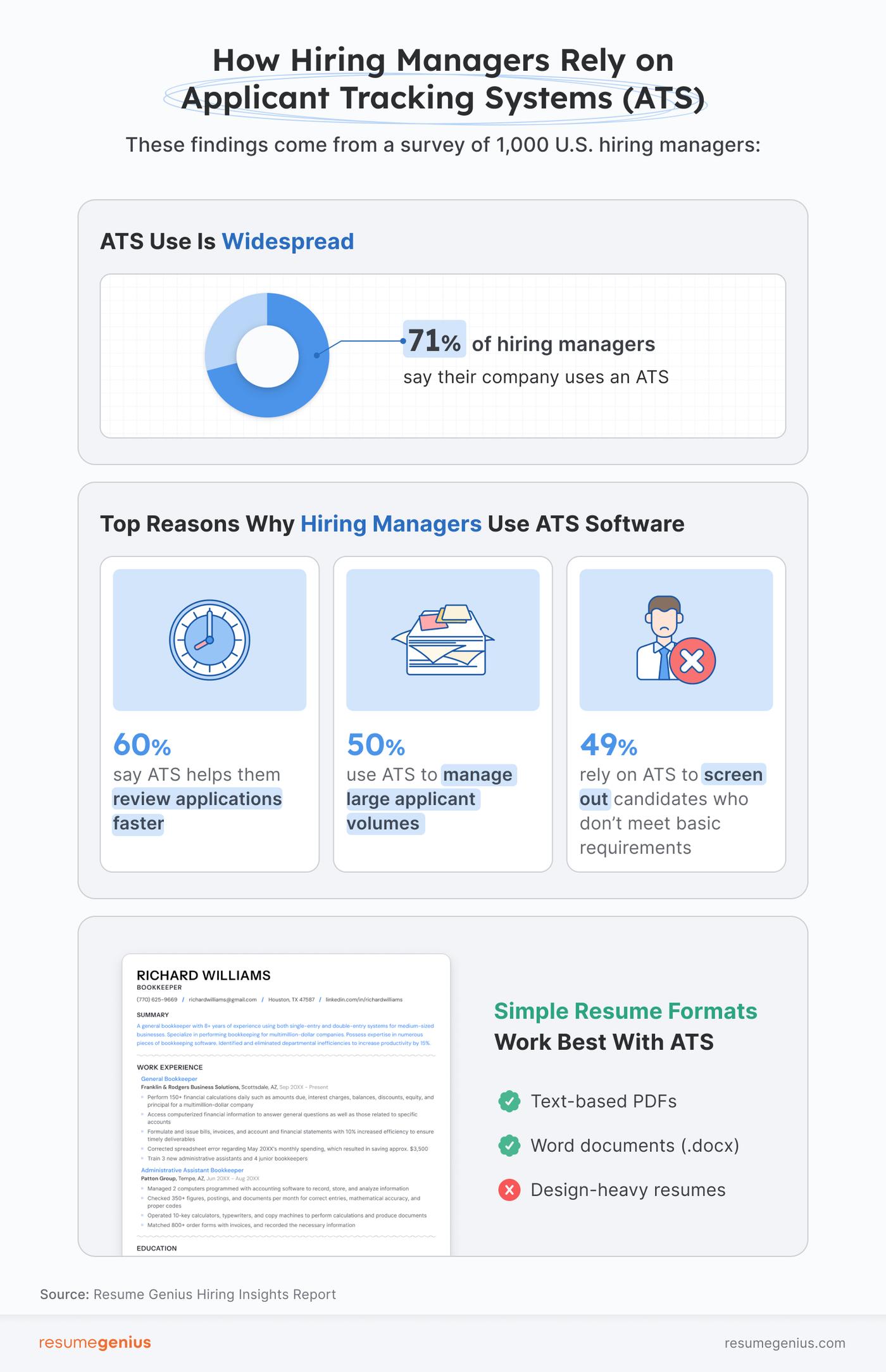
Overall, 71% of hiring managers say their company uses an ATS. Adoption is highest among younger hiring managers:
- Gen Z (85%)
- Millennials: (75%)
- Gen X: (67%)
- Baby Boomers (35%)
Why employers use ATS
As job postings attract more applicants, hiring managers say ATS software helps them manage volume and move faster in the early stages.
Here’s what hiring managers say ATS supports most:
- Reviewing applications faster (60%)
- Managing large volumes of applications (50%)
- Identifying candidates who don’t meet basic requirements (49%)
- Searching, sorting, and organizing applications (46%)
- Evaluating candidates more consistently and fairly (42%)
- Supporting record-keeping and compliance (31%)
Shortcomings & limitations
Hiring managers also reported drawbacks, mostly related to how ATS software affects the quality and feel of the hiring process. Here’s what challenges they’ve had with an ATS:
- 33% say it makes the hiring process feel less personal
- 33% say ATS overemphasizes keyword matching over overall fit or experience
- 21% report reviewing resumes is harder due to formatting or parsing issues
- 19% believe ATS leads to more candidate questions or complaints
- 16% say it’s harder to identify truly qualified applicants
Notably, Gen Z hiring managers are the most critical of ATS, especially on personalization and keyword-heavy screening.
- 44% of Gen Z managers say ATS makes hiring feel less personal, compared with 35% of Millennials, 28% of Gen X, and 22% of Baby Boomers.
- 44% of Gen Z managers say ATS overemphasizes keyword matching over overall fit or experience (versus 31% of Millennials, 34% of Gen X, and 24% of Baby Boomers).
Automation & human involvement
ATS software often gets blamed for rejecting resumes before a human ever sees them. But our survey suggests hiring managers usually remain closely involved.
According to hiring managers:
- 49% still personally review resumes and use the ATS to flag, rank, or organize them
- 37% let the ATS screen out applications based on criteria they set
Ideal file format for systems
Formatting affects whether an application gets processed smoothly. Hiring managers say ATS tools work best with simple, standard file types — and are more likely to struggle with overly designed or unconventional layouts.
Formats hiring managers say work best with ATS software include:
- Text-based PDFs with no images or complex formatting (53%)
- Word documents (.docx) (43%)
- PDFs with light design elements, such as colors or columns (34%)
- Plain-text or fully machine-readable resumes (24%)
By contrast, design-heavy resumes are far less reliable:
- Only 13% say layouts with images or heavy design elements are compatible with their ATS
Filters & rejection
Beyond format, resumes are most likely to be filtered out by the ATS when they don’t clearly show the candidate meets the job’s core requirements.
Top rejection reasons include:
- Missing required skills or poor alignment with the job description (42%)
- Failure to meet basic role requirements (36%)
- Unclear or incomplete work history (33%)
- Generic or AI-heavy content (28%)
- Lack of relevant keywords (28%)
- Formatting that’s difficult to scan or read (26%)
- A resume that’s too long or dense (20%)
Notably, resume length ranks lower than skill mismatch, unclear experience, or generic content, suggesting relevance and clarity matter more than keeping a resume strictly short.
AI’s influence over hiring decisions
As hiring becomes more automated, it’s natural to wonder how much control AI actually has behind the scenes. To get clarity, we asked hiring managers how their teams use AI today.
Applications in 2026
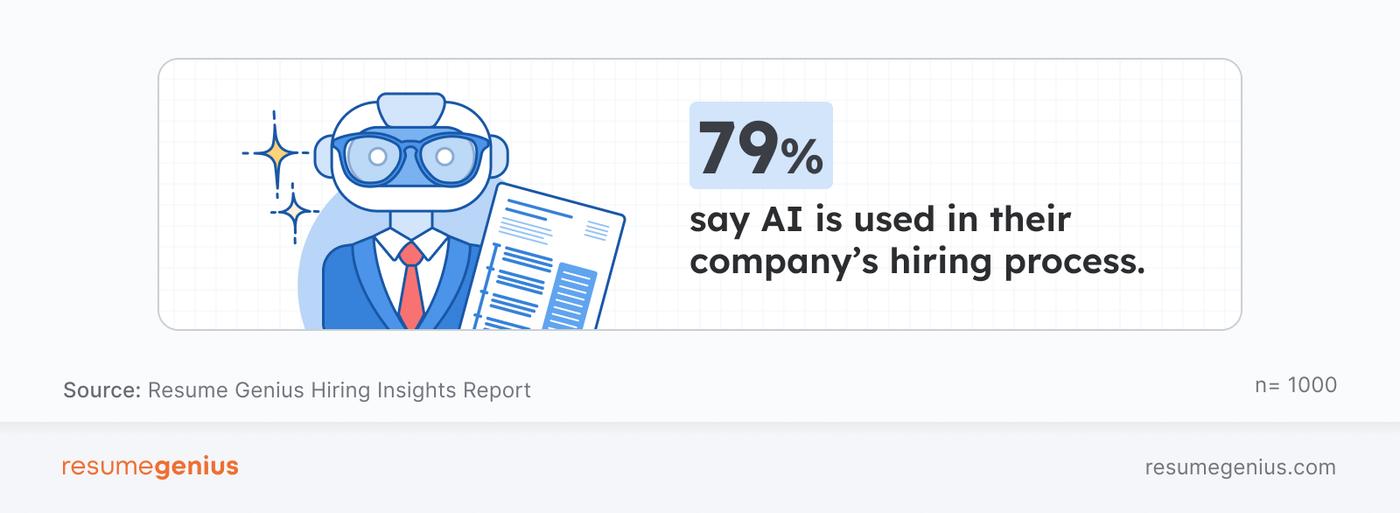
AI has moved from experimentation to everyday use in hiring: Nearly 8 in 10 hiring managers (79%) say their companies use AI somewhere in hiring or recruiting.
Most AI use is concentrated in the early, administrative stages. Here’s how most employers use the technology:
- 35% screen or rank resumes or applications
- 33% schedule interviews or manage logistics
- 32% source candidates
- 31% write job descriptions or job ads
- 28% communicate with candidates (e.g., outreach, follow-ups, Q&A)
- 23% conduct pre-screen interviews (e.g., automated phone screenings, AI video interviews)
- 21% use AI in interviews to write questions, take notes, or summarize candidate information
- 21% create or score skills tests or assessments
In some workflows, AI can take limited actions.
- 13% say AI can automatically send messages or move candidates forward based on predefined criteria
AI & decision-making
Widespread use doesn’t mean unchecked authority. Most hiring managers describe AI as a decision assistant, not a decision maker:
- 32% say AI recommends or ranks candidates, but humans make all final hiring decisions
- 22% say AI is used strictly for administrative support
- 19% say AI screens out some candidates using rules set by humans
Only a small group of hiring managers report minimal human oversight.
- 6% say AI can move candidates forward or reject them with limited human review
Resume insights for 2026
Resumes are easier to skim and better tailored than ever. But hiring managers say it’s also harder to trust what they’re reading as AI becomes more common in job applications.
AI use is making resumes polished but unoriginal
At first glance, applications are improving. Hiring managers say resumes today look more professional and are more closely aligned with open roles. At the same time, many say resumes feel more formulaic and less personal, largely due to AI-assisted writing.
- 79% say resumes are more polished and visually appealing than five years ago
- 78% say resumes are better tailored to specific job postings
- 76% of hiring managers say the overall quality of resumes has improved in recent years
However, “better tailored” doesn’t always mean more distinctive. AI tools can quickly mirror job descriptions and insert keywords, which helps candidates check the right boxes, but can make applications sound the same.
Among hiring managers:
- 80% say they can often tell when a resume has been written by AI
- 77% say many resumes appear completely or partially AI-generated
- 69% say resumes are more generic or formulaic than they were five years ago
Even design improvements can backfire:
- 52% of hiring managers say resumes today have more formatting issues than before, issues that can interfere with ATS parsing and slow down human review
Clarity matters, creativity distracts
In high-volume hiring, hiring managers want resumes that make key information easy to find. Clean structure and consistent formatting matter more than visual creativity.
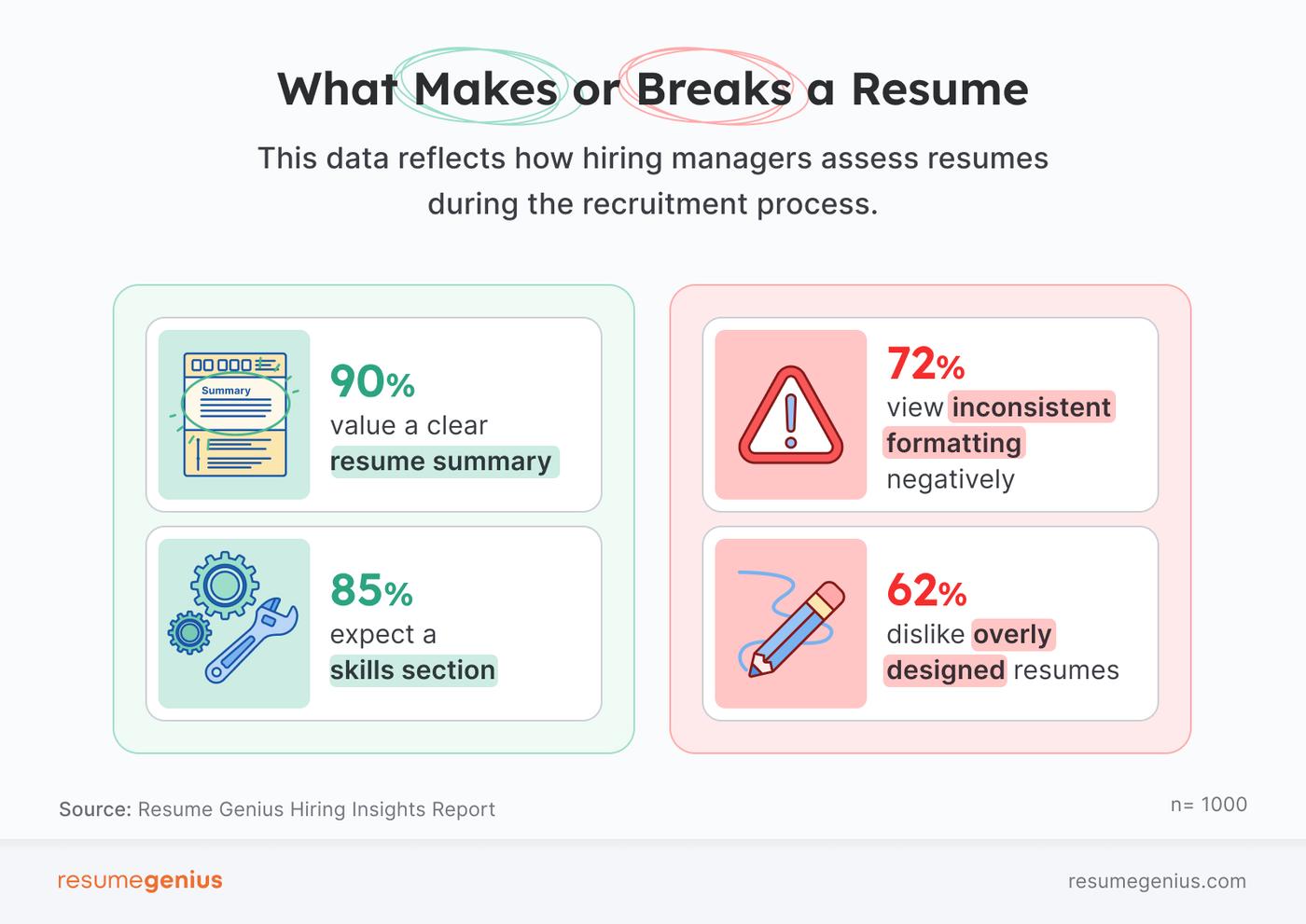
- 90% say a clear resume summary helps them evaluate candidates faster
- 85% expect every resume to include a skills section
- 72% say inconsistent spacing or formatting hurts their perception of a candidate
- 62% say overly designed resumes with lots of color or visual elements hurt their perception of a candidate
Some “rules” are also less rigid than candidates often assume:
- 43% of hiring managers won’t read resumes longer than two pages
- 57% will read beyond two pages when the information is relevant
- 55% say a headshot or photo can help a candidate move forward
- 45% don’t want resumes to show what the candidate looks like
Hiring managers also want balance. A clear skills section helps, but it shouldn’t replace experience.
- 56% say resumes that emphasize skills while downplaying work history make it harder to evaluate candidates
Reliance on AI undermines your skills & professionalism
Hiring managers aren’t universally anti-AI, but they’re cautious about applications that feel generated, impersonal, or detached from real experience.
- 79% say candidates should disclose AI assistance in application materials
- 76% say AI-written resumes make it harder to understand what a candidate actually did
- 72% say heavy reliance on AI makes candidates seem less skilled
At the same time, some hiring managers view thoughtful AI use positively, but opinions are split.
- 59% say using AI signals a candidate’s adaptability
- 51% say it signals efficiency
Word choice & formatting are AI giveaways
When hiring managers think a resume was written with AI, it’s usually not one glaring mistake. It’s the overall feel. If the tone sounds off or the details feel thin, that’s often enough to raise suspicion. And most hiring managers say they do notice these signals.
The most common AI “tells” include:
- Unnatural phrasing or tone (51%)
- Repetitive or overly generic language (44%)
- Vague or inflated descriptions (41%)
- Buzzword-heavy writing (41%)
- Perfect grammar with no variation (39%)
- Specific formatting habits (for example, em dashes) (32%)
- Incorrect or irrelevant details (27%)
Only 4% say they don’t notice signs of AI use at all, meaning most believe they can spot AI-written or AI-assisted resumes.

Key focus areas for hiring managers
Hiring managers aren’t only checking whether you meet requirements on paper. They also look for signals of readiness, recency, relevance, and fit, especially when reviewing large volumes of applications.
Employment gaps
Employment status rarely decides hiring outcomes by itself, but it does shape first impressions.
In our survey, hiring managers reviewed statements about how employment status influences their evaluation of candidates and selected all that applied. The results suggest that employment status is rarely ignored and often affects how resumes are initially read.
When candidates are currently employed, hiring managers infer readiness and recency:
- 38% say employed candidates seem more job-ready
- 37% say they feel more up to date with their skills
- 34% say they tend to have more recent references
- 33% say employment signals reliability or consistency
- 21% say they generally view employed candidates more favorably overall
When candidates are unemployed, hiring managers notice different signals (often logistical):
- 34% say unemployed candidates may be available to start sooner
- 24% say they’re easier to schedule for interviews
- 22% say they may be more motivated or responsive
- 13% say employment gaps are common and not concerning
Only 6% said they haven’t noticed any differences between employed and unemployed candidates, meaning most respondents said employment status influences evaluation in some way.
Skills over education
Hiring managers haven’t abandoned education, but they’re increasingly selective about what kind of education they reward.
When asked to evaluate a series of statements about education and hiring, most hiring managers agreed that formal education is still a core part of hiring. However, we noticed a clear shift in how education is valued, with relevance, experience, and demonstrable skills emphasized over degrees alone.
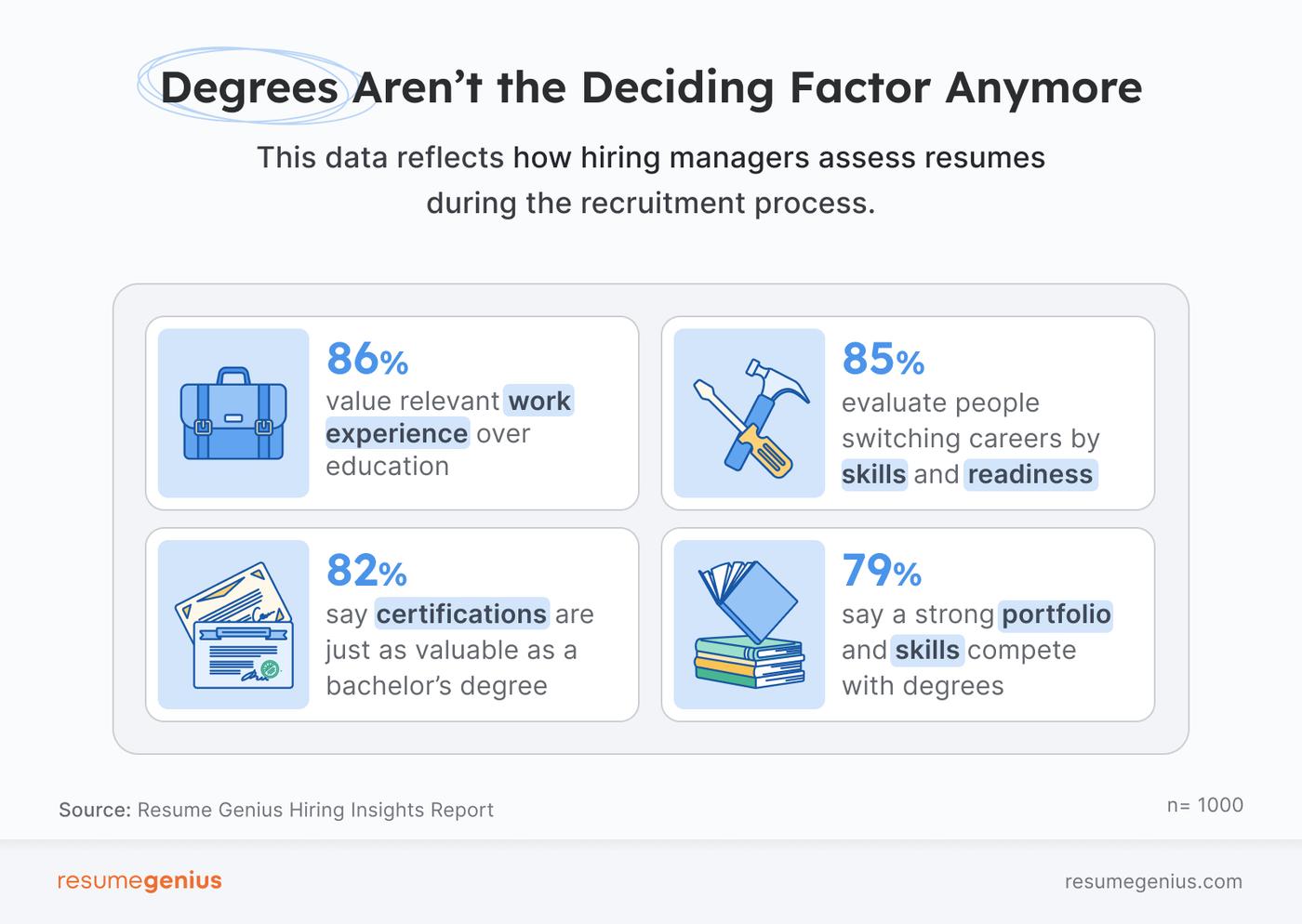
- 86% value relevant work experience over formal education
- 82% say certifications can be as valuable as a bachelor’s degree
- 79% agree self-taught skills or a strong portfolio are as valuable as formal education
- 72% say degree level matters in hiring decisions, suggesting education remains relevant but less decisive than other signals
- 65% agree a master’s degree justifies higher pay, with support declining among older hiring managers
- Generational findings are further broken down here: 74% of Gen Z, 69% of Millennials, 59% of Gen X, and 50% of Baby Boomers
- 62% say that bootcamp programs can qualify candidates for the roles they hire for
If you’re changing careers, skills & readiness
Career changes are common, and most hiring managers evaluate changers on clear signals that they can succeed in a new role.
Most hiring managers say they’re open to career changers:
- 33% say they focus primarily on relevant skills and experience
- 29% balance prior experience with new training or credentials
- 23% focus on transferable skills and growth potential
Taken together, 85% evaluate career changers based on skills or readiness rather than requiring direct role experience. By comparison:
- 14% generally prefer candidates with direct role experience
- 2% aren’t open to hiring career changers at all
Best range for salary negotiations
Salary negotiation is still part of the hiring process, but it happens within clearer boundaries than many candidates expect. To understand how much flexibility exists, we asked hiring managers how far candidates can realistically negotiate above an initial offer before it becomes a deal-breaker.
Hiring managers’ responses show a clear comfort zone. Some negotiation is expected, but it’s not unlimited.
- 42% of hiring managers say they’re comfortable with increases in the 10% to 25% range
- The median acceptable increase is ~22%, and 25% is the single most common response
- 22% prefer smaller increases under 10%, indicating a more conservative group
- 29% are open to increases above 25%, though tolerance drops as expectations rise
- Only 10% accept increases of 40% or more, showing that aggressive negotiation is rarely viable
Requests beyond that range become increasingly uncommon, suggesting aggressive negotiation can backfire unless there’s a strong justification.
Skill assessment insights
When hiring managers decide who moves forward, skills remain one of the clearest signals of job readiness.
Communication & collaboration are in highest demand
Resume Genius’s 2023 Workplace Skills Report found that communication and collaboration mattered most to employers. Three years later, our latest survey data shows those same skills still rank highest, despite rapid changes in hiring and technology.
These are the top skills hiring managers say they prioritize today:
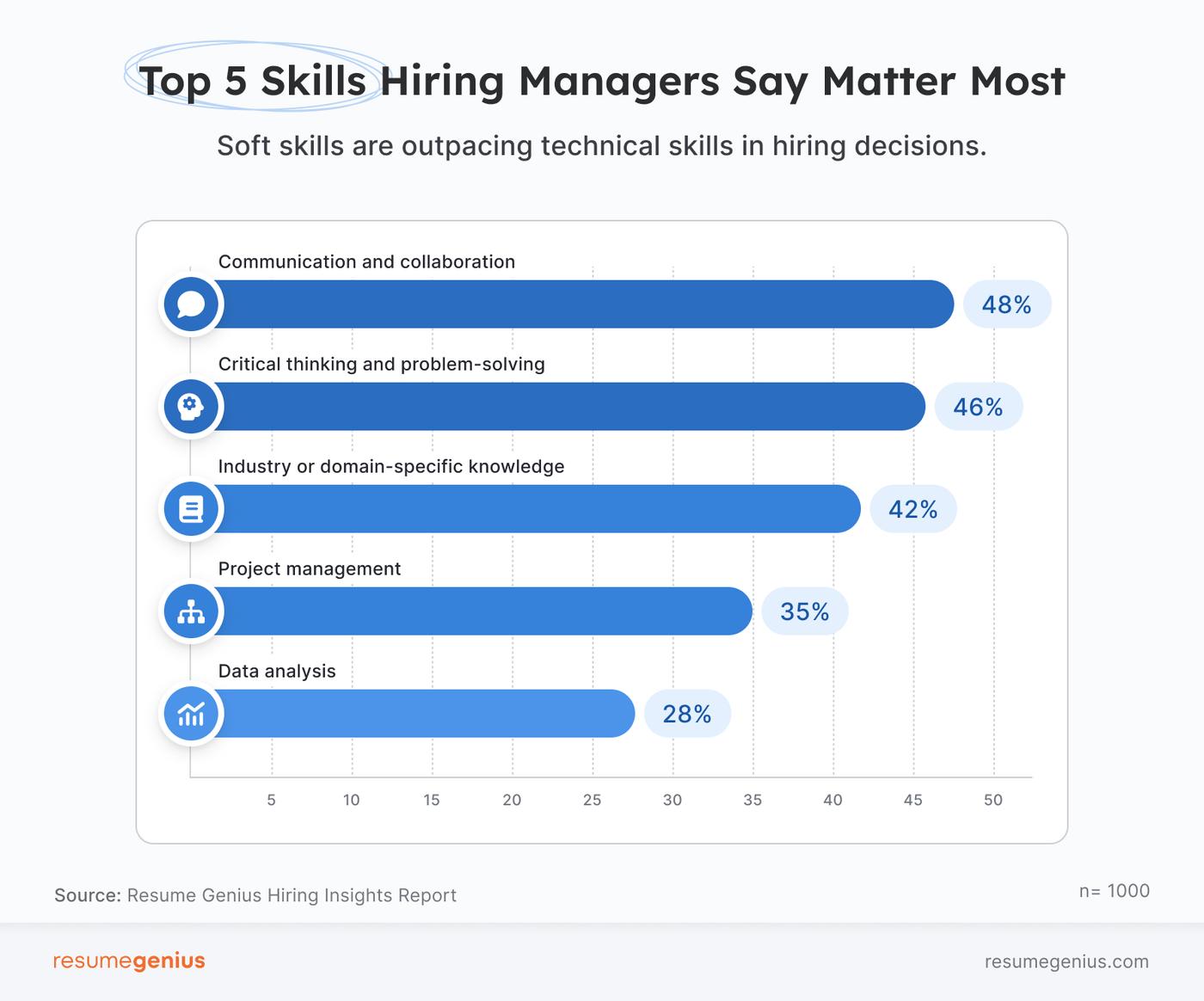
- Communication and collaboration (48%)
- Critical thinking and problem-solving (46%)
- Industry or domain-specific knowledge (42%)
- Project management (35%)
- Data analysis (28%)
- AI and machine learning (including prompt engineering) (26%)
- Software development or engineering (25%)
- Cybersecurity or cloud computing (22%)
- Content creation (e.g., video, graphics, multimedia) (19%)
There’s growing interest in AI skills
Younger hiring managers are more likely to include AI skills among their top priorities, while older hiring managers place more weight on communication, judgment, and problem-solving.
Gen Z hiring managers are the most likely to prioritize AI skills:
- 37% say AI and machine learning matter most when deciding whether a candidate moves forward
That stance is less common among older age groups:
- 26% of Millennials
- 22% of Gen X
- 13% of Baby Boomers
Older hiring managers emphasize human skills more heavily:
- 70% of Baby Boomer hiring managers say communication and collaboration matter most
Younger employers are less likely to rank these skills at the top:
- 35% of Gen Z
- 47% of Millennials
- 50% of Gen X
A similar generational gap appears in views on critical thinking and problem-solving.
- 63% of Boomers prioritize critical thinking and problem-solving skills in applicants
Younger hiring managers are far less likely to rank critical thinking and problem-solving as top skills:
- 25% of Gen Z
- 45% of Millennials
- 55% of Gen X
Most employers consider AI skills important
AI tools are becoming more common in hiring and on the job, but that doesn’t mean candidates should lead with them.
To understand how AI skills factor into hiring decisions, we asked hiring managers (1) how important AI tool proficiency is, and (2) how they prefer candidates to demonstrate it.
Most hiring managers say AI tool proficiency plays a role in hiring decisions, but relatively few see it as a deciding factor:
- 78% say AI tool proficiency is at least “somewhat important”
- 19% say it’s “very important”
- 29% say it’s “important”
- 30% say it’s “somewhat important”
- 22% say it’s “not important”
- Gen Z: 55%
- Millennials: 52%
- Gen X: 42%
- Baby Boomers: 30%, while 42% say AI skills are “not important”
Most employers want to see evidence of your AI skills
According to employers, simply listing AI skills isn’t enough. In fact, more than half of hiring managers (60%) say they want to test, discuss, or see proof of a candidate’s AI abilities rather than take resume claims at face value.
Here’s how hiring managers prefer to see AI skills demonstrated by candidates:
- Applied in an interview or task (26%)
- Mentioned briefly on a resume (19%)
- Reflected through work examples or outcomes (19%)
- Supported by certifications or courses (15%)
- Don’t want candidates emphasizing AI skills (21%)
Overall, hiring managers are more receptive to AI skills when they’re shown in context, such as through interviews, tasks, or real work examples, rather than heavily emphasized in application materials.
Conclusion
Hiring in 2026 is faster, more automated, and more competitive than it used to be, but the basics still decide who moves forward. Hiring managers use ATS and AI to manage volume, not to replace human judgment. Ultimately, candidates move forward when they clearly show they’re a good fit for the role.
Across the report, a few themes remain consistent: relevant experience and skills outweigh credentials, and employers continue to prioritize communication, problem-solving, and role-specific knowledge.
For job seekers, the best strategy is to optimize for relevance and clarity. Tailor your resume to the role, connect your skills to the job posting, and be ready to explain any situational context — whether that’s a career change, time out of work, or how you use AI to improve your job performance. And when it comes to salary, negotiate confidently, but keep your request realistic and anchored in evidence.
The hiring process may be changing, but what hiring managers want hasn’t. Candidates who communicate clearly, show good judgment, and demonstrate a real impact will continue to stand out, no matter how automated hiring becomes.
Methodology
This report is based on a survey of 1,000 U.S. hiring managers, conducted by Pollfish using its Random Device Engagement (RDE) methodology to ensure a diverse, demographically balanced sample. Respondents were screened to confirm they were directly responsible for hiring employees within their organization.
The survey examined how candidates are screened in 2026, with a focus on ATS usage, AI-assisted hiring tools, resume evaluation and rejection factors, skills assessment, interview decisions, salary negotiation boundaries, and differences across age and gender groups.
Resume Genius used standard statistical methods to analyze the survey data and identify overall trends and demographic differences across age and gender groups. Percentages were rounded to the nearest whole number.
For further details or media inquiries, please contact eduardo@resumegenius.com.
About Resume Genius
Since 2009, Resume Genius and its resume builder software have been helping people from all backgrounds and experience levels land their next jobs faster.
Resume Genius also provides a wide range of free career resources, including customizable resume templates, resume examples for different industries, and resume writing guides, to help job seekers find fulfilling work and reach their career goals.
Resume Genius is led by a team of dedicated career advisors and HR experts and has been featured in The New York Times, Harvard Business Review, Fast Company, CNBC, and USA Today.
For media inquiries, please contact us.
About the Author

Eva Chan is a Senior Digital PR Writer and Communications Lead at Resume Genius. Eva oversees the research and data-led campaigns that reveal key trends in today’s workforce and represents the company in media interviews and press features. Her work focuses on guiding job seekers through today’s job market and helping them present their applications and skills with confidence.