


Job hunting in 2026 is becoming harder to navigate as candidates face longer hiring timelines, growing reliance on AI, ongoing ATS concerns, and increasing uncertainty about whether their applications are being seen.
To better understand what people are experiencing, Resume Genius surveyed 1,000 active U.S. job seekers about their experiences and challenges.
This year’s Job Seeker Insights Report brings those findings together to show what applicants are facing in 2026.
- 55% say their top frustration is getting ghosted after applying for a role
- 49% say job searching is hurting their mental health
- 67% of candidates say they’ve seen fake or misleading job postings
- 36% of job seekers have considered “skills manifesting” by putting skills on their resume that they don’t have yet
- AI is the most faked skill at 36%, beating Office tools (33%) and design tools (26%)
- 36% admit they’ve lied in an interview — most commonly about how they’ve left a job (46%)
- 80% fear AI will replace jobs in their field
Mental health and main stressors
For many candidates, today’s application process feels increasingly stressful, uncertain, and difficult to move through.
Half of job seekers say their mental health is suffering
Survey responses show the search is also taking an emotional toll, with about half of job seekers reporting a negative impact on their mental health.
Here’s how job hunting is affecting job seekers’ mental health in 2026:
- Negatively (49%)
- No impact (38%)
- Positively (13%)
Rejection and waiting to hear back from employers are the main causes of poor mental health
Rejection during the hiring process and a lack of response from employers (at any point in the hiring process) stand out as the most damaging aspects of the search.
These are the factors that have hurt mental health most:
- Rejections (47%)
- Not hearing back from employers (46%)
- Financial pressure (45%)
- Trying to stay motivated (45%)
- Feeling unqualified (35%)
- None of the above (12%)
Employer ghosting is the biggest frustration
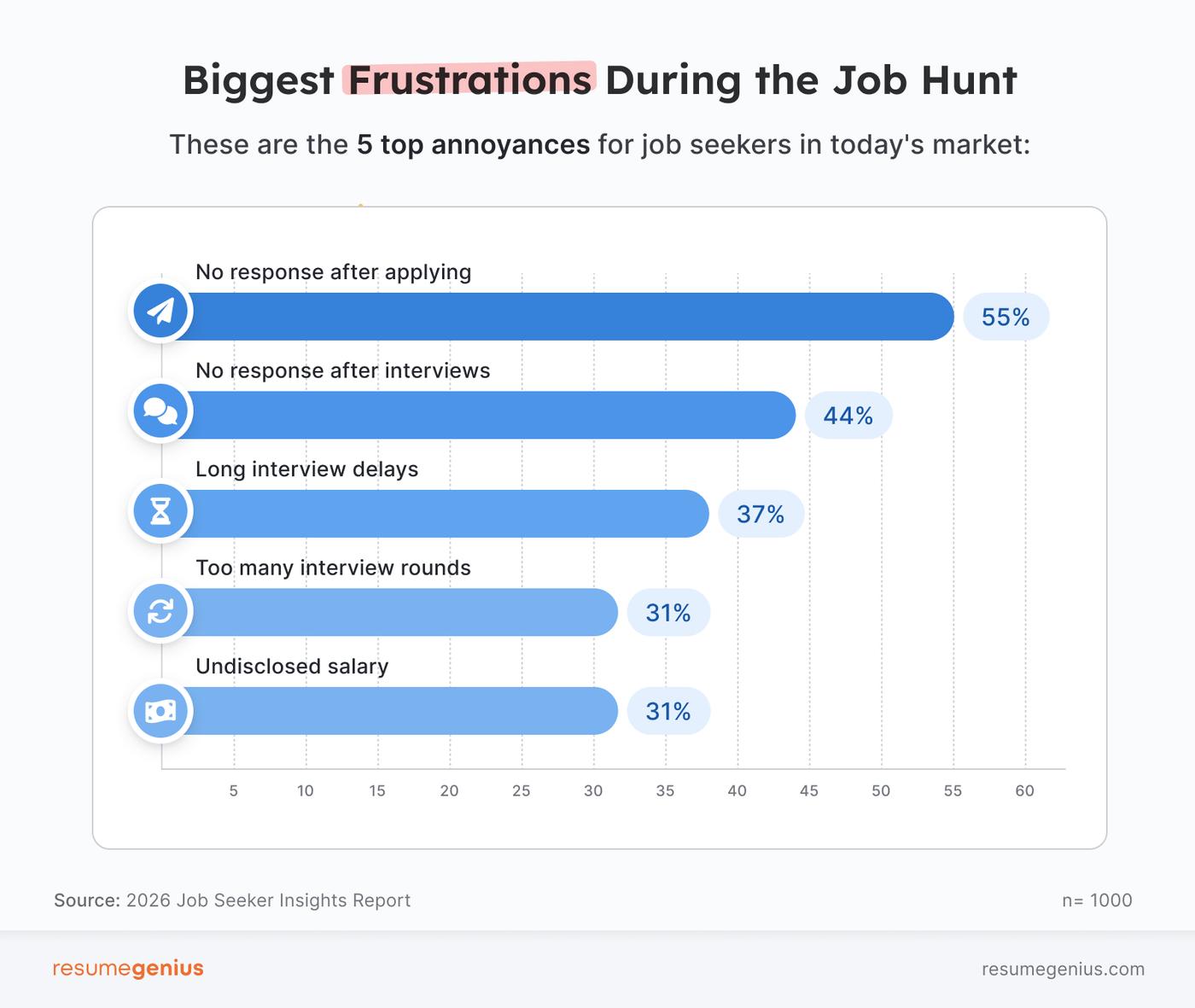
The hiring process is leaving applicants on read. When asked which parts of the hiring process frustrate them most, job seekers pointed to employer ghosting. More than half say their biggest frustration is never hearing back after applying, while others cite post-interview ghosting and long delays between interview rounds.
These are the top hiring frustrations reported by job seekers:
- Not receiving a response after submitting a job application (55%)
- Not hearing back after completing one or more interviews (44%)
- Having long delays between interview stages (37%)
- Being put through too many interview rounds (31%)
- Applying to jobs where the salary isn’t listed (31%)
- Being asked to complete unpaid assignments or tests (25%)
- Receiving automated or AI-generated rejection messages (24%)
- Discovering the role differs significantly from the job posting during the hiring process (22%)
- Being required to complete one-way video or AI-recorded interviews (19%)
Distrust and fake jobs
Today’s hiring process isn’t just frustrating — it’s increasingly difficult to trust. Alongside delays and lack of communication, many job seekers say they’re also questioning whether job postings are legitimate in the first place.
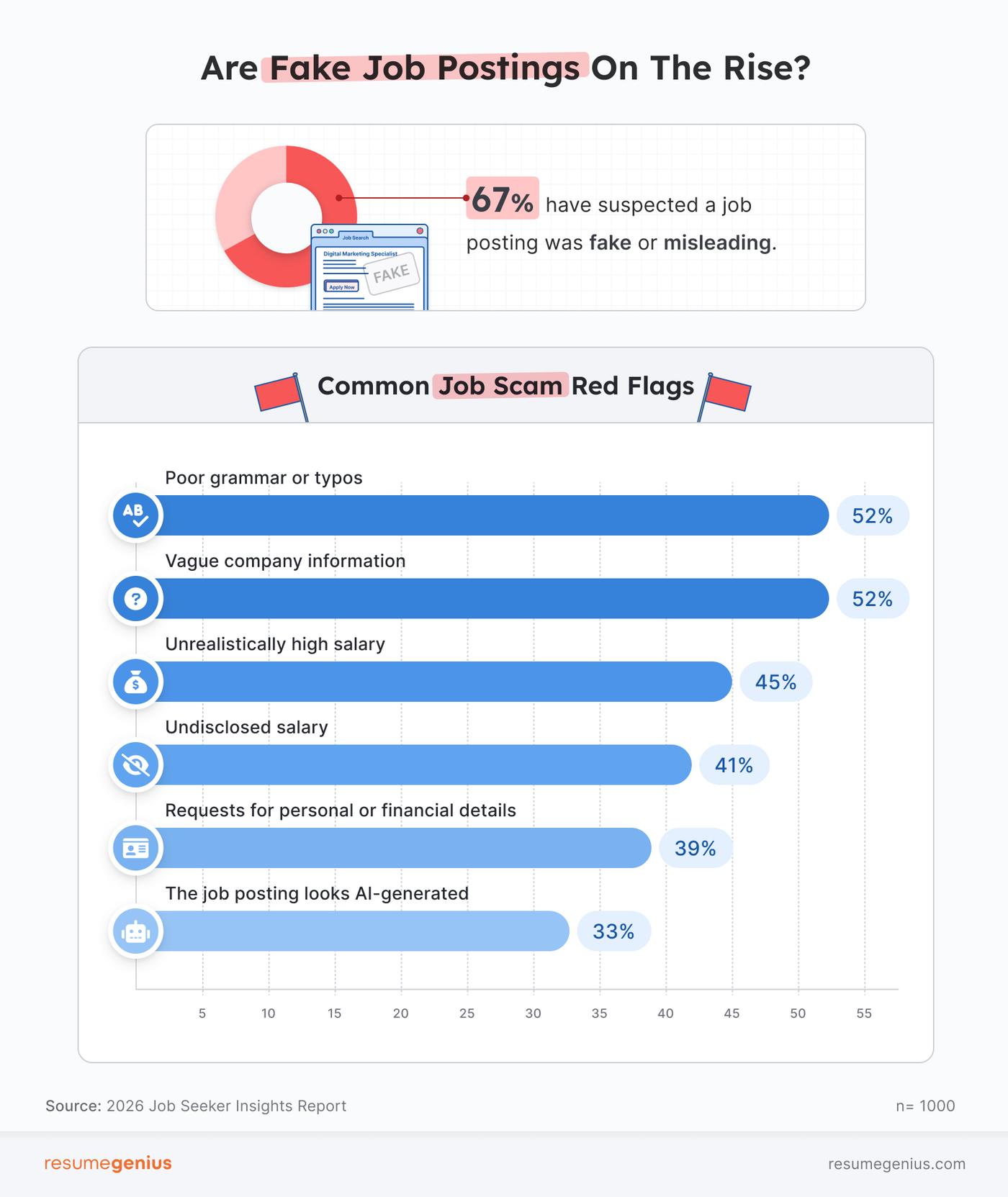
67% of candidates say they’ve suspected a job posting of being fake or misleading
For some job seekers, a bad listing is more than just a turnoff — it raises doubts about whether the opportunity is legitimate in the first place. Resume Genius found that two-thirds of job seekers have come across listings they believed were fake or misleading.
Here’s how job seekers responded when asked if they’ve come across sketchy job postings:
- Have suspected this a few or many times (67%)
- Have never suspected this (14%)
- Are not sure (19%)
Poor grammar, vague company details, and unrealistic pay are the biggest job scam red flags
Job seekers aren’t guessing at random when they question a posting. The report shows that certain details, such as bad writing, vague company details, and unrealistic or unmentioned salary information tend to raise the most suspicion.
The biggest red flags job seekers associate with fake or misleading postings are:
- Poor grammar or typos (52%)
- Vague company information (52%)
- Salary that seems too good to be true (45%)
- Salary not disclosed (41%)
- Requests for personal or financial details (39%)
- A provided application that looks AI-generated (33%)
- Requests to move communication off the job platform (21%)
Resume writing and “skills manifesting”
Standing out with a strong resume isn’t getting any easier. Job seekers are trying to impress employers while also navigating changing expectations, and AI tools that are now influencing both sides of the hiring process.
Job seekers are “manifesting” skills they don’t have yet
“Skills manifesting” is the act of listing skills on a resume that an applicant plans to acquire in the future. Job seekers are using this strategy to stay competitive in a more automated and technical job market.
To understand if this behavior is happening during the job search process, Resume Genius asked whether job seekers had ever added a skill to their resume that they planned to learn later if they got the job.
Overall, 53% said they had either added a skill to their resume that they plan to learn later or considered doing so (“skills manifesting”). Here’s the full breakdown:
- Have added a skill they plan to learn later (36%)
- Have considered doing this (17%)
- Would never add a skill they didn’t already have (47%)
Younger job seekers are more likely to add skills they plan to learn later
Gen Z and Millennials were the most likely to say they’d added a skill to their resume that they planned to learn later, while Baby Boomers were by far the most likely to say they would never do that.
By age:
- Gen Z: Have added a skill they planned to learn later (44%); have considered it (18%); would never do it (38%)
- Millennials: Have added a skill they planned to learn later (42%); have considered it (16%); would never do it (43%)
- Gen X: Have added a skill they planned to learn later (28%); have considered it (19%); would never do it (53%)
- Baby Boomers: Have added a skill they planned to learn later (15%); have considered it (13%); would never do it (72%)
AI tools top the list of skills job seekers plan to learn later
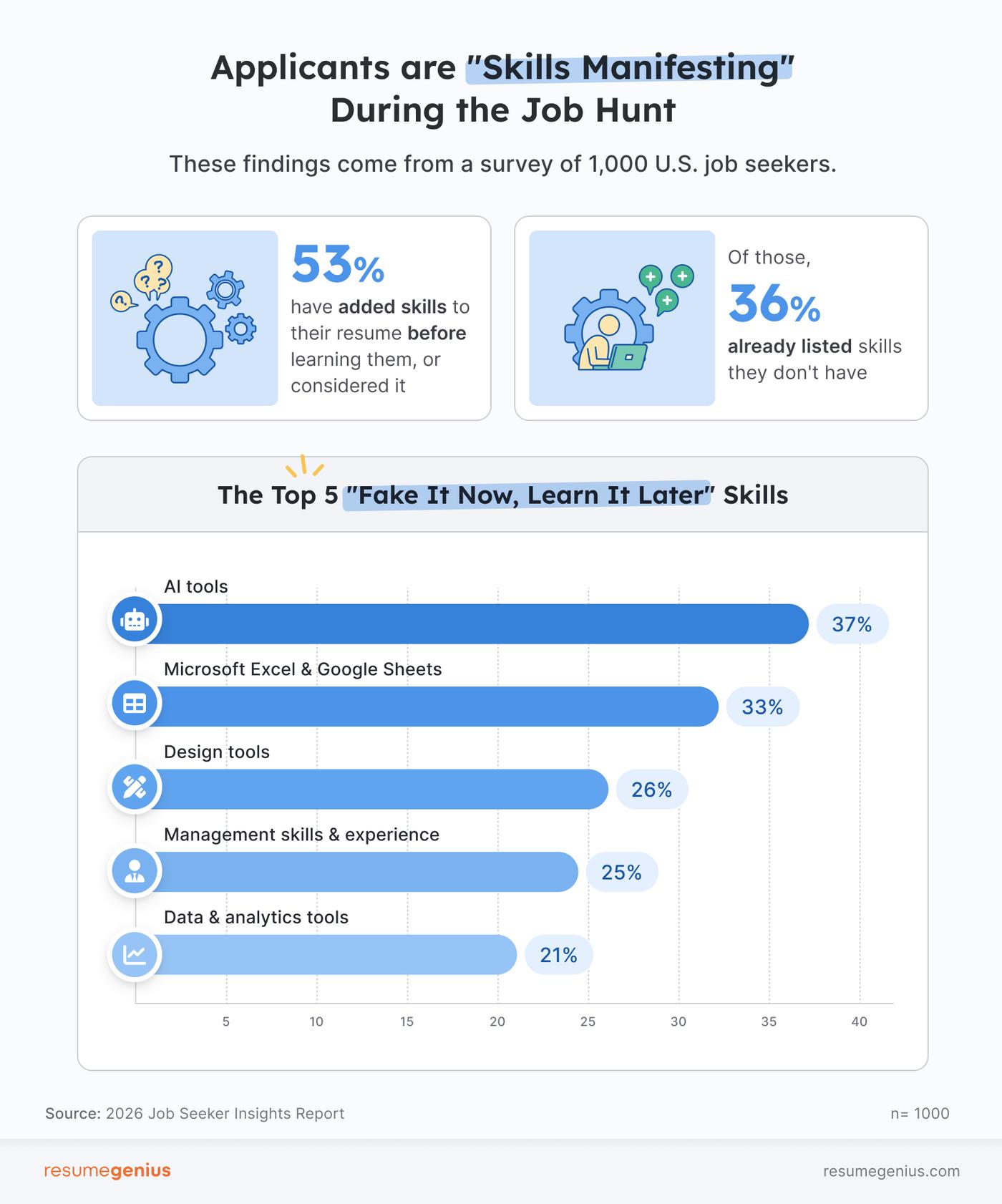
If some job seekers are exaggerating on their resume skills, AI is where they’re most likely to do it. Among job seekers who said they had added a skill they planned to learn later, AI tools like ChatGPT, Gemini, and Claude ranked as the most common skills they listed.
The top skills job seekers said they planned to learn later were:
- AI tools like ChatGPT, Gemini, or Claude (37%)
- Microsoft Office or Google Workspace (33%)
- Design tools like Canva or Figma (26%)
- Management skills or experience (24%)
- Adobe Creative Suite (19%)
- Programming languages like Python or JavaScript (18%)
- Soft skills like communication or leadership (18%)
- Data or analytics tools like Tableau, SQL, or Excel (17%)
- Project management tools like Asana, Trello, or Jira (15%)
- Foreign language skills (13%)
Men and women are adding different manifested skills to their resumes
According to the report, men were more likely to say they’d listed AI and programming-related skills they planned to learn later, while women were more likely to stretch on office tools and soft skills.
- Men were most likely to say they’d listed AI tools (41%)
- Women were most likely to say they’d listed Microsoft Office or Google Workspace (36%)
Other notable patterns were:
- Soft skills stand out much more for women (25%) than for men (12%)
- Programming languages stand out more for men (21%) than for women (14%)
Formatting for the ATS
Uncertainty around how to pass applicant tracking software (ATS) scans is impacting job seeker confidence.
ATS is making job seekers second guess their resumes
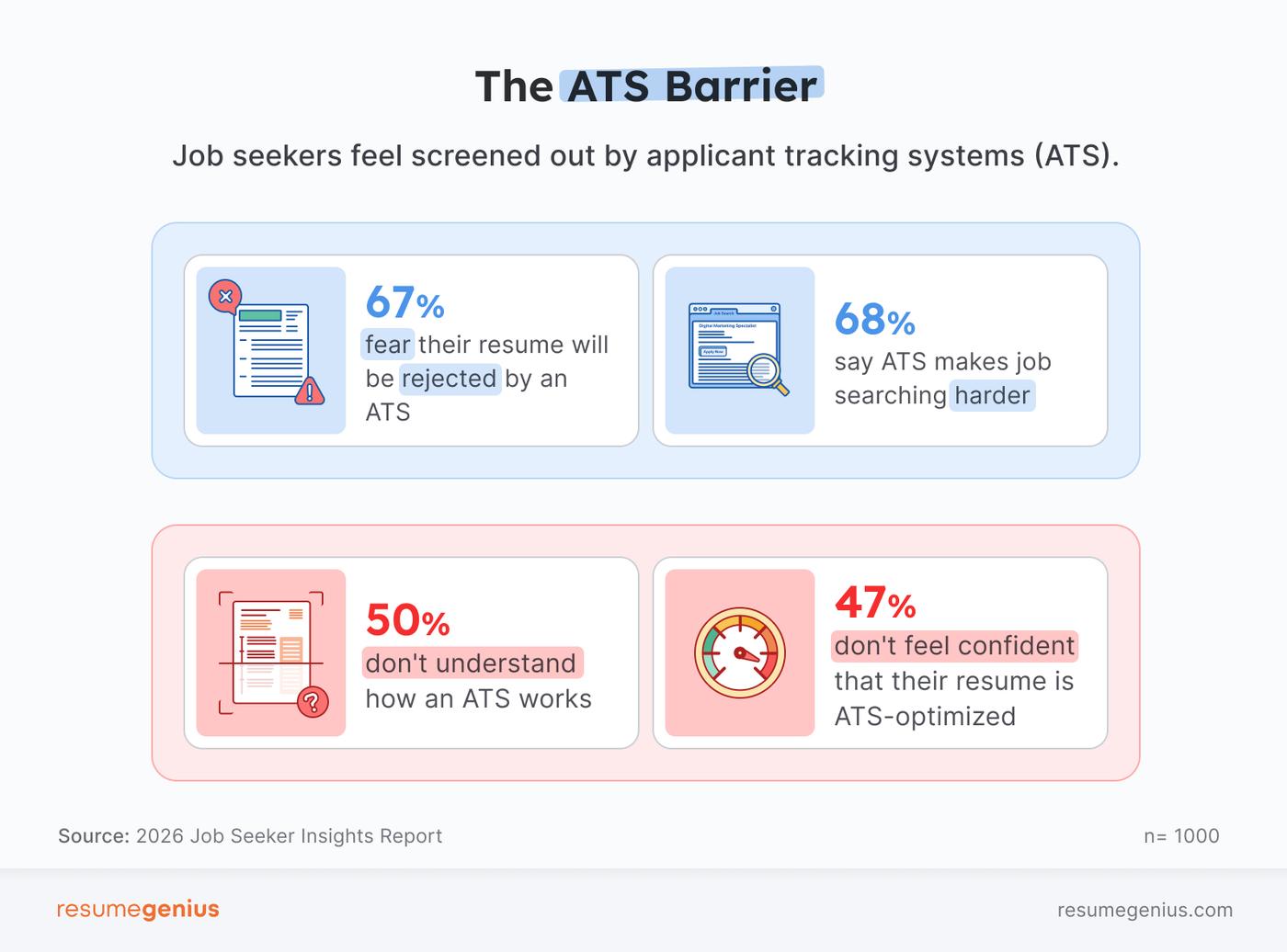
To better understand how job seekers view applicant tracking systems (ATS), Resume Genius asked respondents whether they agreed with a series of statements about this software. The results show that ATS is still a major source of uncertainty, with many worried their resume will be filtered out before it reaches a person.
Here’s how job seekers reported feeling about ATS:
- Say ATS makes job searching harder (68%)
- Worry their resume will be rejected before a person sees it (67%)
- Feel confident their resume is optimized for ATS (53%)
- Say they don’t understand how ATS works (50%)
Job seekers are under pressure to tailor resumes quickly
Personalizing a resume often happens on a fairly short timeline. Even though tailoring is one of the trickiest parts of the process, many job seekers appear to be making those decisions quickly for each application.
According to job seekers, the hardest parts of updating a resume are:
- Tailoring it to the job (41%)
- Remembering tasks and achievements from past roles (39%)
- Turning job duties into strong accomplishments (35%)
- Writing strong bullet points (32%)
- Optimizing for ATS (27%)
Here’s how long job seekers say they spend tailoring a resume for one application:
- 10 to 30 minutes (39%)
- 31 to 60 minutes (23%)
- Less than 10 minutes (20%)
- More than 1 hour (9%)
- Don’t tailor their resume (9%)
AI adoption and automation anxiety
The job search is becoming more AI-driven as candidates adopt the tools and employers build them into hiring.
Nearly 8 in 10 job seekers are open to using AI
For many job seekers, AI has moved from curiosity to consideration. What once felt experimental is becoming more accepted as candidates look for new ways to keep up in a competitive market.
Overall, 78% of job seekers said they either already use AI in the application process or would consider using it.
Job seekers are using AI during live interviews and skills tests
AI has become a standard tool in the job search, but its role is quickly expanding beyond prep. Most candidates still start with the basics, using AI to write resumes and cover letters. But a growing number are now using AI to help generate responses, refine answers, or guide what to say in real time.
More than 1 in 5 job seekers say they’ve used AI in real time during a live interview, and nearly as many report using it to complete skills tests or assessments. What started as a preparation tool is now showing up during the interview itself and even in the evaluations meant to measure ability.
The most common uses of AI among job seekers include:
- Writing resumes (59%)
- Writing cover letters (48%)
- Editing job applications (40%)
- Finding jobs to apply for (34%)
- Preparing for interviews (34%)
- Using AI to answer job interview questions (22%)
- Completing a skills test or assessment (19%)
AI is deepening fears about job security
AI isn’t just changing how people apply for jobs. It’s also making many wonder whether the careers they’re pursuing will still look the same in a few years. When Resume Genius asked job seekers how concerned they were that AI could automate jobs in their desired field, 80% said they were concerned.
Find the full breakdown below:
- Very concerned (28%)
- Somewhat concerned (52%)
- Not at all concerned (20%)
AI anxiety is influencing career decisions
Concern about AI and the broader job market is already spilling into real-life decisions.
For some job seekers, that means rethinking how they make money, what skills they need, and whether their current career path still makes sense. At least 1 in 4 say they’ve taken on side work, seriously considered changing careers, or started learning new skills.
These are the steps job seekers say they’ve taken or seriously considered:
- Taken a side job to pay the bills (28%)
- Seriously considered changing careers (26%)
- Learned a new skill (24%)
- Seriously considered switching to a skilled trade or blue-collar work (21%)
- Gone back to school (12%)
- Worked with a career coach or counselor (11%)
- None of the above (33%)
Gen Z job seekers are making the biggest career pivots because of AI
As the youngest generation in the workforce, Gen Z may feel they have more time to rethink their direction — and the findings suggest they’re the most willing to do so. They were the most likely to take a side job, consider trade or blue-collar work, and go back to school due to career or AI concerns.
- Taken a side job to pay the bills: Gen Z (33%), Millennials (30%), Gen X (26%), Baby Boomers (13%)
- Seriously considered changing careers: Gen Z (30%), Gen X (29%), Millennials (24%), Baby Boomers (13%)
- Seriously considered trade or blue-collar work: Gen Z (30%), Millennials (20%), Gen X (18%), Baby Boomers (17%)
- Went back to school: Gen Z (18%), Millennials (13%), Gen X (8%), Baby Boomers (4%)
Lying in job interviews
When the stakes feel high, some job seekers admit they don’t stick strictly to the truth.
Candidates are most likely to lie about why they left their last job
When the pressure is on, interview answers don’t always stay fully honest. Resume Genius found that interview exaggeration is fairly common: 56% of job seekers say they’ve either lied in an interview or at least considered doing so.
Here’s how job seekers responded:
- 36% admit they’ve lied in an interview
- 20% haven’t lied but have considered it
- 45% say they’ve never lied or considered lying in an interview
Younger job seekers are more likely to exaggerate in interviews
Gen Z and Millennials were the most likely to say they’ve lied or exaggerated in an interview, while Baby Boomers were the most likely to say they’ve never even considered it.
- Have lied or exaggerated in an interview: Gen Z (43%), Millennials (39%), Gen X (31%), Baby Boomers (18%)
- Have never lied or considered lying: Baby Boomers (67%), Gen X (48%), Millennials (42%), Gen Z (37%)
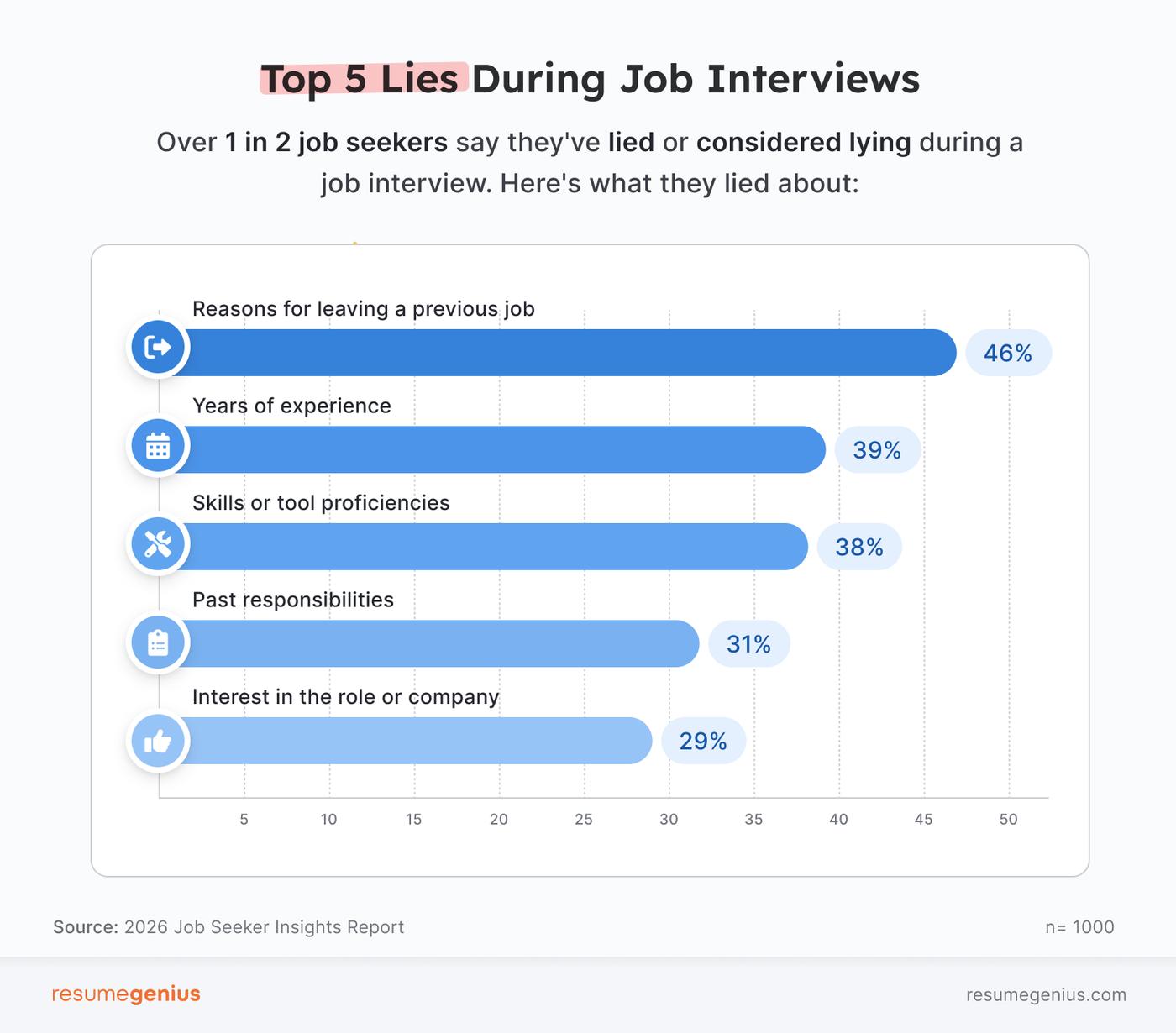
For job seekers who admit to lying or exaggerating in interviews, the most common reason is explaining why they left a previous role. Experience, skills, and past responsibilities also rank high.
The most common interview lies or exaggerations are:
- Reasons for leaving a previous job (46%)
- Years of experience (39%)
- Proficiency with certain skills or tools (38%)
- Responsibilities in a previous role (31%)
- Interest in the role or company (30%)
- Accomplishments or results (18%)
- Salary expectations or previous pay (13%)
- Long-term career goals (12%)
Methodology
This report is based on a survey of 1,000 U.S. job seekers, conducted by Pollfish. Respondents were screened to confirm they were actively searching for a job at the time of the survey.
The survey launched on March 16, 2026, and targeted a sample of 1,000 participants. The sample included job seekers who were employed, self-employed, and temporarily unemployed, reflecting a range of job search experiences. The survey explored topics including resume strategy, ATS concerns, AI use, employer ghosting, interview stress, mental health, and misleading job postings. Resume Genius analyzed the results for overall trends and differences across age and gender. Percentages were rounded to the nearest whole number.
The survey ensured a balanced representation across various demographics, including gender and age groups, to accurately reflect the diversity of U.S. job seekers.
To minimize bias, Pollfish uses Random Device Engagement (RDE) to ensure a fair and organic selection process. For further details on Pollfish’s methodology, please visit their website or eduardo@resumegenius.com.
About Resume Genius
Since 2009, Resume Genius and its resume builder software have been helping people from all backgrounds and experience levels land their next jobs faster.
Resume Genius also provides a wide range of free career resources, including customizable resume templates, resume examples for different industries, and resume writing guides, to help job seekers find fulfilling work and reach their career goals.
Resume Genius is led by a team of dedicated career advisors and HR experts and has been featured in The New York Times, Harvard Business Review, Fast Company, CNBC, and USA Today.
For media inquiries, please contact us.
About the Author

Eva Chan is a Senior Digital PR Writer and Communications Lead at Resume Genius. Eva oversees the research and data-led campaigns that reveal key trends in today’s workforce and represents the company in media interviews and press features. Her work focuses on guiding job seekers through today’s job market and helping them present their applications and skills with confidence.