
- 1. LinkedIn
- 2. Indeed
- 3. Handshake
- 4. ZipRecruiter
- 5. Glassdoor
- 6. USAJobs
- 7. FlexJobs
- 8. SimplyHired
- 9. Monster
- 10. Snagajob
- 11. Wellfound
- 12. CareerBuilder
- 13. Built In
- 14. We Work Remotely
- 15. HigherEdJobs
- Best job search sites by niche
- Agriculture job boards
- Aviation job boards
- Cannabis job boards
- Construction job boards
- Consulting job boards
- Crypto job boards
- Data science job boards
- Design job boards
- Diversity job boards
- Edtech job boards
- Engineering job boards
- Executive job boards
- Fashion job boards
- Finance job boards
- Freelance job boards
- Government job boards
- Green job boards
- Healthcare job boards
- Higher ed job boards
- Hospitality job boards
- HR job boards
- International job boards
- Internship job boards
- Legal job boards
- Manufacturing job boards
- Marketing job boards
- Media job boards
- Music job board
- Nonprofit job boards
- Outdoor job boards
- Part time job boards
- Product management job boards
- Project management job boards
- Public health job boards
- Publishing job boards
- Real estate job boards
- Religious job boards
- Remote job boards
- Restaurant job boards
- Sales job boards
- Science job boards
- Social impact job boards
- Sports job boards
- Teacher job boards
- Tech job boards
- Trucker job boards
- Veteran job boards
- Virtual assistant job boards
- Writing job boards
- Tips for using job search engines
- Additional job hunting resources
- About Resume Genius
Finding the right job board can accelerate your job search and help you uncover opportunities you might otherwise miss.
To help you decide where to find the best job opportunities, we analyzed search data across some of the biggest job platforms in the US, and reviewed what each site offers job seekers in 2026. We’ve also compiled a master list of niche job boards for specific industries, career stages, and types of work (remote, contract, etc.).
Methodology
To update our list for 2026, Resume Genius analyzed US Google search data from Ahrefs for major job-search platforms, including their estimated average monthly branded search volume and search growth over the previous 12 months. Data was collected in August 2026.
Search volume is used as an indicator of consumer interest rather than a direct measure of a platform’s traffic, number of users, job listings, or hiring success. It helped inform our rankings, but the list isn’t ordered by search volume alone. We also considered each platform’s target audience, special features, and overall usefulness to job seekers.
For platforms known for more than just their job boards, we used the brand’s name plus the word “jobs”. For example, we measured searches for “LinkedIn jobs” rather than assuming that every search for “LinkedIn” was made by someone looking for work. In cases like LinkedIn, where broader platform usage is an important part of the job-search experience, we also considered the platform’s wider role when determining its position.
Search volumes and 12-month growth figures are Ahrefs estimates for the United States and have been rounded for readability.
1. LinkedIn
Best for: Networking and professional jobs
- Monthly US searches for “LinkedIn jobs”: 135,000
- Monthly US searches for “LinkedIn”: 9.3 million
- 12-month search growth for “LinkedIn jobs”: +5.0%
LinkedIn is most useful when you treat it as both a job board and a networking tool. LinkedIn search includes filters for experience level, employment type, Easy Apply, jobs with fewer than 10 applicants, and roles where someone in your network works.
You can also use natural-language AI search, set up to 20 job alerts, and signal that you are Open to Work. Opportunities can then be managed in a five-stage job tracker with notes and network contacts attached to each role.
PROS
- Network filters make it easier to identify roles where you already have a potential referral or point of contact
- The job tracker covers saved, in-progress, applied, interview, and archived roles, reducing the need for a separate spreadsheet
- Open to Work and resume-sharing settings can make you discoverable to recruiters even when you have not applied directly
CONS
- Easy Apply roles can attract large applicant pools, and LinkedIn now applies daily and speed limits to Easy Apply submissions
- Some competitive insights, including “top applicant” recommendations, are reserved for Premium subscribers
- AI-powered job search is still being rolled out, so not every user will have the same search experience yet
2. Indeed
Best for: General job searches
- Monthly US searches: 8.5 million
- 12-month search growth: -0.8%
Indeed remains the strongest all-purpose job board because it combines a very large pool of listings with tools for researching pay and employers. You can search by title, company, location, or remote status, save jobs, create alerts, and track applications in “My Jobs”.
Indeed also added Career Scout in 2025, an AI tool native to the mobile app. Career Scout lets you search in natural language, suggests career paths, helps you tailor your resume, and even provides interview and salary guidance.
PROS
- Company reviews and salary data let you evaluate an employer without leaving your job search
- My Jobs keeps saved roles, applications, interviews, and archived opportunities organized in one dashboard
- Career Scout can turn a conversational request such as “remote software jobs near me” into a more targeted search
CONS
- The sheer number of listings means broad searches can become noisy unless you use specific keywords and filters
- Some applications send you to an employer or third-party site, so the experience is not consistent across every listing
- Career Scout is currently app-based, so its newest AI features are less useful if you prefer to search entirely on desktop
3. Handshake
Best for: Students and anyone looking for entry-level jobs
- Monthly US searches: 580,000
- 12-month search growth: +4.7%
Handshake is built around the student-to-work transition rather than the broader labor market. In addition to jobs and internships, Handshake connects users with university career centers, employer events, career fairs, and recruiter messages.
The platform’s robust filter system benefits early-career candidates by including options like work authorization, school year, major, job type, and employer preferences. Handshake recently introduced conversational job search and AI tools that let you compare your profile or resume with the requirements of a specific job.
PROS
- Eligibility-focused filters can help you avoid spending time on roles that do not match your major, graduation stage, or work authorization
- Career fairs, employer events, and direct recruiter messages give you ways to reach employers beyond simply submitting applications
- Personalized recommendations adapt to your profile, stated interests, and the jobs you view, save, or apply to
CONS
- The experience is strongest when your school or university actively participates in Handshake and approves employers and events
- Its student-first design makes it much less useful for established professionals looking for mid-career or senior positions
- Some AI features, including resume assistance, are still in beta or not available to every user
4. ZipRecruiter
Best for: Fast, mobile-friendly applications
- Monthly US searches: 493,000
- 12-month search growth: +1.7%
ZipRecruiter is a general job marketplace that emphasizes speed and active matching. Its app supports one-tap applications on eligible jobs and alerts you when an employer views your submission, giving you more feedback than most job boards.
Salary information appears on many listings, and ZipRecruiter’s AI assistant can help strengthen profile and resume descriptions. You can also connect ZipRecruiter directly to ChatGPT, then search and refine live job listings by criteria such as salary, location, remote work, and experience.
PROS
- Notifications that tell you when an employer has actually opened your submission
- Pay information and salary-search tools make it easier to rule out poorly matched roles before applying
- One-tap applications and mobile alerts help job seekers react quickly to new job postings
CONS
- Less employer-culture and workplace information available than on LinkedIn or Glassdoor
- Fast application tools only useful on eligible listings; other jobs still redirect you to an external application process
- Broad recommendations can require regular preference updates and filtering if you are targeting a narrow occupation or industry
5. Glassdoor
Best for: Researching employers and pay
- Monthly US searches: 398,000
- 12-month search growth: -8.7%
Glassdoor is best used at the research stage of your job hunt. Glassdoor combines jobs with anonymous employee reviews, salary data, company ratings, and workplace discussions, making it easier to investigate culture and compensation before you apply or accept an offer.
Glassdoor’s job listings and personalized matches are now powered by Indeed, and the two platforms can use a synced account, so Glassdoor is increasingly complementary to Indeed rather than a completely separate job-search ecosystem.
PROS
- Reviews and anonymous workplace discussions can surface management, culture, benefits, and interview information that rarely appears in a job ad
- Salary data gives you a useful benchmark before deciding whether to apply, negotiate, or compare competing offers
- A synced Indeed account can carry over profile information, saved jobs, Easy Apply functionality, and recruiter visibility across both platforms
CONS
- Employee reviews are subjective and can overrepresent unusually positive or negative experiences
- Older reviews may describe managers, policies, or working conditions that have since changed
- Because Indeed now powers its job matching, Glassdoor offers less unique value as a standalone place to discover openings
6. USAJobs
Best for: US federal government jobs
- Monthly US searches: 306,000
- 12-month search growth: -1.2%
USAJobs is the federal government’s official job site, and its search tools reflect how federal hiring actually works. You can filter by hiring path, agency, pay or grade, job series, work schedule, appointment type, remote status, travel requirements, and security-clearance level.
The site can also sort results by closing date or highest salary. A completed profile lets you save searches, receive alerts, store multiple resumes, and make a resume searchable to federal recruiters.
PROS
- Filters quickly show who qualifies for the role: the public, federal employees, veterans, students, recent graduates, or other eligible groups
- Security-clearance, grade, series, travel, and appointment-type filters are far more specific than those on general job boards
- You can store up to five resumes and make a profile searchable so agency recruiters can find you for relevant openings
CONS
- Eligibility and qualifications are separate in federal hiring, so a strong resume cannot overcome applying through the wrong channels
- Federal applications require you to carefully align with the announcement, and may require supporting documents — even though federal resumes are now limited to two pages.
- Announcements often have firm closing dates and detailed requirements, so each posting needs more careful reading before you apply
7. FlexJobs
Best for: Vetted remote and flexible work
- Monthly US searches: 110,000
- 12-month search growth: +8.1%
FlexJobs is a paid job board focused on vetted remote and flexible roles, with a subscription model that prioritizes curated listings over sheer volume. Its team says every listing is screened for legitimacy and that it excludes scams, MLMs, commission-only roles, and other low-quality posts.
Members can search remote, hybrid, part-time, freelance, and flexible roles across more than 50 career categories, set alerts, save searches, attend career webinars, and use ExpertApply to help complete applications with AI.
PROS
- Human screening removes much of the scam-checking and duplicate-listing work that job seekers often have to do themselves
- Advanced filters focus specifically on flexibility, schedule, experience level, and remote arrangements rather than treating remote as one generic checkbox
- ExpertApply can prefill and tailor application answers while still letting you review and approve what is submitted
CONS
- You need a paid subscription to see full job details and apply, which is a meaningful disadvantage compared with most major boards
- Not every employer includes salary information, so the paid database does not guarantee full compensation transparency
- The platform is poor value if you are mainly interested in traditional on-site jobs rather than remote or flexible work
8. SimplyHired
Best for: Broad searches with Indeed integration
- Monthly US searches: 42,000
- 12-month search growth: +4.5%
SimplyHired is closely integrated with Indeed, but its streamlined search experience can still be useful for quickly comparing broad listings, salaries, job types, and locations. SimplyHired describes itself as part of the Indeed site.
Your SimplyHired profile is a multi-platform account: changes to job preferences, location, minimum pay, and other profile fields are reflected on Indeed as well. You are also directed to Indeed to upload your resume.
PROS
- Search results show useful at-a-glance details such as pay, job type, benefits, qualifications, and whether Quick Apply is available
- Filters for job type, minimum salary, posting date, and location make it easy to run a simple broad-market search
- Using the same account and preferences across SimplyHired and Indeed reduces duplicate profile and resume maintenance
CONS
- The close Indeed integration means there is substantial overlap in jobs, account features, and overall search experience
- Resume management now happens through Indeed, so SimplyHired is less self-contained than it used to be
- It has fewer genuinely distinctive tools than specialist boards, making it more useful as an extra search source than a primary platform
9. Monster
Best for: Resume tools alongside a broad search
- Monthly US searches for “Monster jobs”: 35,000
- 12-month search growth: -23%
Monster remains a general job board, but its strongest differentiator is the amount of support it provides users looking through job listings. Specifically, you can run a resume check, upload a resume so recruiters can discover you, search millions of listings, and use QuickApply on eligible jobs.
This range of features makes Monster particularly useful if your resume still needs work while you are actively applying.
PROS
- The resume builder and downloadable templates are free, so you can create or revise application documents without paying for a separate tool
- Resume Check provides actionable feedback, while an uploaded resume can be made visible to employers and recruiters
- QuickApply lets you move from resume preparation to applications without leaving the same platform on eligible jobs
CONS
- Monster is broad rather than specialized, so niche industries may be better served by a dedicated board elsewhere on this list
- QuickApply and recruiter discovery depend on the listing and profile settings, so those benefits are not universal
- Its job-search functionality is less differentiated than its resume tools, particularly compared with larger general boards such as Indeed and LinkedIn
10. Snagajob
Best for: Hourly, local, and shift-based work
- Monthly US searches: 31,000
- 12-month search growth: -71%
Snagajob focuses on jobs for hourly workers. Its listings are concentrated in areas such as restaurants, retail, hospitality, warehousing, customer service, and other local or shift-based work.
Your Snagajob profile can act as your application on eligible jobs, and the listings often prominently showcase hours, urgency, and hourly pay. The site also distinguishes between employer-verified pay ranges and local estimates, making it easier to compare rates nearby.
PROS
- Pay is unusually prominent, and the site labels whether a figure was verified by the employer or estimated from the local market
- Easy Apply and profile-based applications reduce repetitive form filling for eligible hourly jobs
- Local results often highlight shift patterns, part-time or full-time status, urgency, and nearby pay comparisons before you open the full listing
CONS
- It is much less useful for salaried office, corporate, or senior professional roles
- Job availability depends heavily on your location because the platform is built around local hourly hiring
- Not every job supports Easy Apply, and some listings send you to an external employer application
11. Wellfound
Best for: Startup and tech jobs
- Monthly US searches: 26,000
- 12-month search growth: +15%
Wellfound, formerly AngelList Talent, is built specifically around startup hiring. The platform gives job seekers information that is often missing from larger boards. For instance, many Wellfound listings show salary and equity ranges, company stage, team size, visa sponsorship, hiring contact information, and remote-work policy details before you even apply.
Remote profiles can also specify timezone and overlap preferences, helping you avoid ‘remote’ jobs that do not actually fit where or when you can work. Candidates can apply with one click or let founders and recruiters discover their profile.
PROS
- Salary, equity, visa sponsorship, remote policy, and hiring-contact details make it easier to judge startup roles before investing time in an application
- Remote filters can account for your location, timezone, and willingness to overlap with US working hours rather than using a simple remote-only flag
- Direct founder and recruiter access is especially valuable at early-stage companies where the hiring process is less formal
CONS
- Startup compensation can be harder to compare because some roles trade cash salary for equity or offer compensation only after funding milestones
- The platform is much less useful if you are targeting established employers, government, education, or other non-startup sectors
- Early-stage companies can change headcount, funding, or role scope quickly, so you need to scrutinize compensation and company-stage details carefully
12. CareerBuilder
Best for: Fast general applications
- Monthly US searches: 20,000
- 12-month search growth: -67%
CareerBuilder operates as a general job-search site. The website today emphasizes practical application tools rather than specialization: salary comparisons, job-alert emails, resume building, mobile search, and Quick Apply.
The salary tool can compare your pay with people in the same role and location, while mobile notifications can tell you when a resume is viewed or when new jobs match your search.
PROS
- Quick Apply can surface recommended roles and let you submit multiple eligible applications with relatively little repeated data entry
- Salary tools compare your pay locally and can highlight skills associated with higher earnings in the same occupation
- Resume-view and matching-job notifications give you more visibility into activity around your applications and profile
CONS
- The platform has fewer distinctive search or research features than the largest general-purpose competitors
- High-speed application tools are not a substitute for tailoring your resume when a role is especially competitive or important
- Its broad general-market focus means specialist boards will usually provide better context for niche industries or career stages
13. Built In
Best for: Tech jobs and company research
- Monthly US searches: 13,000
- 12-month search growth: +8.3%
Built In has grown beyond a small startup board into a large tech-focused job and employer-research platform. It lists roles across software, data, product, sales, marketing, HR, finance, and other functions at technology-driven companies, while company pages provide workplace and salary context.
Current search pages on Built In also include an application tracker and an AI assistant designed to help autofill applications, which makes the service more useful across the full search process.
PROS
- Company profiles and salary information make it easier to compare tech employers before you move from browsing to applying
- Filters cover experience level, job category, industry, company size, remote status, and newly posted roles, which suits targeted tech searches
- The free application tracker and AI application assistant can reduce the administrative work of managing and completing multiple applications
CONS
- The technology focus means many occupations and traditional industries have much thinner coverage than on general job boards
- “Tech” covers a wide range of employers and functions, so broad searches can still need careful filtering by industry and company type
- You may need LinkedIn or a general board alongside it if you want to compare opportunities both inside and outside the tech sector
14. We Work Remotely
Best for: Remote jobs with clear location filters
- Monthly US searches: 13,000
- 12-month search growth: +9.5%
We Work Remotely is a remote-only board, and its biggest advantage is that it treats location eligibility as a core part of the search rather than an afterthought. You can browse by profession, full-time or contract status, country, salary range, skills, and posting date, with listings clearly labeled when they are open ‘Anywhere in the World’ or restricted to particular countries.
Strongest industries We Work Remotely serves include programming, design, product, customer support, sales and marketing, management, finance, and DevOps.
PROS
- Country and “Anywhere in the World” labels make it faster to separate genuinely global remote jobs from location-restricted remote roles
- Salary, skill, category, and engagement-type filters are useful for narrowing a remote-only search without wading through hybrid or office listings
- The site also provides remote-career resources, including a free ATS resume review and remote-work content alongside the job board
CONS
- Being remote does not mean being location-free: many listings still restrict applicants to specific countries or regions
- Remote-only jobs often draw applicants from much larger geographic pools, so competition can be intense for attractive roles
- The board is strongest in digital and professional remote work, so it is less useful for occupations that rarely operate remotely
15. HigherEdJobs
Best for: College and university careers
- Monthly US searches: 8,100
- 12-month search growth: -18%
HigherEdJobs is a specialist board for work at colleges and universities, covering faculty, administrative, research, and executive positions rather than only teaching jobs. A free job-seeker account lets you create and manage alerts, post a resume or CV, and track applications.
Because postings come from higher-education employers, using HigherEdJobs is also helpful for searching sector-specific roles that can be hard to isolate on general boards — from academic departments to student services and institutional administration.
PROS
- Coverage includes both academic and non-academic university careers, which makes it useful for administrators, researchers, and executives as well as faculty
- Job alerts, resume/CV posting, and application tracking give you a simple higher-ed-specific workflow in one account
- Sector-specific listings reduce the amount of irrelevant corporate content you would need to filter out on a general job board
CONS
- Academic and research applications may require a CV, teaching statement, research statement, references, or other materials beyond a standard resume
- It is highly specialized, so anyone considering careers outside colleges and universities will need additional job boards
Best job search sites by niche
Digging through the massive amount of jobs listed on major job boards can be frustrating. Not only do you end up wasting time looking at listings that don’t match your qualifications, but you’re also in competition with a large applicant pool for the same jobs.
In today’s job market, any edge you can get in your job search makes a difference. Using industry or role-specific job boards helps you save time and increases your chances of finding positions that are a perfect fit for you.
When you search for niche job boards, many of the articles you’ll find include job board giants like LinkedIn or Indeed, which isn’t very helpful. To help make your job hunt smoother, we’ve curated a list of the best job boards for every niche.
Explore our list below to find what you’re looking for:
Agriculture job boards
Plant some new seeds with opportunities from these agriculture job boards:
Aviation job boards
Take flight in your next role with these aviation and pilot job boards:
If you need to update your resume, check out our pilot resume and flight attendant resume examples.
Cannabis job boards
Ready to turn that passion for cannabis into a profession? Here are some job boards just for the cannabis industry:
We’ve even got a budtender resume example and writing tips to help you score the job you want in this growing and competitive industry.
Construction job boards
We tracked down a few construction-specific boards (and created some construction resume examples) to help you land your next construction gig:
Consulting job boards
Build up your client list with these consulting job boards:
Need to update your resume? Our consulting resume examples provide some helpful tips and templates.
Crypto job boards
If you’re interested in working in the world of cryptocurrency, here are some job boards just for you:
Data science job boards
Here are some of the best data analyst job boards for the analytical job seeker:
Find out how to make a compelling resume with our data analyst resume examples and writing tips.
Design job boards
Looking for a job in design? Check out these graphic designer job boards to find your next artistic opportunity:
If it’s time to update your resume, take inspiration from our collection of graphic design resumes examples.
Diversity job boards
About half of job seekers say that diversity, equity, and inclusion (DEI) policies play a significant role in deciding where to work. Find companies that are committed to diversity using the following job boards:
DEI job boards
Black job boards
Disability job boards
Hispanic job boards
LGBTQ job boards
Job boards for women
Edtech job boards
Here are some job boards that provide opportunities at the intersection of education and technology:
Engineering job boards
With such a highly specialized skill set, it makes sense to use a highly specialized job board. Here are some of the best job boards for engineers:
Expertly engineer your resume with some help from our engineer resume examples and tips.
Executive job boards
If you’re looking for an executive-level position, large job boards like Indeed or Monster probably aren’t a great option. Find curated job listings for you on these job boards for executives:
Need to elevate your resume? Get some tips and templates from our executive resume examples.
Fashion job boards
Find the best jobs in fashion on these niche fashion job boards:
Finance job boards
If you’re looking for a new job in fintech, venture capital, or banking, here are some of the best job boards for you:
- AAA Career Center
- Accounting.com
- Accountingfly
- AccountingJobsToday.com
- AFP Job Board
- ANAFP Careers
- CareerBank
- Efinancialcareers
- FinancialJobBank
- FinanceJobs.net
- FinancialJobsWeb.com
- Finextra Jobs
- Fintech Collective
- Kapr Capital Job Board
- NVCA Careers
- Startup & VC
- Trueup FinTech Jobs
- Venture Capital Careers
- VC Platform
Learn how to make your application stand out with our banking resume examples.
Freelance job boards
If you’re a freelancer or contractor looking for work, you know that half the battle is landing clients. These contractor job boards offer a convenient way to get gigs and advance your freelance career:
Not sure how to put freelance work on your resume? Check out our freelance resume guide and examples.
Government job boards
If you want to work for the federal government, here are some job boards where you can find valuable opportunities in the public sector:
Green job boards
Interested in channeling your working hours into doing good for the environment? We’ve compiled the best job boards for finding sustainability careers:
- Climate Draft
- Climate Jobs List
- Climatechangejobs.com
- Climatebase
- Climate People
- ClimateTechList
- Conservation Job Board
- CTVC
- Earthworks-jobs.com
- EcoJobs.com
- Ecological Society of America Career Center
- Environmental Jobs
- EnvironmentalCareer.com
- Green Jobs Board
- Greenjobsearch.org
- Idealist
- JobsForSustainability.com
- Josh’s Water Jobs
- North American Association for Environmental Education Job Board
- Reconsidered
- Responsible Tech Job Board
- Schmidt Marine Ocean Job Board
- Sustainablebusiness.com
- Terra.do Job Board
- Trellis Jobs
- Veganjobs.com
- Work For Impact (independent contracting platform)
- Work on Climate (slack community)
- Work in Green
Healthcare job boards
Pursuing a career in healthcare? We’ve got you covered with these general and specialized medical job boards:
General healthcare job boards
Dental job boards
Nursing job boards
- Campus RN (nursing students and recent graduates)
- Diversitynursing.com
- Nurse Fern (remote nursing)
- Nurse Jungle
- Nurse.com
- Nurse.org
- Nursefinders (per diem nursing jobs)
- NurseJobBoard.com
- Nursingjobcafe.com
- NurseRecruiter
Physician job boards
Veterinary job boards
Check out our wide variety of healthcare resume samples to get inspired:
Higher ed job boards
Looking for work at an academic institution? Use these higher education job boards to find the right fit:
If you need a little help putting together an academic CV, refer to our helpful academic CV guide and templates.
Hospitality job boards
Here are some of the finest job boards that cater specifically to people looking for hospitality-industry job openings.
Show employers your talent for making guests feel welcome with some ideas from our hospitality resume example.
HR job boards
If you work in human resources or recruiting, here are some job boards designed specifically for you:
See our human resources resume examples for some extra inspiration in your job search.
International job boards
If you’re interested in traveling the globe, there are plenty of opportunities out there. Check out some of these international job boards to start planning your next move:
Internship job boards
Finding good internships can be difficult. Luckily, there are several job boards with an entry-level focus that provide a lot of internship opportunities. Here are our favorites:
You can create a winning resume even without professional work experience. Here are a couple extra resources to help you:
Legal job boards
For a little extra help, take a look at our lawyer resume example.
Manufacturing job boards
Looking for work in manufacturing? Check out these job boards specifically catering to manufacturing jobs:
Marketing job boards
Whether you specialize in SEO, digital marketing, social media, or advertising, these marketing job boards have roles for you:
Before you apply, take a look at our marketing resume examples and make sure that you’re showcasing your marketing skills effectively.
Media job boards
If you’re looking for work in media, here’s a list of job boards that’ll get you closer to that next job:
Music job board
Pursuing a career in the music industry? Find relevant opportunities on these music-specific job boards:
Nonprofit job boards
Working for a nonprofit can be a fulfilling career choice, and there are so many different kinds of organizations you can be a part of. Find out how to write a resume for a nonprofit job, and then check out the best job boards for nonprofits:
Outdoor job boards
Adventure awaits — find exciting opportunities to work outside or with outdoor companies on these jobs boards:
Part time job boards
If you’re looking for part-time or flexible work, try these job boards:
Need some help writing your resume? Use our guide to writing a resume for a part-time job to get some ideas.
Product management job boards
These product management job boards will help you create your next career roadmap:
Show employers you know how to move their company forward with an impressive product manager resume.
Project management job boards
Though we couldn’t find many, these two project manager job boards are sure to provide some excellent opportunities for job seekers targeting scrum master and project manager openings:
Show off your project management skills with inspiration from our project management resume examples.
Public health job boards
Want to work on protecting the health of our communities? Here are some of the best job boards for public health positions:
Publishing job boards
These are some of the best job boards for a career in publishing:
Real estate job boards
As someone who works in real estate, you know the value of a good listing. Find the best ones for you on these real estate job boards:
Don’t forget to refresh your real estate agent resume before sending out those applications.
Religious job boards
Seeking work that aligns with your values? These religious job boards will put you in touch with faith-driven opportunities:
Christian job boards
Jewish job boards
Muslim job boards
Remote job boards
If you’re interested in the best jobs for remote or at-home work, check out the following websites (and use our work-from-home resume to give you a boost):
Note: With remote jobs in particular, it’s important to be vigilant and to make sure that you’re not falling for scams.
Restaurant job boards
The restaurant industry is one of the biggest employers in the US. Find some of the best opportunities available through these restaurant job boards:
If you need some extra help crafting your resume, take a look at some of our restaurant resume examples.
Sales job boards
Ready to make some sales? Look into these sales-specific job boards to land the perfect role and start raking in those commissions!
To help you on your way, we’ve got a collection of sales resume examples that’ll help sell your candidacy.
Science job boards
We’ve put together a list of some of the best science job boards, but bear in mind that there are many more out there for distinct specializations. These should be a great starting point for your search:
- Association for Women in Science
- BioSpace Jobs
- Cell Career Network
- Conservation Job Board
- Earthworks-jobs.com
- EcoJobs.com
- Ecological Society of America Career Center
- Environmental Jobs
- EnvironmentalCareer.com
- GIS Jobs Clearinghouse
- GISJobs.com
- HireLifeScience.com
- JobRxiv.org
- Nature Careers
- SABER Job Board
- Schmidt Marine Ocean Job Board
- Science Careers
- ScienceJobs.org
- Society for Conservation Biology Job Board
- The Wildlife Society Western Section Jobs
Look over our science CV example for ideas on how to update your own CV.
Social impact job boards
If you’re seeking a meaningful and values-driven career, you’re in luck because there are a ton of social impact job boards full of opportunities. Here are some of our favorites:
- 80,000 Hours Job Board
- All Hands
- Alliance for Peacebuilding Job Board
- Animal Advocacy Careers
- B Work
- Digital Rights Job Board
- Emerging Practitioners in Philanthropy Job Board
- Escape The City
- Feminist Job Board
- Global Impact Investing Network Career Center
- Goodgigs
- Idealist
- Imaginable Futures
- Impact Opportunity
- ImpactPool
- JobsForSustainability.com
- Net Impact
- NGO Job Board
- PCDN Job Board
- Reconsidered
- Responsible Tech Job Board
- Tech Jobs For Good
- TechChange
- The Bloom (newsletter)
- The Chronicle of Philanthropy Job Board
- The Impact Job
- United Nations Careers
- Unreasonable
- Work for Good
Sports job boards
Building a career in sports? Whether you’re a coach or an athletic director, these are the best job boards for the sports industry:
Teacher job boards
Teachers do some of the most important work in our society. If you’re a teacher or looking to start a career in education, use these teacher job boards to make your search a little smoother:
Don’t forget to check district-specific job boards, because they’ll often include openings you may not find on other websites. And if you need some help with your resume, take a look at our teacher resume examples for some ideas and free templates.
Tech job boards
Competition in tech is famously tough. Use the best tech job boards to give yourself an edge:
General technology job boards
Startup job boards
Software engineer job boards
Cybersecurity job boards
If your resume needs an update, check out these tech-facing resume examples for some helpful strategies:
Trucker job boards
Looking for your next opportunity to hit the road? Use our truck driver resume example and these trucking job boards to land an interview. Keep the shiny side up!
Veteran job boards
There are several job boards that curate opportunities for veterans. If you’re looking for your next civilian job, check out these boards:
If you need some extra help with your resume, take a look at our military-to-civilian resume example and writing tips.
Virtual assistant job boards
Working as a virtual assistant can offer flexibility and remote options. The listings below include some agencies as well as job boards to help maximize your chance of finding your next virtual assistant position.
Make sure your virtual assistant resume shows you have the organizational and remote skills you need to do an outstanding job.
Writing job boards
Whether you’re a freelance writer, technical writer, copywriter, or journalist, these writing job boards will have opportunities for you:
Check out our journalism resume or copywriter resume examples to help you polish your application.
Tips for using job search engines
Job search sites are often user-friendly, but there are a few tricks to optimizing your job search and saving time and effort.
1. Don’t only submit easy-apply applications
Some major job search engines allow you to easily apply to certain positions when you upload your resume. This can be a useful feature if you’re short on time, but there are notable benefits to giving each application some special attention.
For example, writing a targeted resume for each position you apply to increases your chances of getting to the interview stage because it’s easier for hiring managers and recruiters to see how your skills and experiences line up with the role.
With AI tools, it’s easier than ever to quickly and efficiently create a tailored application. LinkedIn just released a new feature for Premium users that shows you how well your qualifications match a role, where to improve, and who to reach out to.
If you exclusively use a job board’s quick-apply function to submit job applications, you risk being overlooked by companies that want to see highly motivated applicants who match the qualifications required for the role. In a fiercely competitive job market, it pays to spend extra time making a tailored application.
To strike the right balance, consider putting more effort into applications for your top choices and sending out a general resume to positions you’re less interested in.
2. Use filters to your advantage
When looking for a new job, you probably have some non-negotiable requirements such as location or minimum salary. Some sites prompt you to narrow your search, but others will offer results based on what’s promoted, recent, or trending.
To avoid fatigue from sifting through too many irrelevant listings, get in the habit of using filters on job boards. This strategy ensures you pull up relevant opportunities faster, ultimately saving you time.
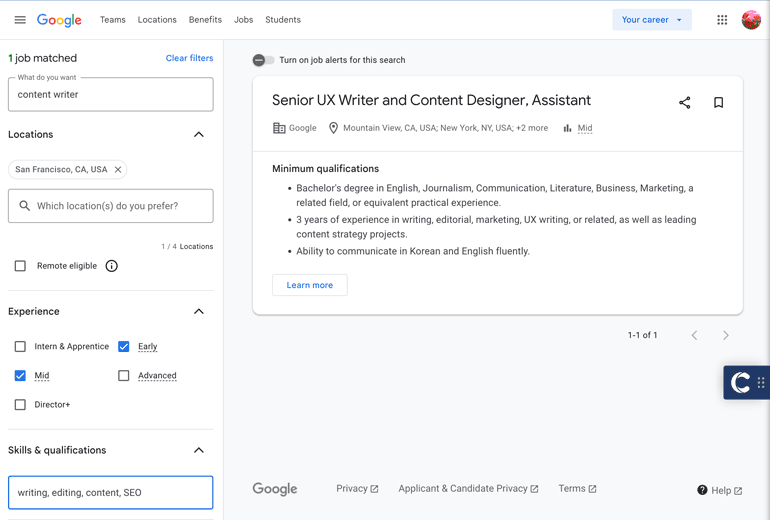
If you’re not seeing enough relevant results after applying search filters, try using a search engine with a larger database or removing a few filters that aren’t as important to you.
3. Set job alerts and notifications
If there’s a particular type of role you’re looking for, set up some job alerts. Many job boards include an alert feature that will send you emails or notifications when matching jobs are listed. Using these features can save you time and let you know when interesting opportunities arise.
If there’s a specific company (or several) you want to work for, you can visit the company page on LinkedIn and set a job alert for a specific job title. Here’s a quick tutorial:

While this is a cool trick, keep in mind that not all companies will post jobs on LinkedIn (and the same goes for any other platform), so it’s not a fail-proof way to find out if companies are hiring.
You should still continue to do your own searches regularly, use several platforms, and check company websites.
4. Try a few different job search websites
Everyone’s job search process looks a little bit different depending on your industry, experience, and individual preferences.
To figure out what works for you, it’s a good idea to try out a few different sites to see what kinds of jobs are available and what features you like.
For example, easy apply features can be a lifesaver for some, while others prefer to browse more comprehensive company information and take their time putting together an application.
It’s also helpful to use a combination of some of the larger job search engines (like Indeed, LinkedIn, or Glassdoor) and niche job boards that cater to your specific interests, industry, or profession. This way, you’ll get a range of opportunities from the large search engines and the more tailored postings from niche job boards.
Subscribing to profession or industry-specific newsletters can also be an excellent way to learn about interesting job opportunities. For example, The Bloom sends out a newsletter every Sunday that includes a list of new opportunities to work in social impact from around the world.
As you’re applying on different job boards, watch out for things like fake companies and job listings, scams, phishing, or ghost jobs.
5. Supplement your search with networking
Networking is a powerful way to improve your job search. If there are networking tools available on the job boards you’re searching on, make use of them!
If there aren’t any networking tools available, supplement your job search with networking platforms or events.
See if you can find information on who the hiring manager or recruiter for each position is, and reach out to them personally. LinkedIn makes it really easy to do this. Here’s how:
- Find the company profile
- Look under “People”
- Search for terms like “Hiring manager,” “Recruiter,” or “Talent Acquisition.”
If you’re able to identify the person who’s filling the role, send them a message or a connection request letting them know that you applied and that you’re really excited to learn more about the opportunity. Keep it short and sweet, and don’t ask for any big favors!
Here’s an example from our article on how to contact recruiters on LinkedIn:
Hi [Name],
I noticed that you’re recruiting for [job position], and wanted to inquire to see if you’d had a chance to review my application. I believe my background in [professional experience], and expertise in [skills #1 and #2] make me the perfect candidate for this position. I’d love the opportunity to further discuss how I’d make a great addition to [company].
You can reach me at [email address] or [phone number]. I look forward to hearing from you soon.
Sincerely,
[Name]
Making connections with people in your job search can help you stand out and make it more likely that you’ll be noticed and remembered.
Additional job hunting resources
Now that you know exactly where and how to track down the right opportunities, it’s time to start putting together your applications. Here’s a helpful list of resources to support you in the next phase of your journey. Best of luck!
- Job Hunting in 2025: The Ultimate Guide
- How to Make a Resume for a Job in 2025
- Resume Examples (By Profession) for 2025
- Resume Templates
- 112+ Job Skills for Your Resume: List & Examples
- Cover Letter Templates
- How to Write a Cover Letter for a Job in 2025
- The 10 Best Cover Letters of 2023
- How to Follow Up On a Job Application
- 11 Best High-Paying Jobs for Teens (and Where To Find Them)
- 14 Job Interview Tips to Help You Succeed
- 25+ Common Interview Questions & Answers for 2025
- How to Send a Follow-up Email After An Interview
About Resume Genius
Since 2009, Resume Genius and its globally popular resume builder have been helping people from all backgrounds and experience levels land their next job faster.
Resume Genius also provides a wide range of free career resources, including customizable resume templates, resume examples for different industries, and resume writing guides, to help job seekers find fulfilling work and reach their career goals.
Resume Genius is led by a team of dedicated career advisors and HR experts and has been featured in The New York Times, Harvard Business Review, Fast Company, CNBC, and USA Today.
For media inquiries, please contact us.
About the Author

Jack Hulatt graduated from the University of Greenwich with a bachelor’s degree in Politics and International Relations before pursuing certifications in computer science and data analytics. In his short career, he has already worked on multiple entrepreneurial projects and as part of a larger team, giving him direct insight into the needs and wants of young job seekers today.


Click to rate this article
3.3 Average rating