

Struggling to get interviews?
Whether you’re looking for a side gig or flexible hours that work with your personal commitments, your part-time resume should present your skills, experience, and availability in the best light possible. Here’s all you need to know.
Do you need a resume for a part-time job?
Yes, you need a resume for a part time job in most situations, especially if you’re applying for an entry-level job out of college, any job that requires specific skills or experience, or an internship.
However, many entry-level positions in the service industry (especially in restaurants) don’t require a resume.
If you want to leave a positive first impression on employers, you can still make a resume with no experience.
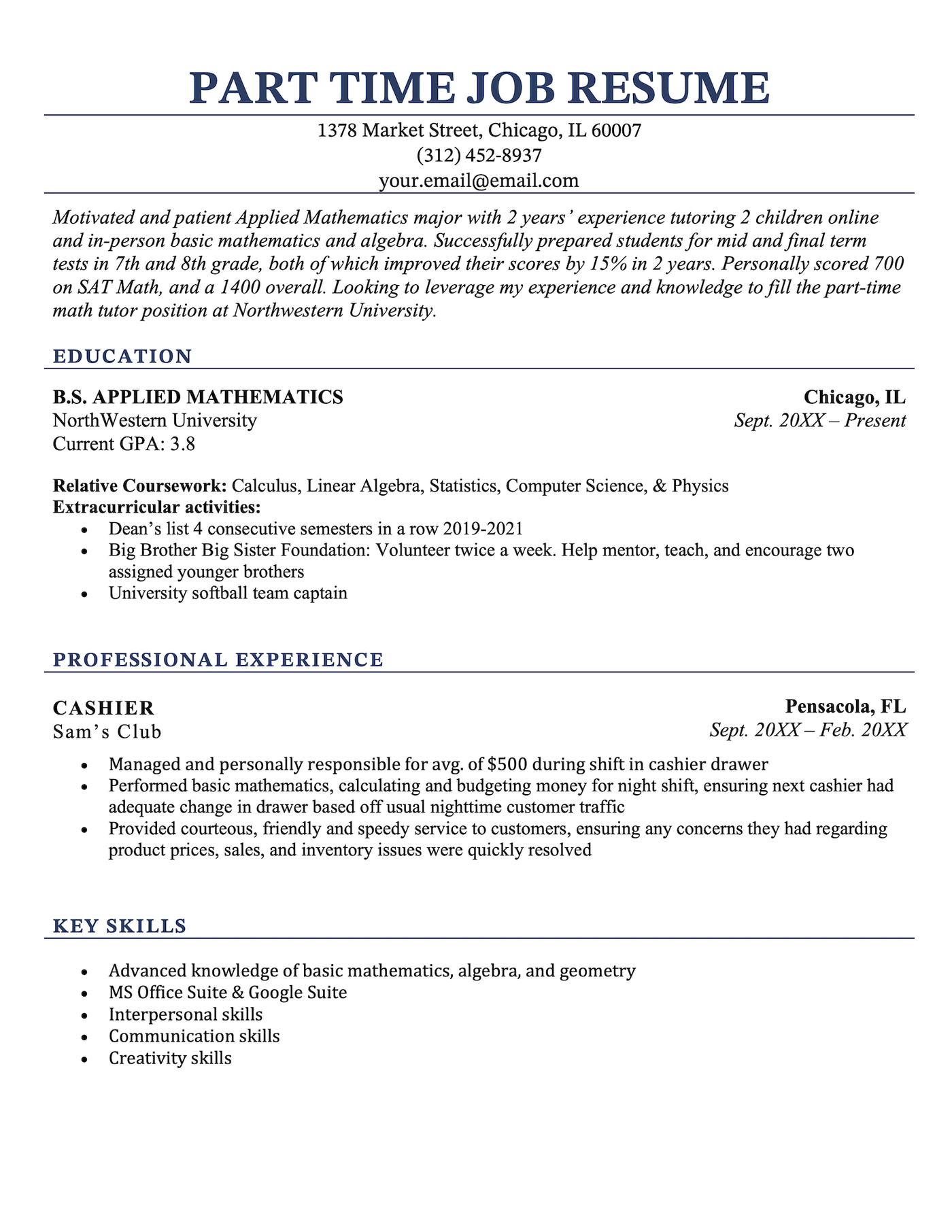
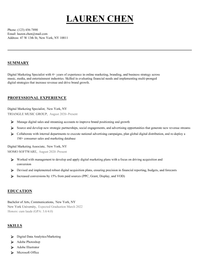
Part-time job resume example
Here’s a resume example written by a college student who’s applying to a part-time tutoring job:
How to write a resume for a part-time job
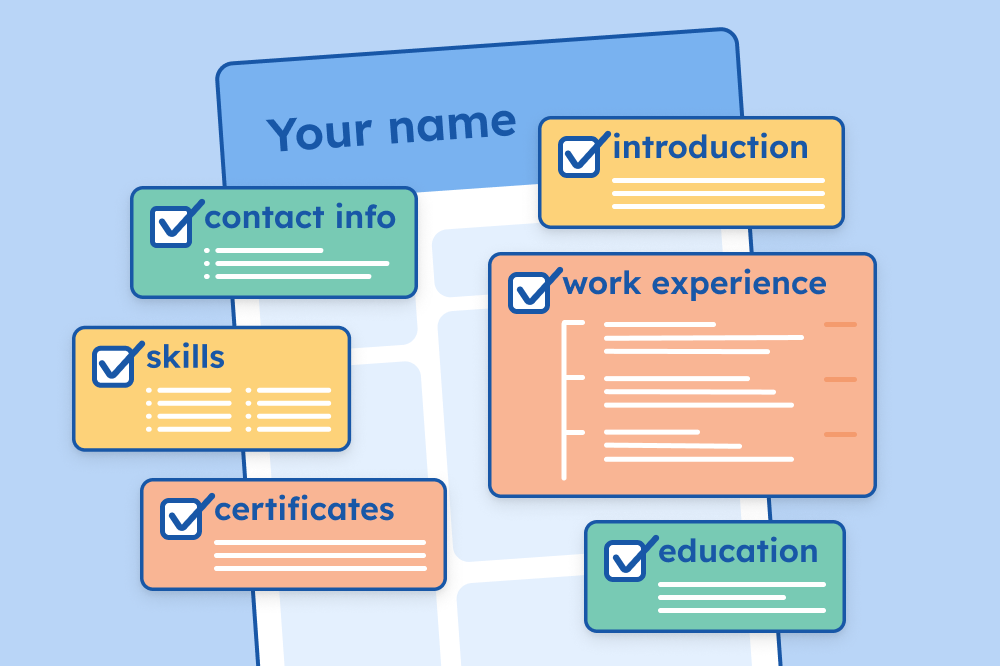
Your resume should include the following core sections:
- Resume header: Add your full name, phone number, email address, and location (city and state) at the top of your resume
- Resume objective: Write a short statement that highlights your goals and relevant skills, focusing on what you can offer the employer
- Work experience: For each past job, include the job title, company name and location, dates of employment, and 3–5 bullet points describing your responsibilities and achievements
- Education: Include your school, degree title, and graduation date (or expected graduation date if you’re still in school)
- Skills: Add a section with a list of skills that you have that match the job description
Depending on your background, you can also add the following optional sections if they’re relevant to the job:
- Internships: Include internships if you have them, focusing on tasks, skills, and results that relate to the job
- Volunteer work: Add volunteer experience to show responsibility, teamwork, and community involvement
- Relevant coursework: List courses that that are relevant to the job if you lack work experience
- Extracurricular activities: Include clubs, sports, or organizations that demonstrate leadership, teamwork, or initiative
- Certifications: Include any relevant certifications, such as CPR, food handling, or technical credentials
- Projects: Highlight school or personal projects that show relevant skills and practical experience
- Awards and honors: Add academic or extracurricular achievements that show strong performance or recognition
Part-time job resume template
Here’s a template you can copy and fill in with your own information:
[Full Name]
[City, State] • [Phone Number] • [Professional Email] • [Optional: LinkedIn or Portfolio]
Objective
[2–4 sentences explaining your goals and highlighting relevant skills. Focus on what you can offer the employer.]
Work Experience (if applicable)
[Job Title]
[Company Name] | [City, State] | [Month Year – Month Year]
- [Action verb] [task or responsibility]
- [Action verb] [task with measurable result, if possible]
- [Action verb] [skill or achievement relevant to the job]
[Job Title]
[Company Name] | [City, State] | [Month Year – Month Year]
- [Action verb] [task or responsibility]
- [Action verb] [task with measurable result]
- [Action verb] [skill or achievement]
Education
[Degree Name or High School Diploma]
[School Name] | [City, State] | [Graduation Date or Expected Graduation]
[Optional: GPA, honors, or relevant coursework]
Skills
- [Skill relevant to the job]
- [Skill relevant to the job]
- [Skill relevant to the job]
- [Skill relevant to the job]
Additional Experience (Optional)
[Activity / Volunteer Role / Project Name]
[Organization or School] | [Dates]
- [Action verb] [responsibility or achievement]
- [Action verb] [skill developed or contribution]
Certifications (Optional)
[Certification Name] — [Issuing Organization]
[Certification Name] — [Issuing Organization]
Awards & Honors (Optional)
[Award Name] — [Date or Organization]
The best resume templates for 2026
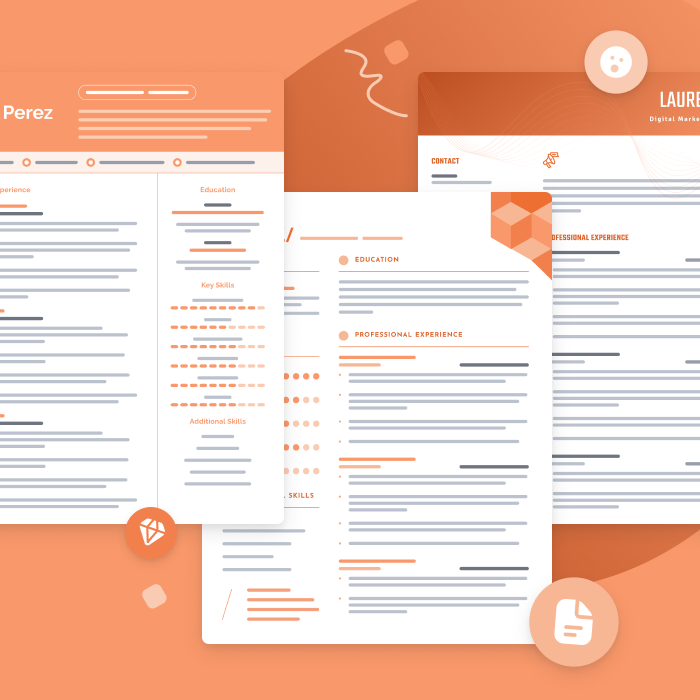
One of the best ways to make your resume is by filling out one of our free resume templates. All our templates are designed by experts and free to download for Microsoft Word or Google Docs.
Tips for writing a resume for a part-time job
Follow these tips to stand out from other applicants:
Tailor your resume to the job
Tailor your resume to each job you apply for by aligning your skills and experience with the job description. Employers often scan resumes quickly, so highlighting the most relevant qualifications makes it easier for them to see that you’re a good fit.
Start by identifying keywords in the job description, such as specific skills, tools, or tasks. Then include those keywords naturally in your resume, especially in your skills section and work experience bullet points.
Add hard numbers
Use numbers to show the impact of your work instead of listing general responsibilities. Employers want to understand what you accomplished, not just what you were assigned. Adding numbers to your resume makes your experience more specific and easier to evaluate.
Include details like how many customers you helped, how often you completed tasks, or how much you improved a process.
For example, instead of saying you “assisted customers,” write that you “assisted 50+ customers per shift” or “handled 30+ transactions daily.” These details help employers quickly understand your level of responsibility. If you don’t have exact numbers, estimate based on your typical workload.
Focus on transferable skills
Highlight transferable skills that apply across different jobs, especially if you have limited or unrelated work experience. Employers hiring for part-time roles often look for qualities like communication, reliability, teamwork, and time management, not just job-specific experience.
Think about what you’ve done in school, volunteer work, extracurricular activities, or past jobs, and connect those experiences to the role you want. For example, working on group projects shows teamwork, while balancing school and activities shows strong time management.
Make these skills clear in your bullet points by showing how you used them in real situations. Instead of listing “communication skills,” describe how you interacted with customers, worked with a team, or solved problems. This helps employers see how your skills apply to the job.
Use simple, clear language
Every word on your resume should count. Use clear, concise language so employers can quickly understand your experience. Avoid long sentences, complex wording, or unnecessary details that make your resume harder to read.
Focus on clarity over style. Employers often review many resumes in a short time, so a clear and straightforward resume helps your qualifications stand out.
Build your resume in minutes

About the Author

Lauren Mastroni is a Senior Digital Content Writer at Resume Genius, where she creates data-driven career content and actionable job search advice. With a background in academic research, she brings a research-focused approach to topics like resume writing, interviewing, and career development. Lauren is dedicated to helping job seekers at all stages navigate the hiring process and present themselves more effectively to employers.