

- Comparing the least and most stressful $100k+ jobs
- Finding #1: There is a workplace stress premium, but it's uneven
- Finding #2: For bachelor's-degree jobs, stress doesn't pay
- Finding #3: Low-stress six-figure jobs are rare, but they exist
- Finding #4: What separates low- and high-stress six-figure jobs? Dealing with people
- Methodology
- FAQ
- Sources
- About Resume Genius
Do stressful jobs actually pay more? Many people assume high-pressure careers come with an unwritten “stress premium”: extra pay to make up for the pressure. But is that actually true?
To find out, we gave 754 U.S. occupations a Stress Index score from 0 (least stressful) to 100 (most stressful), based on their day-to-day working conditions (longer hours, tighter deadlines, stressful interactions, etc.), and compared those scores with the latest federal pay data.
The short answer: stressful jobs do tend to pay more, especially jobs that don’t need a bachelor’s degree and doctoral-level jobs like physicians. But for jobs that typically require a bachelor’s degree, the extra stress comes with no extra pay.
Comparing the least and most stressful $100k+ jobs
All 10 of the least stressful six-figure jobs are in tech, engineering, math or science. 8 of the 10 most stressful are in healthcare, for people or animals.
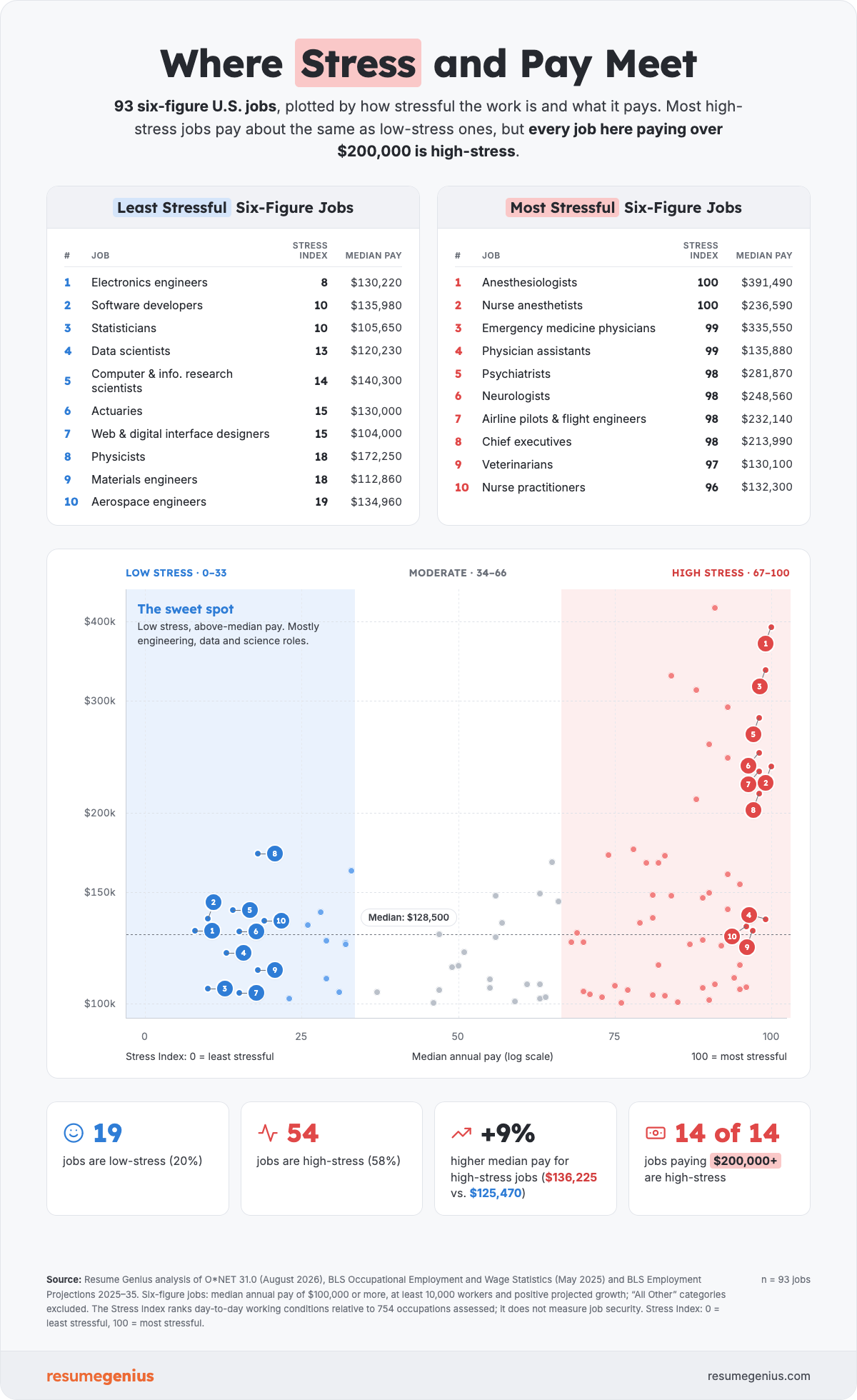
| Least stressful six-figure jobs | Stress Index | Median pay | Most stressful six-figure jobs | Stress Index | Median pay |
|---|---|---|---|---|---|
| #1: Electronics engineers (except computer) | 8 | $130,220 | #1: Anesthesiologists | 100 | $391,490 |
| #2: Software developers | 10 | $135,980 | #2: Nurse anesthetists | 100 | $236,590 |
| #3: Statisticians | 10 | $105,650 | #3: Emergency medicine physicians | 99 | $335,550 |
| #4: Data scientists | 13 | $120,230 | #4: Physician assistants | 99 | $135,880 |
| #5: Computer and information research scientists | 14 | $140,300 | #5: Psychiatrists | 98 | $281,870 |
| #6: Actuaries | 15 | $130,000 | #6: Neurologists | 98 | $248,560 |
| #7: Web and digital interface designers | 15 | $104,000 | #7: Airline pilots, copilots and flight engineers | 98 | $232,140 |
| #8: Physicists | 18 | $172,250 | #8: Chief executives | 98 | $213,990 |
| #9: Materials engineers | 18 | $112,860 | #9: Veterinarians | 97 | $130,100 |
| #10: Aerospace engineers | 19 | $134,960 | #10: Nurse practitioners | 96 | $132,300 |
Stress Index: 0 = least stressful, 100 = most stressful of 754 occupations. Median pay: BLS, May 2025. Where scores tie, the higher-paying job ranks first.
The Stress Index measures day-to-day working conditions, such as time pressure, conflict and the consequences of mistakes. It doesn’t measure job security or layoff risk, so a low-stress job like software development can still face a tough hiring market.
For a closer look at each of the 10 lowest-stress jobs, see 10 Low-Stress, High-Paying Jobs in 2026.
Finding #1: There is a workplace stress premium, but it’s uneven
Across all 754 occupations, pay generally rises with stress. The most stressful 20% of jobs earn a median $78,330 a year, compared with $48,235 for the least stressful 20%.
| Stress level | Stress Index score | Occupations | Median annual pay |
|---|---|---|---|
| Lowest | 0–20 | 154 | $48,235 |
| Low | 21–40 | 151 | $55,570 |
| Middle | 41–60 | 151 | $63,890 |
| High | 61–80 | 150 | $64,200 |
| Highest | 81–100 | 148 | $78,330 |
Part of that median pay gap is related to education. Many of the most stressful careers, like physicians and surgeons, take years of training. The pay for such careers is partly reflected in that training, not just the stress.
To account for pay differences based on education and get a clearer picture on the stress premium, we also compared jobs requiring the same level of education. In these instances the premium shrinks but is still apparent.
Among jobs that need the same level of education, median pay is about 4% higher for every 10 points on the Stress Index. In practice, a job with a high Stress Index score of 80 typically pays about 25% more than a job scoring 30.
Finding #2: For bachelor’s-degree jobs, stress doesn’t pay
Jobs that typically need a bachelor’s degree are the big exception. Here, stress and pay are almost unrelated: the more stressful half of these jobs earns a median $87,990 a year, slightly less than the less stressful half ($88,830).
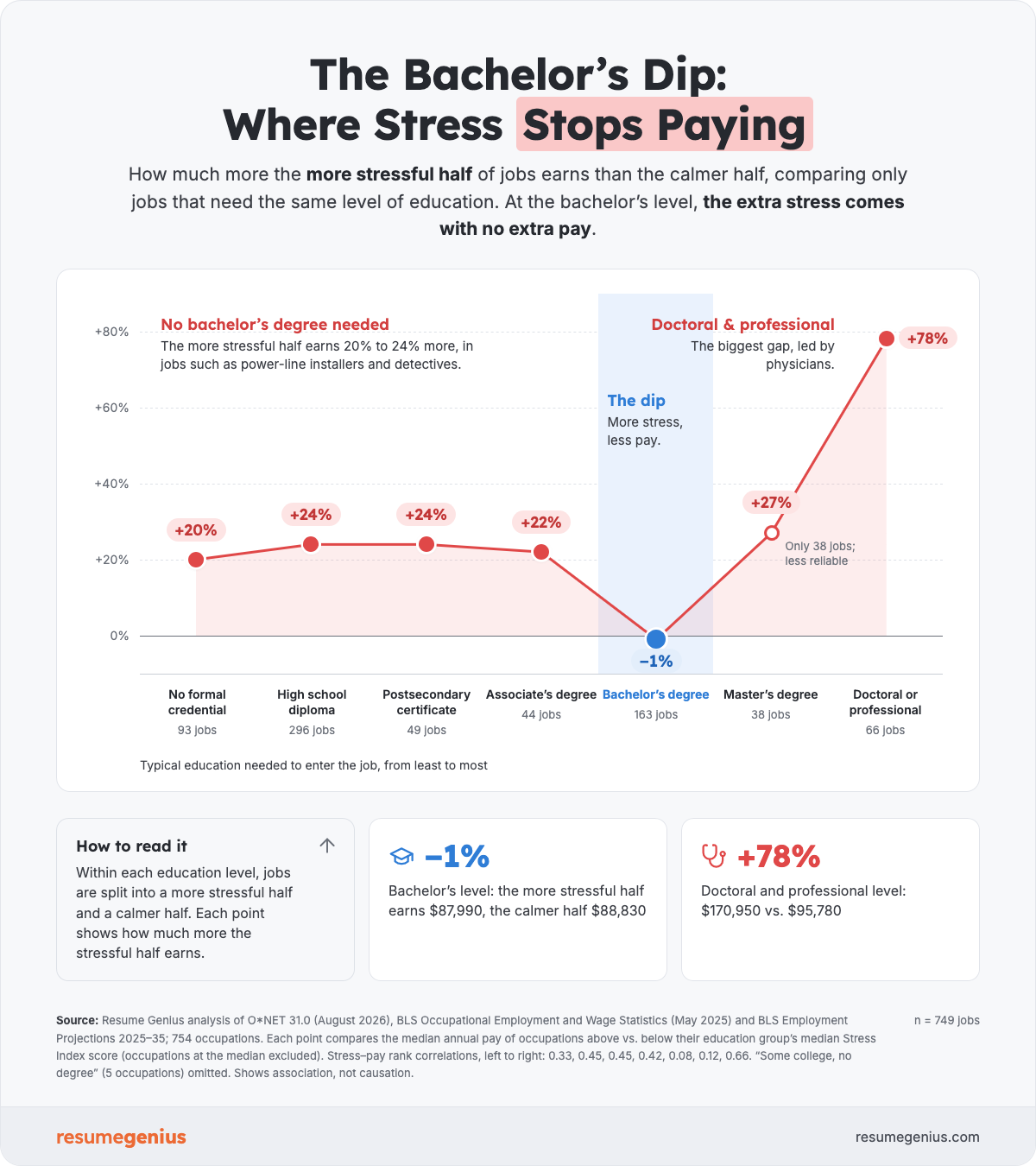
The table below groups jobs by the education they typically require. Within each group, it splits the jobs into a more stressful half and a less stressful half, and shows how much more (or less) the stressful half earns. The correlation shows how consistently pay rises with stress: 0 means no link at all; 1 means the more stressful a job, the higher it pays, without exception.
| Typical entry-level education | Occupations | More stressful half vs. less stressful half (median pay) | Median annual pay | Stress–pay correlation |
|---|---|---|---|---|
| No formal educational credential | 93 | +20% | $40,470 | 0.33 |
| High school diploma or equivalent | 296 | +24% | $50,265 | 0.45 |
| Postsecondary nondegree award | 49 | +24% | $60,600 | 0.45 |
| Associate's degree | 44 | +22% | $66,985 | 0.42 |
| Bachelor's degree | 163 | −1% | $88,720 | 0.08 |
| Master's degree | 38 | +27% | $92,655 | 0.12 |
| Doctoral or professional degree | 66 | +78% | $102,965 | 0.66 |
Excludes 5 occupations that typically require some college but no degree.
So where does stress pay off? Comparing jobs that need the same level of education, more stressful jobs pay noticeably more in two groups:
- Jobs that need a doctoral or professional degree: the more stressful half earns 78% more ($170,950 vs. $95,780), led by physicians such as anesthesiologists and emergency medicine physicians.
- Jobs that don’t need a bachelor’s degree: the more stressful half earns 20% to 24% more. Some of the best-paid roles in these groups carry real risk or pressure, such as electrical power-line installers ($95,320, Stress Index 97) and detectives and criminal investigators ($93,790, Stress Index 100).
For Master’s-level jobs, the most stressful half earns 27% more ($100,040 vs. $78,620), but pay doesn’t rise steadily with stress (correlation of 0.12). With only 38 occupations, the result is less reliable.
For bachelor’s-level jobs, there’s no such pattern: a more stressful job is not more likely to pay well than a less stressful one.
Finding #3: Low-stress six-figure jobs are rare, but they exist
Only 19 of the 93 six-figure occupations in our analysis are low-stress, about one in five. More than half (54) are high-stress.
| Stress tier | Stress Index score | Six-figure occupations | Share | Median annual pay |
|---|---|---|---|---|
| Low stress | 0–33 | 19 | 20% | $125,470 |
| Moderate | 34–66 | 20 | 22% | $111,700 |
| High stress | 67–100 | 54 | 58% | $136,225 |
High-stress six-figure jobs do pay more, but not by much: $10,755 more a year at the median, a 9% premium. And low-stress six-figure jobs actually out-earn moderately stressful ones by about $14,000.
The exception is the very top of the pay scale. All 14 six-figure jobs with a median wage of $200,000 or more are high-stress: 12 are in medicine, and the other two are airline pilots and chief executives.
Finding #4: What separates low- and high-stress six-figure jobs? Dealing with people
Day to day, the biggest differences between low- and high-stress six-figure jobs are how often workers deal with difficult people, conflict and tight deadlines. Hours and competition differ surprisingly little.
| Workers who... | Low-stress six-figure jobs | High-stress six-figure jobs |
|---|---|---|
| Deal with unpleasant or angry people at least weekly | 6% | 43% |
| Handle conflict at least weekly | 11% | 46% |
| Face time pressure every day | 10% | 42% |
| Have high responsibility for others' health and safety | 22% | 58% |
| Say a mistake would be very or extremely serious | 25% | 59% |
| Regularly work more than 40 hours a week | 48% | 57% |
| Work in a highly or extremely competitive environment | 49% | 52% |
| Have a lot of freedom to make decisions | 38% | 60% |
Most of these conditions feed into the Stress Index, so the table describes what high-stress jobs look like day to day rather than proving what causes stress.
- Stress is often about people, not workload. The widest gaps are in dealing with angry people (7 times as common in high-stress jobs), conflict (4 times) and daily time pressure (4 times). In the 10 least stressful six-figure jobs, just 4% of workers deal with angry people weekly, compared with 60% in the 10 most stressful.
- Low stress doesn’t mean easy. About half of workers in low-stress six-figure jobs still regularly work more than 40 hours a week (48%) or work in highly competitive environments (49%), close to the levels in high-stress jobs.
- Being in charge doesn’t make a job less stressful. Workers in high-stress six-figure jobs are more likely to have a lot of freedom to make decisions (60% vs. 38%). Physicians, pilots and executives call the shots, and carry the weight of those calls.
Methodology
We built a Stress Index for 754 U.S. occupations using the O*NET 31.0 database (August 2026), then compared it with pay and outlook data from the U.S. Bureau of Labor Statistics.
The Stress Index (0–100) combines eight O*NET measures:
- Stress Tolerance (one-third of the score): O*NET’s rating of how much coping with stress matters for doing the job well. It is not a measure of how stressed workers feel.
- Seven work conditions (two-thirds, equally weighted): time pressure; conflict situations; dealing with unpleasant or angry people; consequences of errors; responsibility for others’ health and safety; level of competition; and the share of workers on weeks longer than 40 hours.
Each measure was converted to a percentile rank across all 754 occupations and combined using the weights above. The result was ranked again to give a 0–100 score, where 100 is the most stressful occupation. Low stress = 33 or below; high stress = 67 or above. We also tested an eighth work condition, freedom to make decisions, and chose to exclude it: in this data, more stressful jobs come with more freedom, not less, so it ran against the other measures. The choice of measures and weights is a research judgment; with freedom included, nine of each top 10 stay the same.
The Stress Index is a relative measure. A “low-stress” job scores low on these working conditions compared with other occupations; the score is not a clinical measure, a share of stressed workers, or a guarantee that a particular employer offers a low-stress workplace.
Pay and employment come from the BLS Occupational Employment and Wage Statistics (May 2025). Projected growth and typical education come from BLS Employment Projections 2025–35. “Median pay” for a group of jobs is the median of each occupation’s median annual wage. The worker shares in Section 5 are simple averages of O*NET survey responses across the occupations in each group.
For each education level, we also split occupations at that level’s median Stress Index score and compared the median pay of the more and less stressful halves; occupations exactly at the median are excluded.
Six-figure jobs have a median annual wage of $100,000 or more, at least 10,000 workers, and positive projected growth through 2035. Catch-all “All Other” occupations are excluded.
Coverage: Of the 830 detailed occupations in the BLS wage data, we assessed 754; rankings refer to these occupations. The other 76 lack the data needed to score them: 61 have no O*NET stress rating (49 of them catch-all “All Other” categories); 11 have a Stress Tolerance rating but no O*NET work-condition survey data, including cardiologists, orthopedic surgeons, pediatric surgeons and financial analysts; and 4 performing-arts occupations have no published median wage. Nine assessed occupations lack the long-hours measure, so their scores use the remaining measures, reweighted.
Data notes: O*NET flags some estimates as low precision. We kept them in the index, including 68 long-hours estimates (one of them for electronics engineers). Excluding those flagged values leaves the low-stress top 10 unchanged and swaps one entry in the most stressful top 10 (first-line supervisors of police and detectives would replace nurse practitioners); the headline figures are essentially unchanged. O*NET 31.0 is the latest release, but its survey data was collected over many years, mostly since 2019, so not every rating reflects 2026 conditions. In Section 5, six occupations without survey percentages at their main O*NET code use the average of their more detailed O*NET codes.
Limitations: The index reflects day-to-day working conditions for the typical job in each occupation, not job security, layoff risk or exposure to automation. O*NET’s Stress Tolerance ratings are AI-assisted ratings reviewed by occupational experts; the work-condition measures come mostly from worker surveys. Wages are national medians and vary by location, experience and employer. Our findings show associations between stress and pay, not that stress causes higher pay.
This report includes information from the O*NET 31.0 Database by the U.S. Department of Labor, Employment and Training Administration (USDOL/ETA). Used under the CC BY 4.0 license. O*NET® is a trademark of USDOL/ETA. Resume Genius has modified all or some of this information. USDOL/ETA has not approved, endorsed, or tested these modifications.
FAQ
What is the stress premium?
The stress premium is the extra pay that comes with a more stressful job. Comparing jobs that need the same level of education, median pay rises about 4% for every 10 points on our 0–100 Stress Index. But the premium varies a lot: the more stressful half of doctoral-level jobs earns 78% more than the less stressful half, while for bachelor’s-level jobs there’s no premium at all.
What is the least stressful six-figure job?
Electronics engineers (except computer engineers) have the lowest Stress Index score of any six-figure job in our analysis: 8 out of 100. They earn a median $130,220 a year.
What is the most stressful six-figure job?
Anesthesiologists score 100 out of 100, tied with nurse anesthetists for the top score among six-figure jobs; anesthesiologists rank first because they earn more. They’re also among the highest-paid workers in the country, at a median $391,490 a year.
Is software development really a low-stress job?
Based on daily working conditions, yes: software developers score 10 out of 100. They deal with less conflict and fewer difficult people than almost any other occupation, have little responsibility for others’ safety, and relatively few long workweeks. The index doesn’t measure job security, so it doesn’t reflect recent layoffs or a competitive hiring market.
Sources
- O*NET Resource Center, O*NET 31.0 Database
- U.S. Bureau of Labor Statistics, Occupational Employment and Wage Statistics
- U.S. Bureau of Labor Statistics, Employment Projections
About Resume Genius
Since 2009, Resume Genius and its resume builder software have been helping people from all backgrounds and experience levels land their next jobs faster.
Resume Genius also provides a wide range of free career resources, including customizable resume templates, resume examples for different industries, and resume writing guides, to help job seekers find fulfilling work and reach their career goals.
Resume Genius is led by a team of dedicated career advisors and HR experts and has been featured in The New York Times, Harvard Business Review, Fast Company, CNBC, and USA Today.
For media inquiries, please contact us.
About the Author

Jack Hulatt graduated from the University of Greenwich with a bachelor’s degree in Politics and International Relations before pursuing certifications in computer science and data analytics. In his short career, he has already worked on multiple entrepreneurial projects and as part of a larger team, giving him direct insight into the needs and wants of young job seekers today.