


Every job has its hazards, but some professions are actually deadly. Our Riskiest Jobs in America Report analyzes the latest federal data on workplace fatalities and injuries to identify the 10 most dangerous jobs in America in 2026.
For each occupation, we weigh the daily hazards against the median annual salaries to answer one key question: Is the reward worth the risk?
| Job | Workplace Fatalities (per 100k) | Median Salary |
|---|---|---|
| Logging worker | 98.9 | $49,540 |
| Roofer | 51.8 | $50,970 |
| Garbage collector | 41.4 | $48,350 |
| Pilot | 31.3 | $198,100 |
| Firefighter | 27 | $59,530 |
| Truck driver | 26.8 | $57,440 |
| Iron and steel worker | 19.8 | $61,940 |
| Farm manager | 19 | $87,980 |
| Electrical power line technician | 18.4 | $92,560 |
| Police and detectives | 11.75 | $77,270 |
We calculated a “risk/reward score” for each job by combining fatality and injury rates from the Bureau of Labor Statistics with hazard data from O*NET. We then compared those risks against each occupation’s median annual salary and barriers to entry (such as required training).
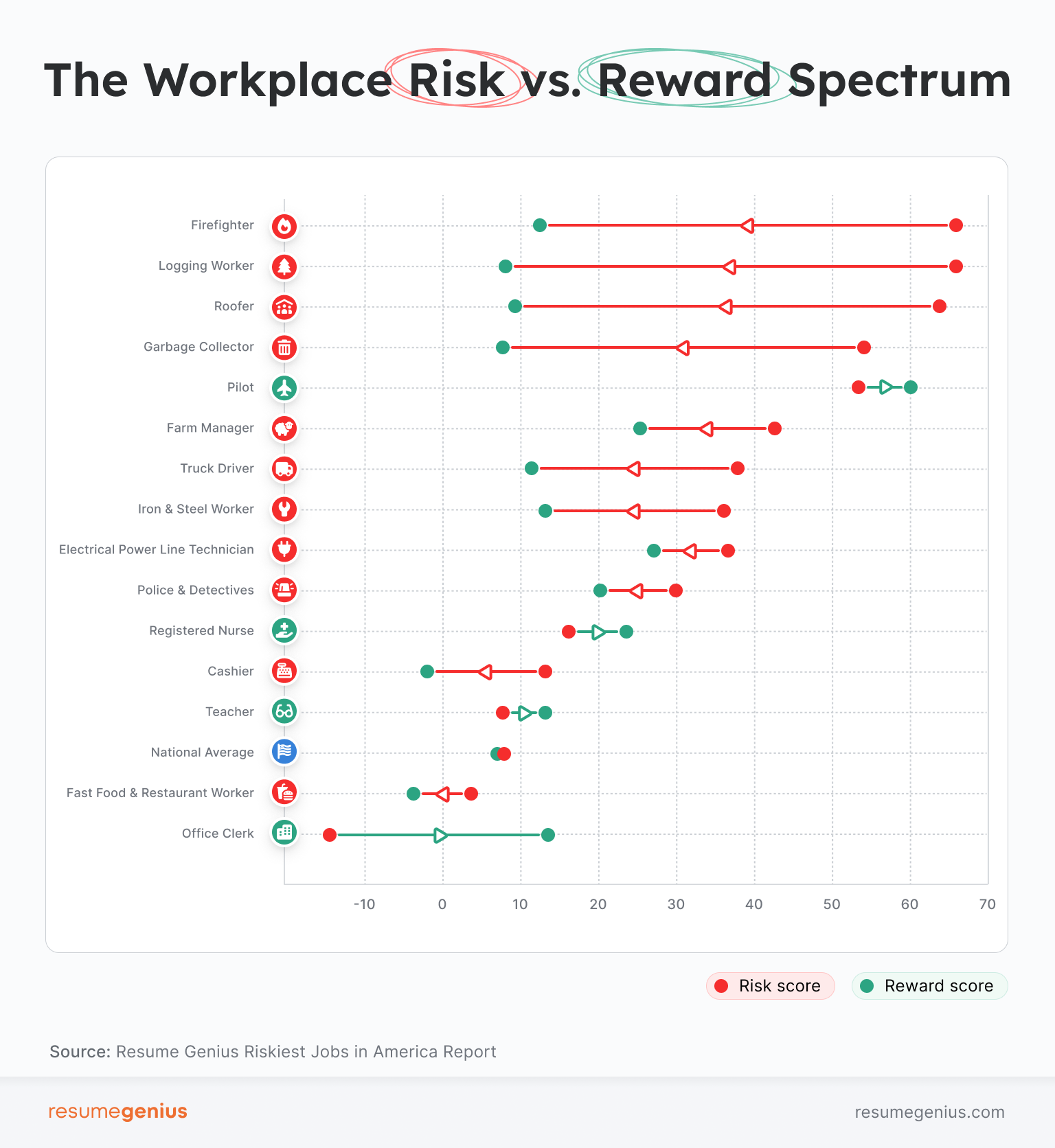
A lower score means that the risks involved in a job outweigh the financial compensation, while a score of 50 represents a perfect balance between risk and reward.
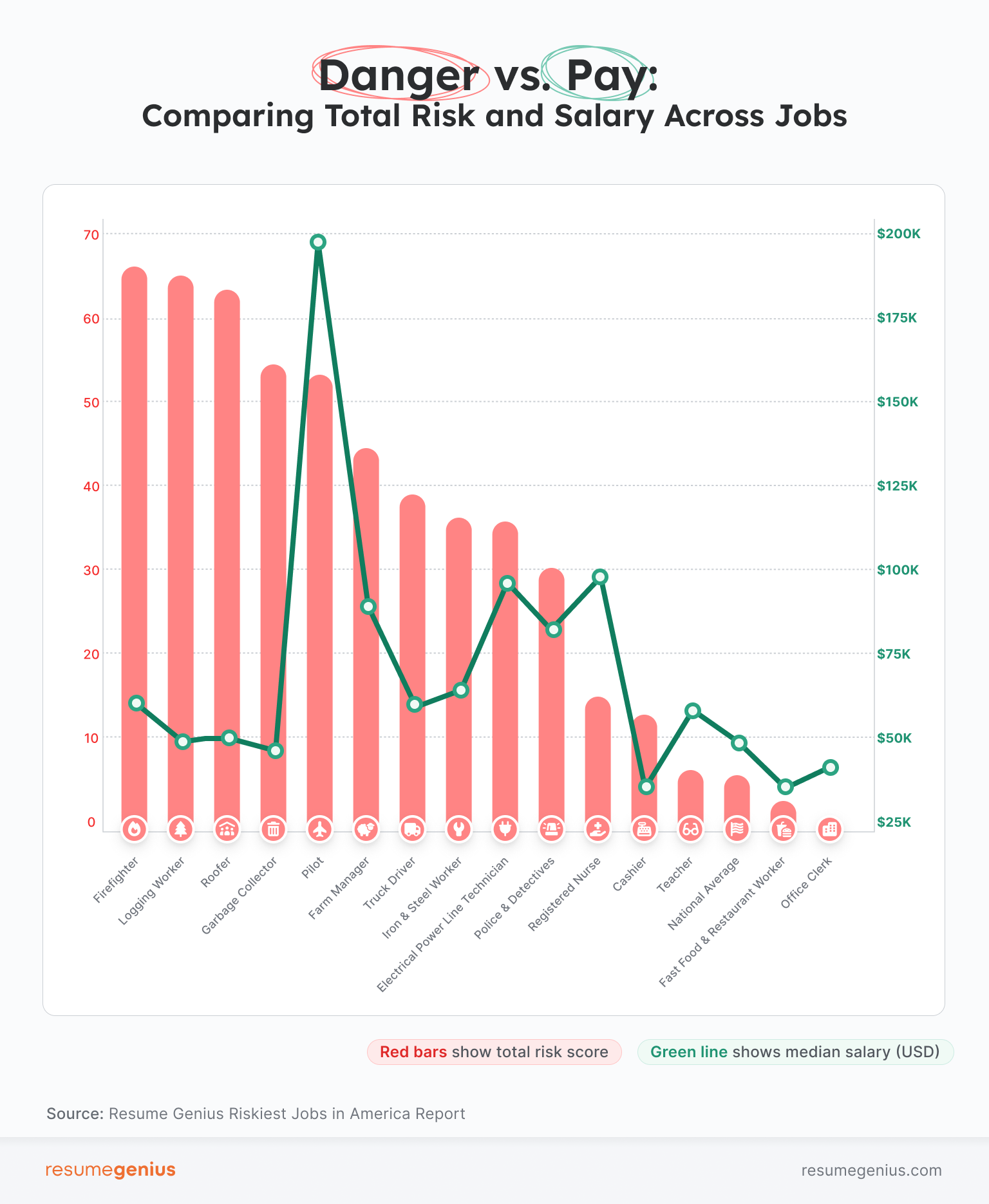
The graph below shows jobs sorted by their overall risk, compared to median salary data as reported by the Bureau of Labor Statistics for 2024:
1. Logging worker
- Workplace fatalities (per 100k): 98.9
- Workplace injuries (per 100k): 3,000
- Median annual salary: $49,540
- Median hourly wage: $23.82
- Education: High school diploma or equivalent
- Risk/reward score: 21.0
What they do
Logging workers harvest trees that become paper and other wood-based products. They fell trees with chainsaws and use heavy machinery to transport massive logs, all often deep in remote forest areas.
It’s physically demanding work that sounds straightforward until you consider the conditions: trees weighing several tons, steep, uneven terrain, and unpredictable weather. Loggers face constant risks from falling branches, unstable ground, and high-powered machinery, making this job one of the most dangerous professions in America.
Is it worth the risk?
With a fatality rate nearly 30 times higher than the average for all U.S. jobs, and almost double any other entry on our list, the pay for logging workers hardly seems to justify the danger. The median annual salary is only slightly over the national median, offering little financial reward for facing life-threatening hazards every day.
This career is best suited for those who genuinely love working outdoors and have a very high tolerance for risk, since the paycheck alone isn’t much of an incentive.
2. Roofer
- Workplace fatalities (per 100k): 51.8
- Workplace injuries (per 100k): 3,200
- Median annual salary: $50,970
- Median hourly wage: $24.51
- Education: No formal education required
- Risk/reward score: 22.8
What they do
Roofers quite literally keep a roof over our heads. They install, repair, and replace roofs on all kinds of buildings, working with materials ranging from asphalt shingles to metal sheets. The job demands a good head for heights and steady balance, because a roofer’s “office” is often a sloped surface several stories from the ground. Besides the ever-present risk of falling, roofers face constant exposure to the elements, from blistering summer heat that can cause burns from tar or tools to sudden high winds.
Is it worth the risk?
For a job where one wrong step could be your last, a median salary of just under $51,000 feels like a modest reward. The fatality rate is alarmingly high, and while no formal education is needed, the physical demands are relentless. Roofing offers steady work, but it’s a career for those who don’t mind quite literally living life on the edge.
3. Garbage collector
- Workplace fatalities (per 100k): 41.4
- Workplace injuries (per 100k): 4,400
- Median annual salary: $47,810
- Median hourly wage: $22.99
- Education: No formal education required
- Risk/reward score: 26.4
What they do
These essential workers keep our communities clean and functioning. Their days are spent riding on the back of trucks, jumping off to collect trash cans, and operating the hydraulic lifts that empty trash into the garbage trucks.
It’s a physically demanding role that requires an early start and the strength to lift heavy containers all day long. The biggest danger comes from other drivers, as workers are constantly moving in and out of traffic. They also face risks from hazardous materials thrown away and powerful hydraulic crushers.
Is it worth the risk?
While refuse collection is a vital public service, the pay doesn’t reflect its importance or danger. With a higher injury rate than logging or roofing, and a significant fatality rate, refuse workers face serious daily hazards for the lowest median salary on our list so far.
For the physical strain and constant risk of traffic accidents, an annual income of $47,810 may seem underwhelming. That said, it’s steady work with solid benefits in many municipalities, but the compensation hardly matches the risk or public value of the role.
4. Pilot
- Workplace fatalities (per 100k): 31.3
- Workplace injuries (per 100k): 4,400
- Median annual salary: $198,100
- Median hourly wage: $95.24
- Education: Degree and specialized training
- Risk/reward score: 52.9
What they do
Pilots are highly trained professionals who fly airplanes, helicopters, and other aircraft to transport people and cargo safely. The role requires years of training, a deep understanding of aerodynamics and navigation, and a calm, decisive mindset under pressure. While most people think of commercial airline pilots, the profession also includes bush, tour, and agricultural pilots.
That high fatality rate isn’t driven by commercial airliners, which remain one of the safest forms of transportation. The statistic is heavily skewed by accidents involving small aircraft flying in challenging conditions with less advanced equipment and fewer built-in safety systems than modern commercial airliners.
Is it worth the risk?
This job is one profession where the numbers deserve a closer look. With an average salary approaching $200,000, the pay is a huge draw, and for commercial airline pilots, the actual day-to-day risk is extremely low. Years of training, strict safety regulations, and sophisticated technology make flying modern jetliners one of the safest jobs, despite the overall fatality rate.
For these pilots, the high pay reflects immense responsibility and technical expertise rather than physical danger. However, those flying smaller planes or helicopters face far greater risks. For these pilots, their career offers unparalleled freedom and adventure. For those with the right skills and a cool head, this job’s earning potential proves that the sky is truly the limit.
5. Firefighter
- Workplace fatalities (per 100k): 27
- Workplace injuries (per 100k): 9,800
- Median annual salary: $59,530
- Median hourly wage: $28.62
- Education: Postsecondary nondegree award
- Risk/reward score: 21.8
What they do
While a pilot’s danger statistics are skewed by small aircraft, a firefighter’s risks are exactly what they appear to be. These first responders are trained to control and extinguish fires, rescue people from burning buildings, and handle a wide range of emergencies like car accidents and medical incidents.
The dangers they face are both immediate and severe: collapsing structures, smoke inhalation, chemical exposure, and severe burns are daily realities. Their staggering injury rate — 9,800 per 100,000 workers — is nearly double that of any other job on this list, underscoring the immense personal risk firefighters accept to protect us every day.
Is it worth the risk?
Firefighting is often described as a calling, and for good reason. The median salary of just under $60,000, while respectable, feels modest for a job where injuries are almost inevitable. Constant exposure to trauma and life-threatening situations requires a unique level of courage and dedication that goes far beyond a paycheck.
While benefits and pension plans are often strong, firefighting is a career driven by a desire to serve, not profit. The personal rewards can be profound, but the physical and emotional costs are immense, a testament to the bravery and selflessness that few other professions demand.
6. Truck driver
- Workplace fatalities (per 100k): 26.8
- Workplace injuries (per 100k): 3,000
- Median annual salary: $57,440
- Median hourly wage: $27.62
- Education: Postsecondary nondegree award
- Risk/reward score: 36.0
What they do
Truck drivers are the backbone of the supply chain, keeping goods moving across the country. They spend long hours on the road, navigating highways and ensuring that cargo arrives safely and on time. Although it might seem less physically demanding than some of the other jobs on this list, the danger is constant. Fatigue from the long, monotonous hours is a major risk factor, and traffic accidents remain the most significant hazard. Truckers also contend with unpredictable weather.
Is it worth the risk?
For many, the appeal of truck driving lies in the freedom of the open road and the ability to earn a solid middle-class income without a college degree. However, the salary comes with significant trade-offs. The high fatality rate, primarily from vehicle crashes, is a constant concern, and the sedentary lifestyle often contributes to chronic health issues. A salary of around $57,000 for a job that keeps you away from home for weeks and carries constant risk makes this a demanding but essential career.
7. Iron and steel worker
- Workplace fatalities (per 100k): 19.8
- Workplace injuries (per 100k): 2,100
- Median annual salary: $61,940
- Median hourly wage: $29.78
- Education: High school diploma or equivalent
- Risk/reward score: 38.1
What they do
Iron and steel workers build the frameworks of skyscrapers, bridges, stadiums, and other massive structures. They install and secure the iron and steel beams that form the skeleton of these buildings, often working dozens or even hundreds of feet in the air, and walking on narrow beams with nothing but a safety harness to catch them.
The work is physically punishing, requiring them to lift heavy materials and tools. Each day brings exposure to wind, rain, and extreme temperatures at dizzying heights. Major hazards include falls, crushing injuries, and severe burns.
Is it worth the risk?
Earning over $60,000 a year to help build city skylines can be enticing for those unafraid of heights. The pay is strong compared to many other manual trades, but the dangers are just as real. A fall from that height is almost always fatal, and the constant physical strain can take a lasting toll on the body. It’s a profession that requires a rare combination of strength, balance, and pure nerve.
For the right person, the pride in seeing a completed skyscraper might be worth the daily dance with danger, but it’s a career built on courage. If you’re looking for a blue-collar career that keeps your feet on the ground, check out our list of the highest-paying blue-collar jobs instead.
8. Farm manager
- Workplace fatalities (per 100k): 19
- Workplace injuries (per 100k): 5,700
- Median annual salary: $87,980
- Median hourly wage: $42.30
- Education: High school diploma or equivalent
- Risk/reward score: 41.3
What they do
It might be surprising to find a manager on a list of dangerous jobs, but agriculture carries unique and often underestimated risks. Farm managers oversee the daily operations of farms, ranches, and greenhouses, handling everything from crop planning and budgeting to operating heavy-duty equipment like tractors and combines.
Despite the title, this job is hands-on. The danger comes from operating powerful machinery and handling unpredictable livestock. These hazards contribute to an injury rate of 5,700 per 100,000 workers — second only to firefighters on this list.
Is it worth the risk?
With a median salary nearing $88,000, farm management offers solid financial rewards, especially since a college degree isn’t always required. However, the high injury rate, skills requirements, and long hours make it one of the more gruelling management roles in any industry.
The salary reflects both the complexity of running large-scale operations and the risks inherent to farm life. For those passionate about agriculture, the income and lifestyle can be deeply fulfilling, but it’s a career that demands respect for the dangers involved.
9. Electrical power line technician
- Workplace fatalities (per 100k): 18.4
- Workplace injuries (per 100k): 1,600
- Median annual salary: $92,560
- Median hourly wage: $44.50
- Education: High school diploma or equivalent
- Risk/reward score: 45.9
What they do
Electrical power line technicians install and maintain the vast network of cables that deliver electricity to our homes and businesses. This role involves climbing utility poles and transmission towers, often at great heights, to repair or replace high-voltage lines.
As you might expect, working directly with live electrical wires is not for the faint of heart. The most serious hazard is electrocution, which can occur from the slightest misstep. Technicians also face risks from falling and extreme weather, especially during storm recovery efforts when the job is most critical.
Is it worth the risk?
This is one of the most lucrative blue-collar jobs available, with a median salary of over $92,000. The high pay directly reflects both the danger and specialized skill set required. Few people are willing or able to do this work, which keeps demand and wages high. Even with a significant fatality rate, the financial security offered is almost unmatched in professions that don’t require a degree.
For those who can handle the heights and the constant exposure to high voltage, it’s a career that offers strong financial stability and a sense of purpose in return for requiring continuous focus and nerve.
10. Police and detective
- Workplace fatalities (per 100k): 11.75
- Workplace injuries (per 100k): 4,600
- Median annual salary: $77,270
- Median hourly wage: $37.15
- Education: Postsecondary nondegree award
- Risk/reward score: 44.8
What they do
Police officers and detectives uphold law and order, protect communities, and investigate crimes. Their duties are wide-ranging, from patrolling neighborhoods and responding to emergencies to directing traffic, meaning they’re constantly interacting with the public in situations that can be unpredictable and dangerous.
While specialized units like SWAT teams handle planned high-risk operations, most fatalities and injuries occur during routine duties. Traffic-related incidents are statistically the most common danger an officer faces, followed by confrontations and domestic disturbances.
Is it worth the risk?
With a median salary of over $77,000, plus strong benefits and pension plans, law enforcement offers financial stability. However, the job carries significant personal risk and a high rate of injury, particularly for patrol officers.
The decision to enter this profession is rarely a purely financial one. It’s a demanding career that requires a deep sense of civic duty and the ability to handle high-stress situations calmly and professionally. For those motivated by duty and protecting others, the personal fulfillment can outweigh the considerable dangers involved.
How does your job compare?
How do these high-stakes professions compare to a typical American job? To put the risks into perspective, we analyzed five of the most common occupations alongside the national average to see just how different the workday looks for those on our list.
Fast food and restaurant worker
- Workplace fatalities (per 100k): 2.3
- Workplace injuries (per 100k): 2,700
- Median annual salary: $31,040
- Median hourly wage: $14.92
- Risk/reward score: 44.8
The injury rate for food service workers might surprise you. It’s nearly on par with that of logging workers, but the dangers are different. The hazards here aren’t falling trees, but the everyday hazards of a fast-paced kitchen: burns from hot oil or grills, deep cuts from knives, and slips or falls on wet floors.
These frequent but less severe injuries, combined with the lowest salary on our list, show that a job doesn’t need to involve heavy machinery or great heights to be physically demanding and risky.
Cashier
- Workplace fatalities (per 100k): 2.1
- Workplace injuries (per 100k): 4,400
- Median annual salary: $31,190
- Median hourly wage: $14.99
- Risk/reward score: 42.2
The data revealed one of our most surprising findings. While the fatality risk for cashiers is low, the injury rate is unexpectedly high — surpassing that of roofers, loggers, and even truck drivers. Most of these injuries stem from the everyday hazards of a retail environment: slips and falls on freshly cleaned floors, muscle strains from lifting heavy items like cases of water, and cuts from handling box openers.
Teacher
- Workplace fatalities (per 100k): 0.8
- Workplace injuries (per 100k): 2,900
- Median annual salary: $62,310
- Median hourly wage: $29.95
- Risk/reward score: 52.6
Classrooms are a unique kind of workplace, and the risks reflect that. Teaching requires constant focus and interaction, conditions that make minor accidents surprisingly common. The data highlights the nonstop pace and physical and emotional toll of managing a room full of people.
Registered nurse
- Workplace fatalities (per 100k): 0.8
- Workplace injuries (per 100k): 5,200
- Median annual salary: $93,600
- Median hourly wage: $45.00
- Risk/reward score: 54.9
At its core, nursing is about hands-on patient care, and that comes with a high physical cost. While fatalities are rare, the rate of non-fatal injuries is staggering, the highest among all jobs in our comparison group. Physically moving patients leads to constant strain on the back and shoulders.
Nurses also face the daily risks of needle sticks, exposure to infectious diseases, and even the possibility of being assaulted by patients. The relatively high salary reflects not only the advanced medical skills required but also the immense physical and emotional toll of the job.
Office clerk
- Workplace fatalities (per 100k): 0.7
- Workplace injuries (per 100k): 800
- Median annual salary: $43,630
- Median hourly wage: $20.97
- Risk/reward score: 59.4
This role stands as the benchmark for a low-risk profession. With the lowest fatality and injury rates on our list by a wide margin, office clerks represent the baseline of safety most indoor workers enjoy. The hazards in this environment are a world apart from the life-threatening dangers faced by the professions in our main list — the leading causes of injuries being repetitive strain injury and poor posture.
Methodology
To identify America’s most dangerous jobs, we analyzed the latest data from the U.S. Bureau of Labor Statistics (BLS), the nation’s leading source for workplace safety information. Our rankings are primarily based on the fatal injury rate per 100,000 full-time workers, the most reliable measure of life-threatening risk across professions. To provide a fuller picture, we also incorporated BLS data on non-fatal injury rates and median annual salaries.
To create our core metrics, we developed two unique scores. The first, a “Total Risk Score”, combines fatal injury rates, non-fatal injury rates, and supplemental O*NET data on exposure to hazardous conditions. Fatalities were weighted most heavily, and we applied statistical adjustments to prevent outliers from distorting results.
The second, an “Adjusted Reward Score”, looks beyond raw pay to include each job’s “barrier to entry.” Professions requiring extensive education or costly training scored more favorably than jobs without formal requirements, providing a more realistic measure of a career’s overall benefit.
Finally, we merged these two metrics into a unique “Risk/Reward Score.” This score directly compares a job’s total risk to its adjusted reward, offering a single, easy-to-understand number. A score of 50 represents perfect balance — where compensation and risk are proportionally aligned. Scores below 50 suggest the danger may outweigh the compensation, while scores above 50 indicate that the compensation is favorable relative to the hazards involved.
Sources
- Bureau of Labor Statistics, Civilian Occupations with High Fatal Work Injury Rates (2023)
- Bureau of Labor Statistics, Occupational Outlook Handbook
- Bureau of Labor Statistics, Injuries, Illnesses, and Fatalities
- Bureau of Labor Statistics, Incidence Rates of Nonfatal Occupational Injuries and Illnesses by Industry and Case Types (2023)
- O*NET, Frequency of Exposure to Job Hazards
- U.S Fire Administration, Annual Report on Firefighter Fatalities in the United States
About Resume Genius
Since 2009, Resume Genius and its resume builder software have been helping people from all backgrounds and experience levels land their next jobs faster.
Resume Genius also provides a wide range of free career resources, including customizable resume templates, resume examples for different industries, and resume writing guides, to help job seekers find fulfilling work and reach their career goals.
Resume Genius is led by a team of dedicated career advisors and HR experts and has been featured in The New York Times, Harvard Business Review, Fast Company, CNBC, and USA Today.
For media inquiries, please contact us.
About the Author

Jack Hulatt graduated from the University of Greenwich with a bachelor’s degree in Politics and International Relations before pursuing certifications in computer science and data analytics. In his short career, he has already worked on multiple entrepreneurial projects and as part of a larger team, giving him direct insight into the needs and wants of young job seekers today.