


- Employees feel pressure to conform, not just produce
- People-pleasing and self-doubt are shaping workplace culture
- Who really gets awarded at work
- Mistakes are getting weaponized
- The “yes, but” reality of boundaries
- Promotion expectations aren’t aligned
- Coworkers matter, but trust is limited
- Work stress gets handled in private
- Sick days aren’t always about being sick
- Career breaks are going mainstream
- Conclusion
- Methodology
- About Resume Genius
Sometimes a job isn’t just a paycheck. Workers also have to manage how they’re perceived, stay “on” socially to keep up appearances, and avoid anything that might make them look unpolished, difficult, or replaceable.
To capture what employees are experiencing behind the scenes, we surveyed 1,000 full-time U.S. workers about the realities shaping their day-to-day lives at work.
Our Workplace Realities Report breaks down what workers are dealing with most, and how those experiences vary by generation and gender.
Employees feel pressure to conform, not just produce
Many workers aren’t just doing their jobs: They’re managing their image while they do it. Whether that means inflating accomplishments, hiding mistakes, or curating a professional, “paycheck personality,” employees report feeling pressure to perform a role in order to succeed.
When asked about workplace pressure, employees said they feel compelled to:
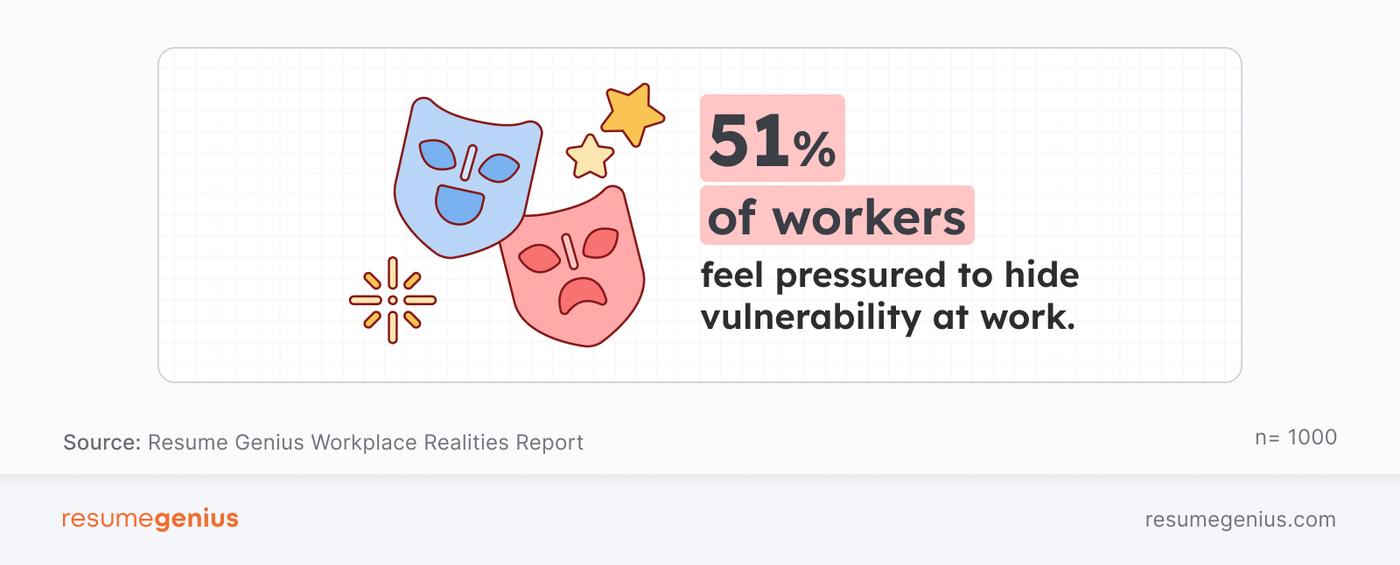
- Avoid showing weaknesses at work to protect their image (51%)
- Maintain a professional persona that’s different from their real personality (49%)
- Do public-facing work (e.g., presenting, posting, speaking) just to seem visible or impressive (40%)
- Exaggerate how busy or in-demand they are (32%)
- Hide gaps or failures on their resume (30%)
- Exaggerate accomplishments on LinkedIn and/or their resume (25%)
Gen Z feels the most pressure to put on a “paycheck personality”
This pressure hits younger workers hardest, especially Gen Z, who are more likely to feel they need to “perform professionalism” to be taken seriously.
Here are other notable findings broken down by generation:
- 60% of Gen Z feel pressure to maintain a professional persona that’s different from their real personality (vs. 55% of Millennials, 36% of Gen X, and 21% of Boomers)
- 58% of Gen Z feel pressure to avoid showing their weaknesses at work (vs. 56% of Millennials, 42% of Gen X, and 40% of Boomers)
- 52% of Gen Z feel pressure to exaggerate accomplishments (vs. 32% of Millennials, 15% of Gen X, and 4% of Boomers)
- 50% of Gen Z feel pressured to do public-facing work just to seem visible (vs. 47% of Millennials, 30% of Gen X, and 21% of Boomers)
- 36% of Gen Z feel pressure to hide resume gaps or failures (vs. 35% of Millennials, 23% of Gen X, and 8% of Boomers)
People-pleasing and self-doubt are shaping workplace culture
A lot of workplace stress isn’t about the work itself: it’s about managing relationships while trying to perform well.
Many workers say they hold back feedback, second-guess themselves, and avoid setting boundaries because they don’t want to be seen as difficult or unreliable.
Here’s how respondents related to the following statements about their current workplace experience:
- 58% say they often prioritize others’ needs, even if it affects their workload or well-being
- 52% struggle to delegate because they want things done a certain way
- 46% avoid giving critical feedback to avoid upsetting others
- 42% worry that saying no or setting boundaries will change how people see them
- 38% hesitate to speak up due to fear of judgement
- 36% feel less competent than others think they are
- 36% spend a lot of time second-guessing or redoing their work
- 27% prioritize being liked at work over doing their job efficiently
Men were slightly more likely to describe that people-pleasing dynamic, including higher rates of prioritizing others’ needs even when it affects workload (61% of men vs. 56% of women) and prioritizing being liked over efficiency (31% of men vs. 24% of women).
Gen Z workers report the most imposter-syndrome and pressure
Across generations, the same themes show up: people hold back, second-guess themselves, and avoid friction.
But younger workers report those pressures more intensely, especially around confidence issues and how they’ll be perceived.
Gen Z’s workplace stress often looks like “imposter syndrome” in practice. They’re the most likely to say they hesitate, self-edit, and worry that setting boundaries could backfire socially, while Boomers are consistently the least likely to relate to those feelings.
- Worrying boundaries will change perceptions: Gen Z (54%) vs. Millennials (46%), Gen X (40%), and Boomers (31%)
- Avoiding critical feedback to avoid upsetting others: Gen Z (51%) vs. Millennials (49%), Gen X (50%), and Boomers (33%)
- Hesitating to speak up due to fear of judgement: Gen Z (47%) vs. Millennials (45%), Gen X (38%), and Boomers (23%)
- Second-guessing or redoing work: Gen Z (47%) vs. Millennials (42%), Gen X (39%), and Boomers (13%)
- Feeling less competent than others think: Gen Z (46%) vs. Millennials (41%), Gen X (35%), and Boomers (19%)
- Prioritizing being liked over efficiency: Gen Z (38%) vs. Millennials (33%), Gen X (27%), and Boomers (10%)
Who really gets awarded at work
Work is often framed as a meritocracy, but many employees say the reality is more complicated.
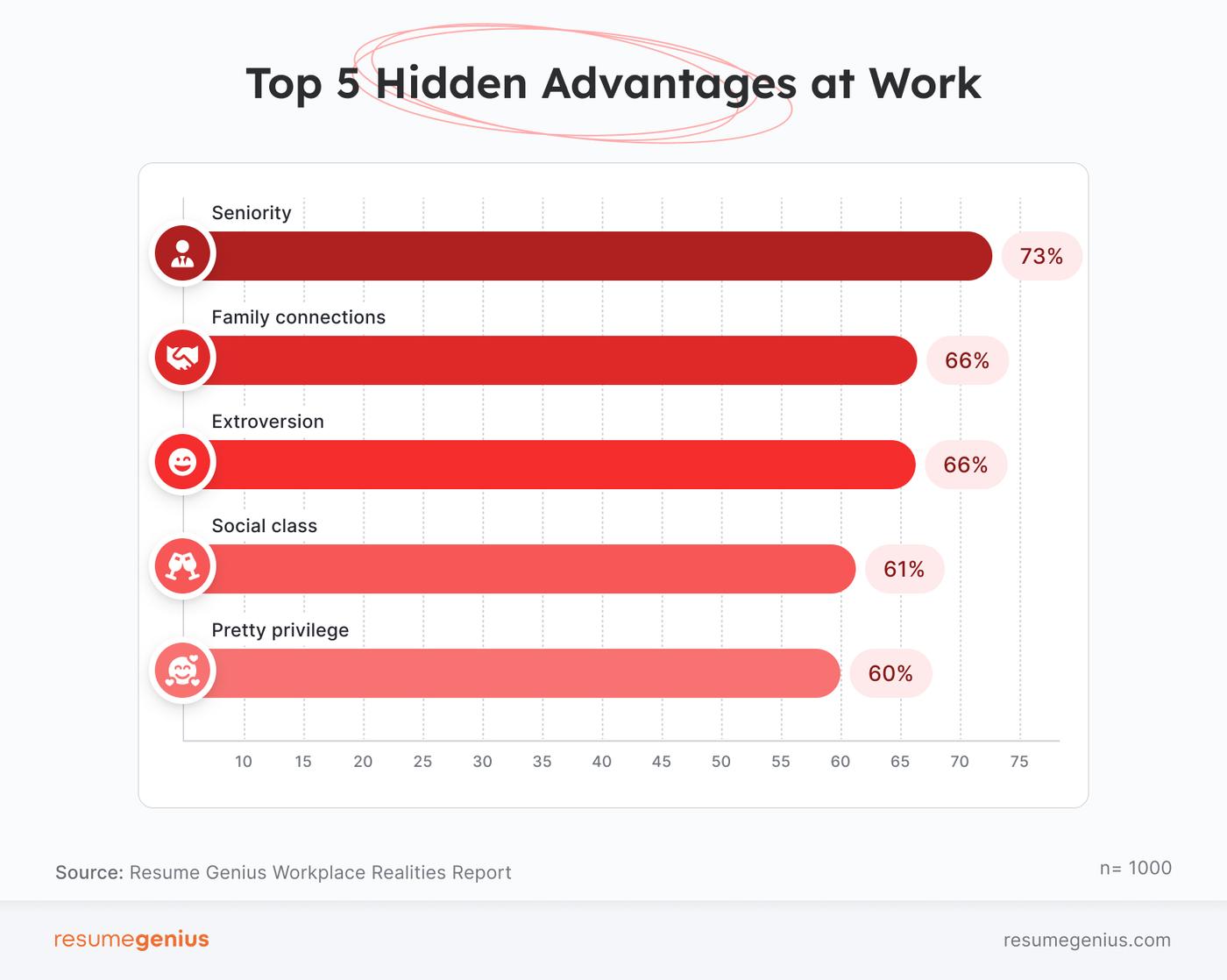
In our survey, many workers reported that success isn’t driven by skill alone. Instead, they believe workplace outcomes are shaped by factors like seniority, family connections, and an “extrovert advantage.” These perceptions have caused frustration, especially among younger generations, who already feel pressure to prove themselves.
When asked which factors give others an unfair advantage at work, workers said the following apply “sometimes,” “often,” or “always”:
- Seniority (years in the industry vs. actual skill) (73%)
- Family connections (66%)
- Being more extroverted (66%)
- Social background/class (61%)
- Physical appearance (“pretty privilege”) (60%)
- Being younger (55%)
- Gender (54%)
- Being older (53%)
Taken together, these findings suggest workplace success is still heavily influenced by factors beyond your skillset — and that perception can matter as much as qualifications.
Unfair advantages hit younger workers hardest
Younger workers were more likely to say these “unfair advantage” factors show up at work, especially seniority and personality.
In other words, the groups with the least tenure are the most likely to feel the playing field isn’t level.
Below are our top findings of the factors each generation thinks give an unfair advantage at work:
- Seniority: Gen Z (76%), Millennials (78%), Gen X (69%), Boomers (56%)
- Being more extroverted: Gen Z (72%), Millennials (70%), Gen X (60%), Boomers (58%)
- Being older: Gen Z (61%), Millennials (58%), Gen X (45%), Boomers (40%)
- Physical appearance (“pretty privilege“): Gen Z (65%), Millennials (66%), Gen X (52%), Boomers (54%)
For women, “getting ahead” still feels gendered
When asked whether gender gives some people an unfair advantage at work, the gap between men and women was clear:
- 61% of women say gender can give some people an unfair advantage at work, compared with 47% of men
- Women are also more likely to point to an “extrovert advantage” (68% of women vs. 64% of men)
- On “pretty privilege,” results were nearly identical (60% of women vs. 61% of men reporting it as an unfair advantage)
Mistakes are getting weaponized
Most workers say they’ll own up when they mess up, but the story changes when the failure is big enough to threaten how they’re perceived.
While the vast majority say they’d admit a mistake to their boss, 22% also say they might try to shift blame if an important project went sideways.
When asked how they handle failures at work, employees reported the following:
- 90% would admit to their boss if they made a mistake at work
- 71% would consider leaving if they consistently struggled to meet expectations
- 69% share mistakes and failures openly with coworkers
- 22% would try to shift the blame if they failed at an important project
That impulse is heavily generational:
- Deflecting blame: Gen Z (32%) are most likely to shift the blame if they failed at an important project, compared with 28% of Millennials, 11% of Gen X, and 2% of Boomers
- Not admitting mistakes to a boss: Gen Z (11%) and Millennials (11%) are most likely to say they wouldn’t admit a mistake to their boss (vs. 7% of Gen X and 4% of Boomers)
The “yes, but” reality of boundaries
To understand how workers draw boundaries in practice, we asked full-time employees two things: what they’d do when work spills beyond their role or hours, and which situations make them feel guilty for pushing back.
The results point to a workplace where many people are willing to help, but still feel pressure to say yes, especially when the request comes from a manager.
Here’s what workers say they would do or feel, depending on the situation:
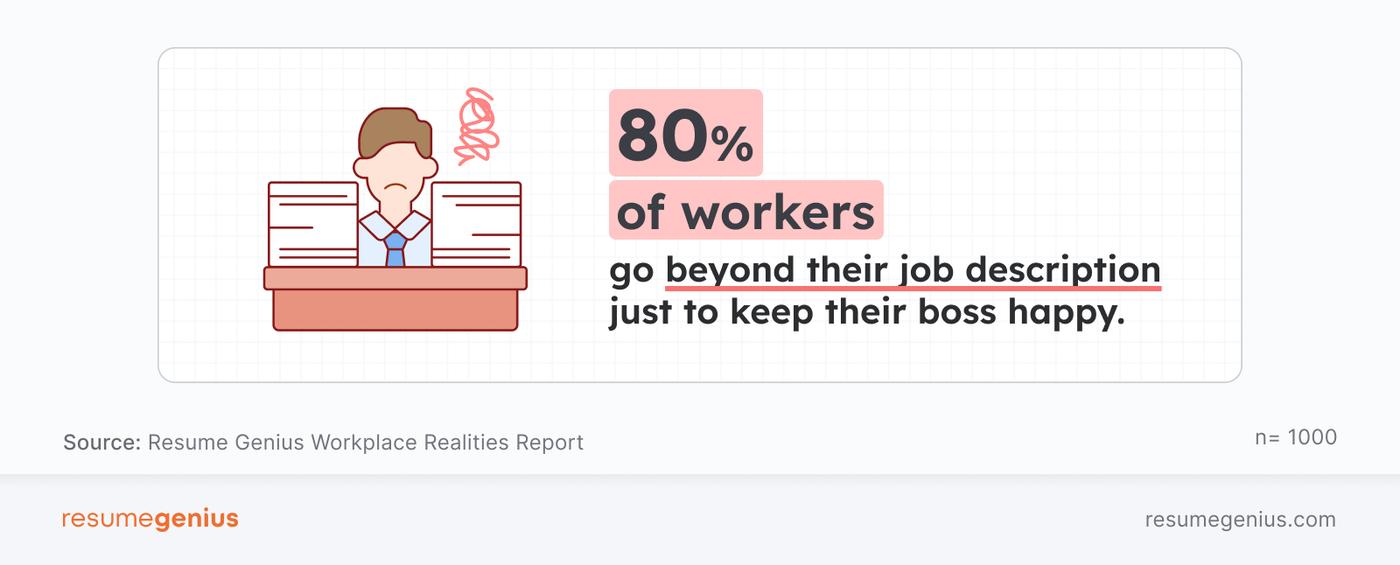
- 80% take on tasks outside their job description if their boss asked
- 58% refuse work outside their job description if it wasn’t compensated
- 53% feel guilty saying no to their manager’s requests
- 41% feel guilty taking sick days
- 38% feel guilty if they didn’t check work messages after hours
Gen Z draws the hardest lines, but they’re also the most guilt-prone
Gen Z is the most likely to push back on unpaid extra work and limit overtime. At the same time, they’re also the generation most likely to report guilt around everyday self-advocacy, like asking for help or taking sick time.
In other words, they’re trying to protect boundaries, but don’t always feel comfortable enforcing them.
Here are the key findings by generation:
- Refusing uncompensated extra work: 70% of Gen Z would refuse tasks outside their job description if it wasn’t compensated (vs. 57% of Millennials, 53% of Gen X, and 50% of Boomers)
- Saying no if a boss asks: 27% of Gen Z wouldn’t take on tasks outside their job description even if their boss asked (vs. 20% of Millennials, 18% of Gen X, and 19% of Boomers)
- Guilt about taking time off: 46% of Millennials and 44% of Gen Z feel guilty taking time off work (vs. 34% Gen X and 27% Boomers)
- Guilt about asking for help: 57% of Gen Z would feel guilty bothering coworkers or managers for help (vs. 50% of Millennials, 34% of Gen X, and 35% of Boomers)
- Guilt about sick days: 47% of Gen Z would feel guilty taking sick days (vs. 45% of Millennials, 35% of Gen X, and 27% of Boomers)
Promotion expectations aren’t aligned
We asked full-time workers how they’re most likely to approach a promotion.
While most would speak up if they felt they’d earned it, a sizable group expects promotions to come without asking. A smaller share say they’d respond by negotiating harder or looking elsewhere.
Here’s how workers say they’d react if they believed they deserved a promotion:
- 39% would ask for a promotion
- 28% wouldn’t ask because they’d expect to be approached if they deserve it
- 14% would ask for a higher raise than the promotion offered
- 14% would start looking for another job if they didn’t get the promotion they deserved
- 6% would quit if they didn’t get the promotion they believed they deserved
Gender differences show up in comfort with self-advocacy. Women are more likely to ask outright (41% of women vs. 36% of men), while men are more likely to wait to be approached (31% of men vs. 25% of women).
Gen Z workers want the promotion but aren’t asking for it
Gen Z is the least likely to ask for a promotion directly, but they’re the most likely to expect recognition without asking, and the most likely to walk away if they don’t get it.
- Only 33% of Gen Z say they’d ask for a promotion if they believed they deserved it (vs. 35% of Millennials, 44% of Gen X, and 56% of Boomers)
- Meanwhile, Gen Z (32%) is the most likely to say they wouldn’t ask for a promotion because they’d expect to be approached (vs. 28% of Millennials, 26% of Gen X, and 25% of Boomers)
- And if they still don’t get the promotion they believe they deserve, Gen Z (10%) is the most likely to say they’d quit (vs. 7% of Millennials, 3% of Gen X, and 0% of Boomers)
Taken together, these findings suggest Gen Z may benefit from having clearer promotion conversations earlier, so expectations don’t go unspoken.
Coworkers matter, but trust is limited
Most people say they like their colleagues and expect some workplace friendships to last, but they’re also keeping their guard up, choosing carefully what they share and who they share it with.
- 81% say they’re careful not to overshare with coworkers
- 78% say they’d still be friends with one (or more) coworkers after leaving the job
- 75% genuinely like their coworkers and spend (or would spend) time with them outside of work
- 63% keep in touch with coworkers who’ve quit
- 57% aren’t comfortable discussing salary with coworkers
- 43% say coworkers are their main motivation for staying at their company
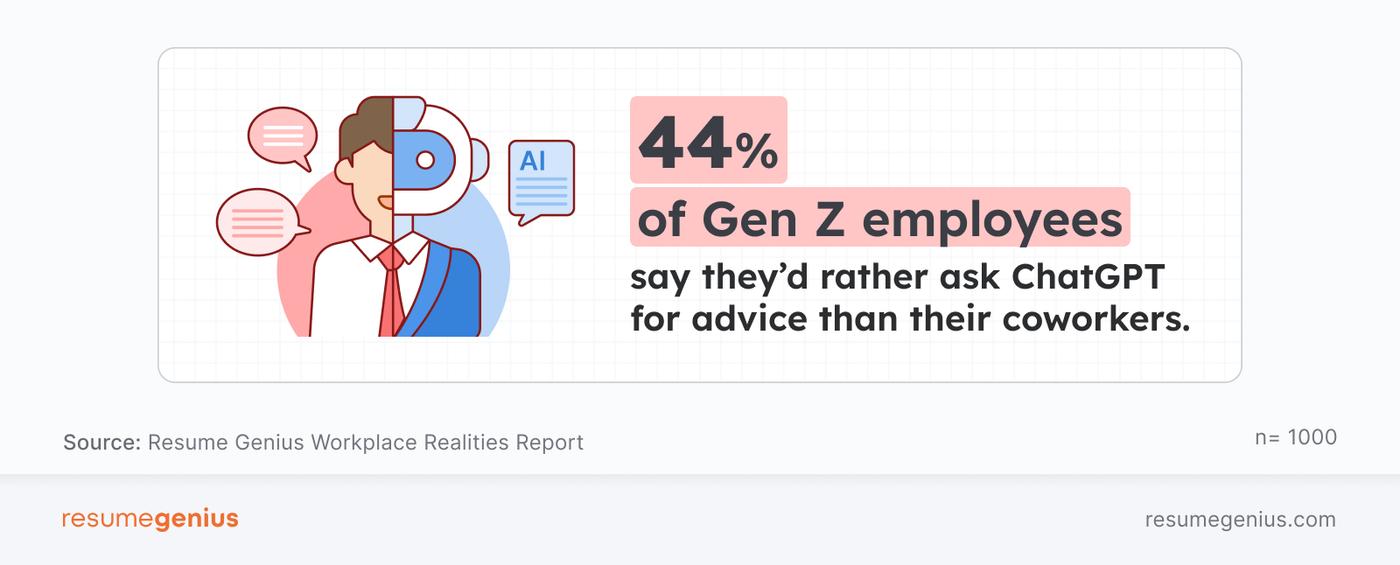
- 32% would rather ask ChatGPT for advice than ask their coworkers
Gen Z would rather ask ChatGPT for advice than their coworkers
Gen Z stands out in two ways that don’t typically go together: They’re the most likely to say coworkers are what keeps them at their job, yet they’re also the most likely to turn to ChatGPT instead of a coworker when they need help.
Overall, the data suggests many workplaces are friendly, but not always psychologically safe. Meanwhile, older workers are more likely to keep things to themselves at work. And when it comes to sensitive topics, that caution shows up clearly: comfort discussing salary drops with age, and it’s also much lower among women (36%) than men 51%).
Here are some other notable findings broken down by generation:
- Gen Z is most likely to ask ChatGPT for advice: Gen Z (44%), Millennials (35%), Gen X (25%), Boomers (21%)
- Gen Z is most likely to say coworkers keep them at their company: Gen Z (53%), Millennials (47%), Gen X (35%), Boomers (33%)
- Older workers are most likely to avoid oversharing: Gen Z (77%), Millennials (78%), Gen X (85%), and Boomers (85%)
- Comfort discussing salary drops steadily with age: Gen Z (55%), Millennials (48%), Gen X (34%), Boomers (25%)
- And that gap shows up by gender too. 51% of men feel comfortable discussing salary with coworkers, compared with 36% of women.
Work stress is turning into venting, scrolling, and sick days
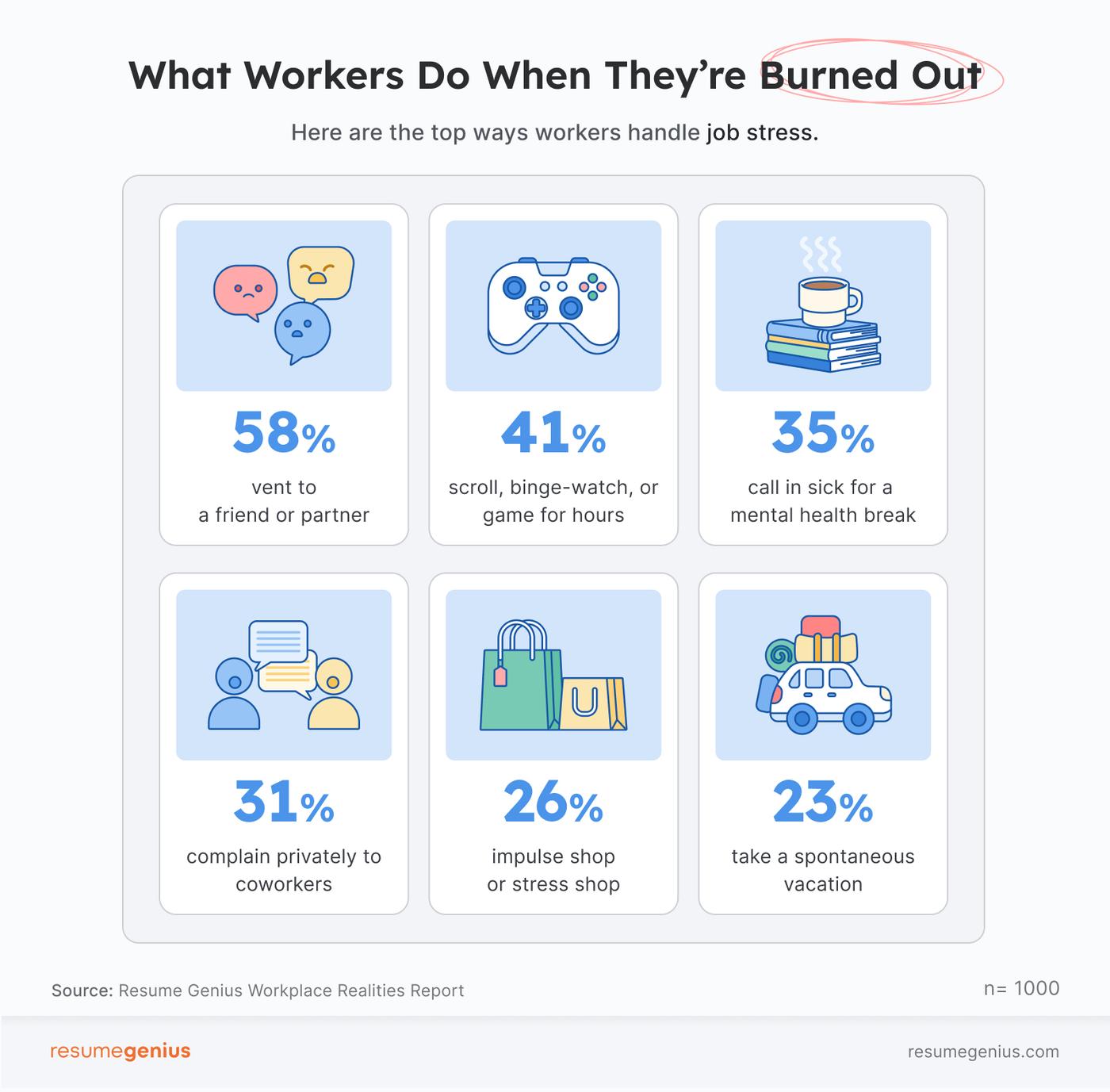
When asked how they cope with work-related stress or anxiety, here’s what workers say they’ve done:
- Vented to a friend or partner (58%)
- Spent hours scrolling, binge-watching, or gaming (41%)
- Called in sick for a mental health break (35%)
- Complained privately to co-workers (31%)
- Made impulsive purchases or stress-shopped (26%)
- Taken a spontaneous vacation (23%)
- Focused on a side hustle to feel more in control (23%)
- Used alcohol or other substances to cope with stress (21%)
- Gone to therapy (20%)
Younger workers are more likely to cope through screens, therapy, and time away from work
The data shows clear generational patterns in how workers manage stress. Gen Z is most likely to retreat into screens and take mental health days, Millennials are most likely to talk it out, and Boomers are most likely to say they don’t use any of these coping strategies.
Here are the top findings broken down by generation:
- Millennials are most likely to vent
- “Vented to a friend or coworker”: Gen Z (51%), Millennials (61%), Gen X (58%), Boomers (61%)
- Screen-based to coping is highest among younger workers
- “Spent hours scrolling, binge-watching, or gaming”: Gen Z (49%), Millennials (45%), Gen X (34%), Boomers (23%)
- Mental health sick days are most common among Gen Z and Millennials
- “Called in sick to take a mental health break”: Gen Z (37%), Millennials (37%), Gen X (33%), Boomers (19%)
- Side hustles skew younger
- “Focused on a side hustle to feel more in control”: Gen Z (27%), Millennials (26%), Gen X (17%), Boomers (17%)
- Therapy use drops with age
- “Gone to therapy”: Gen Z (23%), Millennials (24%), Gen X (15%), Boomers (13%)
- Substance coping is more common among younger workers
- “Used alcohol or other substances to cope with stress”: Gen Z (23%), Millennials (25%), Gen X (17%), Boomers (15%)
Work-related stress hits men and women differently
Work stress doesn’t hit everyone the same way. In our survey, men and women reported coping in noticeably different directions. Both groups commonly vent or zone out online, but support-seeking options diverge beyond that.
Women were more likely to report stress-shopping (31%), while men were more likely to report alcohol use as a coping tool (25%).
Therapy also shows a clear gap: 23% of women say they’ve gone to therapy to cope with work stress, compared with 17% of men.
Here’s what women and men say they’ve done to cope with work-related stress or anxiety:
- Vented to a friend or partner (64% of women vs. 52% of men)
- Spent hours scrolling, binge-watching, or gaming (44% of women vs. 37% of men)
- Called in sick to take a mental health break (35% of women vs. 33% of men)
- Complained privately to coworkers (34% of women vs. 29% of men)
- Made impulse purchases or stress-shopped (31% of women vs. 22% of men)
- Focused on a side hustle to feel more in control (24% of women vs. 21% of men)
- Taken a spontaneous vacation (24% of women vs. 22% of men)
- Gone to therapy (23% of women vs. 17% of men)
- Used alcohol or other substances to cope with stress (18% of women vs. 25% of men)
Sick days aren’t always about being sick
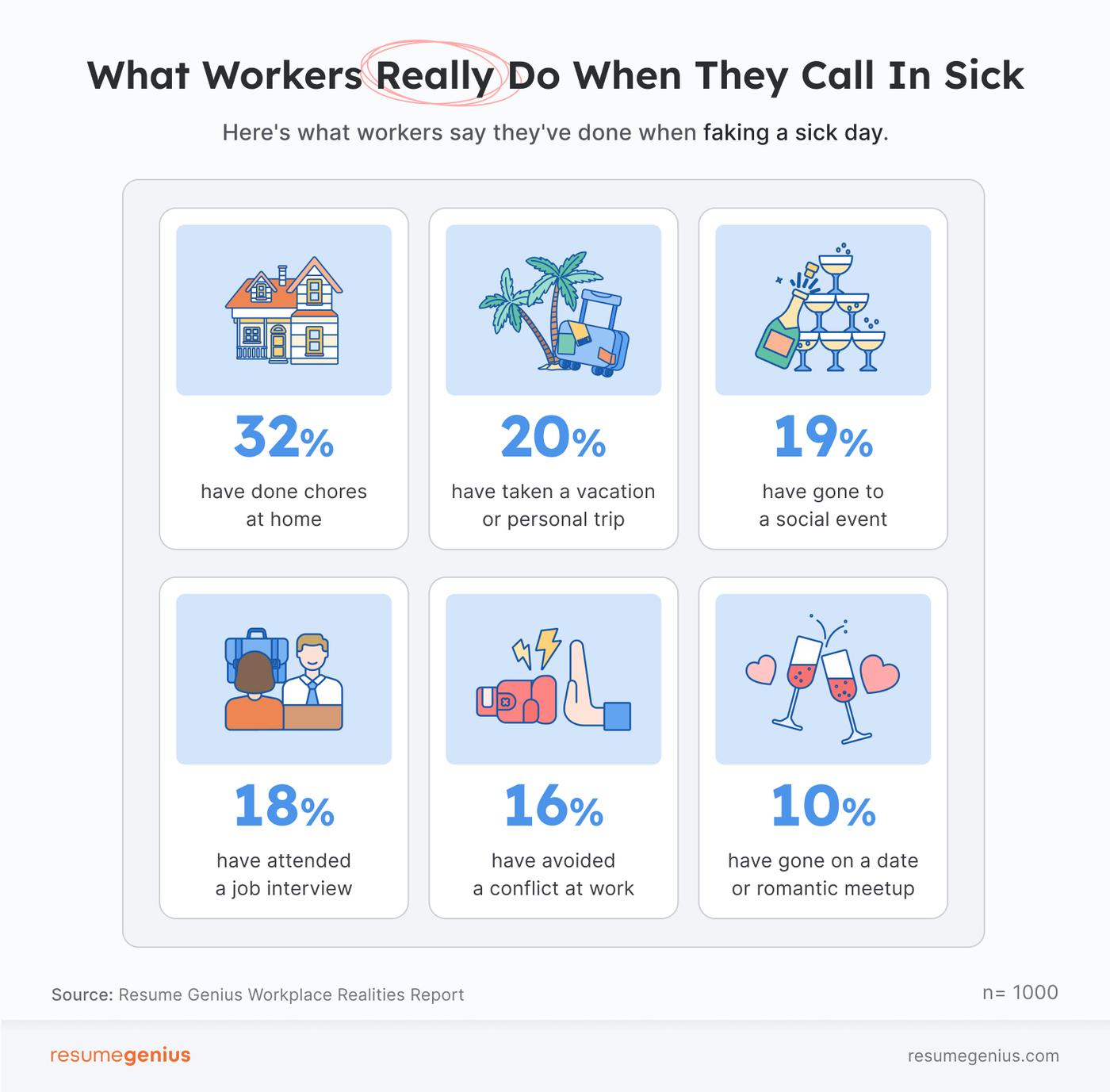
To find out how sick days are actually used, we asked workers whether they’ve ever called in sick for each of the reasons below.
- Only called in sick when actually sick (47%)
- Catch up on errands or responsibilities at home (32%)
- Take a vacation or personal trip (20%)
- Go to a social event (e.g., concert, party, family gathering) (19%)
- Attend a job interview or work another job (18%)
- Avoid a conflict or difficult situation at work (16%)
- Go on a date or have a hookup (10%)
Younger workers are more likely to call in sick for non-sick reasons
The generational split is clear: younger workers report using sick time for social plans and job mobility more often than older workers.
- Called in sick to go to a social event: Gen Z (30%) vs. Millennials (21%), Gen X (14%), and Boomers (6%)
- Called in sick to take a vacation or personal trip: Millennials (24%) vs. Gen Z (21%), Gen X (14%), and Boomers (8%)
- Called in sick to attend a job interview or work another job: Gen Z (21%) and Millennials (21%) vs. Gen X (13%), and Boomers (8%)
- Called in sick to go on a date or have a hookup: Gen Z (14%) vs. Millennials (13%), Gen X (5%), and Boomers (2%)
Career breaks are going mainstream
Career gaps are starting to look less like a red flag and more like a reality of modern work.
When we asked full-time workers how they feel about stepping away from work for rest, caregiving, or personal priorities, responses suggest a shift toward normalizing breaks, including “micro-retirements” between jobs.
At the same time, not everyone sees these moves as risk-free. While over half (53%) disagree that taking a break would hurt long-term career prospects, that still leaves many people who believe it could.
Here’s what full-time workers said when asked whether it’s okay to step away from work for caregiving, personal growth, travel, or rest:
- 93% agree it’s okay to take a break to care for a family member
- 82% agree that it’s okay to take a break for personal growth
- 78% agree that they would take a career break if they could afford it
- 78% agree that it’s okay to take a break to travel
- 73% agree that they would take time off between jobs to rest and avoid burnout (“micro-retirement”)
- 68% agree that they’d be open to returning to a company they previously left if there aren’t enough other options
- 53% disagree that taking a break would hurt career prospects
Gen X is most likely to take a career break
Gen X is most likely to want a true career pause if money weren’t a factor, which reads less about wanderlust and more about burnout prevention. Millennials, meanwhile, are the most likely to frame breaks as something that’s simply okay to do, especially when it comes to travel.
- 80% of Gen X workers would take a career break if they could afford it (vs. 76% of Gen Z, 79% of Millennials, and 65% of Boomers)
- 81% of Millennial workers agree it’s okay to take a break to travel (vs. 76% of Gen Z, 76% of Gen X, and 63% of Boomers)
- 70% of Millennial workers would be open to returning to a company they previously left if job options were limited (vs. 65% of Gen Z, 67% of Gen X, and 54% of Boomers)
Conclusion
Our Workplace Realities Report suggests modern work comes with a second, quieter job: managing perception, navigating unwritten rules, and protecting your reputation while trying to do good work.
Across generations, workers say they feel pressure to “perform” professionalism, cope with stress privately, and avoid conflict, even when something feels unfair. Younger workers report these pressures most intensely, while older workers are more likely to keep their guard up and share less.
For employers, the findings suggest that retention and performance aren’t shaped by benefits alone. Day-to-day culture is what employees feel most. Clear expectations, consistent feedback, and a culture where people feel comfortable asking questions can materially improve the everyday employee experience at work.
Methodology
The Workplace Realities Report was based on a nationwide survey conducted on September 15, 2025, targeting 1,000 full-time U.S. workers. Analysis was conducted between November 20 and December 1, 2025. The study examined employee attitudes toward workplace fairness, stress coping behaviors, coworker dynamics, boundary-setting, and workplace guilt.
Respondents were 18 or older at the time of the survey. The sample was designed to represent a balanced cross-section of U.S. workers across key demographics, including gender, education level, and region.
We analyzed the Pollfish results and the raw data in Google Sheets to produce this report and its findings. Results are reported at a 95% confidence interval with a ±3% margin of error.
To minimize bias, Pollfish uses Random Device Engagement to ensure a fair and organic selection process. For more on Pollfish’s methodology, visit its website or contact eduardo@resumegenius.com.
About Resume Genius
Since 2009, Resume Genius and its resume builder software have been helping people from all backgrounds and experience levels land their next job faster.
Resume Genius also provides a wide range of free career resources, including customizable resume templates, resume examples for different industries, and resume writing guides, to help job seekers find fulfilling work and reach their career goals.
Resume Genius is led by a team of dedicated career advisors and HR experts and has been featured in The New York Times, Harvard Business Review, Fast Company, CNBC, and USA Today.
For media inquiries, please contact us.
About the Author

Eva Chan is a Senior Digital PR Writer and Communications Lead at Resume Genius. Eva oversees the research and data-led campaigns that reveal key trends in today’s workforce and represents the company in media interviews and press features. Her work focuses on guiding job seekers through today’s job market and helping them present their applications and skills with confidence.