


Employee engagement has been sliding. Fewer employees feel engaged at work than they did a few years ago, and that decline is becoming a bigger concern in 2026.
Our Employee Engagement Statistics Report breaks down the most significant factors affecting workplace engagement in 2026, and their impact on productivity and profitability.
1. Use of AI and automation at work
Increased AI use has increased productivity at the cost of employee connectedness and wellbeing.
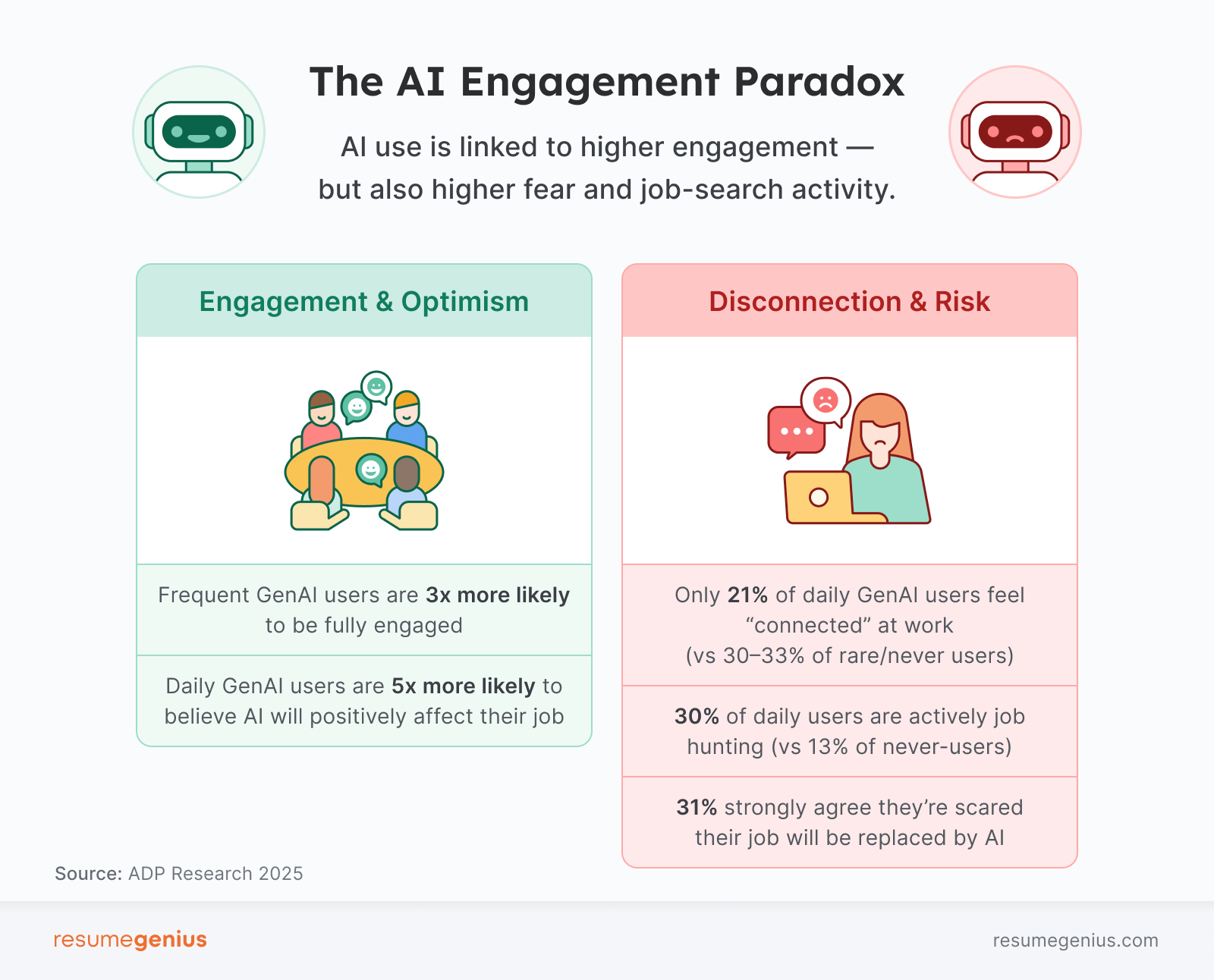
Regular AI users find that work feels faster, clearer, and more achievable, but they are also more likely to feel isolated in their roles and insecure about future job security.
- 43% of U.S. workers say they use generative AI frequently at work; 42% say they use it rarely or not at all (ADP Research, 2025)
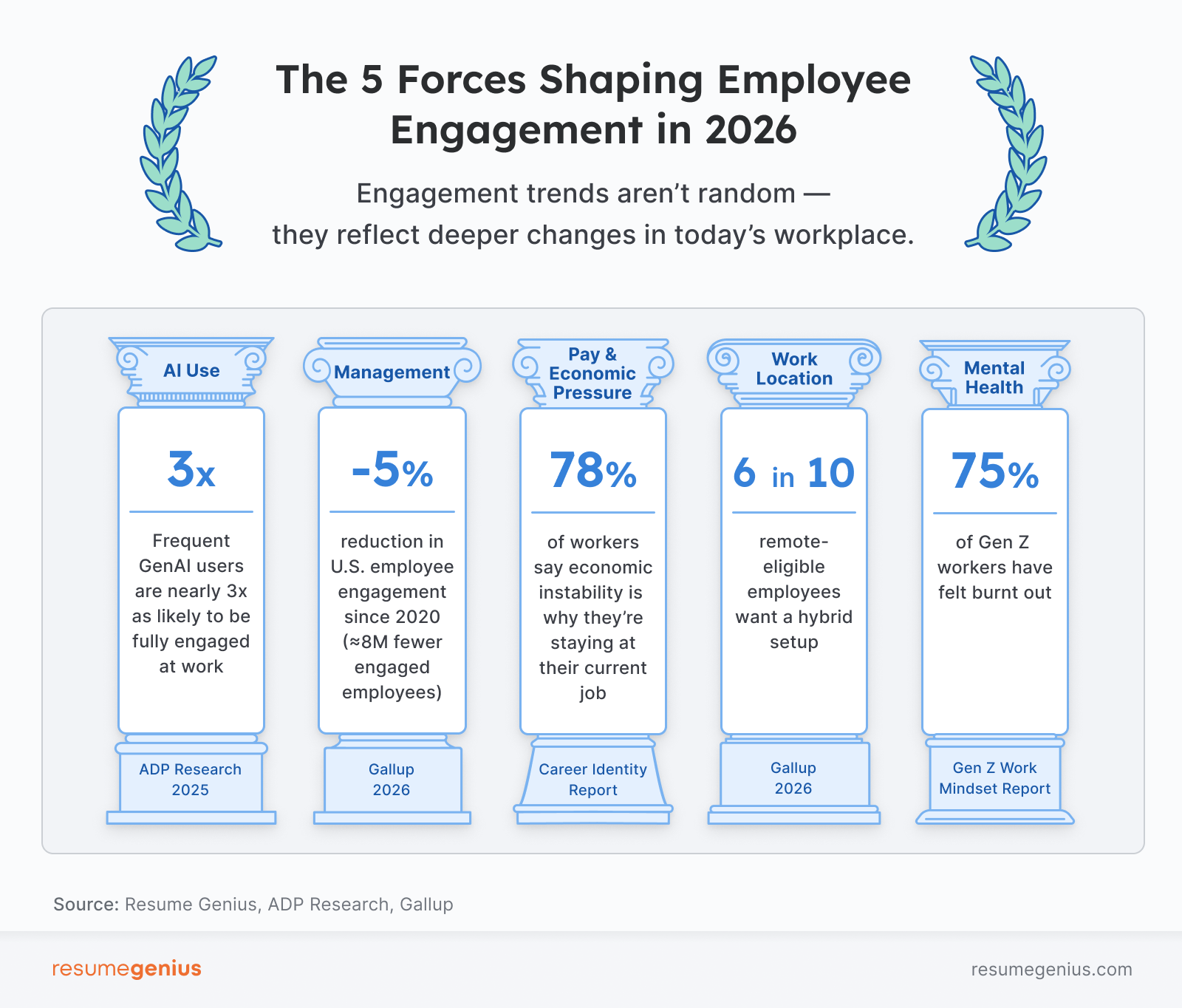
- Frequent AI users are nearly 3x more likely to be fully engaged at work (ADP Research, 2025)
- Daily AI users are 5x more likely to say AI will positively affect their job over the next year (ADP Research, 2025)
- However, only 21% of workers who use AI daily say they feel “connected” at work, compared with 30–33% of workers who use GenAI rarely or never (ADP Research, 2025)
- 30% of daily AI users say they are actively looking or interviewing for a new job, versus 13% of workers who have never tried AI (ADP Research, 2025)
- 31% of daily AI users are scared their job will be replaced by AI (ADP Research, 2025)
- 32% of workers would rather ask ChatGPT for advice than ask their coworkers; this rises to 44% among Gen Z (Resume Genius, 2025)
- 47% of workers in the technology sector say they use AI every day, with only 7% saying they never use it at work (ADP Research, 2025)
2. Manager support and communication
Employees say they are receiving less support from managers, despite being set higher performance expectations. This trend is the most acute among Gen Z employees, the majority of whom feel under-supported.
- The share of employees who “strongly agree” they know what is expected of them at work has dropped 9 points since 2020 (Gallup, 2026)
- Additionally, the share who “strongly agree” someone at work cares about them has dropped 8 points since 2020 (Gallup, 2026)
- The share who “strongly agree” say they have the opportunity to do what they do best every day has dropped 7 points since 2020 (Gallup, 2026)
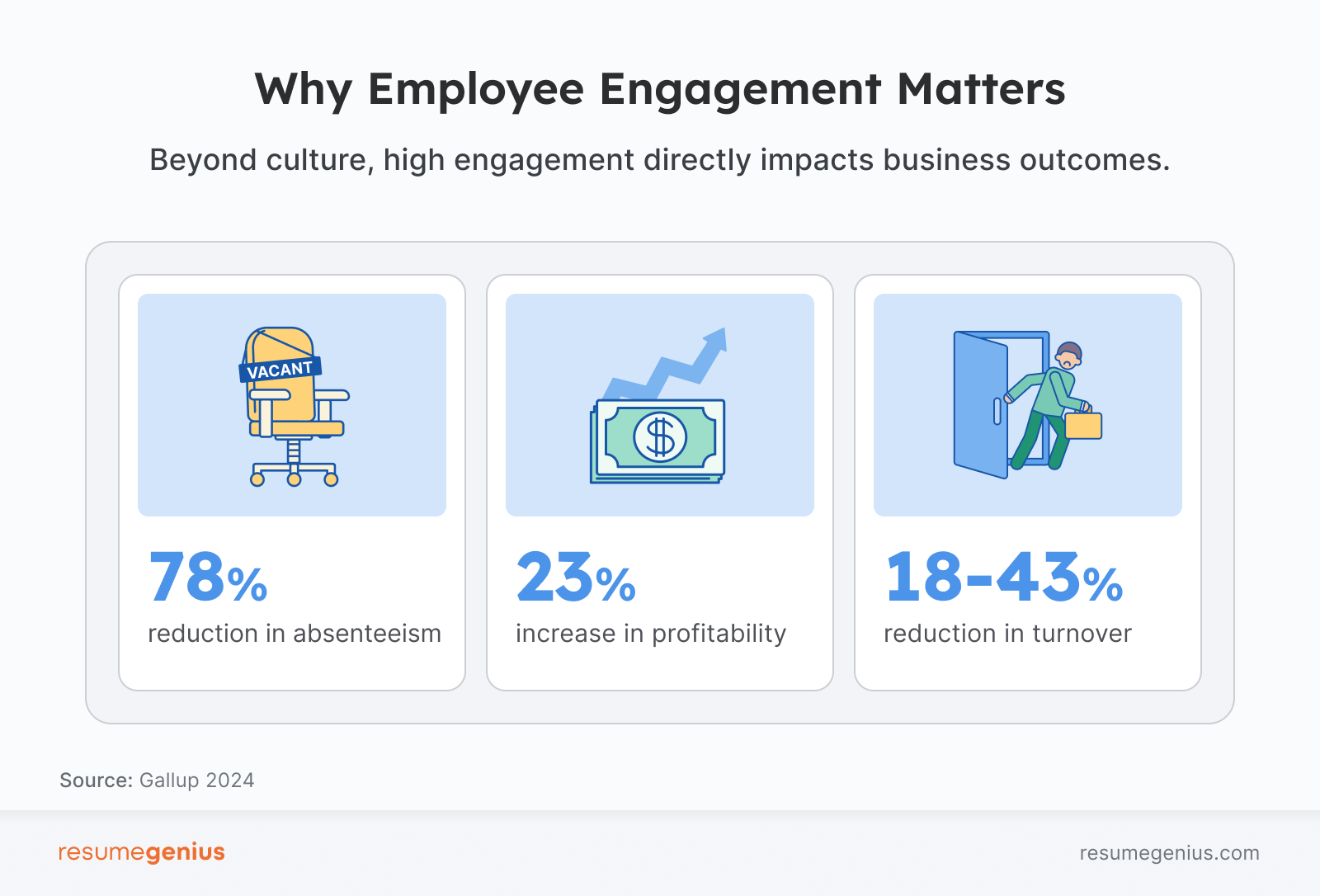
- High-engagement workplaces see 78% lower absenteeism than low-engagement workplaces (Gallup, 2024)
- High-engagement workplaces see 23% higher profitability and meaningfully lower turnover than low-engagement workplaces (Gallup, 2024)
- 62% of Gen Z workers say they face high-performance expectations but don’t receive enough support (Resume Genius, 2025)
- 57% of Gen Z workers say they’re uncertain about their performance due to a lack of feedback from management (Resume Genius, 2025)
3. Pay and financial stress
Despite many employers planning modest salary increases in 2026, average pay gains are expected to remain relatively flat and may not offset high costs, leaving many workers feeling underpaid and financially stretched.
When employees are worried about meeting basic expenses they tend to be more distracted on the job, less optimistic about staying with their employer, and more likely to look for new opportunities.
- 23% of employees say increased pay, benefits, and job security would make them feel cared about at work (Gallup, 2026)
- Among financially stressed employees who feel distracted at work, 56% spend 3+ hours per week during work hours dealing with or thinking about personal finances (PwC, 2023)
- Only 54% of financially stressed employees feel there is a promising future for them at their employer, compared with 69% of employees who aren’t financially stressed (PwC, 2023)
- The average U.S. worker expects an annual raise of 8.6% even without a promotion (Resume Genius, 2026)
- Gen Z expects a 10% annual raise — and 85% say they would leave their current role for higher pay (Resume Genius, 2026)
- 69% of workers say they’re staying at their jobs to build experience and skills for a better role (Resume Genius, 2026)
- 78% of workers say economic instability is the main reason they’re staying at their current job (Resume Genius, 2026)
4. Flexibility and remote work
Flexibility is a top priority for most employees. Most want some say over where and how they work, and they quickly notice when policies are poorly implemented or abruptly reversed. The risk for employers is high turnover and quiet disengagement.
- 25% of U.S. workers with remote-capable jobs choose to work from the office most of the time (Pew Research Center, 2025)
- In remote-capable U.S. jobs, 26% of employees are exclusively remote, 52% are hybrid, and 21% are on-site (Gallup, 2026)
- Six in 10 employees with remote-capable jobs want a hybrid arrangement; about one-third prefer fully remote, and less than 10% prefer on-site (Gallup, 2026)
- Only 11% of employees say their work team sets its hybrid policy together (Gallup, 2026)
- Six in 10 remote-capable employees who work exclusively remotely say they’re “extremely likely” to look for a new job if remote flexibility is taken away (Gallup, 2026)
5. Mental health and burnout
As burnout remains elevated, a growing number of U.S. workers report feeling pressure to conceal exhaustion or aspects of their identity to align with workplace norms.
Amid economic uncertainty and heightened performance expectations, employees are compelled to “power through” fatigue or downplay personal differences.
This emotional labor comes at a cost. Workplaces that reward conformity over authenticity risk disengagement and higher turnover — particularly among younger employees.
- 75% of Gen Z workers feel burnt out at least “sometimes,” with 27% feeling it “often” and 14% “always” (Resume Genius, 2025)
- 35% of workers have called in sick specifically to take a mental health break (Resume Genius, 2025)
- 51% of workers feel pressured to avoid showing weakness at work to protect their image (Resume Genius, 2025)
- 38% of workers hesitate to speak up due to fear of judgment (Resume Genius, 2025)
- 60% of Gen Z workers feel pressure to maintain a “paycheck personality” (Resume Genius, 2025)
- 71% of Gen Z and 59% of Millennials report “unhealthy” working environments, compared to 52% of Gen X and 42% of Baby Boomers (Mental Health America, 2024)
Methodology
Data in this report was compiled from a combination of publicly available research and original survey data from Resume Genius. External statistics were sourced from studies by Gallup, ADP Research, Pew Research Center, PwC, and Mental Health America. Resume Genius survey findings referenced in this report come from studies conducted between 2025 and 2026 among U.S. workers on workplace engagement, burnout, and career expectations.
Sources
- ADP Research (2025), AI Isn’t Just Changing Work. It Might Be Changing Workers
- Gallup (2026), Employee Engagement Declines From 2020 Peak
- Gallup (2024), Hybrid Work Statistics
- Gallup (2024), Returning to the Office
- Gallup (2024), State of the Global Workplace 2024 Key Insights
- Mental Health America (2024), Mind the Workplace Report
- Pew Research Center (2025), Working From Home Continues to be Popular
- PwC (2023), Employee Financial Wellness Survey
- ResumeGenius (2026), Career Identity Report
- ResumeGenius (2025), Gen Z Work Mindset Report
- ResumeGenius (2025), Workplace Realities Report
About Resume Genius
Since 2009, Resume Genius and its resume builder software have been helping people from all backgrounds and experience levels land their next jobs faster.
Resume Genius also provides a wide range of free career resources, including customizable resume templates, resume examples for different industries, and resume writing guides, to help job seekers find fulfilling work and reach their career goals.
Resume Genius is led by a team of dedicated career advisors and HR experts and has been featured in The New York Times, Harvard Business Review, Fast Company, CNBC, and USA Today.
For media inquiries, please contact us.
About the Author

Jack Hulatt graduated from the University of Greenwich with a bachelor’s degree in Politics and International Relations before pursuing certifications in computer science and data analytics. In his short career, he has already worked on multiple entrepreneurial projects and as part of a larger team, giving him direct insight into the needs and wants of young job seekers today.