



Gen Z isn’t following the same career blueprint as the generations before them. Where past generations may have focused on climbing the corporate ladder or earning prestigious degrees, today’s young workers are taking a different approach.
In our 2025 Gen Z Career Prospects Report, we surveyed 1,000 full-time U.S. Gen Z employees to explore how they define a good career and what they think about education, work, and the future.
- 1 in 5 Gen Z workers (19%) say their degree didn’t contribute to their career
- 1 in 4 Gen Z workers (23%) say they regret going to college
- 6 in 10 Gen Z workers (58%) have a side hustle alongside their full-time job, with 22% citing the need for extra income as their primary reason.
- If they could go back and do things differently:
- 22% of Gen Z workers would choose a different degree associated with opportunities in higher-paying fields (e.g., tech, finance, engineering, healthcare)
- 13% would learn a skilled trade or pursue a career that doesn’t require a degree
- 12% would get a creative or passion-driven degree
- 11% would choose the same or a similar degree but from a cheaper or less prestigious institution
- 10% would focus on entrepreneurship or self-employment
- 9 in 10 Gen Z workers (91%) say work-life balance is “important” or “very important” to their career success
STEM degrees pay off most for Gen Z workers
While most young professionals in our survey have pursued higher education, there’s a growing sense that not all degrees deliver the same value, and some fields fare much better than others.
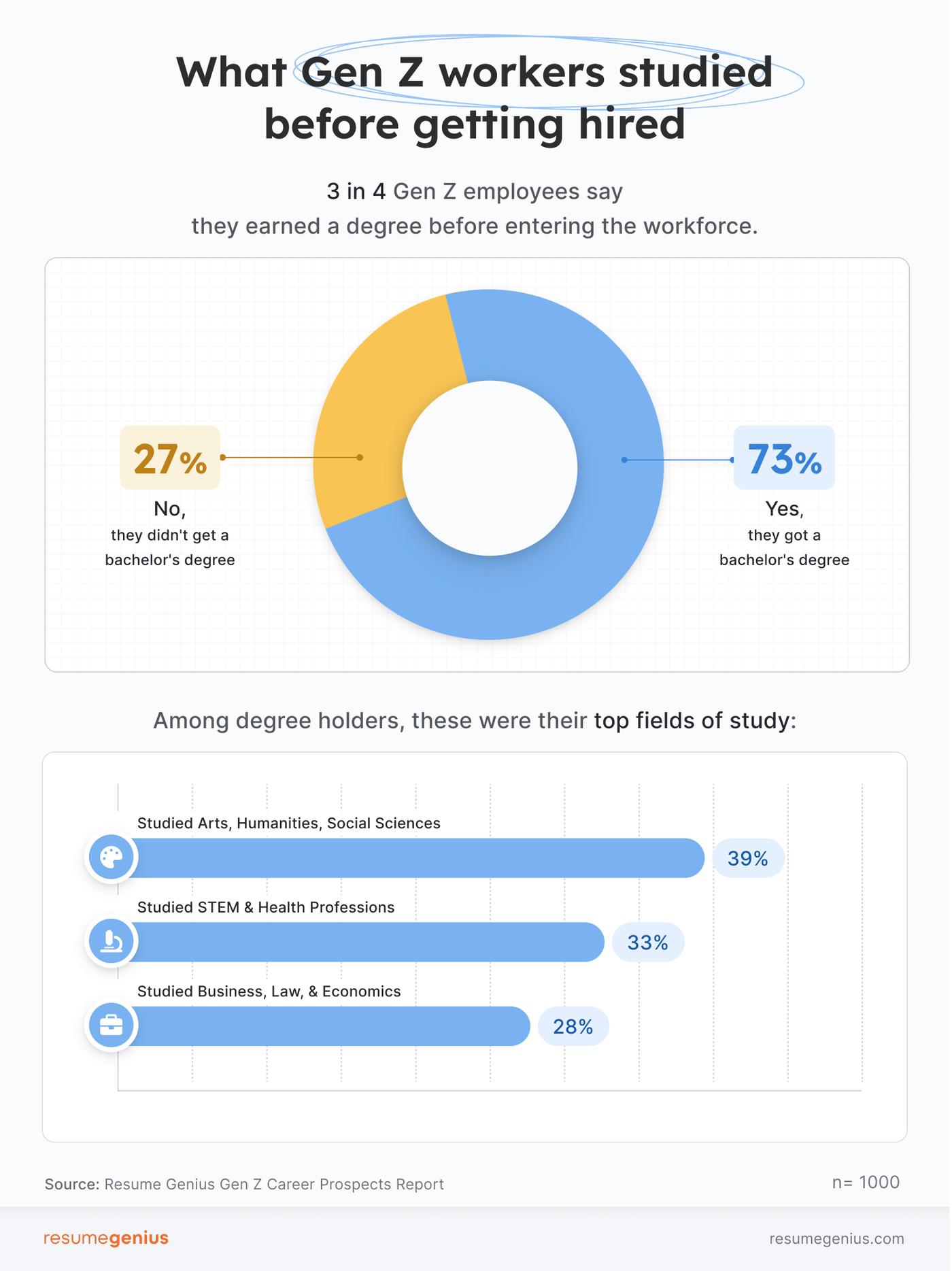
When asked whether getting a degree contributed to their career, surveyed Gen Z workers first shared whether they pursued higher education at all: 73% say they got a degree, while 27% say they haven’t.
Among those with a degree:
- 39% studied arts, humanities, or social sciences
- 33% studied STEM or health professions
- 28% studied business, law, or economics
Overall, 81% of surveyed Gen Z workers with a degree say it contributed to their career. Here’s the full breakdown:
- 60% say it directly helped them advance in their career
- 21% say it helped, but they work in a different field now
- 19% say their degree didn’t contribute to their career at all
Interestingly, that also means nearly 1 in 5 Gen Z workers feel their education hasn’t paid off.
The type of degree appears to make a big difference. The results show STEM grads benefit most from their degrees, while arts and humanities grads report the least direct impact. Here’s how Gen Z workers from different fields of study responded:
Gen Z workers who studied STEM or health professions:
- 87% say their degree contributed to their career
- 73% say their degree directly helped them advance
- 14% say their degree helped, but they now work in a different field
Gen Z workers who studied business, law, or economics:
- 83% say their degree contributed to their career
- 59% say their degree directly helped them advance
- 24% say their degree helped, but they now work in a different field
Gen Z workers who studied arts, humanities, or social sciences:
- 77% say their degree contributed to their career
- 51% say their degree directly helped them advance
- 26% say their degree helped, but they now work in a different field
The report also found that Gen Z men and women often choose different fields of study — a choice that shapes where they end up working.
- 43% of women studied arts, humanities, or social sciences, compared to 33% of men
- 32% of women studied business, law, or economics, compared to 36% of men
- 25% of women studied STEM or health, compared to 21% of men
1 in 4 Gen Z workers regret going to college
For many Gen Z workers, higher education hasn’t delivered the value they hoped for.
When asked what they’d choose if they could redo their studies, nearly 1 in 4 Gen Z workers (23%) said they regret going to college altogether — a signal that traditional higher education hasn’t lived up to its promise for a significant share of this generation.
If given a do-over, here’s how this younger generation says they’d approach their education:
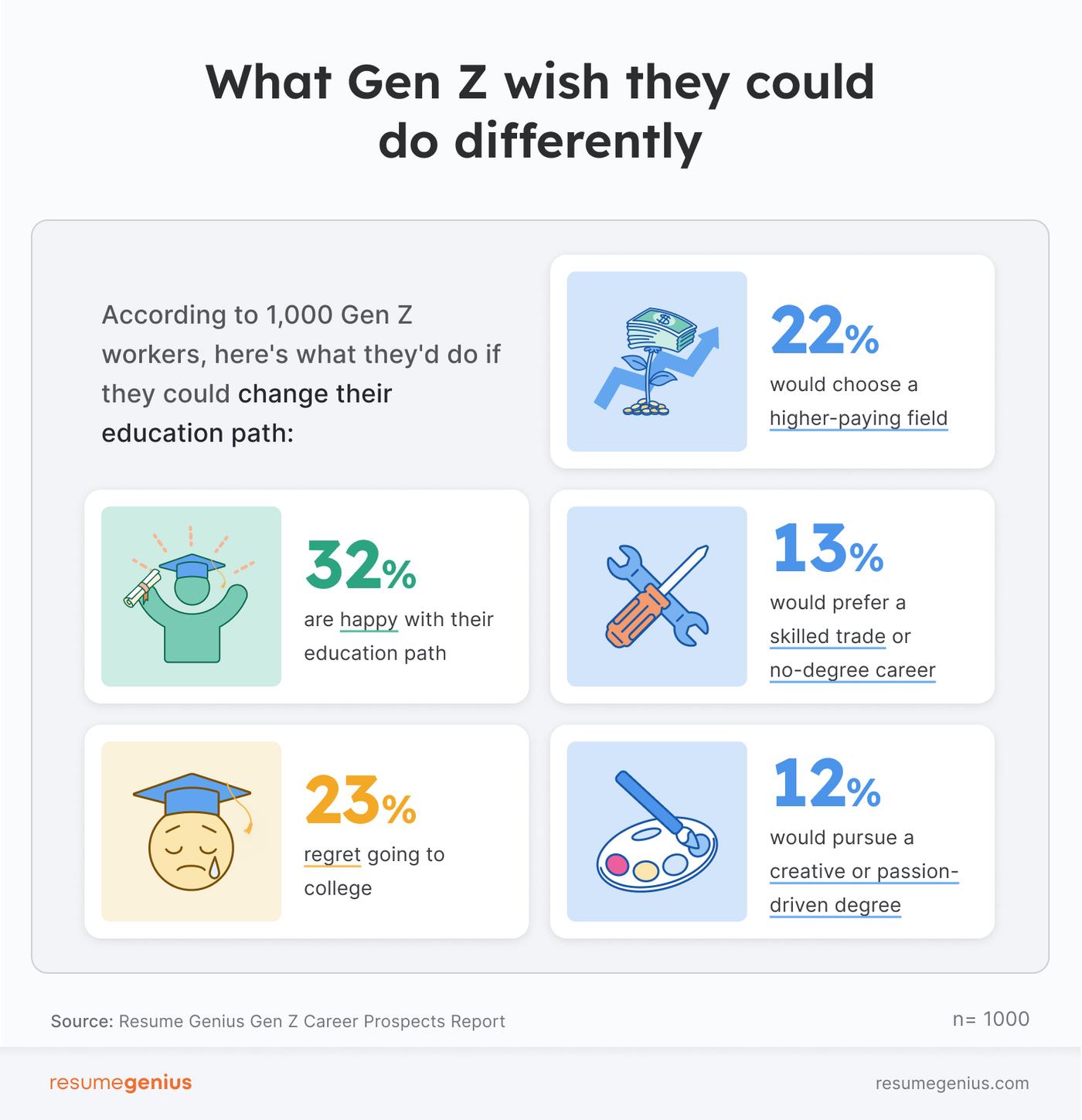
- 32% say they’re content with their education path and wouldn’t change it
- 22% would choose a degree associated with opportunities in higher-paying fields (e.g., tech, finance, engineering, healthcare)
- 13% would learn a skilled trade or pursue a career that doesn’t require a degree
- 12% would get a creative or passion-driven degree
- 11% would choose the same or a similar degree but from a cheaper or less prestigious institution
- 10% would focus on entrepreneurship or self-employment
Gen Z men have more education regrets than women
While regret about college is common among Gen Z workers, men and women differ in what they wish they’d done instead.
- 28% of Gen Z men say they regret going to college, compared to 19% of women
- 14% of men say they’d learn a skilled trade or pursue a career that doesn’t require a degree, compared to 12% of women
- 14% of men say they’d focus on entrepreneurship or self-employment, compared to 8% of women
- 32% of women say they’re content with their education path, compared to 26% of men
Higher degrees bring higher satisfaction for Gen Z workers
When we asked Gen Z workers what they would choose if they could redo their studies, their responses revealed that while higher education brings greater satisfaction, many still question whether the price is worth it.
The percentages below show the share of Gen Z workers at each education level who say they’re content with their study path:
- Master’s degree or higher: 44%
- Bachelor’s degree: 40%
- Associate’s degree: 26%
- Some college (no degree): 25%
- High school diploma: 21%
This finding suggests that the higher the degree Gen Z workers have, the higher the satisfaction.
However, cost regret remains a common concern, even among those with advanced degrees.
Here’s the breakdown for Gen Z employees who say they wish they’d chosen a more affordable, less prestigious institution:
- Master’s degree or higher: 18%
- Bachelor’s degree: 10%
- Some college (no degree): 7%
- Associate’s degree: 6%
6 in 10 Gen Z workers have a side hustle
For many Gen Z workers, one job simply isn’t enough. Whether it’s for extra income, creative expression, or future plans, side hustles have become a major part of Gen Z’s career strategy.
Our report set out to understand how common side hustles are among Gen Z and why so many young professionals take them on.
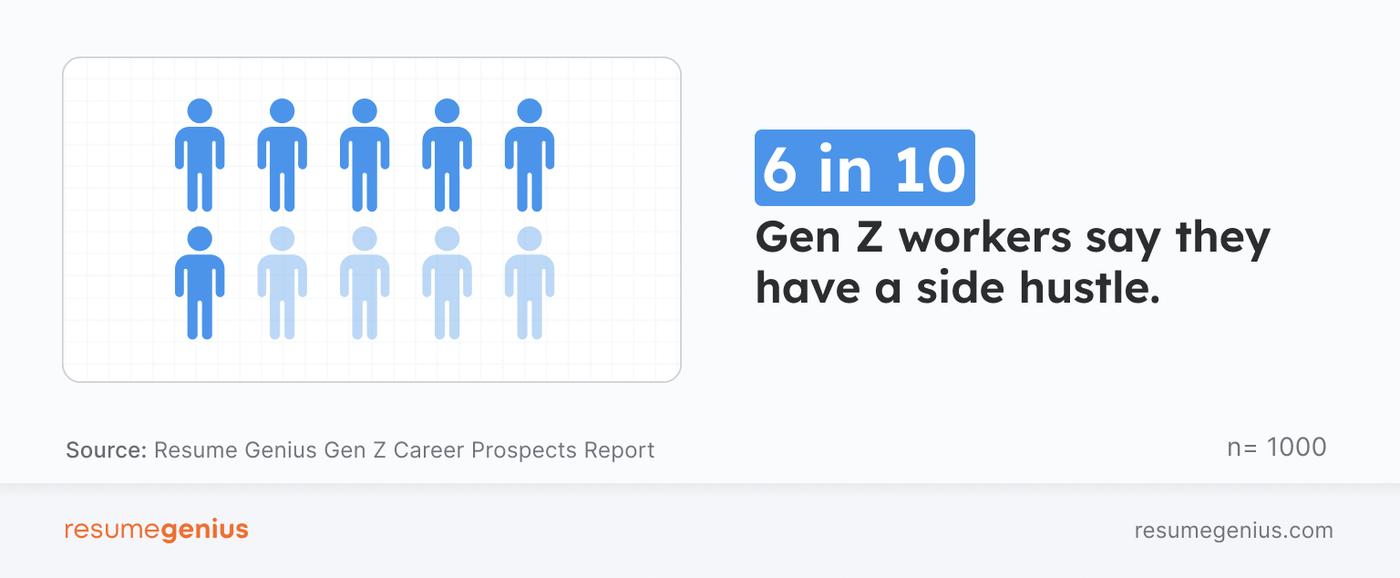
58% of Gen Z workers say they have a side hustle alongside their full-time job, and another 25% are considering starting one. That leaves only 17% who don’t have a side hustle and have no plans to start one.
When asked why they take on side hustles, Gen Z workers cited a mix of practical and personal reasons:
- 22% say they need the additional income because of rising costs
- 18% say it’s a passion or hobby
- 7% want to gain new skills or experiences to help their career
- 6% are working toward starting their own business
- 5% say it’s a form of financial security against job loss
Gen Z men are turning side hustles into career moves
When looking at gender differences in side hustles, our report found that Gen Z men are more likely than women to already have a side hustle, but women show stronger interest in starting one soon.
The reasons men and women take on side work also revealed some interesting differences:
- 63% of Gen Z men say they currently have a side hustle, compared to 55% of women
- 20% of men are considering starting a side hustle, compared to 27% of women
When it comes to why they have a side hustle:
- 10% of men say they have one to gain new skills or experiences that will benefit their career, compared to 5% of women
- 10% of men say they have one because they’re working toward starting their own business, compared to 3% of women
Younger Gen Z workers are the most likely to hustle
Our data shows that the youngest Gen Z workers are the most likely to take on side hustles. Early in their careers, these workers are eager to boost their income, build skills, or explore new opportunities, and side work is helping them do this.
- 85% of 18–21-year-olds either have a side hustle (69%) or are considering starting one (15%)
- 84% of 22–25-year-olds either have a side hustle (57%) or are considering starting one (27%)
- 81% of 26–28-year-olds either have a side hustle (56%) or are considering starting one (24%)
Gen Z workers with less formal education are more likely to have side hustles
The likelihood of having a side hustle decreases as Gen Z workers’ level of formal education increases.
Our data shows that side hustles are most common among Gen Z workers with associate degrees or some college experience. Have a look below:
- 89% of Gen Z associate degree holders either have a side hustle (64%) or are considering starting one (25%)
- 85% of Gen Z workers with some college experience either have a side hustle (69%) or are considering starting one (16%)
- 83% of bachelor’s degree holders either have a side hustle (55%) or are considering starting one (28%)
- 80% of those with a master’s degree or higher either have a side hustle (56%) or are considering starting one (24%)
Work-life balance matters more to Gen Z than money
A good life beats good pay for Gen Z workers. Our data found that while salary matters, work-life balance and job security are even higher on this generation’s list of what defines career success.
When asked how they define career success, here’s what Gen Z professionals answered:
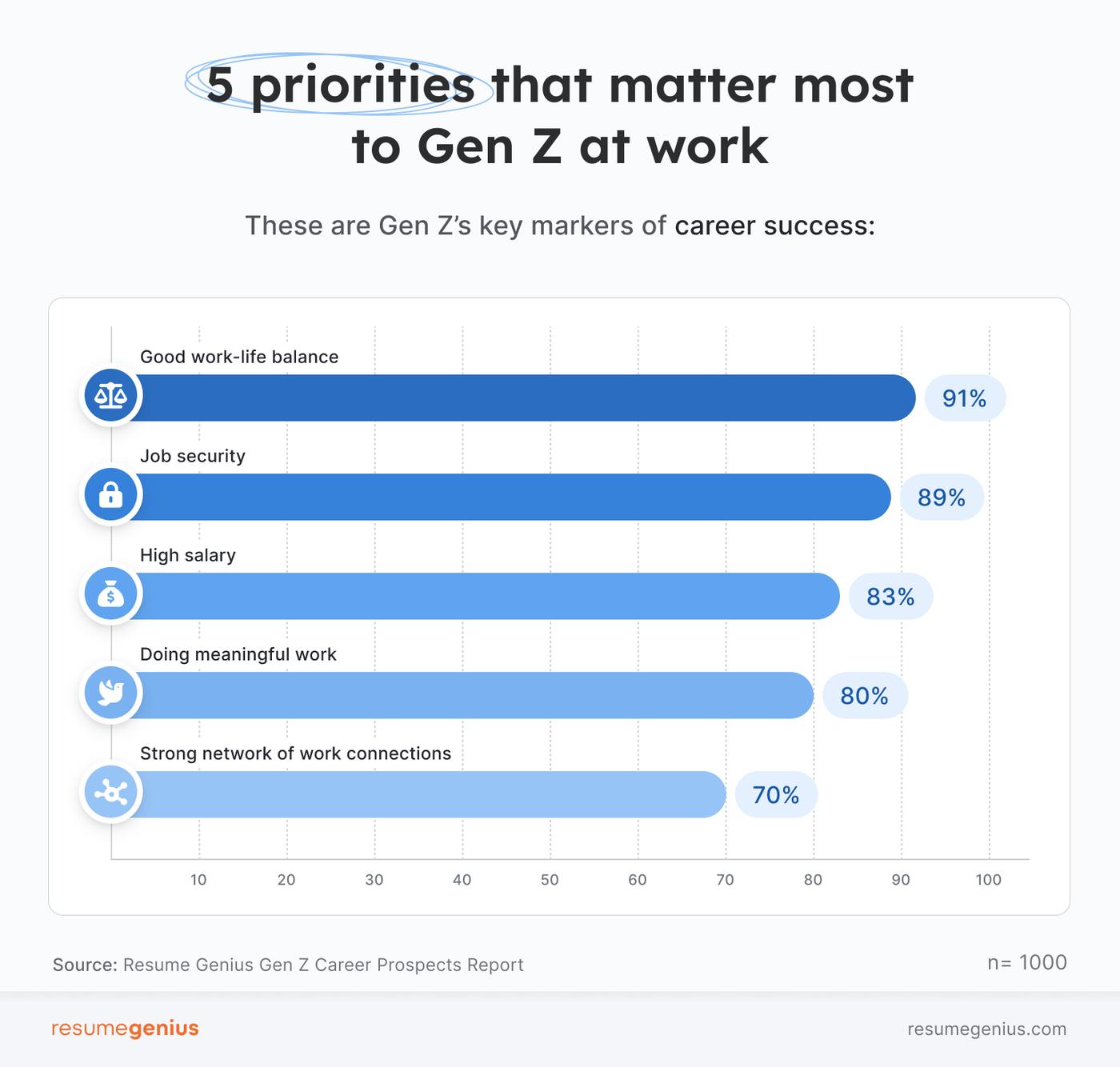
Work-life balance tops the list for Gen Z workers:
- 91% of Gen Z workers say work-life balance is “important” (34%) or “very important” (57%)
- 89% say job security is “important” (38%) or “very important” (51%)
- 83% say a high salary is “important” (40%) or “very important” (43%)
Doing meaningful or fulfilling work is essential to Gen Z:
- 80% say doing meaningful or fulfilling work is “important” (40%) or “very important” (40%)
- 70% say a strong network of work connections is “important” (44%) or “very important” (26%)
- 64% say being able to retire early is “important” (35%) or “very important” (29%)
Fewer surveyed Gen Z workers prioritize titles or prestige:
- 52% say reaching a leadership position is “important” (31%) or “very important” (21%)
- 37% say working for a prestigious company is “important” (24%) or ‘very important” (13%)
Conclusion
The 2025 Gen Z Career Prospects Report shows that today’s young workers are rethinking what it means to build a satisfying career. Many no longer see a degree as a guaranteed path to success, with nearly 1 in 5 Gen Z employees saying their education hasn’t contributed to their career, and 1 in 4 saying they regret going to college.
Side hustles have become a key part of Gen Z’s approach to work. Most take on extra jobs to boost their income, explore personal interests, or build skills for future opportunities. When it comes to defining career success, work-life balance, job security, and fair pay matter most, well ahead of leadership titles or company prestige.
Gen Z’s values are pushing the workplace in a new direction, so employers who want to keep up will need to rethink their offerings.
Methodology
The Gen Z Career Prospects Report came from a Pollfish survey launched between April 24 and May 10, 2025, targeting a sample of 1,000 participants. The analysis was conducted from May 14 to 22, 2025. The study aimed to understand full-time U.S.-based Gen Z workers’ attitudes and opinions toward their education and career paths.
Qualifying respondents were required to be born between 1997 and 2012. The survey ensured a balanced representation across various demographics, including gender and age groups, to accurately reflect the diversity of the U.S. workforce.
The data was analyzed using both the results provided by Pollfish and the outputted raw data in Google Sheets via programs created with Python Pandas.
To minimize bias, Pollfish uses Random Device Engagement (RDE) to ensure a fair and organic selection process. For further details on Pollfish’s methodology, please visit their website or contact eduardo@resumegenius.com.
About Resume Genius
Since 2009, Resume Genius and its resume builder software have been helping people from all backgrounds and experience levels land their next job faster.
Resume Genius also provides a wide range of free career resources, including customizable resume templates, resume examples for different industries, and resume writing guides, to help job seekers find fulfilling work and reach their career goals.
Resume Genius is led by a team of dedicated career advisors and HR experts and has been featured in The New York Times, Harvard Business Review, Fast Company, CNBC, and USA Today.
For media inquiries, please contact us.
About the Author

Eva Chan is a Senior Digital PR Writer and Communications Lead at Resume Genius. Eva oversees the research and data-led campaigns that reveal key trends in today’s workforce and represents the company in media interviews and press features. Her work focuses on guiding job seekers through today’s job market and helping them present their applications and skills with confidence.