



How much does the average American paycheck really stretch in 2025?
Resume Genius surveyed 1,000 full-time employees to understand how their earnings translate into everyday living costs, savings habits, and additional income streams.
Our 2025 Modern Paycheck Report reveals how professionals across the U.S. spend and supplement their income, and what they believe it truly takes to live comfortably in today’s economy.
- Half of workers (50%) spend 30% or more of their salary on housing
- 12% put over half their paycheck toward rent or mortgage costs
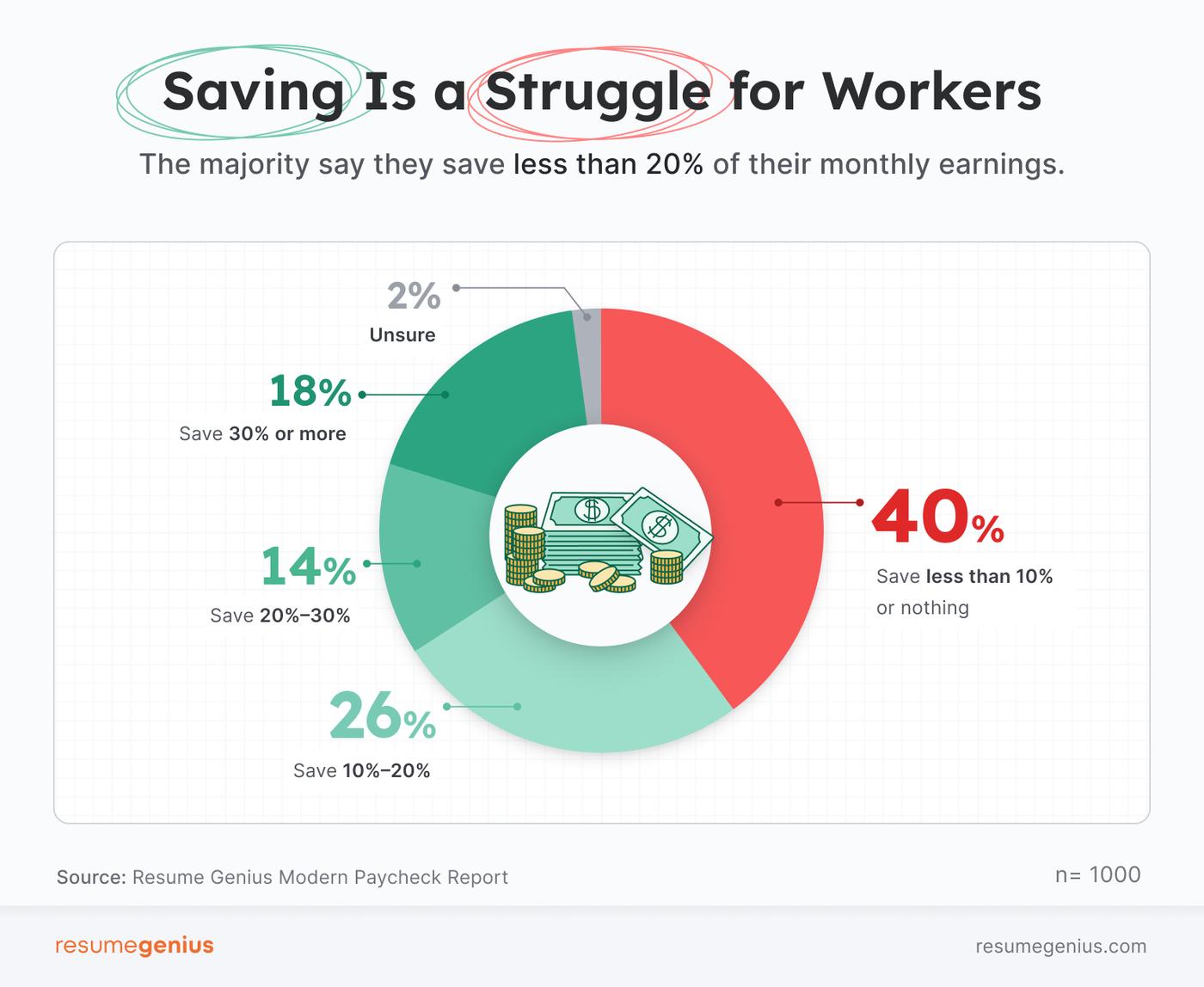
- 65% save less than 20% of their monthly income
- 15% report they can’t save a single dollar from their paycheck
- Gen Z leads in savings — nearly half (45%) save at least 20% of their income
- 63% of Millennials report living paycheck to paycheck
- Over half (53%) of full-time workers say they earn money outside their primary job
- 15% of Gen Z say they create adult content on subscription-based platforms, compared to 10% of Millennials, 3% of Gen X, and 0% of Boomers
- 1 in 3 workers (33%) believe it takes a six-figure salary to live comfortably in 2025
- Workers in the Western U.S. feel the pinch the most — nearly half say they need $100,000 or more to get by
Housing costs are eating up paychecks
Rising housing costs are taking a major bite out of worker incomes, with half of full-time employees saying their payments exceed the traditional affordability benchmark of 30% for mortgage and rent.
Nearly half of workers spend a third of their income on housing costs
Half of workers (50%) report spending 30% or more of their salary on housing — the upper limit of what’s considered financially sustainable.
Below is a breakdown of how much workers spend on monthly rent or mortgage payments:
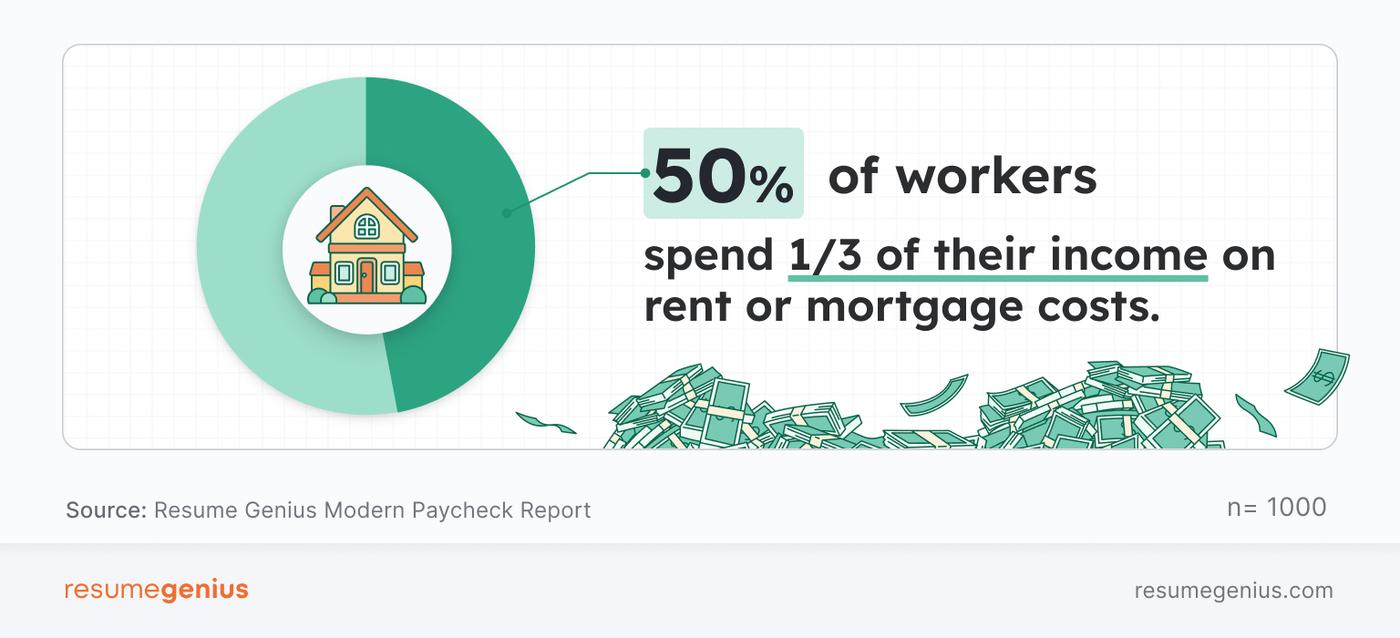
- 24% of workers spend 20–30% of their salary on housing
- 23% spend 30–40%
- 15% spend 40–50%
- 12% spend more than half of their paycheck on housing
- 13% spend 10–20%
- 10% don’t pay rent or a mortgage
- 4% spend less than 10%
Millennials face the steepest housing costs
Older generations are more likely to have paid off their homes, but younger workers — especially Millennials — are still navigating steep housing costs.
Millennials are the most housing-cost burdened generation:
- 80% of Millennials spend 20% or more of their salary on rent or mortgage
- That figure compares to 72% of Gen Z, 67% of Gen X, and 67% of Boomers.
How (and if) workers are saving money
Despite increasing financial literacy, most American workers are still struggling to save meaningfully. The majority set aside only a small portion of their paycheck each month — and many can’t save at all.
66% of workers save less than 20% of their monthly income
Here’s how workers describe their monthly savings habits:
- 26% save 10–20% of their income
- 25% save less than 10%
- 15% say they’re unable to save any of their income
- 14% save 20–30%
- 8% save 30–40%
- 5% save 40–50%
- 5% save more than half of their income
- 2% are unsure how much they save
Gen Z workers save a larger share of their income than any other generation
Despite being early in their careers, Gen Z workers stand out for their disciplined saving habits. Their financial habits suggest a stronger focus on building stability, even as living costs continue to rise.
Here’s a breakdown of each generation’s savings habits:
- 45% of Gen Z workers save more than 20% of their monthly income — the highest of any generation
- By comparison, only 36% of Millennials, 25% of Gen X, and 27% of Boomers save at that level
- Half of Gen Z (52%) save 10–40% of their income, similar to 46% of Boomers, but higher than 42% of Millennials and 36% of Gen X
Time in the workforce isn’t translating to bigger savings
After decades in the workforce, you’d expect Boomers to save more — but they’re not. Rising expenses and the lingering effects of inflation may be leaving little room to set money aside, even for those nearing retirement.
- 1 in 3 Boomers (33%) save 10–20% of their income — only slightly higher than 27% of Gen X and 27% of Millennials, and notably higher than 20% of Gen Z
- Nearly 1 in 5 Gen X workers (18%) say they’re unable to save anything, the highest rate of any generation
- By comparison, 13% of Millennials, 12% of Gen Z, and 17% of Boomers also say they can’t save at all
Financial stress and low savings is the new normal
Even with full-time jobs, most American workers in 2025 report feeling financially strained. Rising costs, lingering debt, and uncertainty about the future have made financial stress an everyday reality.
Retirement feels out of reach for most workers
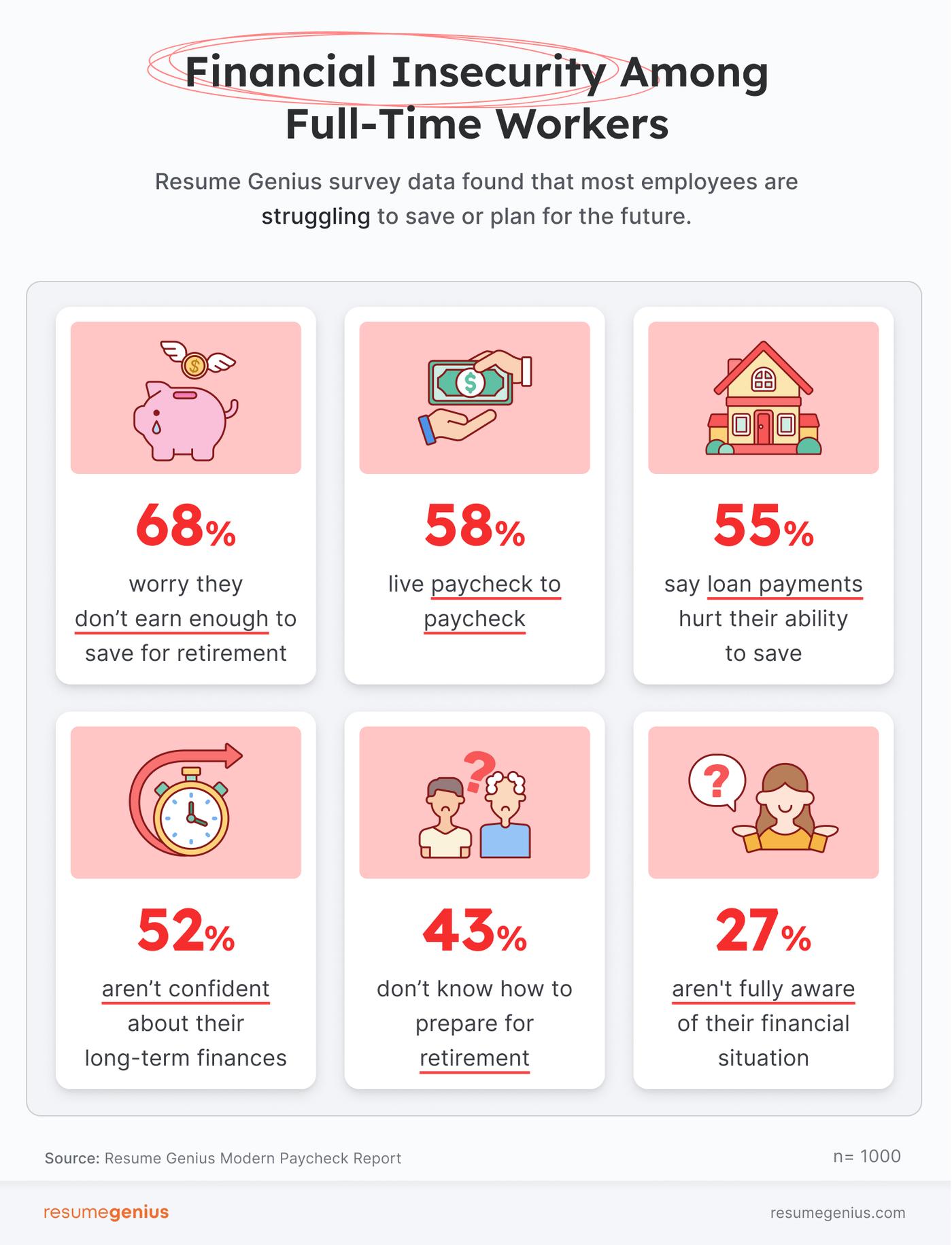
When we asked 1,000 full-time U.S. workers how they feel about their financial situation, the results revealed widespread anxiety:
- 68% worry they don’t earn enough to save for retirement
- 58% live paycheck to paycheck
- 55% say loan payments hurt their ability to save
- 52% don’t feel financially secure about their future
- 43% admit they don’t know how to prepare for retirement
- 27% say they’re not fully aware of their financial situation
63% of Millennials are living paycheck to paycheck
Caught between student loans, rising housing costs, and family expenses, Millennials are the generation reporting being the most stretched thin.
- 63% of Millennials say they live paycheck to paycheck, compared to 60% of Gen Z, 54% of Gen X, and 38% of Boomers
- 57% say they don’t feel financially secure about their long-term future — slightly higher than Gen X (54%) and notably higher than Gen Z (43%) and Boomers (41%)
- Nearly half (45%) admit they have no idea how to prepare for retirement, compared to 41% of Gen Z, 34% of Gen X, and 21% of Boomers
- 61% say loan payments hurt their ability to save, versus 52% of Gen Z, 50% of Gen X, and 44% of Boomers
- 1 in 3 Millennials (33%) say they’re not confident in their understanding of their own finances — a higher rate than Gen Z (29%), Gen X (21%), or Boomers (23%)
These numbers reveal that despite being in their prime earning years, many Millennials still struggle to get ahead financially.
The side hustle is here to stay
The modern paycheck rarely comes from just one source and for many, side hustles and investments have become essential to keeping up with rising costs.
Over half of workers make additional income outside of their main job
Side gigs and secondary income streams are now a defining feature of the modern workforce. More than half of full-time workers (53%) say they earn money outside their primary role — through everything from investing and gig work to freelancing and tutoring.
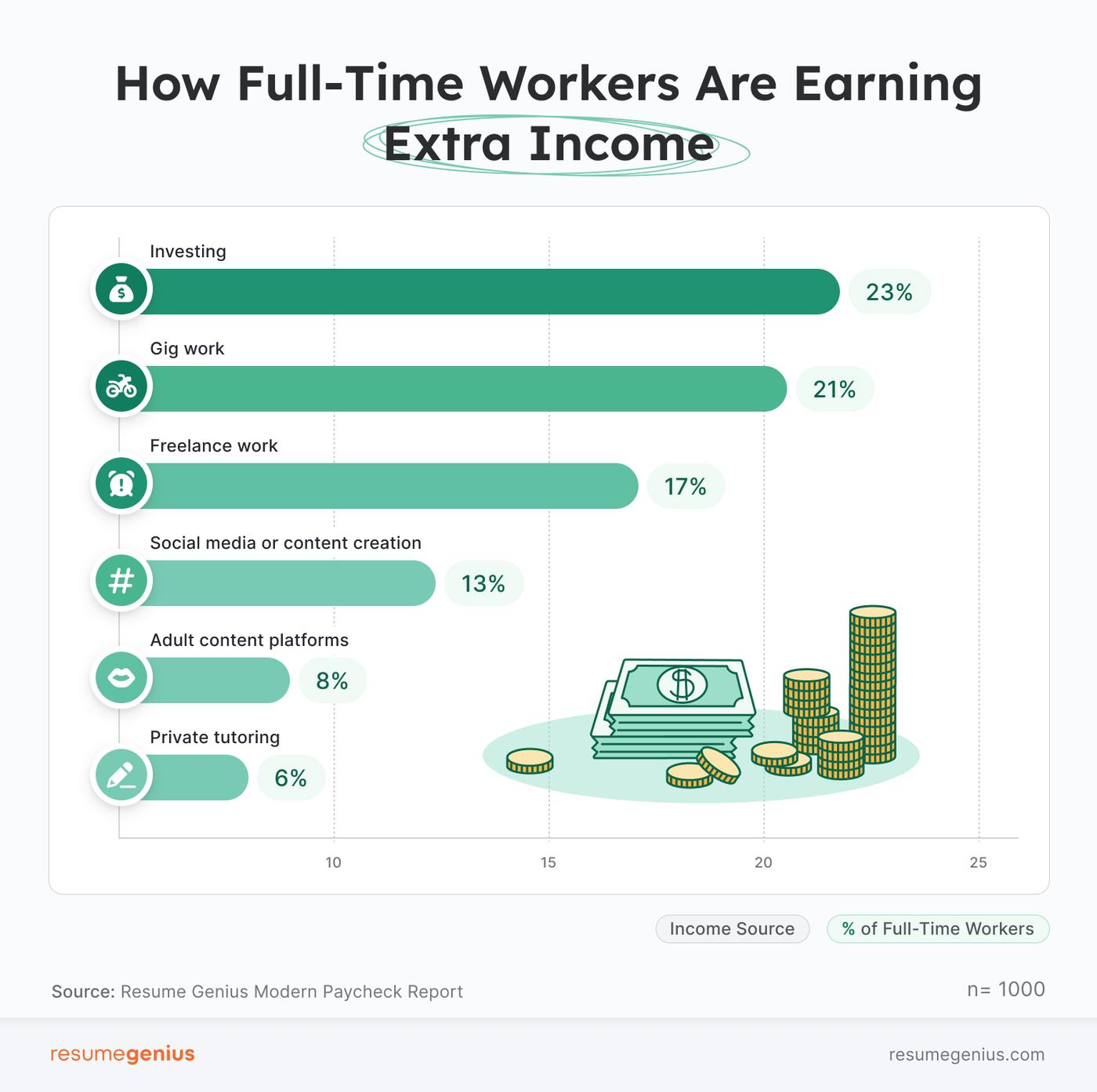
Here’s how workers are supplementing their paychecks in 2025:
- 53% earn income outside of their full-time job
- 23% invest in stocks, crypto, or real estate
- 21% take on gig work (e.g., Uber, DoorDash, TaskRabbit)
- 17% do freelance work (e.g., writing, design, coding)
- 13% earn through social media or content creation
- 8% earn from subscription-based adult content platforms
- 6% offer private tutoring
Far more than older generations, Gen Z and Millennials are supplementing their paychecks through freelance work, social media earnings, and creative side hustles.
- 1 in 4 Gen Z workers (25%) earn money through social media or content creation, compared to 16% of Millennials, 5% of Gen X, and 0% of Boomers
- 15% of Gen Z say they create adult content on subscription-based platforms, versus 10% of Millennials, 3% of Gen X, and 0% of Boomers
- 21% of Gen Z and 21% of Millennials do freelance work, roughly double the rate of Gen X (11%) and more than triple that of Boomers (6%)
- 26% of Gen Z and 22% of Millennials earn money through gig work (like Uber, DoorDash, or TaskRabbit), compared to 18% of Gen X and 6% of Boomers
Most younger workers have diversified their income — only 33% of Gen Z and 42% of Millennials rely solely on their full-time job. By contrast, 58% of Gen X and 71% of Boomers depend entirely on a single paycheck.
Men are more likely to pursue additional income streams
When it comes to earning extra money beyond their primary job, men lead the way, particularly through investments and side ventures. Women, meanwhile, are more likely to rely solely on their main paycheck.
- 30% of men invest in stocks, crypto, or real estate, compared to 17% of women
- 8% of men earn money from private tutoring, compared to 5% of women
- 15% of men earn income from social media or content creation, compared to 10% of women
- 8% of men and 7% of women create adult content on subscription-based platforms — roughly equal participation in this category
- 51% of women don’t earn any income outside of their full-time job, compared to 42% of men
The new “comfortable salary” threshold
As living costs continue to rise nationwide, the definition of “living comfortably” has shifted. For many Americans, financial security starts in the six-figure range. What once defined financial security now feels out of reach for many, especially in high-cost regions.
1 in 3 workers say they need at least $100K a year to live comfortably
In 2025, a six-figure salary has become less of a goal and more of a baseline for financial stability.
When asked what salary they believe is the minimum needed to live comfortably in their area, responses varied but mostly leaned toward higher income brackets:
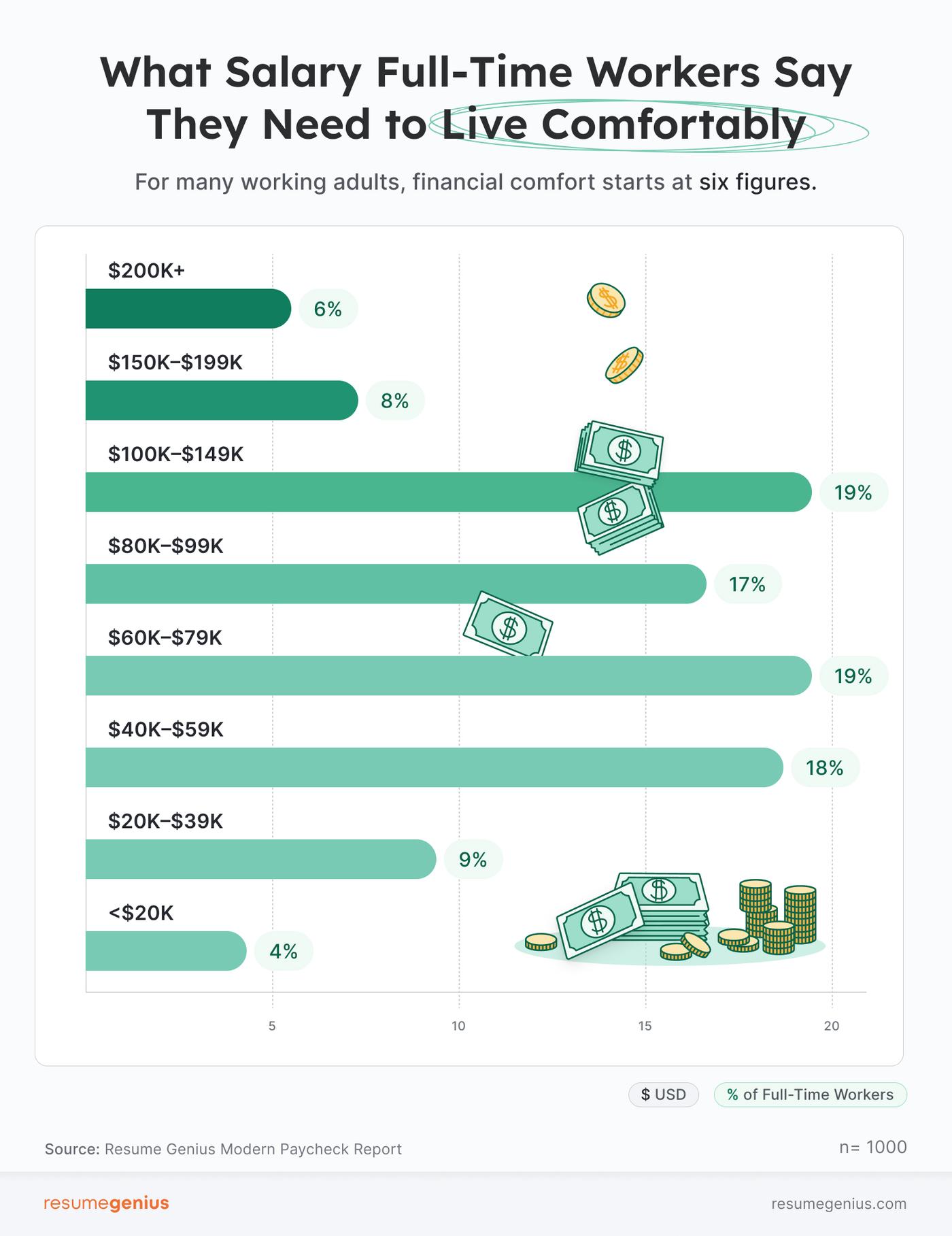
- 19% of workers say they need $100,000–$149,000
- 19% say they need $60,000–$79,000
- 18% say they need $40,000–$59,000
- 17% say they need $80,000–$99,000
- 9% say they need $20,000–$39,000
- 8% say they need $150,000–$199,000
- 6% say they need $200,000 or more
- 4% say they need less than $20,000
Older generations set higher income goals than Gen Z
What it means to “live comfortably” depends heavily on age. Older workers set higher income targets, while younger workers report getting by on less, though often with tighter margins.
- 3 in 4 Baby Boomers (75%) and Gen X workers (74%) say they need at least $60,000 to live comfortably in their area, compared to 69% of Millennials and 60% of Gen Z
- 58% of Boomers say they’d need $80,000 or more to feel financially secure, versus 54% of Millennials, 52% of Gen X, and 39% of Gen Z
- 15% of Boomers believe they’d need $150,000–$199,000 a year to live comfortably — more than 10% of Millennials, 6% of Gen X, and 5% of Gen Z
- Nearly 1 in 5 Gen Z workers (18%) say they could get by on $39,000 or less, compared to 15% of Millennials, 10% of Boomers, and 9% of Gen X
Comfort costs most in the West
Where workers live dramatically shapes what they consider a “comfortable” income. Workers in the Western U.S. report the highest salary expectations — reflecting higher living costs and housing prices — while those in the South and Midwest report more modest salary expectations.
- 3 in 4 workers in the West (76%) say they need at least $60,000 to live comfortably, nearly identical to 74% in the Northeast but higher than 68% in the Midwest and 65% in the South
- 61% of Western workers say they’d need $80,000 or more, compared to 56% in the Northeast, 46% in the Midwest, and 45% in the South
- Nearly half of workers in the West (45%) believe they need $100,000 or more to live comfortably — the highest of any region. That’s compared to 40% in the Northeast, 29% in the South, and 22% in the Midwest
Among those aiming for higher incomes, comfort looks a little different depending on where you live.
- 1 in 4 workers in the West (25%) say they’d need $100,000–$149,000 to feel financially secure — more than in the Northeast (23%), Midwest (15%), or South (17%)
- The Northeast stands out at the top of the scale: 11% of workers there say they’d need $200,000 or more to live comfortably, compared to 9% of workers in the West (9%), 4% in the South (4%), and 3% in the Midwest
Conclusion
The 2025 Modern Paycheck Report reveals that for many full-time workers, financial security remains out of reach.
Rising housing costs, limited savings, and persistent debt continue to erode take-home pay, forcing millions of Americans to resort to side hustles, freelance work, and investments to stay financially afloat.
Younger workers are leading the way in savings habits and supplemental income, but even they’re still facing significant financial strain. Across all age groups and regions, the definition of “living comfortably” has shifted, with many Americans now seeing a six-figure income as the baseline for financial stability.
Even as workers adapt to the new economic reality, that shift is slowly taking shape: steady work no longer guarantees financial peace of mind when Americans are struggling to cover essentials, save money, and keep up with rising expenses.
Methodology
The 2025 Modern Paycheck Report was based on a nationwide survey conducted on September 15, 2025, targeting 1,000 full-time U.S. workers. The analysis took place between September 24 and October 7, 2025. The study aimed to understand full-time U.S.-based workers and how they earn, spend and save and how they feel about their financial well-being.
Qualifying respondents were 18 years or older at the time of the survey. The sample was designed to represent a balanced cross-section of U.S. workers across various demographics, including gender, education level, and region, to accurately reflect the diversity of U.S. job seekers.
We analyzed the Pollfish results and the raw data in Google Sheets to produce this report and its findings. The results have a 95% confidence interval with a margin of error of ±3%.
To minimize bias, Pollfish uses Random Device Engagement to ensure a fair and organic selection process. For further details on Pollfish’s methodology, please visit its website or contact eduardo@resumegenius.com.
About Resume Genius
Since 2009, Resume Genius and its resume builder software have been helping people from all backgrounds and experience levels land their next job faster.
Resume Genius also provides a wide range of free career resources, including customizable resume templates, resume examples for different industries, and resume writing guides, to help job seekers find fulfilling work and reach their career goals.
Resume Genius is led by a team of dedicated career advisors and HR experts and has been featured in The New York Times, Harvard Business Review, Fast Company, CNBC, and USA Today.
For media inquiries, please contact us.
About the Author

Eva Chan is a Senior Digital PR Writer and Communications Lead at Resume Genius. Eva oversees the research and data-led campaigns that reveal key trends in today’s workforce and represents the company in media interviews and press features. Her work focuses on guiding job seekers through today’s job market and helping them present their applications and skills with confidence.