


- Gen Z is struggling with job performance expectations and lack of support
- Almost half of Gen Z feel they receive inadequate mental health support
- 86% of Gen Z workers would quit their current jobs for career growth
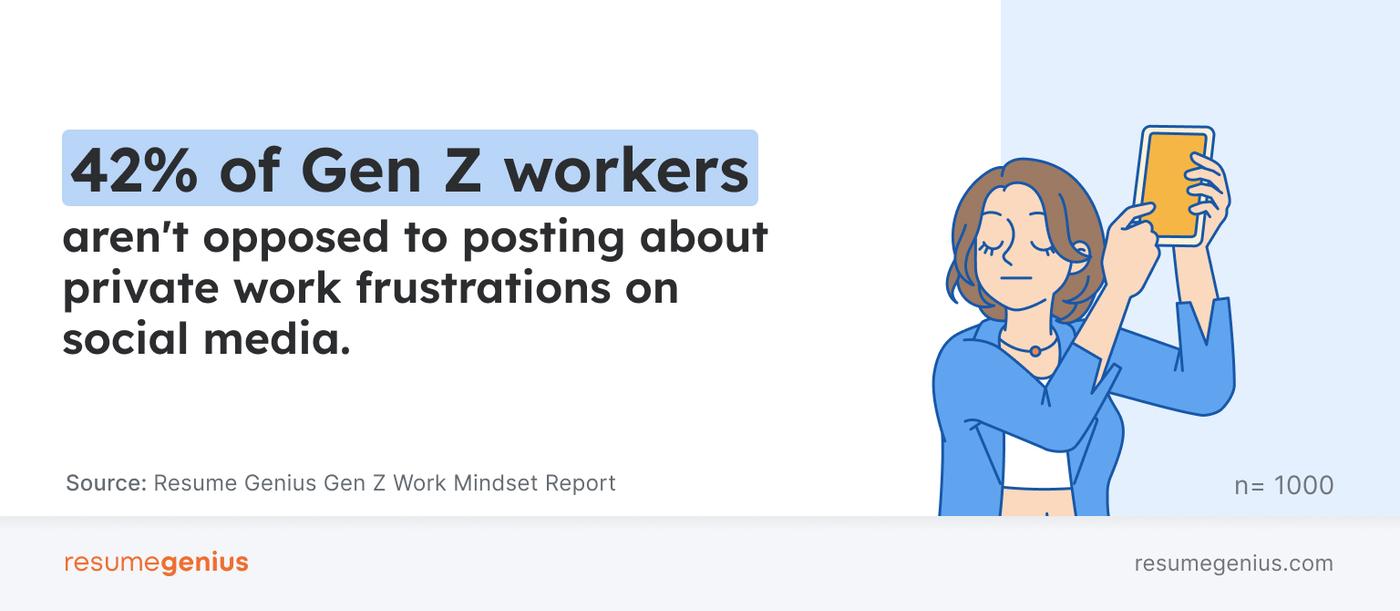
- 4 in 10 Gen Z workers aren't opposed to sharing private work struggles on social media
- 50% of Gen Z say naming and shaming employers is fair game
- 81% of Gen Z workers are unhappy with traditional office hours
- Conclusion
- Methodology
- About Resume Genius
What does work look like for Gen Z in 2025? For many, it’s a mix of ambition and strain.
To understand how these young professionals are navigating their careers, Resume Genius surveyed 1,000 Gen Z employees across the United States. Our 2025 Gen Z Work Mindset Report explores how they experience their jobs today and what could influence their next career moves.
- 75% feel burnt out at least “sometimes”
- 86% would leave their current jobs for career growth, and 85% say they’d leave for higher pay
- 62% face high-performance expectations but don’t receive enough support
- 61% say they feel undervalued by leadership, and 55% feel undervalued by older colleagues
- 57% are uncertain about their performance because of a lack of feedback
- 51% report struggling with unclear job roles or expectations
- 53% would leave for a more inclusive and diverse workplace
- Although 83% say posting about work frustrations could hurt their professional reputation, 42% noted they’ve posted or considered posting about them online
- 50% support naming and shaming bad employers on social media
- 81% want flexible work hours and say the traditional 9–5 office day is outdated
- 75% would rather prioritize their mental health than hustle to advance their careers
Gen Z is struggling with job performance expectations and lack of support
When asked what workplace challenges they experienced most often, Gen Z said burnout. 3 in 4 Gen Z workers (75%) say they feel burnt out at least “sometimes” — with 34% saying “sometimes,” 27% saying “often,” and 14% saying “always.”
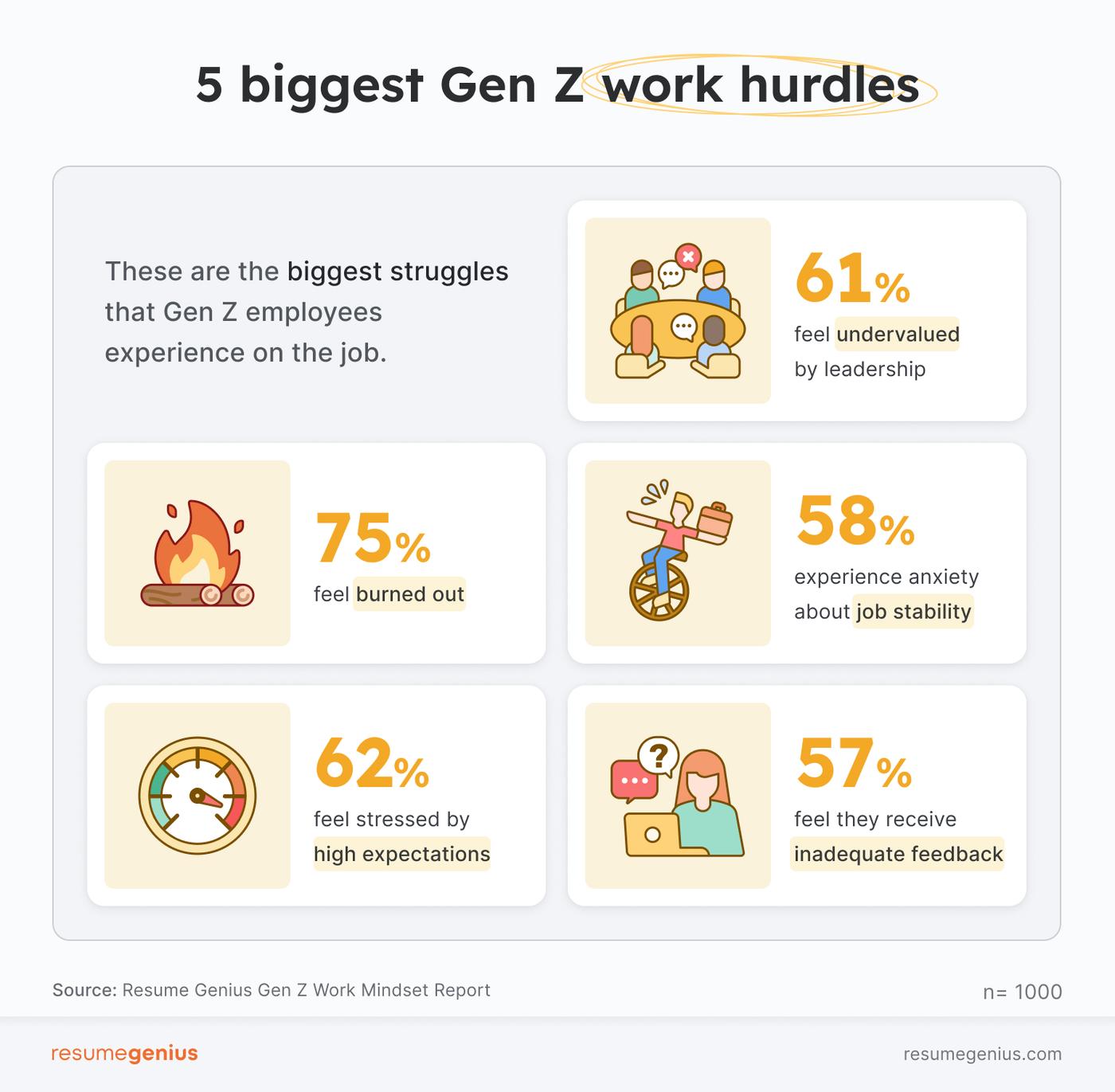
While burnout is the most common struggle, it rarely exists in isolation. Most workers face a mix of pressures, and several other challenges affect a majority of Gen Z employees. The following figures represent workers who said they face these challenges on a recurring basis — whether “sometimes,” “often,” or “always.”
- 62% say they face high-performance expectations but don’t receive enough support
- 61% say they feel undervalued by leadership
- 58% report anxiety about their job stability
- 57% are uncertain about their performance because of a lack of feedback
Here’s one possible reason for those gaps in support: performative managers.
Resume Genius defines a performative manager as a boss who focuses more on looking engaged than actually leading effectively. Similar in concept to the “performative male” seen on TikTok, a performative manager is someone who shows up for visibility, not to add value.
In remote and hybrid workplaces, performative managers often fly under the radar. They focus on being seen rather than being supportive — taking credit for successes, only showing up for meetings when higher-ups are around, and disappearing when times get hard. For younger employees eager to learn, that lack of genuine guidance from a manager can quickly wears them down. Gen Z workers trying to impress these kinds of managers often push themselves too hard by overworking and burning out.
Eva Chan, Career Expert at Resume Genius
Concerns around recognition and career progress are widespread as well:
- 55% feel undervalued by older colleagues
- 51% report experiencing feelings of falling behind peers in their career progress
- 51% report struggling with unclear job roles or expectations
Less common, but still notable, challenges include:
- 44% say they struggle with impostor syndrome, though only 19% report feeling this way “often” or “always”
- 44% report difficulty managing conflicts with colleagues or supervisors
Women are more likely than men to report severe burnout
77% of female Gen Z workers say they feel burnt out at least “sometimes,” compared with 72% of men. And when looking at severe burnout — feeling burnt out often or always — 46% of women report this, compared with 33% of men.
Impostor syndrome shows the reverse pattern, where 47% of men say they experience imposter syndrome, compared to 41% of women.
Master’s degree holders struggle most with impostor syndrome and conflict
While the majority of Gen Z workers report suffering from burnout “at least sometimes”, respondents with higher levels of education were more likely to experience the condition.
PhD holders reported the heaviest levels of burnout, while master’s graduates were most likely to report experiencing conflict, impostor syndrome, and dissatisfaction.
Burnout and exhaustion:
Here’s how burnout affects every education group:
- 79% of PhD holders report feeling burnt out at least “sometimes” (the highest of any group)
- 75% of bachelor’s degree holders and 75% of associate degree holders report burnout
- 71% of high school graduates report burnout
- 66% of master’s degree holders report burnout (the lowest of the surveyed groups)
Burnout from high expectations shows a similar trend.
- 74% of PhD holders say they feel burnout
- 56% of master’s degree holders report the same
Conflict at work:
Conflict is where master’s degree holders differ most from their peers.
- 69% of master’s graduates say they “often” or “always” struggle with conflict at work
- Only 18% of bachelor’s holders, 19% of associate degree holders, 18% of high school graduates, and 5% of PhD holders report the same
Impostor syndrome and career dissatisfaction:
Self-doubt and dissatisfaction are also far more common among master’s graduates.
- 59% say they “often” or “always” experience imposter syndrome
- 26% of PhD holders, 19% of associate degree holders, and 18% of both bachelor’s and high school graduates say the same
Career dissatisfaction follows the same trend.
- 58% of master’s graduates say they “often” or “always” feel dissatisfied with their achievements compared with peers
- By contrast, 24% of associate degree holders, 20% of bachelor’s holders, 18% of high school graduates, and 16% of PhD holders report the same
Almost half of Gen Z feel they receive inadequate mental health support
When asked about job satisfaction, 67% of Gen Z workers highlighted several factors as key to their wellbeing.
Job security and benefits came out on top, with 3 in 4 workers (75%) expressing satisfaction, while office perks and mental health support ranked lowest.
Most other areas (including management, work-life balance, and daily tasks) fell in between.
Here’s the breakdown:
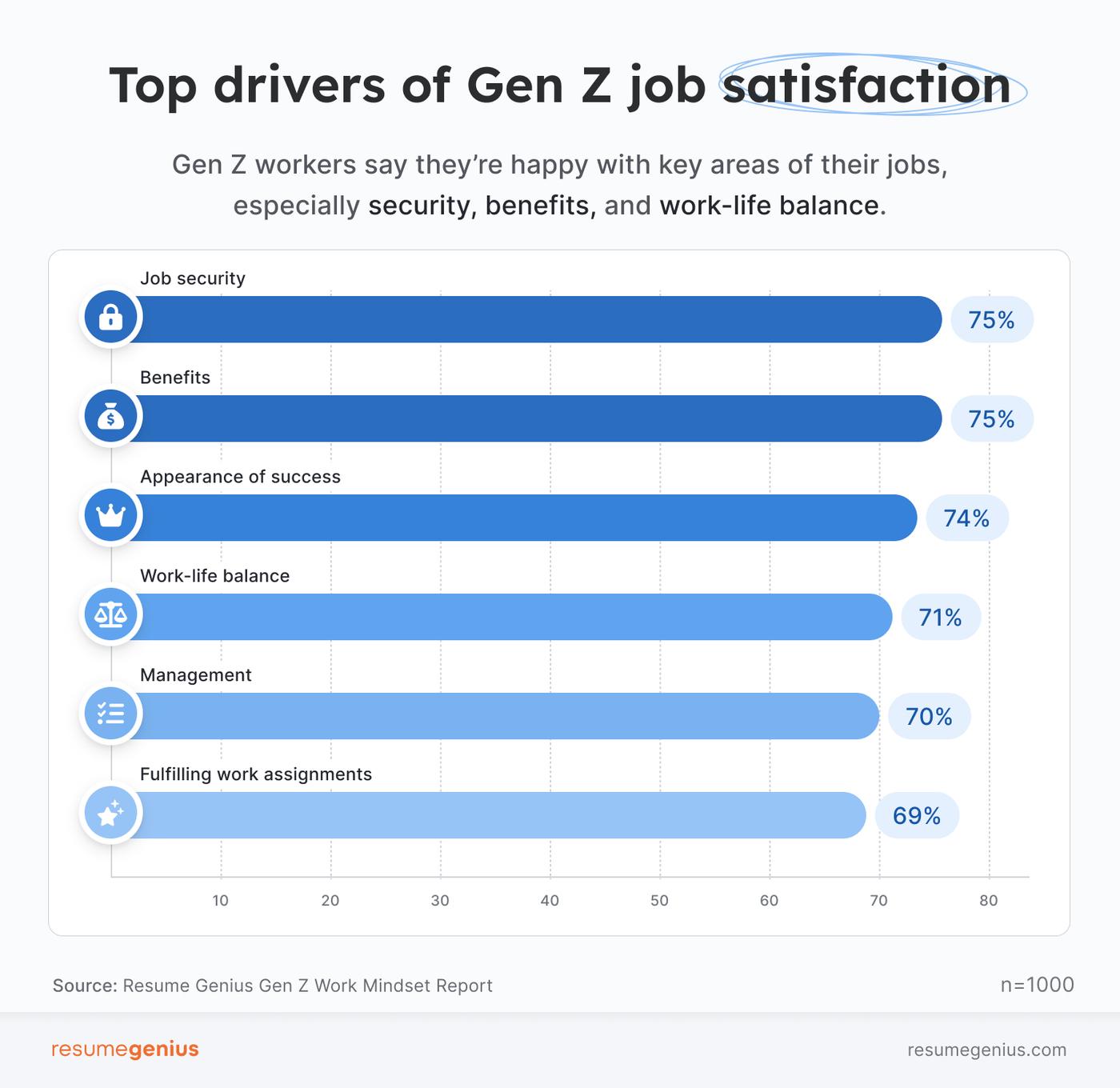
- 75% are satisfied with their job security
- 75% are satisfied with benefits such as health plans and retirement programs
- 74% are satisfied with their job title and company image
- 71% are satisfied with work-life balance
- 70% are satisfied with management
- 69% are satisfied with their daily tasks
- 63% are satisfied with opportunities for advancement
- 62% are satisfied with their salary
- 59% are satisfied with mental health support
- 58% are satisfied with office perks such as free meals or gym access
86% of Gen Z workers would quit their current jobs for career growth
Even with relatively high job satisfaction, two thirds (67%) of Gen Z workers across every category say they’d quit their jobs under the right circumstances. Career growth is by far the biggest driver of this trend, with 86% saying it would push them to move on.
Higher pay follows closely, while factors like office mandates and workplace diversity matter less, even though return-to-office debates and talks oft this generation pushing the most for diversity and inclusion have dominated headlines in recent years.
Here’s how Gen Z answered when asked what factors would cause them to quit:
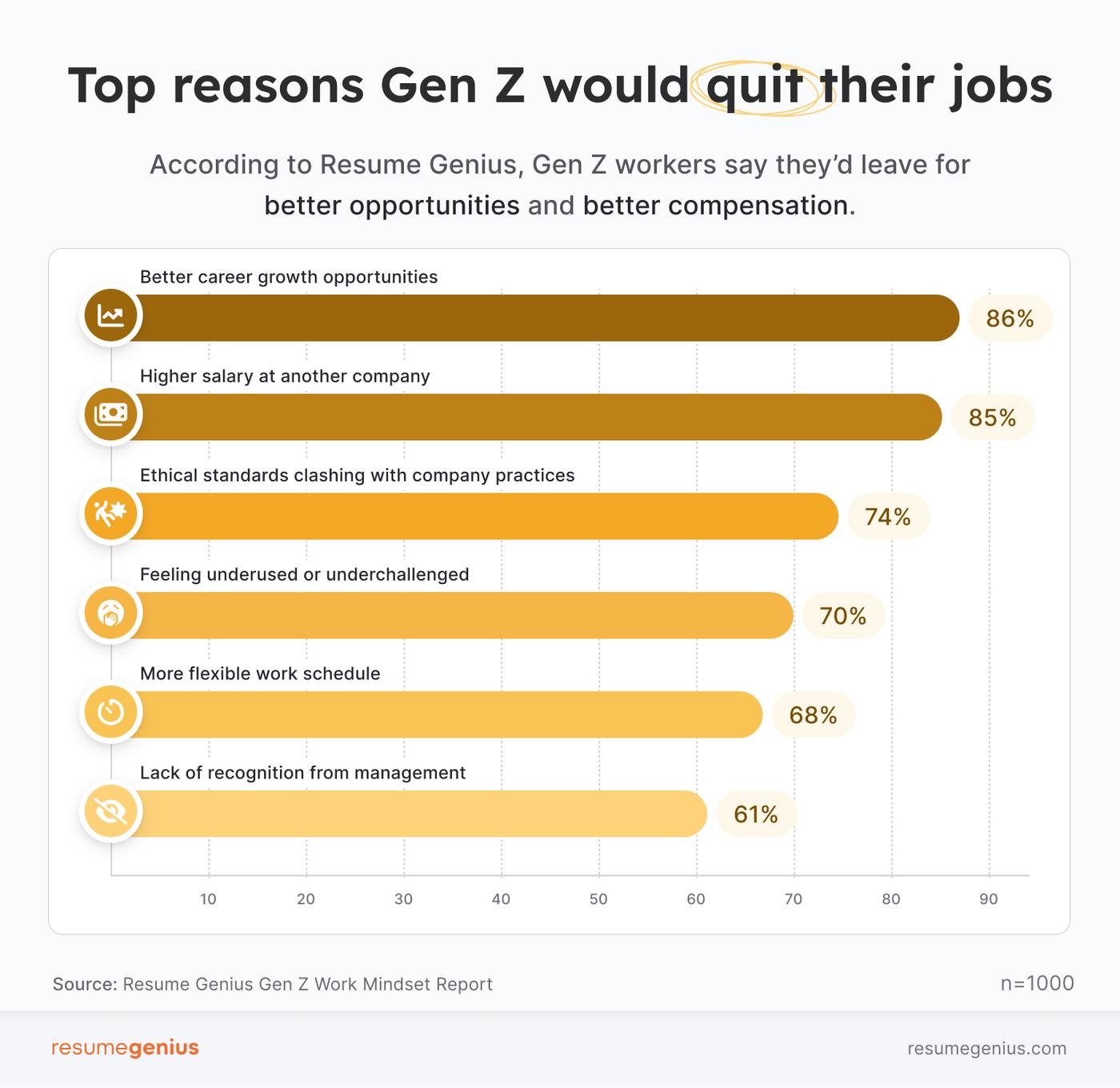
- 86% would leave for better career growth opportunities
- 85% would leave for a higher salary at another company
- 74% would leave if their ethical standards clashed with company practices
- 70% would leave if their skills weren’t being used effectively
- 68% would leave for a more flexible work schedule
- 61% would leave because of a lack of recognition or appreciation from management
- 53% would leave for a more inclusive and diverse workplace
- 39% would leave if a return-to-office mandate were enforced
Return-to-office mandates split Gen Z by gender
Gen Z men from our report say they’re more likely to walk away if a return-to-office mandate is enforced — 43% say they’d quit compared to 35% of women.
Women, however, are more likely to leave if their ethical standards clash with company practices (78% of women vs. 68% of men).
Ethics drive older Gen Z workers, while workplace culture matters more to younger employees
Ethical concerns weigh more heavily on older Gen Z professionals: 77% of those aged 26–28 say they’d leave over ethical concerns, compared to younger employees (71% of 18–21-year-olds and 70% of 22–25-year-olds).
By contrast, Gen Z younger workers put more emphasis on workplace culture — 60% of 18–21-year-olds would leave for a more inclusive and diverse workplace, compared to 47% of those aged 26–28.
4 in 10 Gen Z workers aren’t opposed to sharing private work struggles on social media
Gen Z isn’t just venting to friends — some are taking their frustrations online. In our survey, we asked workers whether they had ever posted (or considered posting) about their work struggles on social media.
While a majority of Gen Z workers prefer to keep work issues private, a significant minority are willing to post about them on social media, either publicly, anonymously, or on private accounts.
The breakdown looks like this:
- 42% have posted or considered posting about their work struggles online
- 22% have posted about private work frustrations on social media — and almost half of these respondents did so on public accounts (8% of total respondents)
- 20% would consider posting about a private work frustration
- 58% say they wouldn’t post about private work frustrations on social media
50% of Gen Z say naming and shaming employers is fair game
Gen Z workers are split over whether it’s okay to post about negative employer experiences online.
To some respondents, naming and shaming is seen as a powerful way to expose unfair pay, toxic culture, or bad management. To others, the practice is unprofessional and likely to do more harm than good.
The results show this tension clearly:
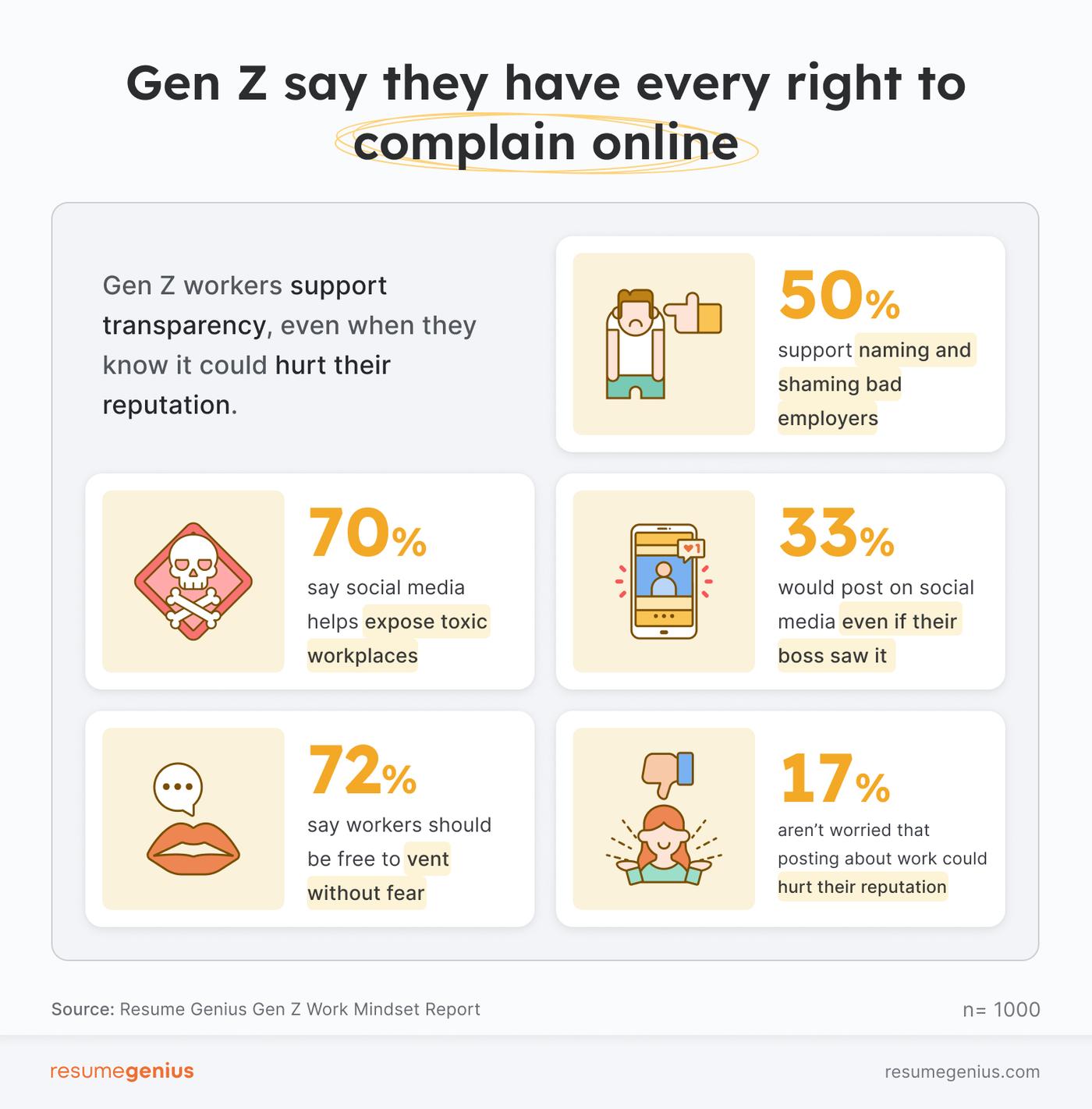
- 83% say that publicly discussing workplace struggles can harm their professional reputations.
- 17% don’t see it as a risk.
- 72% say companies shouldn’t penalize employees for talking about their work experiences online
- 70% believe social media is a valuable tool for exposing workplace issues
- 67% avoid posting about work because they worry about the backlash from their employer
- 33% say they’d share negative information about their job even if the post was visible to their employer
- 50% think naming and shaming employers online should be encouraged to prevent workplace abuse
Gen Z men believe in challenging bad employers, while women take a more cautious stance
According to our report, Gen Z men are more likely to support publicly calling out employers, while women worry more about the risks.
Just over half of men (53%) say naming and shaming bad employers should be encouraged, compared to 48% of women.
But women are more concerned about reputational damage — 87% believe posting about work could harm their careers, compared to 78% of men.
Older Gen Z are more cautious online than younger peers
Nearly 9 in 10 workers aged 26–28 (87%) believe posting about work could hurt their professional reputation, compared to 79% of 18–21-year-olds.
Younger Gen Z are more likely to consider social media an effective tool for exposing bad office practices. 56% of 18–21-year-olds say naming and shaming employers should be encouraged, compared to about half of those aged 22–28.
In the survey, Gen Z workers were asked how they assess their own work ethic and preferences:
81% of Gen Z workers are unhappy with traditional office hours
According to our findings, Gen Z is reshaping expectations around how, when, and why they work. When asked how they assess their own work ethic and preferences, we found that Gen Z wants flexibility, balance, and fairness built into their jobs — and they’re not afraid to challenge outdated norms.
Flexibility matters more than tradition
A large share of Gen Z workers favor flexibility in their schedules and benefits, even if it means taking less traditional jobs.
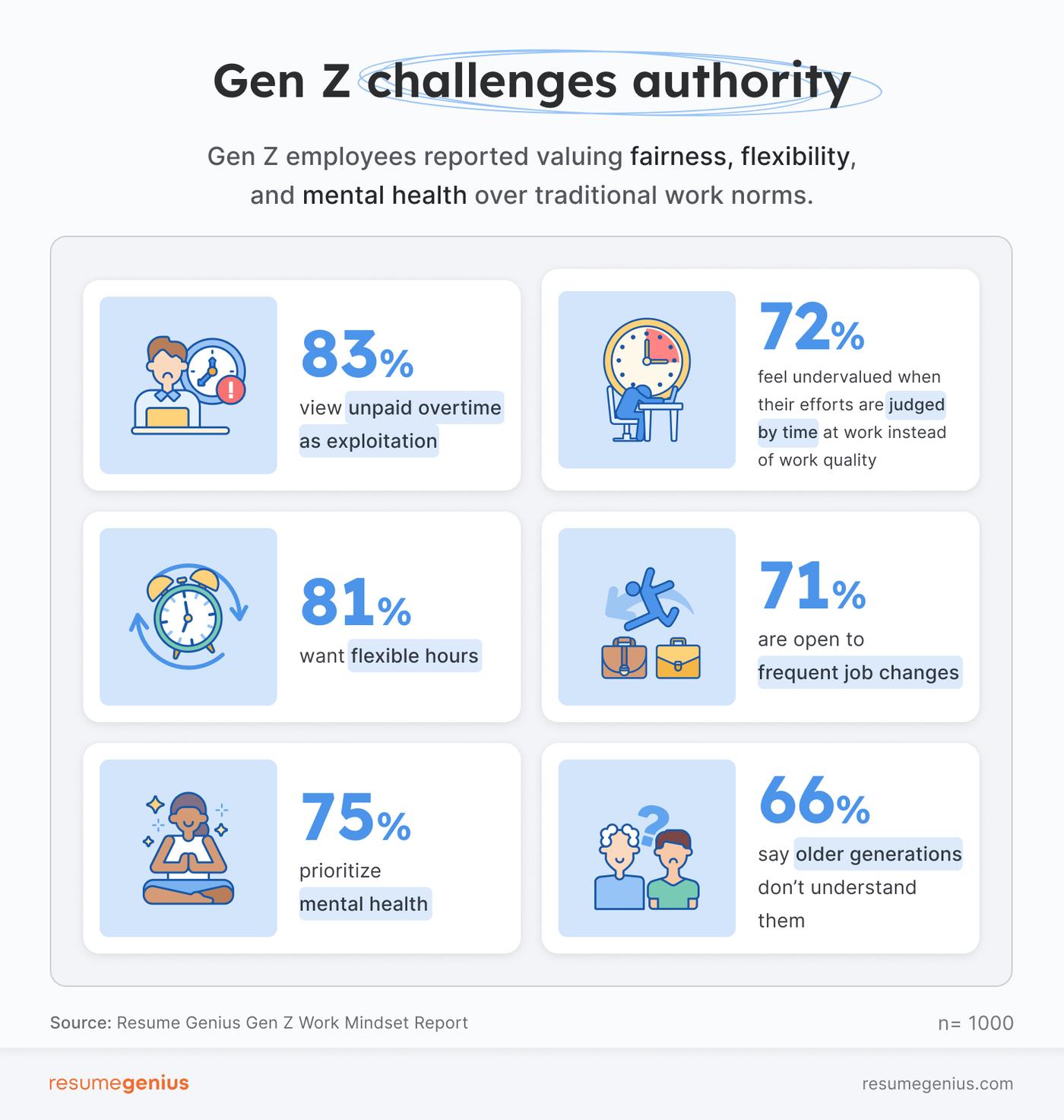
- 81% believe that traditional 9-to-5 office hours are outdated and should be replaced with flexible hours
- 67% would consider taking a job that doesn’t perfectly align with their skills if it offered exceptional benefits or flexibility
- 62% value job satisfaction over stability, saying they’d leave a stable job if it doesn’t fulfill them
Gen Z works hard but is unwilling to do unpaid overtime
The majority of Gen Z say they’re willing to work hard, but they won’t tolerate overwork without fair compensation. Many also emphasize mental health and output over hours.
- 83% say they work hard but oppose unpaid overtime and overwork, which they view as exploitation
- 75% prioritize their mental health over making unnecessary work-related sacrifices
- 72% feel underappreciated when their work is measured by hours rather than the quality of their output
66% of Gen Z prefer shared decision-making in the office
Many younger workers don’t see eye to eye with older generations on workplace culture. They lean toward more democratic workplaces and say they’re open to job changes if their values aren’t met.
- 71% are open to changing jobs frequently to find better opportunities
- 66% believe older generations misunderstand their approach to work and overvalue traditional culture
- 66% prefer democratic workplaces over hierarchical management styles
- 43% would rather work at startups or innovative companies than at established corporations
Advanced Gen Z degree holders are most open to job-hopping
Our findings show that openness to frequent job changes grows with education. Respondents who said they are willing to job hop to find better opportunities included:
- 84% of PhD holders
- 73% of associate’s degree holders
- 71% of high school grads
- 70% of bachelor’s degree holders
- 63% of master’s degree holders
Conclusion
The survey shows that Gen Z is redefining what it means to build a career. Many are satisfied with their jobs, but burnout, lack of support, and questions about growth remain pressing concerns.
Even in a tight economy, they are unwilling to stay in roles that don’t meet their needs.
For employers, the takeaway is simple: Gen Z will commit where their well-being and ambitions are taken seriously, and they’ll leave where they are not.
Methodology
The Gen Z Work Mindset Report came from a Pollfish survey launched between April 24 and May 10, 2025, targeting a sample of 1,000 participants. The analysis was conducted from May 14 to 22, 2025. The study aimed to understand Gen Z workers’ attitudes and preferences regarding the state of the workplace.
Qualifying respondents were required to be born between 1997 and 2012. The survey ensured a balanced representation across various demographics, including gender and age groups, to accurately reflect the diversity of U.S. job seekers.
The data was analyzed using the results provided by Pollfish and the raw data in Google Sheets. The results have a margin of error of ±3% at a 95% confidence level.
To minimize bias, Pollfish uses Random Device Engagement (RDE) to ensure a fair and organic selection process. For further details on Pollfish’s methodology, please visit their website or contact eduardo@resumegenius.com.
About Resume Genius
Since 2009, Resume Genius and its resume builder software have been helping people from all backgrounds and experience levels land their next job faster.
Resume Genius also provides a wide range of free career resources, including customizable resume templates, resume examples for different industries, and resume writing guides, to help job seekers find fulfilling work and reach their career goals.
Resume Genius is led by a team of dedicated career advisors and HR experts and has been featured in The New York Times, Harvard Business Review, Fast Company, CNBC, and USA Today.
For media inquiries, please contact us.
About the Author

Eva Chan is a Senior Digital PR Writer and Communications Lead at Resume Genius. Eva oversees the research and data-led campaigns that reveal key trends in today’s workforce and represents the company in media interviews and press features. Her work focuses on guiding job seekers through today’s job market and helping them present their applications and skills with confidence.