



Today’s workers are not quitting, even though many are quietly planning their next career move.
Our 2026 Career Identity Report shows a workforce navigating tradeoffs. As economic uncertainty rises, workers prioritize stability, benefits, and predictable income — while simultaneously harboring quieter ambitions for work that offers greater flexibility, autonomy, and control over their time.
This report examines how workers perceive their jobs today, why many remain in roles that they’re unhappy with, and what their dream work scenarios reveal about the modern workplace (and what it’s lacking).
Key takeaways
- 68% of workers see their job mainly as a way to pay the bills
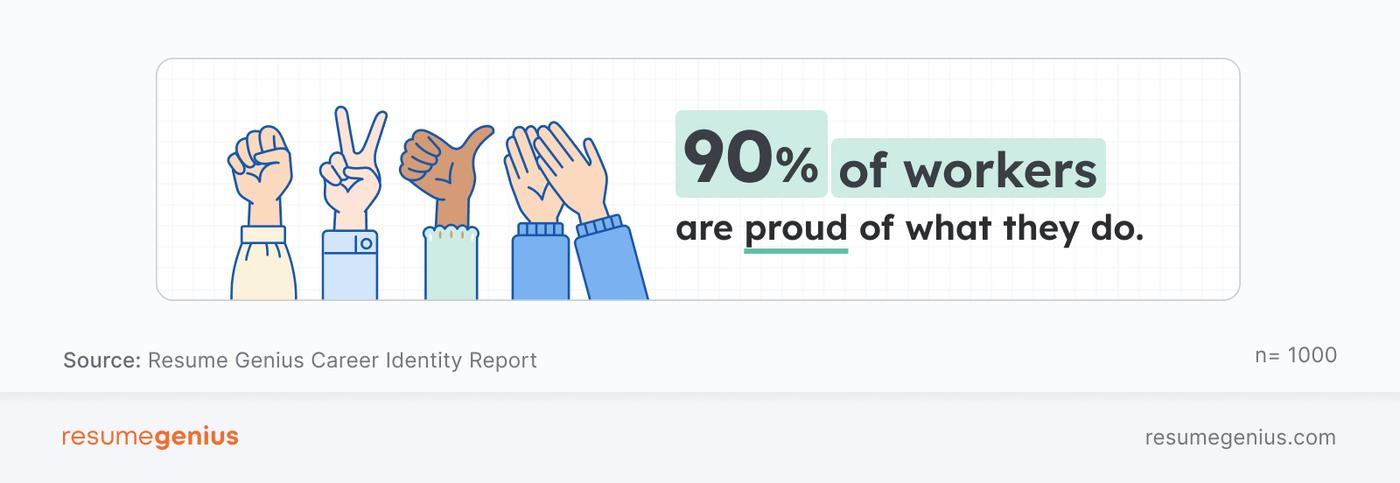
- 90% say they’re proud of the work they do
- Younger workers are far more likely to view jobs as temporary
- 57% of Gen Z say they’re only staying until they find something better, compared to 13% of Baby Boomers
- 9 in 10 Gen Z workers (90%) say they would walk away from a traditional career
- 69% of workers are staying to build experience and skills for a better role
- 64% of workers say their benefits are too good to give up
- 60% of workers say they aren’t in their dream role, and 77% of them say they don’t want to quit their current job
- 78% say economic instability is the main reason they’re staying
Workers are settling into “good enough” roles
Many seem to be settling into roles that feel good enough rather than actively pursuing a more meaningful fit. It’s a stable but subdued kind of satisfaction.
Workers are proud of their work, even if they don’t love their jobs.
Although 90% of workers report being proud of the work they do, 68% still view their job primarily as a way to cover their expenses and not something they’re passionate about.
Interestingly, workers reported being quite happy in their roles. 77% of workers say they’re satisfied with their job and don’t dream about quitting, suggesting today’s workforce is more cautious than disengaged.
Young workers view job hopping as necessary
While younger workers often treat their jobs as temporary stops on a longer career path, older workers are more likely to tie their work closely to their sense of identity.
- 77% of Gen Z workers see their current job primarily as a way to pay the bills (vs. 65% overall of other generations)
- By generation: 70% of Millennials, 62% of Gen X, and 52% of Baby Boomers
- 57% of Gen Z workers say they’re only staying until they find a better job (vs. 42% overall of other generations)
- By generation: 52% of Millennials, 34% of Gen X, and just 13% of Baby Boomers say the same
- 33% of Millennials say they’re unsatisfied with their job and dream of quitting (vs. to 28% overall of other generations)
- By generation: 32% of Gen Z, 28% of Gen X, and 23% of Baby Boomers
The real reasons workers aren’t quitting: the economy and job market
Many workers aren’t in their dream role, but that doesn’t mean they’re ready to leave. In fact, 60% of workers don’t agree that their current job is their ideal one, yet most remain in their current role for practical reasons.
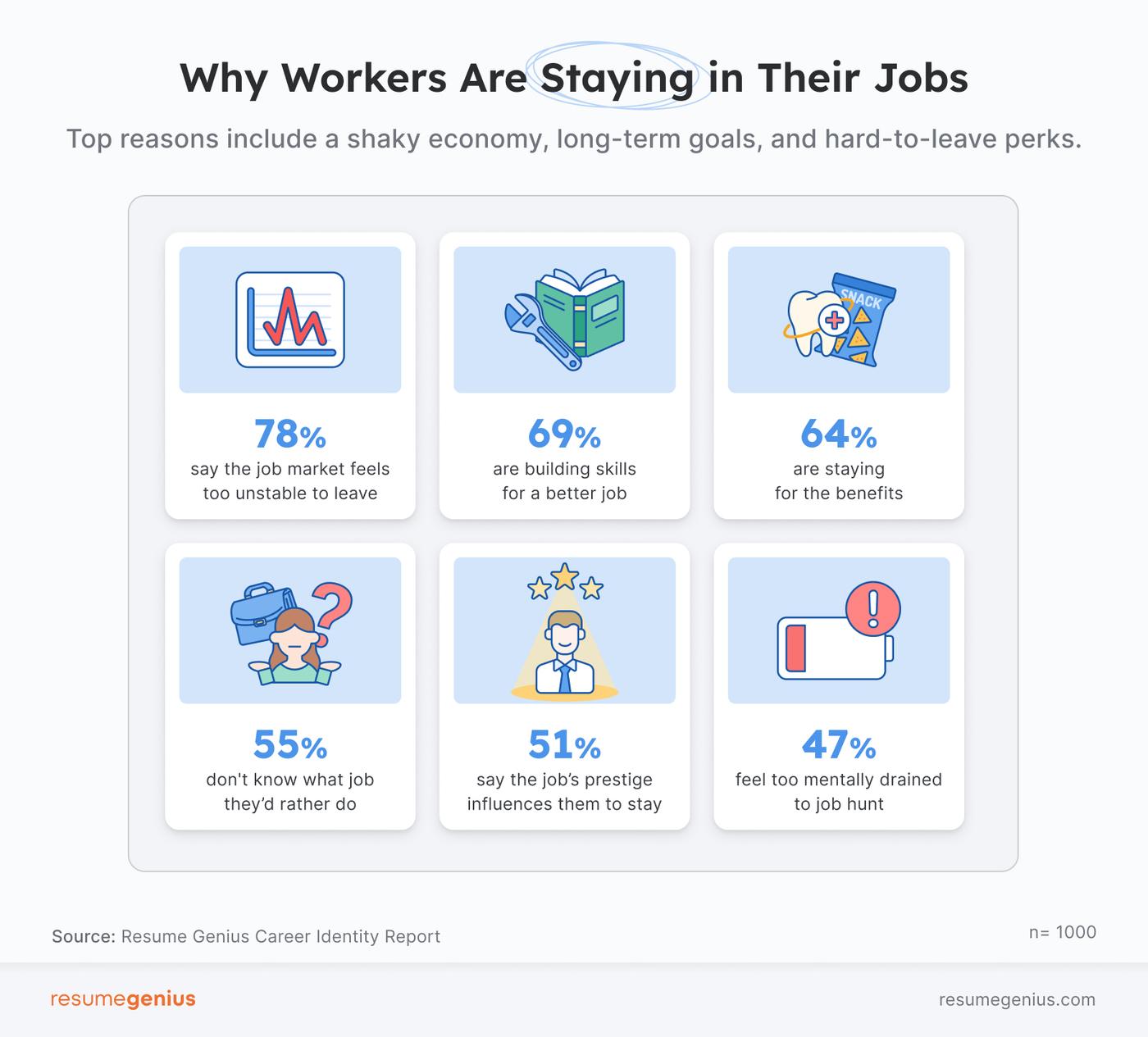
Economic uncertainty is the biggest factor keeping workers in place. 78% say the job market and economy feel too unstable for them to quit, making staying feel like the safer choice. Beyond that, workers point to long-term planning and financial security as major reasons for holding on.
Key reasons workers are staying in their current job include:
- Building toward something better: 69% say they’re staying to gain experience and skills for a future role
- Benefits: 64% say their benefits, like health insurance and PTO, are too good to give up
- Pay concerns: 64% don’t believe they’d earn more in their dream role than they do now
- Uncertainty: 55% say they don’t know what else they’d rather be doing
- Burnout: 47% feel too mentally drained to start job hunting
- Social status: 51% say their job enhances their social image or makes them sound impressive
Together, these findings suggest that staying isn’t about comfort or complacency. For many workers, quitting feels like a financial and emotional risk they can’t afford to take right now.
Younger workers stay strategically, while older workers stay for security
While workers of all ages cite similar reasons for staying, the motivations behind those reasons differ.
Younger workers are more likely to view their current role as a stepping stone: 77% of Gen Z say they’re staying to build experience and skills for a better job down the road, vs. 68% of other generations (76% of Millennials, 62% of Gen X, and only 35% of Baby Boomers.
Older workers are more anchored by stability:
- 67% of Gen X workers say they’re staying because their benefits are too good to give up (vs. 63% overall of other generations)
- Other generations: 59% of Gen Z, 64% of Millennials, and 65% of Boomers
- 82% of Gen X workers cite economic instability as a reason they’re not quitting (vs. 76% of overall of other generations)
- Other generations: 73% of Gen Z, 78% of Millennials, and 67% of Boomers
Overall, the data shows a clear divide. Younger workers tend to stay with an eye on what comes next, while older workers are more focused on protecting the security they already have.
A better life outside of work comes down to gaining useful skills and freedom
When workers imagine walking away from their current career, they aren’t picturing a life without work. Instead, they’re imagining a different relationship with it.
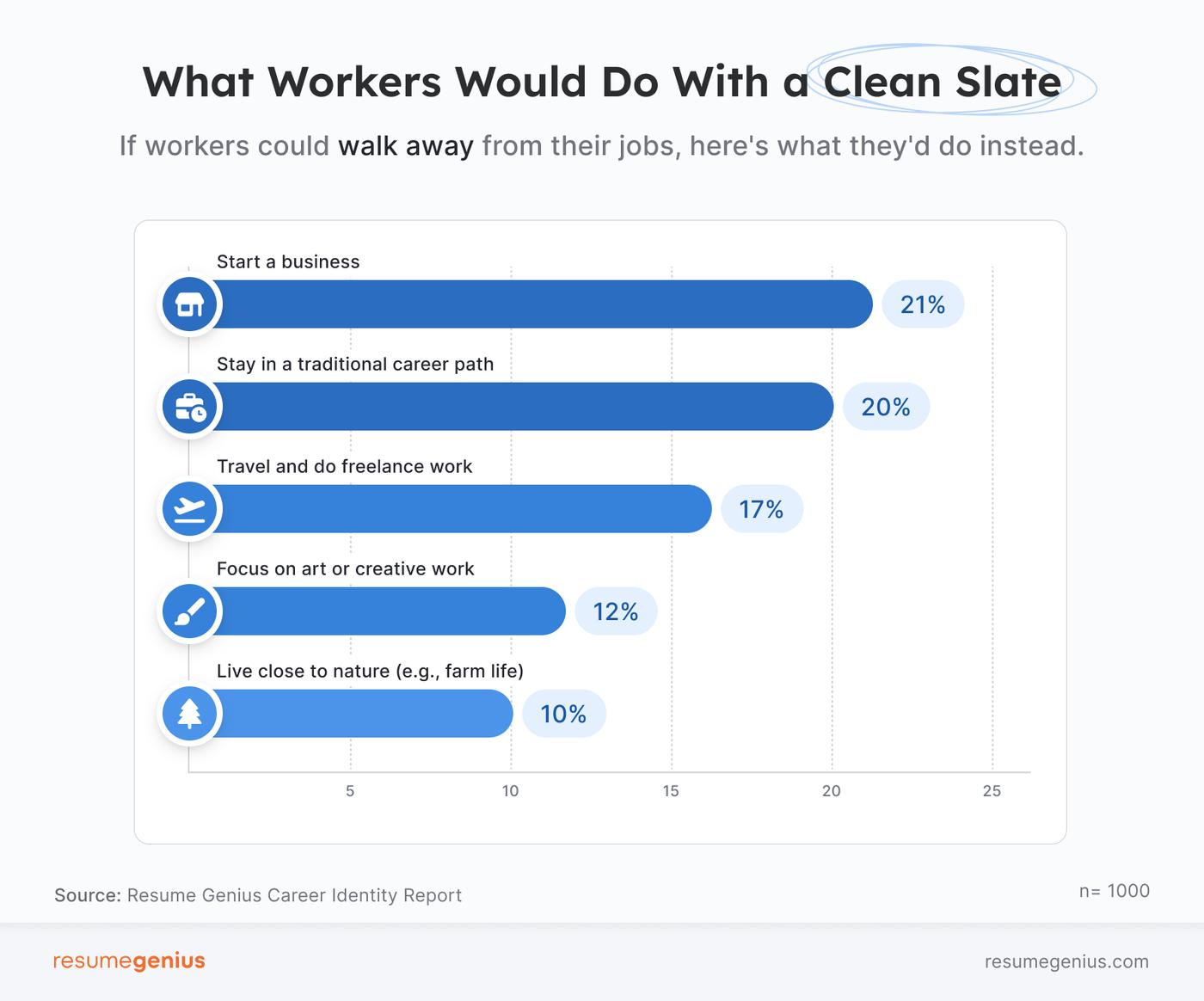
When asked what they’d do if they could walk away from their current career, workers’ answers reveal a deep yearning for creativity, craftsmanship, entrepreneurship, and freedom, a stark contrast to their daily professional lives.
Many workers say they would rethink their career path entirely if given the chance.
- The most popular alternative is starting a business, with 21% saying they would pursue entrepreneurship
- Close behind, 20% would stick with a traditional career path, suggesting stability still holds strong appeal
- Others are drawn to more flexible lifestyles, with 17% interested in traveling while freelancing
- Creative pursuits also stand out, as 12% say they would focus on art or other creative work
- Meanwhile, 10% imagine stepping away from conventional work altogether to live closer to nature, such as adopting a farm-based lifestyle
A smaller number of people said they would learn a trade or work with their hands (9%), become full-time content creators (7%), or pursue careers outside societal norms (e.g., NSFW content, adult industry work) (4%).
Taken together, these choices suggest workers aren’t looking to escape effort or responsibility. They’re looking for autonomy. Even those who say they wouldn’t leave a traditional career are signaling that stability matters most when it still allows for a sense of control.
Gen Z is the generation least interested in following traditional career paths
Compared to older generations, younger workers are more open to creative, independent, and nontraditional career options, whereas older workers tend to prioritize stability and familiar professional structures.
Gen Z workers are the most open to reinvention. Their top alternatives include:
- Starting a business (23%)
- Focusing on art or creative work (17%)
- Traveling and freelancing or becoming full-time content creators (12%)
90% of Gen Z workers say they would walk away from a traditional career, far more than any other generation. They’re also more likely than other generations to want to become full-time content creators.
Millennial workers fall somewhere in the middle. Their top choices are:
- Starting a business (21%)
- Staying in a traditional career (17%)
- Traveling and freelancing (17%)
While many Millennials still value stability, a large majority (83%) say they’d be willing to walk away from a traditional career under the right circumstances.
Gen X workers lean more cautiously toward change. Their top options include:
- Staying in a traditional career (26%)
- Traveling and freelancing (21%)
- Starting a business (19%)
Only 74% of Gen X workers say they’d walk away from a traditional career, reflecting a stronger pull toward stability than younger cohorts.
Baby Boomers are the most resistant to career reinvention. Their top responses were:
- Staying in a traditional career (42%)
- Starting a business (21%)
- Traveling and freelancing (17%)
Just 58% of Boomers say they’d walk away from a traditional career at all. Notably, no Boomers expressed interest in learning a trade or working with their hands, and none said they’d pursue careers outside societal norms.
Conclusion
According to our report, most workers are proud of their work, but they’re realistic about what it provides. Pride in work coexists with clear-eyed realism about risk, pay, and stability. Younger workers are planning ahead. Older workers are locking in security. Across generations, staying has become a strategic choice, not a default one.
The result is a workforce defined by timing, not loyalty. Career decisions today are less about passion and more about when the risk finally feels worth it.
Methodology
The Career Identity Report was based on a nationwide survey conducted on September 15, 2025, targeting 1,000 full-time U.S. workers. The analysis was conducted between November 20 and December 1, 2025. The study examined employees’ attitudes toward their careers.
Respondents were 18 or older at the time of the survey. The sample was designed to represent a balanced cross-section of U.S. workers across key demographics, including gender, education level, and region.
We analyzed the Pollfish results and the raw data in Google Sheets to produce this report and its findings. Results are reported at a 95% confidence interval with a ±3% margin of error.
To minimize bias, Pollfish uses Random Device Engagement to ensure a fair and organic selection process. For more on Pollfish’s methodology, visit its website or contact eduardo@resumegenius.com.
About Resume Genius
Since 2009, Resume Genius and its resume builder software have been helping people from all backgrounds and experience levels land their next jobs faster.
Resume Genius also provides a wide range of free career resources, including customizable resume templates, resume examples for different industries, and resume writing guides, to help job seekers find fulfilling work and reach their career goals.
Resume Genius is led by a team of dedicated career advisors and HR experts and has been featured in The New York Times, Harvard Business Review, Fast Company, CNBC, and USA Today.
For media inquiries, please contact us.
About the Author

Eva Chan is a Senior Digital PR Writer and Communications Lead at Resume Genius. Eva oversees the research and data-led campaigns that reveal key trends in today’s workforce and represents the company in media interviews and press features. Her work focuses on guiding job seekers through today’s job market and helping them present their applications and skills with confidence.