



As tuition costs continue to rise, prospective grad students are asking a critical question: when does a master’s degree actually pay off?
In our 2026 Education and Earnings Report, we surveyed 1,500 U.S. hiring managers on how they evaluate master’s degree holders versus candidates with a bachelor’s degree and two years of work experience.
We found that your industry, your role, and where you are in your career determine whether a master’s degree is actually worth your time and money. For most candidates, here’s what the data shows: two years of solid work experience is a legitimate competitor to a master’s degree.
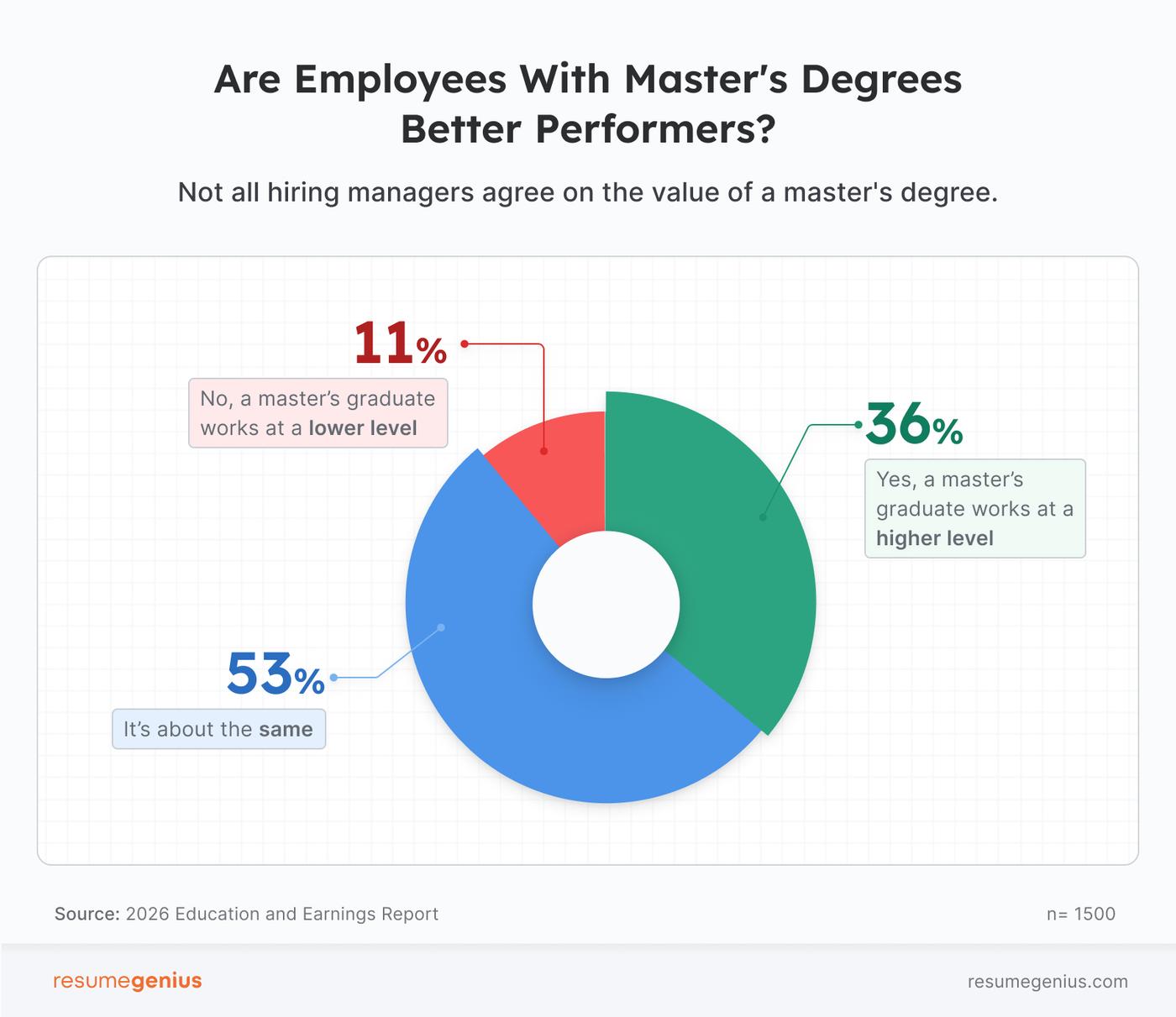
- 64% of hiring managers say a master’s degree delivers no better performance than two years of work experience
- 36% say they see genuine performance benefits from a master’s degree
- 40% say a master’s degree adds the most value for people advancing within their current field
- 18% say candidates pivoting to a new industry benefit most from a master’s degree
- Only 13% say a master’s degree helps entry-level candidates
64% of hiring managers say a master’s degree doesn’t improve performance
We asked hiring managers: In 2026, do employees with a master’s degree perform better than those with a bachelor’s degree and two years of hands-on experience? The results challenged that idea.
Here’s the overall breakdown:
- 53% say performance is about the same
- 11% say master’s degree holders perform worse
- 23% say they perform at a slightly higher level
- 13% say they perform at a considerably higher level
Tech hiring managers care most about what degree you have
According to our findings, nearly half of tech hiring managers (49%) say only directly relevant master’s degrees matter. Education comes in a close second at 45%, suggesting both sectors prioritize degree relevance similarly.
Finance and manufacturing stand out as the most flexible, viewing any master’s degree similarly — suggesting they care more about having an advanced degree than the specific field of study.
Here’s how hiring managers from different sectors view degree type:
Tech hiring managers value master’s degrees the most
Master’s degrees also faced widespread skepticism across industries when compared to a bachelor’s degree and two years of work experience. Hiring managers in government are the most dismissive, reporting that having a master’s degree is the same or worse. Retail and hospitality follow closely.
The tech industry is where employers are divided. Nearly half of tech hiring managers (48%) remain skeptical, while 52% see value in a master’s degree.
Here’s the percentage of hiring managers broken down by sector who say it’s the same or worse:
- Government & public administration (79%)
- Retail (72%)
- Business & professional services (67%)
- Manufacturing, engineering, & construction (66%)
- Transportation, warehousing, & logistics (64%)
- Finance & banking (63%)
- Healthcare & social assistance (58%)
- Education (50%)
- Technology (software, IT, internet companies) (48%)
The type of degree matters less than you think
When we asked hiring managers how much the type of master’s degree matters when evaluating a candidate’s qualifications and compensation level, the answers revealed a split perspective.
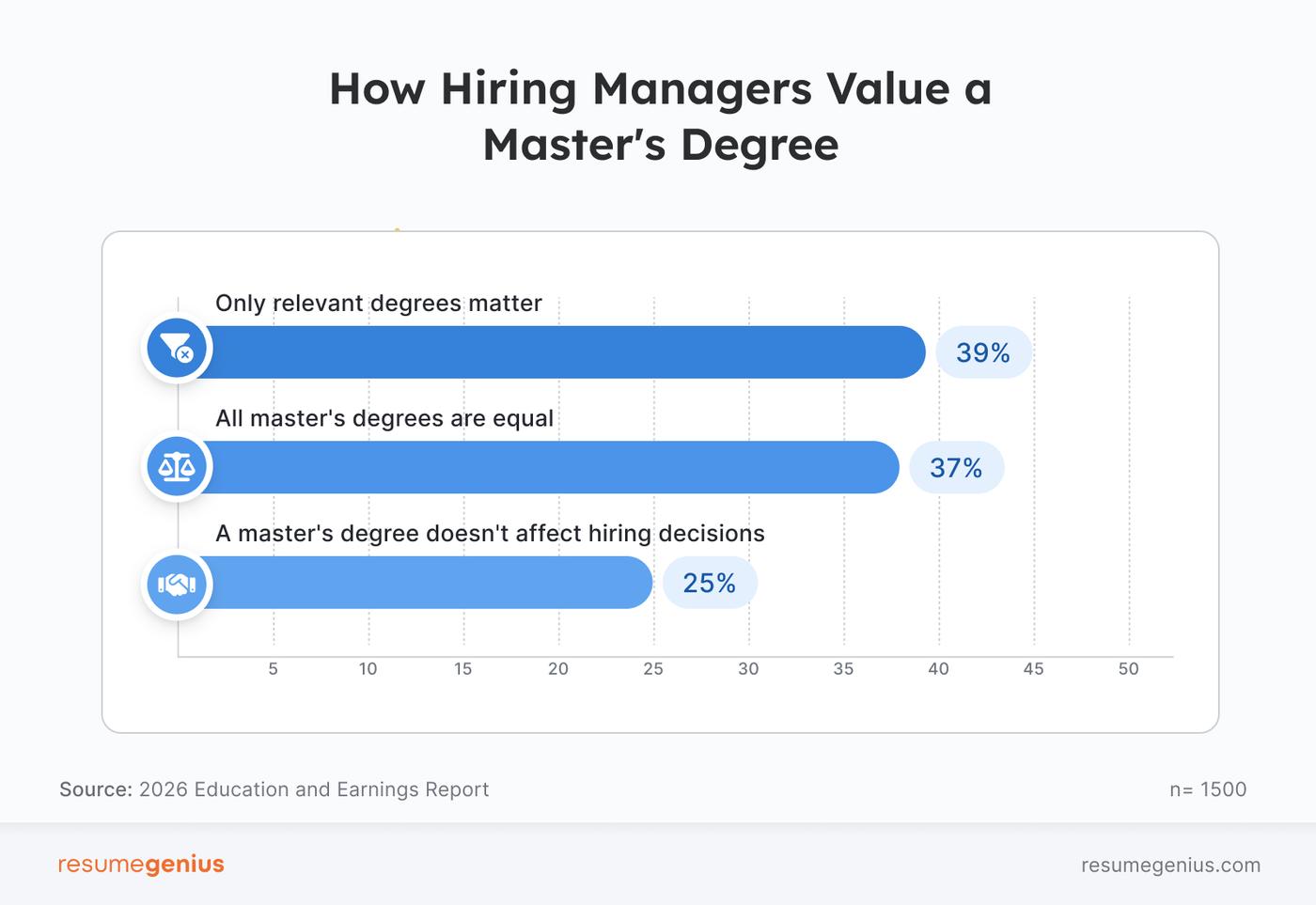
Nearly 2 in 3 hiring managers (62%) don’t care what type of master’s degree you have. They either view all master’s degrees similarly (37%) or don’t factor degree type into hiring decisions at all (25%).
Only 39% of hiring managers say the specific degree matters — and even then, only if it’s directly relevant to the role.
| Sector | Only directly relevant master's degrees matter | Any master's degree is viewed similarly | The master's degree doesn't factor in the decision |
| Technology | 45% | 38% | 17% |
| Education | 43% | 47% | 10% |
| Healthcare & social assistance | 42% | 40% | 18% |
| Business & professional services | 44% | 31% | 25% |
| Transportation | 41% | 35% | 24% |
| Finance & banking | 41% | 43% | 16% |
| Government | 34% | 39% | 28% |
| Manufacturing, engineering, & construction | 35% | 39% | 26% |
| Retail | 24% | 35% | 42% |
Master’s degrees help career progression, not entry-level hires
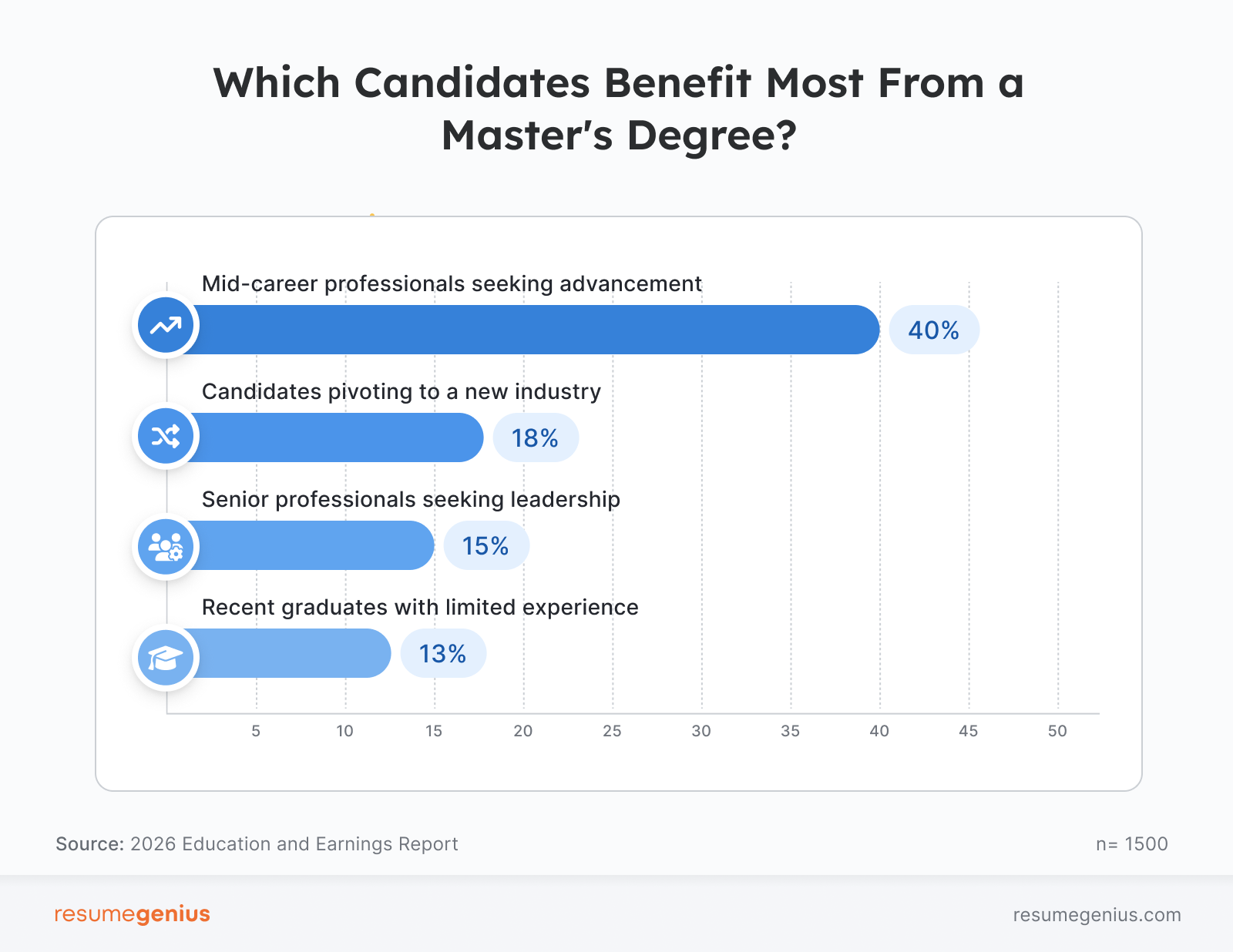
When we asked hiring managers which candidates benefit most from a master’s degree, the answer was clear: candidates already established in their careers.
A master’s degree only adds value if you already have work experience. According to hiring managers, mid-career professionals who advance within their field benefit the most.
If you’re thinking about grad school right out of undergrad, here’s the reality: only 13% of hiring managers say it helps recent graduates. That means 87% of them don’t see it as valuable for entry-level candidates.
Hiring managers ranked the following groups by who benefits most:
- 40% say mid-career professionals advancing in their current field benefit most
- 18% say candidates pivoting to a new industry or function benefit most
- 15% say a master’s degree doesn’t add meaningful value for anyone
- 15% say senior professionals seeking leadership roles benefit most
- 13% say recent graduates with limited work experience benefit most
Conclusion
A master’s degree isn’t universally valuable. It depends almost entirely on your industry, your career stage, and what you’re trying to accomplish.
Our report found that hiring managers increasingly view a master’s degree as optional, not essential — especially for entry-level candidates. Two years of solid work experience is just as valuable. However, for mid-career professionals advancing within their field, a master’s degree can offer real advantages, particularly in tech and education.
Before you take on the time and debt of grad school, ask yourself: Will this specific degree help me in my specific industry at my specific career stage? If you’re mid-career and it’s directly relevant, it might be worth it. If you’re just starting out, your time and money might be better spent building real-world experience instead.
Methodology
This report came from a Pollfish survey launched from June 12–24, 2026, via Pollfish, targeting a sample of 1,500 participants. The survey examined hiring manager perceptions of master’s degree holders versus bachelor’s degree holders with two years of equivalent work experience, based on Radford’s Career Ladder system.
Qualifying respondents were required to be working as a hiring manager, or be part of the hiring team in their company. Resume Genius analyzed the results for overall trends and differences across age, industry, and gender. Percentages were rounded to the nearest whole number.
To minimize bias, Pollfish uses Random Device Engagement (RDE) to ensure a fair and organic selection process. For further details on Pollfish’s methodology, please visit their website or contact eduardo@resumegenius.com.
About Resume Genius
Since 2009, Resume Genius and its resume builder software have been helping people from all backgrounds and experience levels land their next job faster.
Resume Genius also provides a wide range of free career resources, including customizable resume templates, resume examples for different industries, and resume writing guides, to help job seekers find fulfilling work and reach their career goals.
Resume Genius is led by a team of dedicated career advisors and HR experts and has been featured in The New York Times, Harvard Business Review, Fast Company, CNBC, and USA Today.
For media inquiries, please contact us.
About the Author

Eva Chan is a Senior Digital PR Writer and Communications Lead at Resume Genius. Eva oversees the research and data-led campaigns that reveal key trends in today’s workforce and represents the company in media interviews and press features. Her work focuses on guiding job seekers through today’s job market and helping them present their applications and skills with confidence.