


Struggling to get interviews?
Adding core competencies to your resume is a great way to communicate the value you bring. Learn how to include them correctly with our examples and guide.
Key takeaways
- Core competencies are broader than individual skills
- Place core competencies near the top of your resume for visibility
- Including core competencies helps with ATS optimization
- You can have both a core competencies section and a separate skills section
What are core competencies?
Core competencies are the key strengths, skills, and abilities that depict what you do best in your profession. When included on your resume, they showcase your most marketable qualifications (including both hard and soft skills) and help you stand out from other candidates.
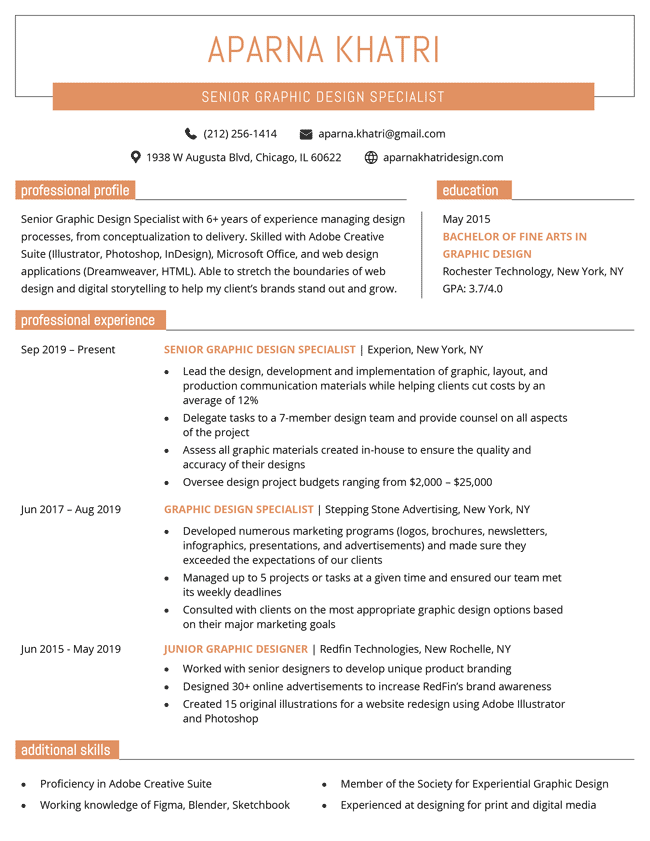
Your core competencies should appear in a dedicated section near the top of your resume, ideally right below your resume’s header, like this:
[Your Name]
[Your Email Address] | [Your Phone Number]
Core competencies: JIRA & Agile Software | Customer & data analysis | SWOT analysis | Market research & trend analysis | Leadership | Strategic planning | Cross-functional team collaboration | Quality assurance | Risk management
How are core competencies different from skills?
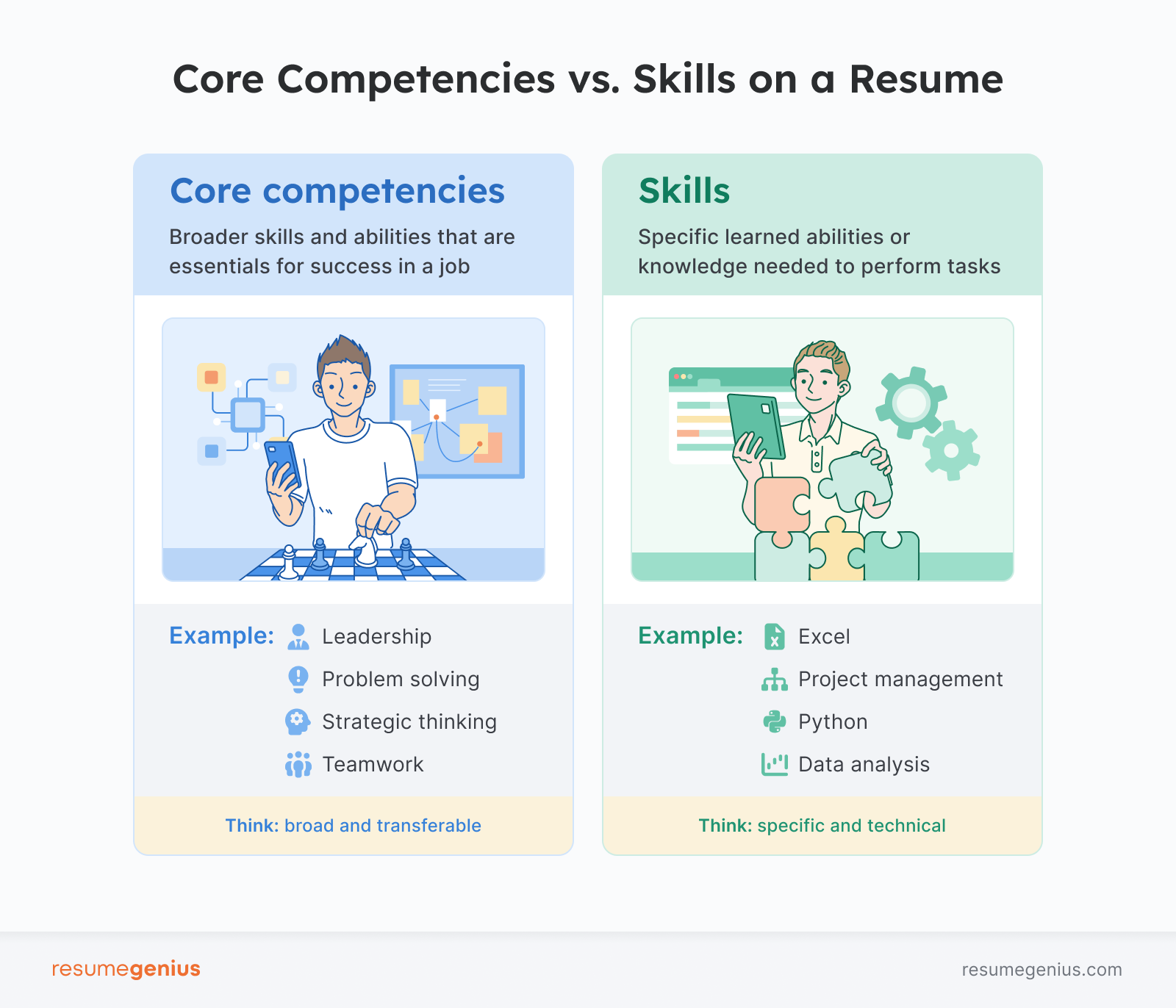
Skills and core competencies both describe your abilities, but they differ in scope:
- Core competencies are your broad, role‑defining strengths. They often combine multiple skills, knowledge areas, and professional traits, such as leadership, problem solving, and strategic thinking.
- Skills are specific, tangible abilities, like software, tools, certifications, or technical know‑how.
You can include both a core competencies section and a skills section on your resume, as long as they serve different purposes: use the core competencies section to communicate your overall value and expertise, and use the skills section to list concrete abilities that support those strengths.
The benefits of including a core competencies section
Listing core competencies helps you stand out by showing hiring managers your most valuable strengths right away. It immediately communicates that you’re broadly qualified and highlights the qualities that make you an ideal candidate for the job.
A core competencies section can also boost your chances of passing applicant tracking systems (ATS) by naturally incorporating important keywords from the job description.
How to list core competencies on your resume
Create a dedicated section near the top of the page, typically right beneath your name, contact information, and professional summary. Choose 6–12 competencies that align with the job description and reflect both your hard and soft skills.
Keep the format clean and easy to scan by separating each competency with vertical bars or bullets.
Jordan Taylor
jordan.taylor@email.com
(555) 123-4567
Core Competencies:
Project Management | Team Leadership | Strategic Planning | Data Analysis | Communication | Problem Solving | Budgeting | Agile Methodologies
Examples of core competencies employers are looking for
To help you start your resume, here are some of the most valued core competencies to include on your resume.
Communication
Communication skills reflect your ability to clearly share expectations, information, and ideas with others. They show employers you can collaborate with customers, coworkers, and leaders.
List on your resume:
- Email writing
- Telemarketing
- Negotiation
- Public speaking
- Verbal communication
- Written communication
- Active listening
- Presentation skills
- Conflict resolution
- Negotiation
- Clarity and conciseness
- Feedback delivery
Customer service
Customer service skills show employers that you can provide great service, help customers walk away happy, and represent the company in a positive way.
List on your resume:
- Customer support
- Phone or email correspondence
- Time management
- Patience
- Empathy
- Positive attitude
- Product knowledge
- Complaint handling
- Responsiveness
- Service personalization
- Time management
Leadership
Leadership skills show that you know how to achieve goals, meet deadlines, and motivate others to perform at their best.
List on your resume:
- Delegating
- Giving and receiving feedback
- Conflict resolution
- Organization
- Motivating others
- Decision-making
- Team motivation
- Emotional intelligence
- Vision and strategy
- Accountability
- Coaching and mentoring
- Adaptability
- Performance management
Adaptability
Adaptability shows employers you can adjust quickly to new situations to change and handle new challenges confidently.
List on your resume:
- Fast learner
- Communication
- Analytical thinking
- Strategic planning
- Flexibility
- Handling change
- Emotional resilience
- Open-mindedness
- Multitasking
- Decision-making under pressure
Innovation
Innovation shows you can think creatively and develop original solutions to new problems.
List on your resume:
- Creative thinking
- Brainstorming
- Analytical thinking
- Continuous learning
- Risk-taking
- Process improvement
- Research and development
- Trend analysis
Problem solving
Problem solving is valuable in every industry. Employers look for this core competency because it shows you can handle high-pressure situations and turn challenges into actionable solutions.
List on your resume:
- Brainstorming
- Decision making
- Risk assessment
- Mediation
- Conflict resolution
- Research skills
- Collaboration
- Resourcefulness
- Data interpretation
- Creativity
- Root cause analysis
Cost reduction
Listing core qualifications that show you can reduce costs is instantly attractive for any company. When hiring managers see evidence that you can save the company money and deliver value beyond what they expect from an average hire, they’ll be more likely to bring you in to learn more.
List on your resume:
- Budgeting
- Critical analysis
- Efficient employee management
- Cost analysis
- Negotiation
- Process optimization
- Waste reduction
- Lean management
- Resource management
- Vendor management
- Financial forecasting
- Strategic sourcing
Salesmanship
Most companies provide a product and/or service. Highlighting your ability to drive sales, whether through direct marketing, face-to-face interaction, or online platforms, gives hiring managers confidence that you can contribute to the company’s success.
List on your resume:
- Direct marketing
- Communication
- Rapport building
- Negotiation
- Customer Service
- Product knowledge
- Active listening
- Persuasion
- Cold calling
- Client relationship management (CRM)
- Sales presentations
- Closing techniques
Technical skills
Including core competencies on your resume that highlight your technical skills proves you have the specific knowledge needed to do the job. If you’re applying for tech or engineering positions, highlighting your technical competencies is essential.
List on your resume
- Programming languages (e.g., Python, Java)
- Software proficiency
- Data analysis
- Cloud computing (e.g., AWS, Azure)
- Networking and IT infrastructure
- Cybersecurity
- Troubleshooting
- Database management (e.g., SQL)
- Automation tools (e.g., PowerShell)
- Version control (e.g., Git)
Teamwork
Collaboration and teamwork are essential in any workplace. Employers value candidates who can work effectively with others to achieve the company’s mission.
List on your resume:
- Mediation
- Communication
- Delegation
- Attention to detail
- Networking
- Empathy
- Collaboration
- Conflict resolution
- Emotional intelligence
- Adaptability
- Active listening
- Accountability
- Flexibility
Research
Any job that relies on quality information needs someone who can find credible sources and analyze them carefully.
List on your resume:
- Literature review
- Hypothesis testing
- Survey design
- Primary and secondary research
- Statistical analysis
- Market research
- Fieldwork
- Report writing
- Critical thinking
- Fact checking
- Attention to detail
- Data analysis
Decision making
In many roles, urgent problems come up and decisions have to be made quickly. An employee who can stay calm, assess the situation, and make clear decisions is a valuable asset.
List on your resume:
- Analytical thinking
- Leadership
- Professionalism
- Risk assessment
- Critical thinking
- Data interpretation
- Prioritization
- Strategic planning
- Problem solving
- Cost-benefit analysis
Computer skills
Computer skills are valuable for most jobs and are especially important if you work in tech, engineering, or design.
If you already know the software the position requires, employers don’t need to spend time or money training you, which makes you a more attractive candidate.
List on your resume:
- Microsoft Office (Word, Excel, PowerPoint)
- Email management (e.g., Outlook, Gmail)
- Typing proficiency
- File management
- Internet research
- Data entry
- Basic coding (e.g., HTML, CSS)
- Cybersecurity awareness
- Presentation software (e.g., Google Slides)
- Cloud collaboration tools (e.g., Google Drive)
- Python
- Adobe Creative Suite
- Social media
- Content management systems
- Cloud management
Organizational skills
Organizational skills show employers you can manage your time, prioritize tasks, and stay productive with minimal supervision.
List on your resume:
- Coordination
- Scheduling
- Attention to detail
- Cleaning
- Facilitation
- Time management
- Prioritization
- Multitasking
- Task delegation
- Attention to detail
- Calendar management
- Goal setting
- File organization
- Project planning
Interpersonal skills
Interpersonal skills reflect how you communicate and build relationships with others. Employers value candidates with great interpersonal skills because they work well with clients, customers, and coworkers.
List on your resume:
- Communication
- Emotional intelligence
- Active listening
- Negotiation
- Reliability
- Empathy
- Active listening
- Conflict resolution
- Building rapport
- Team collaboration
- Positive attitude
- Cultural sensitivity
About the Author

Lauren Mastroni is a Senior Digital Content Writer at Resume Genius, where she creates data-driven career content and actionable job search advice. With a background in academic research, she brings a research-focused approach to topics like resume writing, interviewing, and career development. Lauren is dedicated to helping job seekers at all stages navigate the hiring process and present themselves more effectively to employers.


Click to rate this article
4.5 Average rating