Written By Lauren MastroniCareer Expert & Senior Digital Content Writer
Reviewed By Samuel JohnsSenior Content Editor & Certified Professional Resume Writer
Lauren Mastroni
Career Expert & Senior Digital Content Writer
5 years of experience
Lauren Mastroni is a Senior Digital Content Writer at Resume Genius, where she creates data-driven career content and actionable job search advice. With a background in academic research, she brings...
Occupational therapy is an exciting yet competitive career that requires technical knowledge and people skills. A well-written occupational therapist cover letter is one of the best ways to show you have both. Use our free downloadable sample and writing tips to create yours.
Copy-paste Occupational Therapist Cover Letter (Text Format)
FIRST AND LAST NAME
Email: your.email@email.com
Phone: (123) 456-7891
Address: Street, City, State
LinkedIn: linkedin.com/in/yourprofile
[Today’s Date]
[Hiring Manager’s Name] 123 Company Address Company’s City, State, Zip Code (xxx) xxx-xxxx hiring.manager@gmail.com
Dear [Mr./Ms./Mx.] [Hiring Manager’s Last Name],
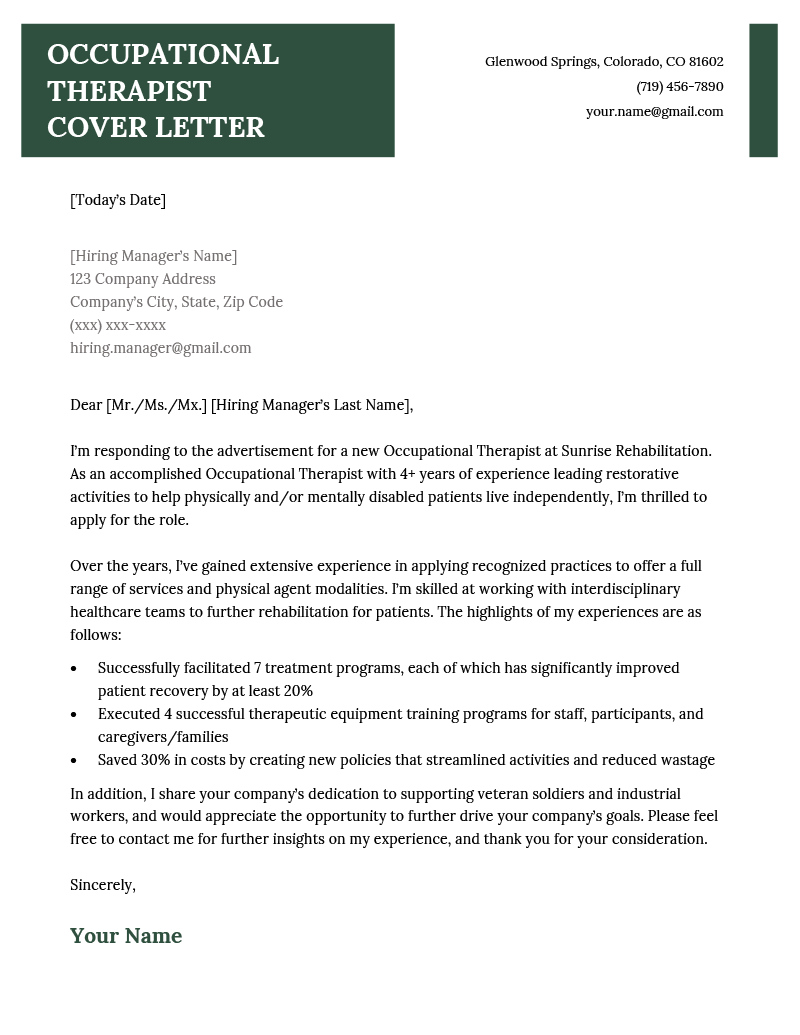
I’m responding to the advertisement for a new Occupational Therapist at Sunrise Rehabilitation. As an accomplished Occupational Therapist with 4+ years of experience leading restorative activities to help physically and/or mentally disabled patients live independently, I’m thrilled to apply for the role.
Over the years, I’ve gained extensive experience in applying recognized practices to offer a full range of services and physical agent modalities. I’m skilled at working with interdisciplinary healthcare teams to further rehabilitation for patients. The highlights of my experiences are as follows:
Successfully facilitated 7 treatment programs, each of which has significantly improved patient recovery by at least 20%
Executed 4 successful therapeutic equipment training programs for staff, participants, and caregivers/families
Saved 30% in costs by creating new policies that streamlined activities and reduced wastage
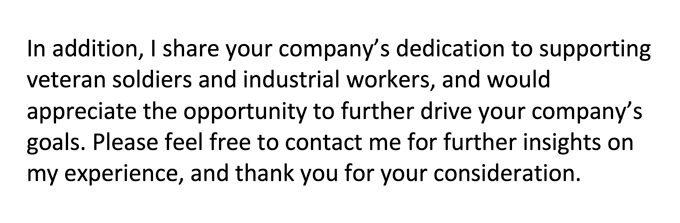
In addition, I share your company’s dedication to supporting veteran soldiers and industrial workers, and would appreciate the opportunity to further drive your company’s goals. Please feel free to contact me for further insights on my experience, and thank you for your consideration.
Sincerely,
Your Name
Writing tips for your occupational therapist CV
Here are three things to remember when you write your occupational therapy cover letter.
1. Use the right cover letter format
Occupational therapist cover letters follow the same cover letter format used for most industries.
Your cover letter should be concise and well-structured so the employer can scan it and quickly determine if you’re qualified for the job.
Similar to a standard business letter, your occupational therapist cover letter should open with the following:
A brief introduction (including your name, specialty, the job title you’re applying for, and your reason for applying)
In the body of your cover letter, you should outline your suitability for the role and state your reasons for applying.
Highlight common values or experiences valuable to the specific position.
Finally, end your cover letter with a call-to-action requesting an interview and thanking the employer for the opportunity.
2. Demonstrate the right occupational therapist skills
As occupational therapy roles involve both medical and caregiving duties, occupational therapists need to demonstrate several hard and soft skills (technical skills and personality traits).
Your cover letter is the right place to demonstrate soft skills that a resume can’t fully capture. The table below lists the top-rated soft skills for occupational therapists from the O*NET database, each with a concrete example that integrates relevant hard skills.
Skill
Example Sentence
Active listening
"I conduct structured intake interviews to identify patients' priority ADLs and functional goals so the treatment plan reflects patient priorities, not a default protocol."
Monitoring
"I track functional performance metrics across sessions in Casamba to document progress toward ADL goals and adjust treatment intensity when plateau patterns emerge."
Service orientation
"I adapt treatment activities to each patient's home environment, cultural context, and physical tolerance so interventions translate to real-world function, not just clinic performance."
Reading comprehension
"I review physician orders, evaluation reports, and prior OT notes before the initial session to build a complete clinical picture and avoid redundant assessments."
Writing
"I write progress notes and discharge summaries in the EHR using functional outcome language so payers, physicians, and care coordinators can evaluate treatment effectiveness without clinical interpretation."
Including bullet points can also be very helpful for making your letter easier to skim.
3. Outline your motivations for applying
In addition to wanting qualified, knowledgeable staff, employers want occupational therapists that will reflect their organization’s core values and principles.
Show that your values are aligned with the employer by doing background research.
Look at the employer website’s “About Us” section and any press releases they’ve put out to identify core values, brands, and areas of specialty. You can use this information to show how working for the employer serves your professional interests or career path.
Aligning yourself with the employer’s values suggests you’ll be a good fit for the team.
Average occupational therapist salaries in the US
The following table includes information from O*NET Resource Center by the U.S. Department of Labor, Employment and Training Administration (USDOL/ETA). Used under the CC BY 4.0 license, this data is pulled from the most recent US Bureau of Labor Statistics’ Employment & Earnings report (as of 10/16/2024), featuring the top states by use.
Top 10 states by average occupational therapist salary
Lauren Mastroni is a Senior Digital Content Writer at Resume Genius, where she creates data-driven career content and actionable job search advice. With a background in academic research, she brings a research-focused approach to topics like resume writing, interviewing, and career development. Lauren is dedicated to helping job seekers at all stages navigate the hiring process and present themselves more effectively to employers.
We hope our free downloadable resources will help you on your path to career success. If you have time, a quick review would really make our day (it'll only take 15 seconds). Best of luck on the job hunt!