Business Manager Resume Examples & Writing Guide
 Written By Lauren MastroniCareer Expert & Digital Content Writer
 Reviewed By Geoffrey ScottSenior Hiring Manager & Career Coach
Lauren Mastroni is a Digital Content Writer at Resume Genius, where she creates data-driven career content and actionable job search advice. With a background in academic research, she brings a...
To complete your application, pair your resume with a tailored manager cover letter.

Business manager resume examples by experience level
Find resume designs for any job in our collection of resume templates.
Related Resume Samples
View All Resume Examples
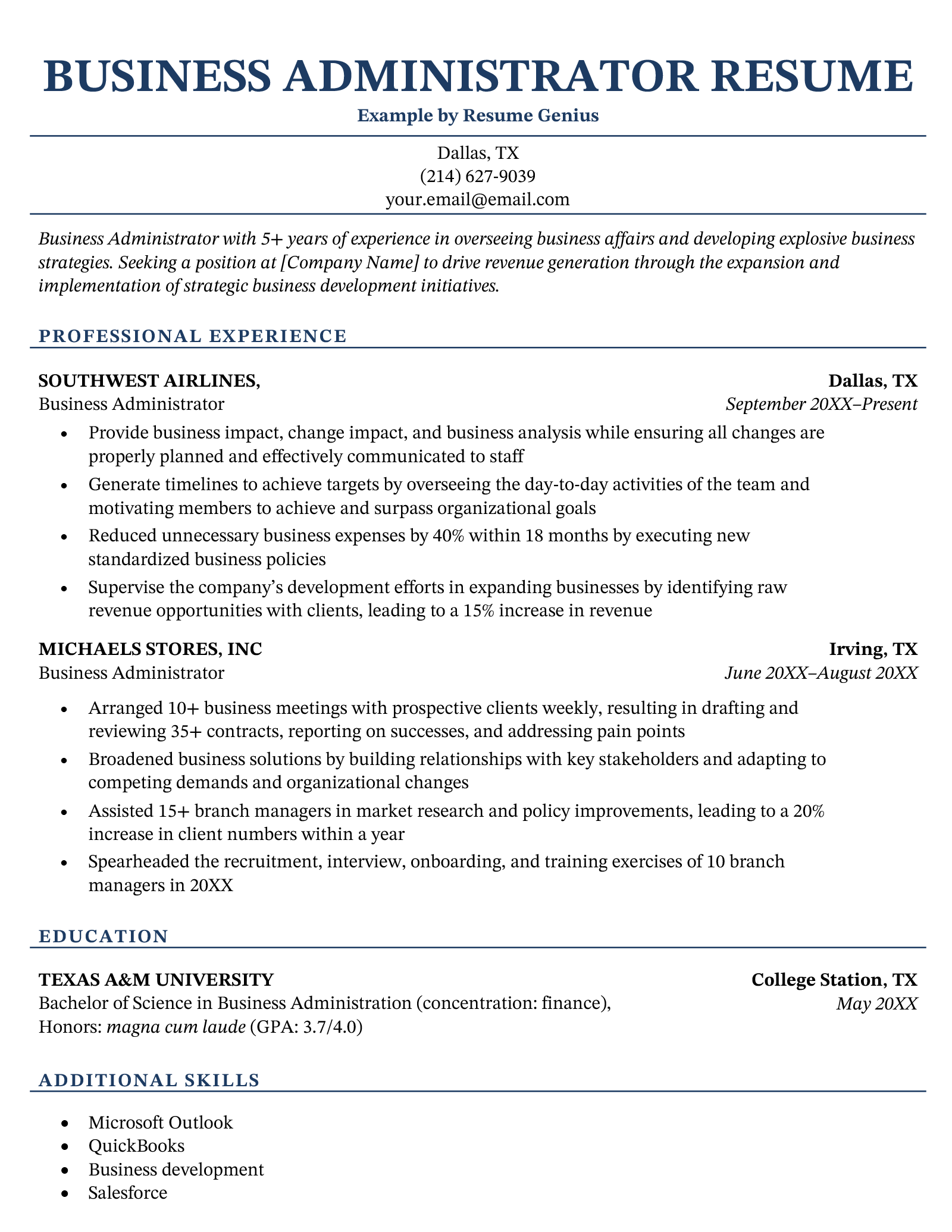
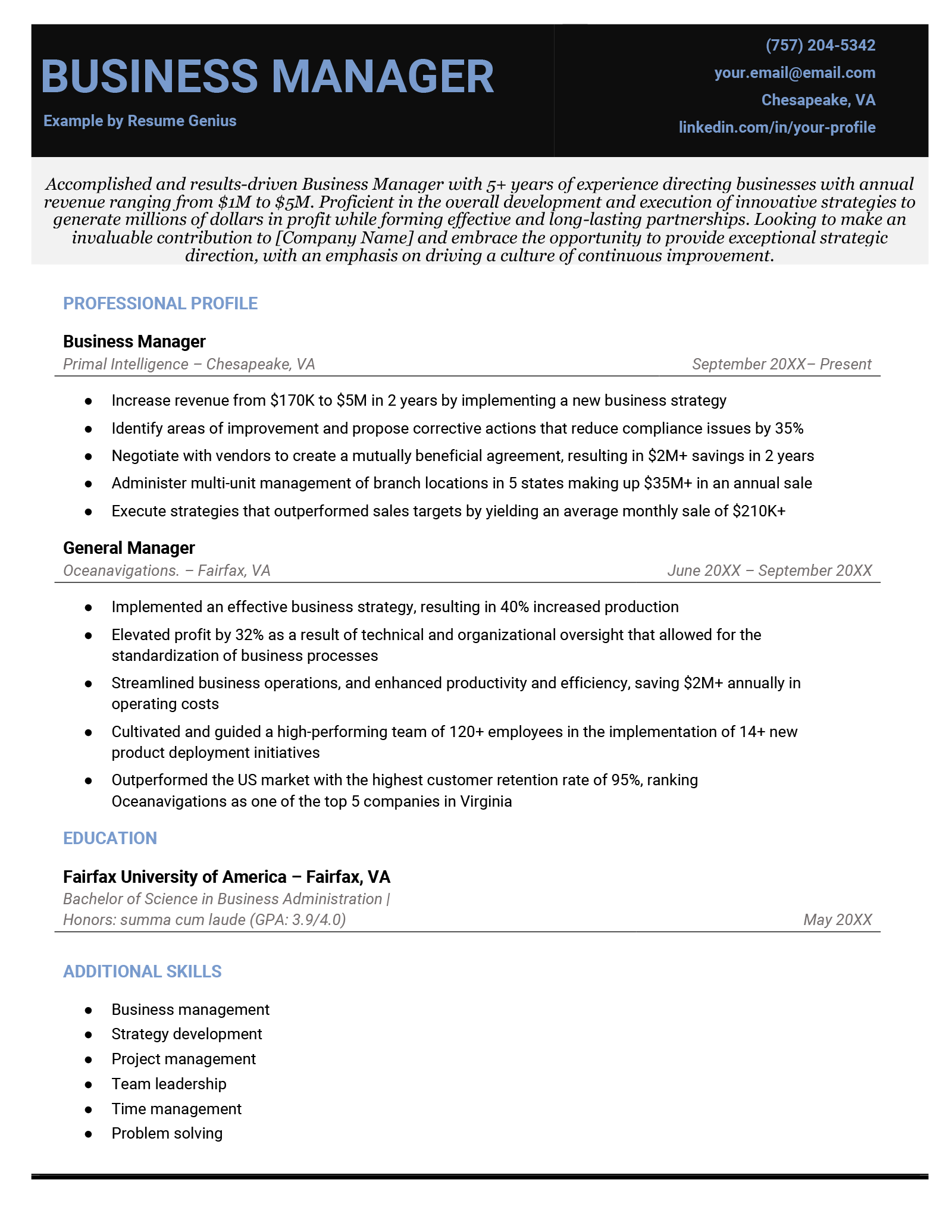
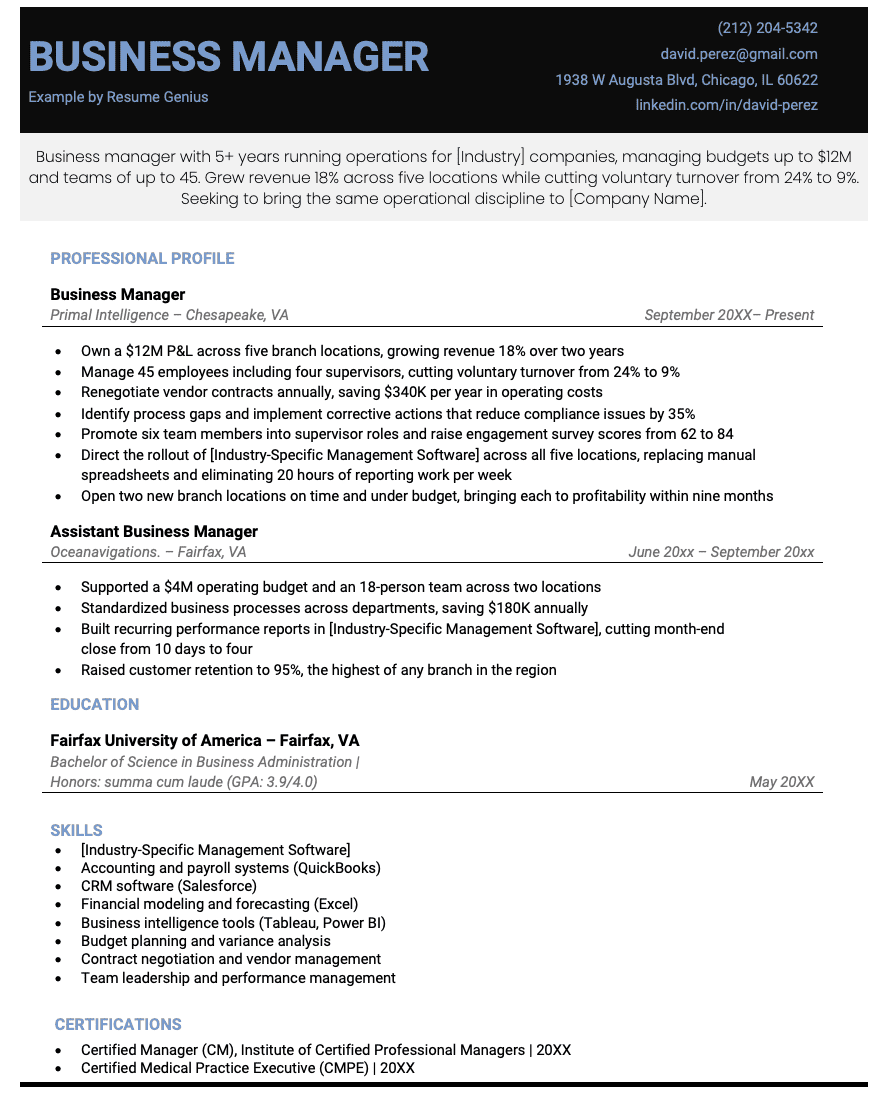
Business manager resume template
[Your Name]
[Your Address], [City, State]
[Your Email Address] | [Your Phone Number]
[LinkedIn Profile] (optional)
Professional Summary
Business manager with 5+ years running operations for [Industry] companies, managing budgets up to $12M and teams of up to 45. Grew revenue 18% across five locations while cutting voluntary turnover from 24% to 9%. Seeking to bring the same operational discipline to [Company Name].
Skills
- [Industry-Specific Management Software]
- Accounting and payroll systems (QuickBooks)
- CRM software (Salesforce)
- Financial modeling and forecasting (Excel)
- Business intelligence tools (Tableau, Power BI)
- Budget planning and variance analysis
- Contract negotiation and vendor management
- Team leadership and performance management
Certifications
Certified Manager (CM), Institute of Certified Professional Managers | 20XX
[Industry-Specific Certification, e.g., Certified Medical Practice Executive (CMPE)] | 20XX
Professional Experience
Primal Intelligence
Business Manager | Chesapeake, VA | May 20XX – Present
- Own a $12M P&L across five branch locations, growing revenue 18% over two years
- Manage 45 employees including four supervisors, cutting voluntary turnover from 24% to 9%
- Renegotiate vendor contracts annually, saving $340K per year in operating costs
- Identify process gaps and implement corrective actions that reduce compliance issues by 35%
- Promote six team members into supervisor roles and raise engagement survey scores from 62 to 84
- Direct the rollout of [Industry-Specific Management Software] across all five locations, replacing manual spreadsheets and eliminating 20 hours of reporting work per week
- Open two new branch locations on time and under budget, bringing each to profitability within nine months
Oceanavigations
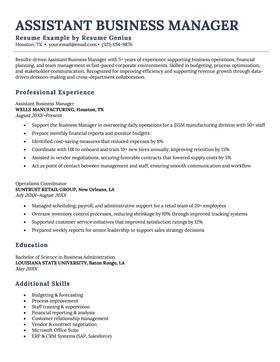
Assistant Business Manager | Fairfax, VA | August 20XX – April 20XX
- Supported a $4M operating budget and an 18-person team across two locations
- Standardized business processes across departments, saving $180K annually
- Built recurring performance reports in [Industry-Specific Management Software], cutting month-end close from 10 days to four
- Raised customer retention to 95%, the highest of any branch in the region
Education
Resume Genius University | Bachelor of Science in Business Administration
Graduation Date: May 20XX
How to write a business manager resume
Here are some tips to guide you as you write your resume:
1. Lead with the scope you managed
Employers screening business manager resumes look for size first: how much money you controlled, how many people reported to you, and how many locations you covered. Put those numbers in your resume summary and in the opening bullet of each job.
Scope comes down to four details:
- Budget: The annual revenue, operating budget, or cost center you owned
- Headcount: How many people you managed, and whether any of them were managers themselves
- Footprint: The number of sites, business units, or product lines under you
- Change: What improved while you ran it
Compare these two bullets:
Good
Managed a $12M P&L across five branch locations, growing revenue 18% in two years while cutting operating costs by $340K
Bad
Managed daily operations and led a team to hit company targets
The good bullet answers the size question before the employer has to ask it.
If you can’t share exact figures, use ranges or percentages — “a team of 20+” and “a seven-figure budget” both work.
2. Target your resume to the industry
“Business manager” means something different in every industry, and employers hire for industry knowledge as much as management ability.
The requirements swing hard by sector. A biotech company wants you to interpret clinical trial data and explain gene editing mechanisms to physicians. A retail brand wants CRM familiarity and time on the sales floor. A software company hiring for sales operations wants advanced Excel modeling and an MBA. Little of that overlaps, so a resume built for one sector reads as underqualified for the others.
When in doubt, read the posting and mirror the specific knowledge and abilities it names.
Start with the software the industry runs on.
Employers prefer someone who already knows the tools they use, so what is the default stack in your field? Retail and hospitality managers are expected to know the POS and inventory systems. Small-business and nonprofit managers are expected to know QuickBooks. Agency and sales-side managers are expected to know Salesforce.
Find out what your target industry uses, and list it by name if you use it.
When you know the category but not the specific platform, list the category with the industry standard named inside it:
- Accounting and payroll systems (QuickBooks): Shows you work with this class of software day to daycopied
- ERP platforms (NetSuite): Signals you understand how the system fits the business, even if your experience is on a different platformcopied
That framing is accurate and it opens the conversation. Managers who understand how one accounting system works pick up the next one quickly, and employers know it.
The limit is honesty: don’t name a platform you can’t discuss in an interview.
As you write targeted resumes, don’t forget to specify the industry in your other resume sections:
- Summary: Name the sector and your years in it — “Business manager with six years in clinical-stage biotech”
- Bullets: Use industry-specific measurements, whether that’s units sold, trials supported, accounts retained, or claims processed
- Education, certifications, licenses: List relevant qualifications and required licenses
- Skills: Identify necessary hard skills and high-priority soft skills for your industry
3. Back up your leadership skills with evidence
Every business manager resume claims team leadership, so the claim by itself does nothing. Prove it with something an employer can check.
Certifications
A credential shows you were trained and tested, not just present. These carry weight for business managers:
- Certified Manager (CM): General management fundamentals
- Project Management Professional (PMP): For roles heavy on project delivery
- Certified Management Accountant (CMA): For finance-focused roles
- Certified Professional in Supply Management (CPSM): For procurement and operations roles
- SHRM-CP: For roles that include people operations
Awards and recognition
Manager of the year, a company leadership program, Toastmasters accreditation, or selection for a high-potential track all confirm someone above you evaluated and rated your leadership skills.
People metrics
If you have management experience, these are strong evidence for your capabilities:
- Employee engagement or team cohesion survey scores
- Direct reports you promoted into higher roles
- Training completion or certification rates on your team
- Safety records or compliance audit results
Compare a claim to a proof:
Bad
Excellent team leadership and communication skills
Good
Raised team engagement scores from 62 to 84 in 18 months by restructuring weekly check-ins and starting a peer mentoring program
Good
Cut voluntary turnover from 24% to 9% across a 40-person department and promoted six team members into supervisor roles
You can still list leadership skills in your skills section, and you should when the posting names them, because the ATS looks for the exact terms. Treat that list as keyword coverage rather than as your case. The evidence in your experience section is what convinces the person reading it.
Build your resume in minutes

Average business manager salaries in the US
After you’ve written your resume, make sure you use it to apply for jobs within a fair salary range.
The following table includes information from the US Bureau of Labor Statistics’ latest Occupational Employment and Wage Statistics report for 2026. Here are the ten states with the highest salaries for business managers, as well as the national average for your reference when applying for work.
Top 10 states by average business manager salary
| State | Salary / Year |
|---|---|
| New Jersey | $205,250 |
| District of Columbia | $179,130 |
| New York | $167,820 |
| Connecticut | $167,400 |
| Delaware | $163,820 |
| Colorado | $161,970 |
| Washington | $158,920 |
| Massachusetts | $155,020 |
| South Dakota | $153,020 |
| California | $152,250 |
| National Average | $134,940 |
About the Author

Lauren Mastroni is a Digital Content Writer at Resume Genius, where she creates data-driven career content and actionable job search advice. With a background in academic research, she brings a research-focused approach to topics like resume writing, interviewing, and career development. Lauren is dedicated to helping job seekers at all stages navigate the hiring process and present themselves more effectively to employers.


Click to rate this article
4.8 Average rating