

Announcing on LinkedIn that you’ve just landed a new job is a great way to share your excitement about starting a new chapter in your life while keeping your professional network up-to-date on your latest career changes.
What to say in your new job announcement
A good LinkedIn job announcement should be professional, positive, and concise. The goal is to share your excitement, acknowledge the people who helped you along the way, and give your network a clear idea of what you’ll be doing next.
While there’s no single formula for writing a new job announcement, consider doing the following:
- Share your news: Start by clearly stating that you’ve accepted a new position so readers immediately understand the purpose of your post.
- Mention your new role and company: Include your job title and employer to give your connections context about your next career move.
- Express your enthusiasm: Briefly explain why you’re excited about the opportunity to create a positive and engaging tone.
- Thank those who helped you: Acknowledge mentors, colleagues, managers, friends, or family members who supported you throughout your career journey.
- Highlight what you’re looking forward to: Mention a specific aspect of the role, company, or industry that excites you to show genuine interest in the opportunity.
- Add a personal touch: Including a brief reflection, lesson learned, or career milestone can make your announcement feel more authentic and memorable.
- Include a photo if appropriate: Adding a professional photo or company image can help your post attract more attention and engagement on LinkedIn.
I am excited to announce that I’ve been offered a position at Ocula Arts and I start next week. I would never be here today making this announcement if it weren’t for Agata who onboarded and trained me and Julien who led our team with such skill. I learned so much about branding and content strategy from you. Shoutout to Sam and Steven for all your support. I’ll miss our morning coffees and daily chats.
How to post your new job announcement
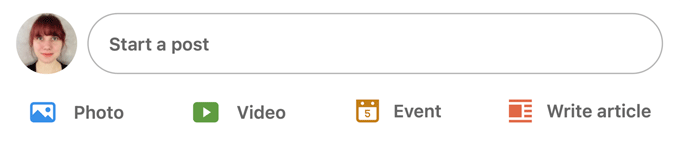
To share the news that you’re changing jobs, click “Start a post” at the top of your feed:
Then, write your announcement and click the “Post” button:
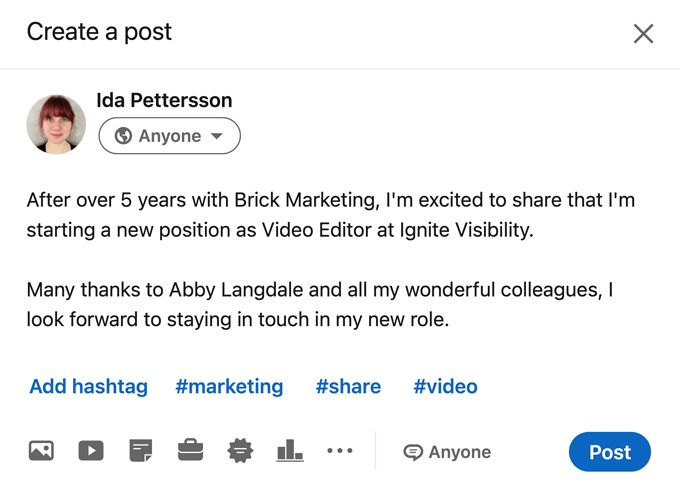
You can choose whether you want anyone on LinkedIn to be able to see your post, or if you only want to share your new job announcement with people in your network.
When to announce your new job on LinkedIn
Time your new job announcement correctly to avoid getting in trouble with both your current and future employer:
Announce your job change:
- After you’ve signed your new contract, informed your current employer that you’re leaving the company, and sent a goodbye email to your coworkers
- Or on your first day or in the first week of starting, so you have a bit more information about the office and their new colleagues
How to announce a promotion on LinkedIn
When you announce a promotion on LinkedIn, it’s better to add your new role as a new entry in your work experience section rather than update your current role. This gives a more accurate reflection of your work history.
Include the following information in your promotion announcement post:
- Your new title
- A thank you to colleagues who supported you in the past
- What your new position entails
I’m happy to announce that I’ve been promoted to the position of Human Resources Manager at Zilch. I look forward to helping ensure Zilch remains a safe, diverse, and inclusive workplace and launching several exciting new initiatives to promote core company values. I’d like to give a shoutout to my director, Caleb Baker, for his invaluable advice and eagerness to help. I wouldn’t be where I am today without the team I worked with for the last two years. Thank you!
New job announcement examples
Here are some example job announcements that you can adjust to fit your specific circumstances:
I’m thrilled to announce that I’ve accepted a full-time position at Retro Fitness! Starting in July, I’ll join the company in the position of Digital Marketing Manager.
I’d like to thank my colleagues at Rejoy and give special thanks to Jenny Collins for her expert guidance and constructive feedback, and Nicholas Olsen for his never-ending support. While I’m sad to leave, I’m looking forward to taking on a new challenge
In this example, the candidate focuses on expressing thanks and is appreciative of their previous employer and colleagues who supported them during their time there.
After an incredible journey at OPPO, I’m excited (and a little sad!) to share that I’m moving on to pursue a new opportunity as a UI/UX Designer at Samsung.
The past three years here have been nothing short of amazing. I’ve been lucky to work with an insanely talented and supportive team, and I’m beyond grateful for the growth, collaboration, and all the milestones we’ve hit together. To everyone on the OPPO design team, you’ve truly made this experience unforgettable, and I’ll miss working alongside each of you!
Here’s to new adventures and continuing to chase my passion for design and innovation. Onward!
In this example, the writer focuses on showing appreciation for the team they worked with over the last few years, which emphasizes the strong connections they made with colleagues at work.
Today is my first day as a senior editor at Nectar Zine and after looking at this month’s content calendar I can already tell the next few years are going to be a wild ride. I am so excited to spend my days writing, editing, and collaborating with some of the most talented creatives in LA. I’m looking forward to diving into fresh work and publishing vanguard thinking.
This candidate has written a future-focused new job announcement that shows hope and excitement.
About the Author

Lauren Mastroni is a Senior Digital Content Writer at Resume Genius, where she creates data-driven career content and actionable job search advice. With a background in academic research, she brings a research-focused approach to topics like resume writing, interviewing, and career development. Lauren is dedicated to helping job seekers at all stages navigate the hiring process and present themselves more effectively to employers.