

Struggling to get interviews?
Show employers what you can do with these programming project ideas for your resume. Each one highlights practical skills and real-world applications.
Why include programming projects on your resume?
Whether you’re new to coding or a seasoned programmer, including projects on your resume highlights your skills and experience to employers, helping you stand out from the competition. It also shows that you’re:
- Self-motivated and able to finish a challenging task from start to finish
- Actively using your programming skills
- Continuing to learn new frameworks and languages
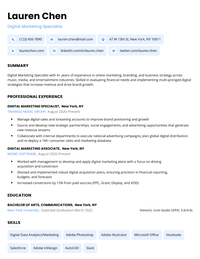
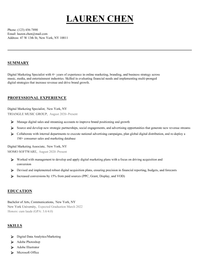
Our resume builder can make you a resume in as little as 5 minutes. Pick the template you want, and our software will format everything for you.
Programming projects to make your resume stand out
Here are some popular programming projects to include on your resume:
1. An online portfolio
An online portfolio shows your work in one place and makes it easy for employers to review your skills. Use it to highlight your strongest projects, explain your process, and demonstrate the results you achieved.
Include a link to your portfolio in your resume header or contact section so employers can access it quickly.
What to include in your portfolio:
- A short description of each project
- Technologies and tools used (e.g., Python, React, SQL)
- Your role and contributions
- Measurable results (if available)
- Links to live demos or GitHub repositories
2. Websites
Building websites shows your ability to design, develop, and launch functional products. Employers look for clean code, responsive design, and user-focused features.
Include website projects that match the role you’re applying for. Focus on the technologies you used, the problems you solved, and the results you achieved.
If possible, link to a live version of the site or your GitHub repository so employers can review your work.
What to highlight:
- Frontend and backend technologies (e.g., HTML, CSS, JavaScript, React, Node.js)
- Key features (e.g., user authentication, payment systems, dashboards)
- Performance improvements or optimizations
- Any measurable impact (traffic, conversions, load time improvements)
3. Utility mobile or web applications
Utility apps show your ability to solve real problems with practical tools.
Choose apps that demonstrate clear use cases, such as productivity tools, trackers, or automation tools. Focus on how your app works, the technologies you used, and the value it provides to users.
Include a link to the app or repository so employers can review your work.
What to highlight:
- Core functionality and purpose of the app
- Technologies used (e.g., React Native, Flutter, Django, Firebase)
- Key features (e.g., data storage, notifications, integrations)
- Performance improvements or user impact
4. Games
Game development shows your ability to solve complex programming problems and build interactive systems.
Include games that highlight your technical skills, such as physics engines, AI behavior, or real-time interactions. Link to a playable version or repository so employers can test your work.
What to highlight:
- Game engine or framework (e.g., Unity, Unreal Engine, Pygame)
- Core mechanics (e.g., physics, collision detection, AI behavior)
- Performance improvements or optimizations
- User engagement or feedback (if available)
5. An API
Building an API shows your ability to handle data and connect applications.
Include APIs that solve a clear problem, such as managing data, integrating third-party services, or supporting a web or mobile app. Add a link to your documentation or repository so employers can review your code and endpoints.
What to highlight:
- Technologies used (e.g., Node.js, Express, Django, Flask)
- API design (RESTful or GraphQL)
- Key features (e.g., authentication, data processing, integrations)
- Performance improvements or scalability
6. Web scraping
Web scraping projects show your ability to collect and process large sets of data. They also demonstrate problem-solving skills, especially when working with messy or constantly changing sources.
Focus on projects where you gathered useful data and turned it into something meaningful, such as insights, reports, or automated workflows. Employers want to see how you handled data extraction, cleaning, and analysis.
Include a link to your code or output so employers can understand your approach.
What to highlight:
- Tools and libraries used (e.g., Python, BeautifulSoup, Scrapy, Selenium)
- Type of data collected and how you used it
- Any automation or scheduling features
- Results, such as improved efficiency or insights generated
7. Machine learning
Machine learning projects show employers that you can go beyond basic programming and apply advanced techniques to real-world scenarios.
Include projects where you trained a model, evaluated its performance, and used the results to make decisions or improve outcomes. Link to your code, dataset, or notebook so employers can review your work.
What to highlight:
- Algorithms or models used (e.g., regression, classification, neural networks)
- Tools and frameworks (e.g., Python, TensorFlow, PyTorch, scikit-learn)
- Data preprocessing and feature selection
- Model performance (accuracy, precision, recall, etc.)
How to add programming projects to your resume
Here are three different ways to feature programming projects on your resume:
Option 1: Make a dedicated projects section
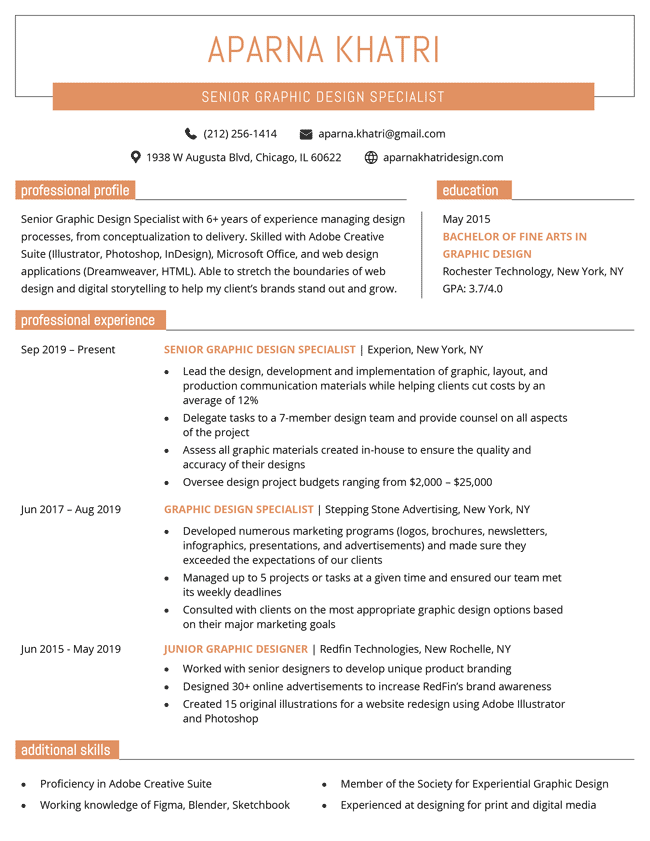
Create a separate Projects section and format it like a work experience section. This approach works well if you have limited professional experience or if your projects closely match the job requirements.
Use clear titles and structured bullet points to show what you built, how you built it, and the results you achieved.
Include the following for each project:
- Project name
- Technologies used (e.g., Python, React, SQL)
- Link to GitHub, portfolio, or live demo
- Brief description of the project
- Key achievements or results (use metrics when possible)
For example:
Task Management App
React, Node.js, MongoDB
https://github.com/yourname/task-app
- Built a full-stack task management app with user authentication and real-time updates
- Improved user productivity by adding reminders and deadline tracking features
- Reduced load time by 30% through performance optimization
E-commerce Website
HTML, CSS, JavaScript, Stripe API
https://shopdemo.com
- Developed a responsive e-commerce website with secure payment processing
- Increased conversion rates by 20% with a simplified checkout flow
- Designed product pages to improve user experience and navigation
Option 2: Mention projects in your work experience section
Include projects as part of your work experience if they are closely related to the job you’re applying for. List the project under the relevant job or role and describe your contributions.
For example:
Software Developer
TechNova Solutions | San Francisco, CA
June 20XX – Present
- Developed a customer analytics dashboard using React and Python, improving reporting efficiency by 35%
- Built and integrated a REST API to support real-time data updates across internal tools
- Led the redesign of the company website, increasing user engagement by 25%
Option 3: Include projects in your education section
Add projects to your education section if you completed them as part of coursework, bootcamps, or certifications. List the project under your degree or program and briefly describe what you built and the skills you used.
For example:
Bachelor of Science in Computer Science
University of Michigan | Ann Arbor, MI
Graduated: May 20XX
- Student performance prediction model: Built a machine learning model using Python and scikit-learn to predict student outcomes based on academic data
- Full-stack web application: Developed a task management app using React and Node.js with user authentication and real-time updates
About the Author

Lauren Mastroni is a Senior Digital Content Writer at Resume Genius, where she creates data-driven career content and actionable job search advice. With a background in academic research, she brings a research-focused approach to topics like resume writing, interviewing, and career development. Lauren is dedicated to helping job seekers at all stages navigate the hiring process and present themselves more effectively to employers.