



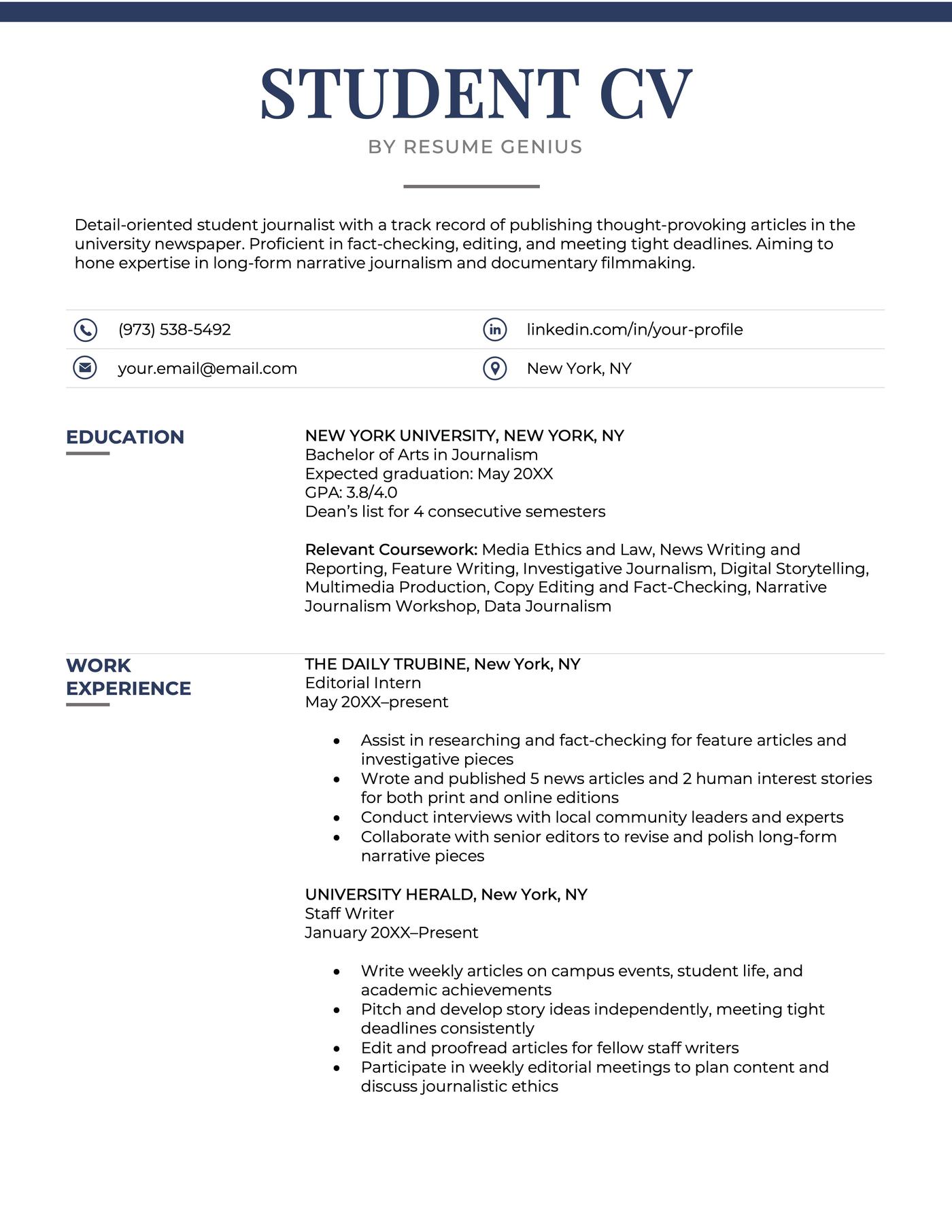
College student CV example
This undergraduate CV example shows how to make a strong case for yourself using the experience you already have. Highlight your most relevant qualifications, present them with confidence, and show how your skills and interests connect to the role you’re pursuing.
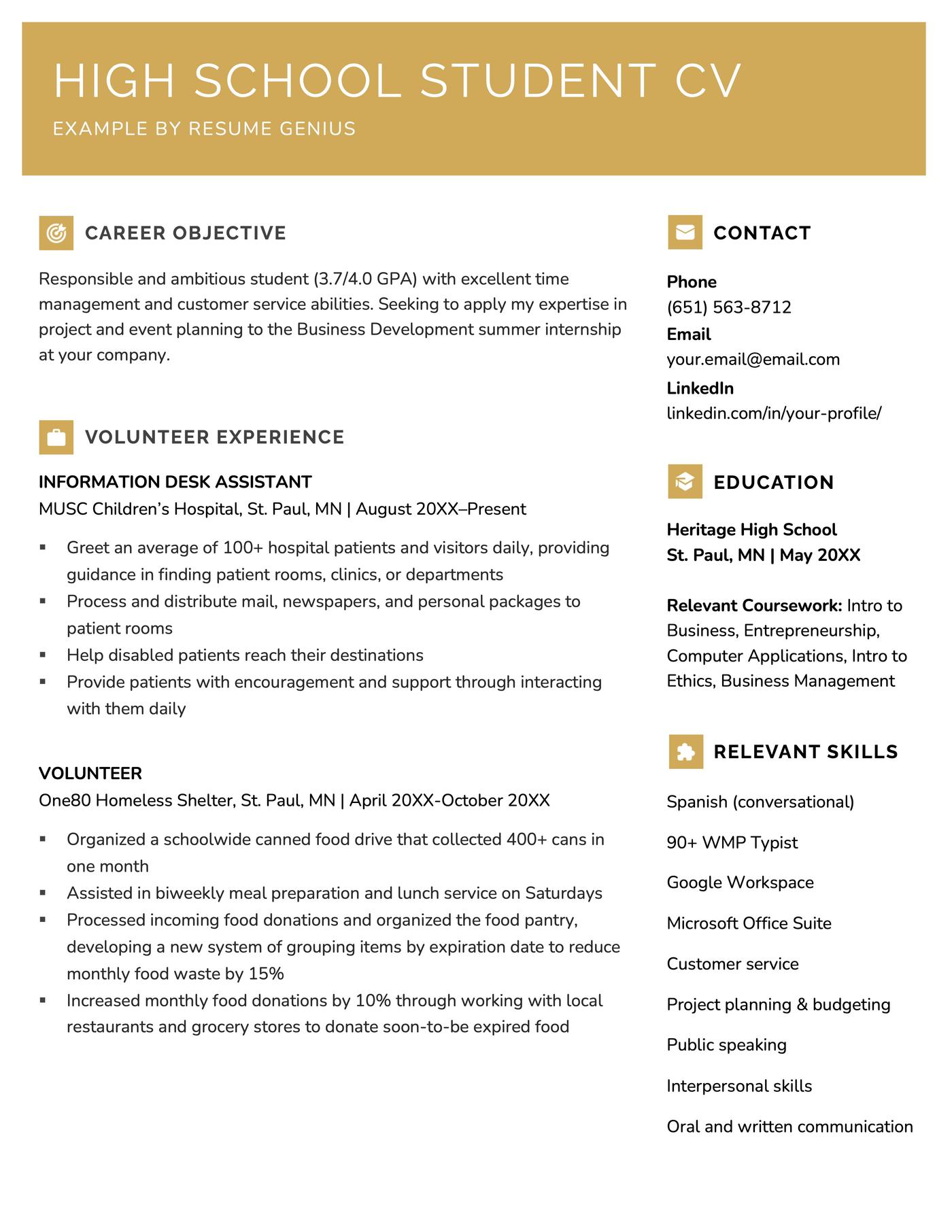
High school student CV example
As a high school student, your CV should focus on your academic achievements, extracurricular activities, and any volunteer work or part-time jobs you’ve held.
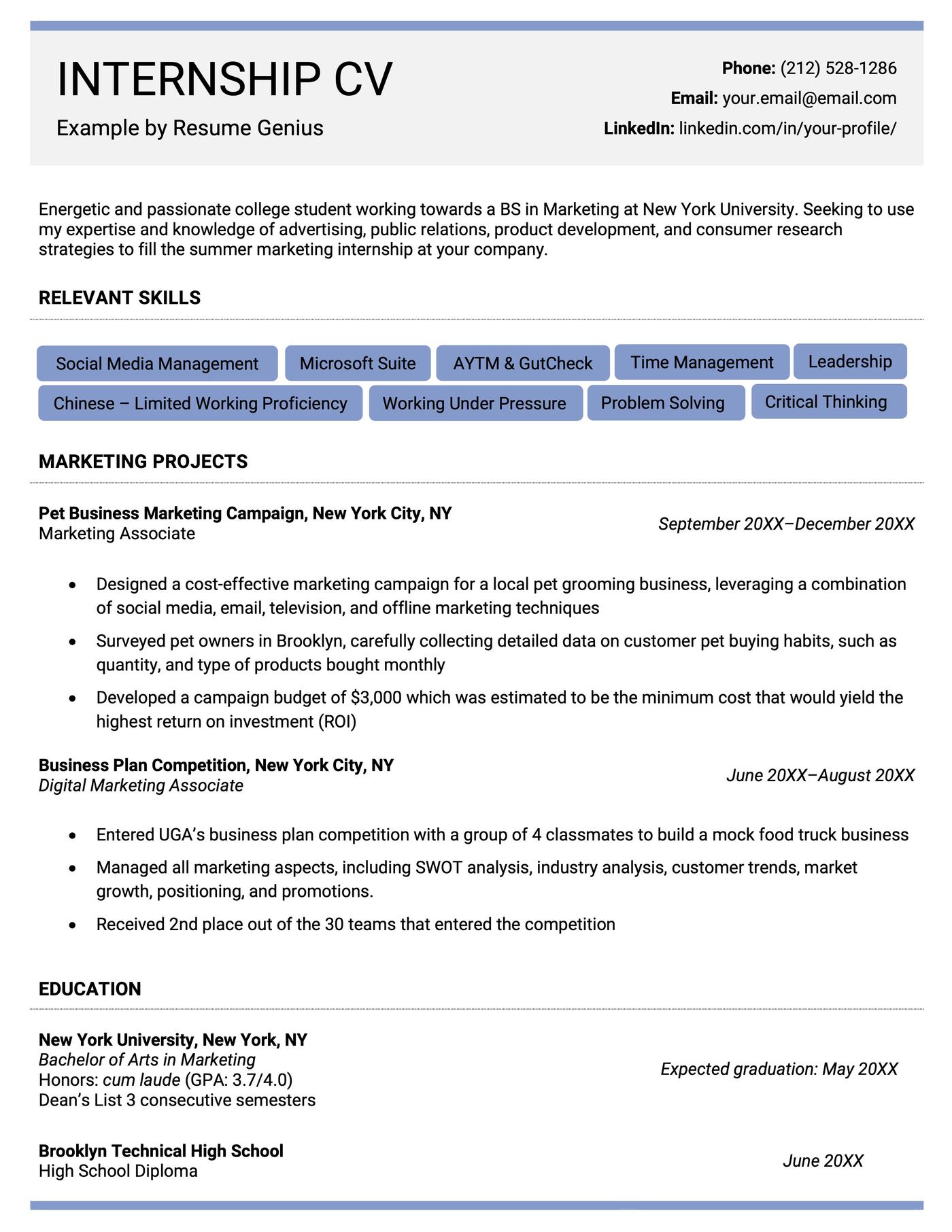
Internship CV example
When applying for internships, focus your CV on relevant coursework, academic projects, and skills that match the internship’s requirements.
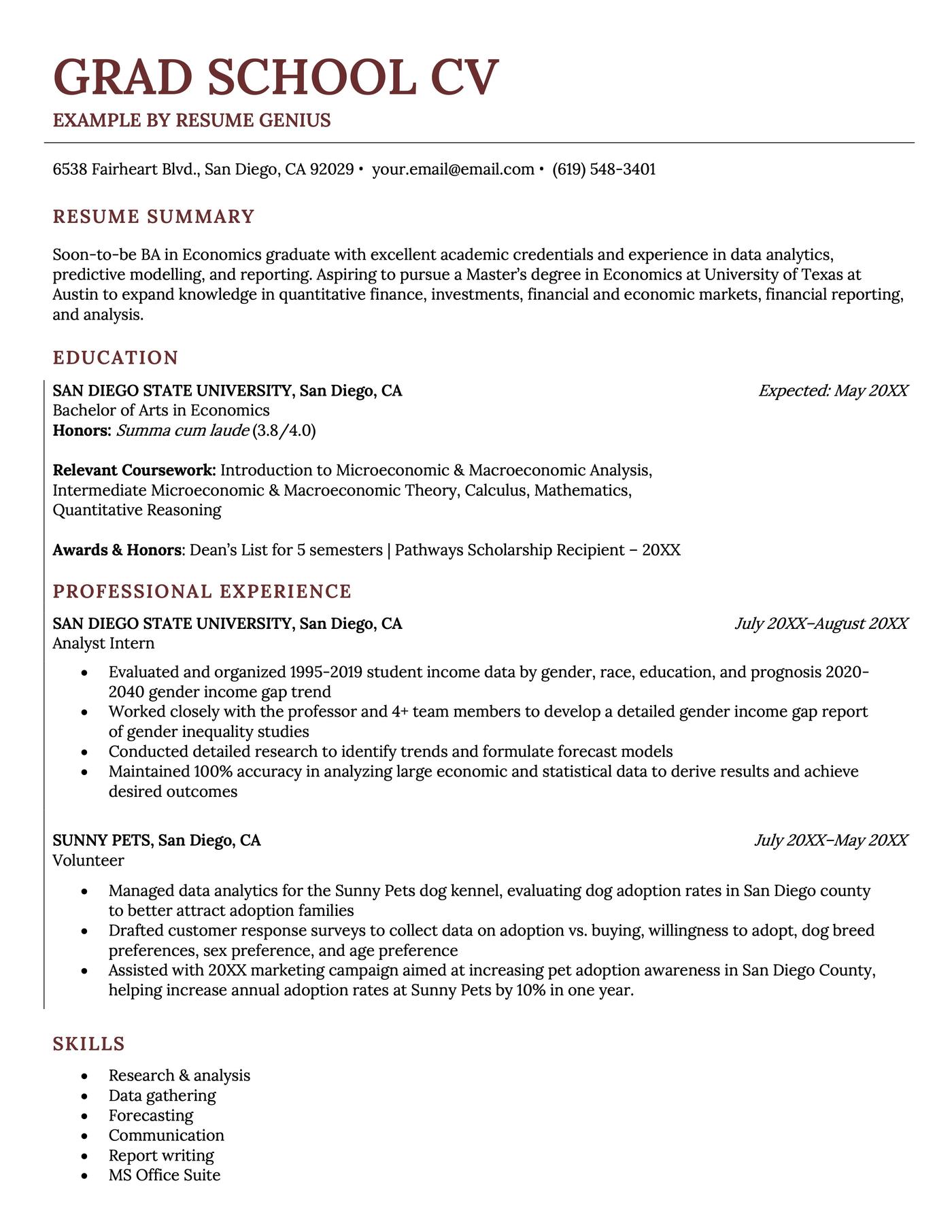
Grad school CV example
On a CV for a grad school application, emphasize your academic achievements and research experience.
Academic CV example
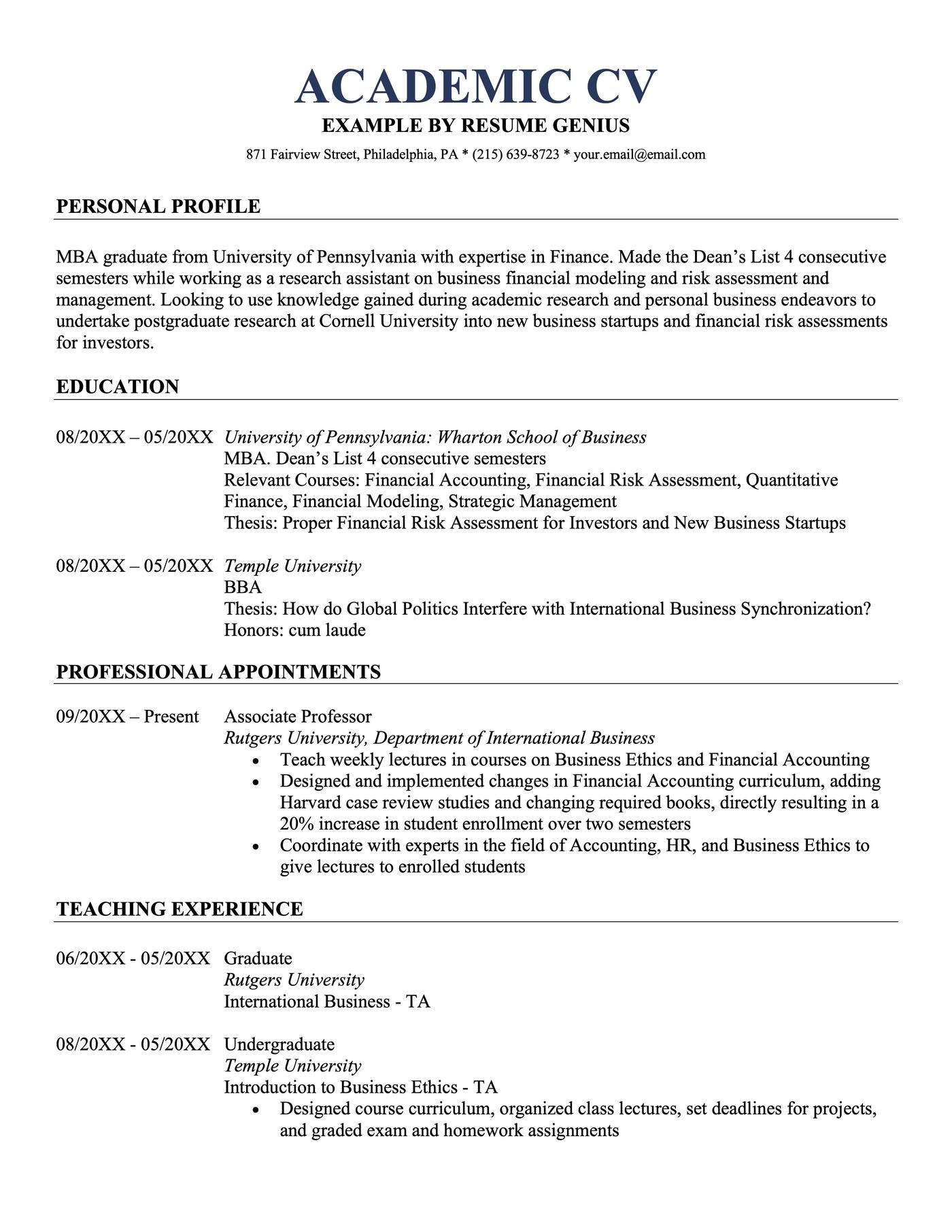
An academic CV is used for positions in academia or research and is more detailed than a standard CV (or resume).

Include information about any grants, fellowships, or funding you’ve received. Also, list your professional memberships, academic honors, and relevant skills such as language proficiency or specialized research techniques.
Academic CVs are typically longer than standard CVs and should include more detail about your scholarly achievements and contributions to your field.
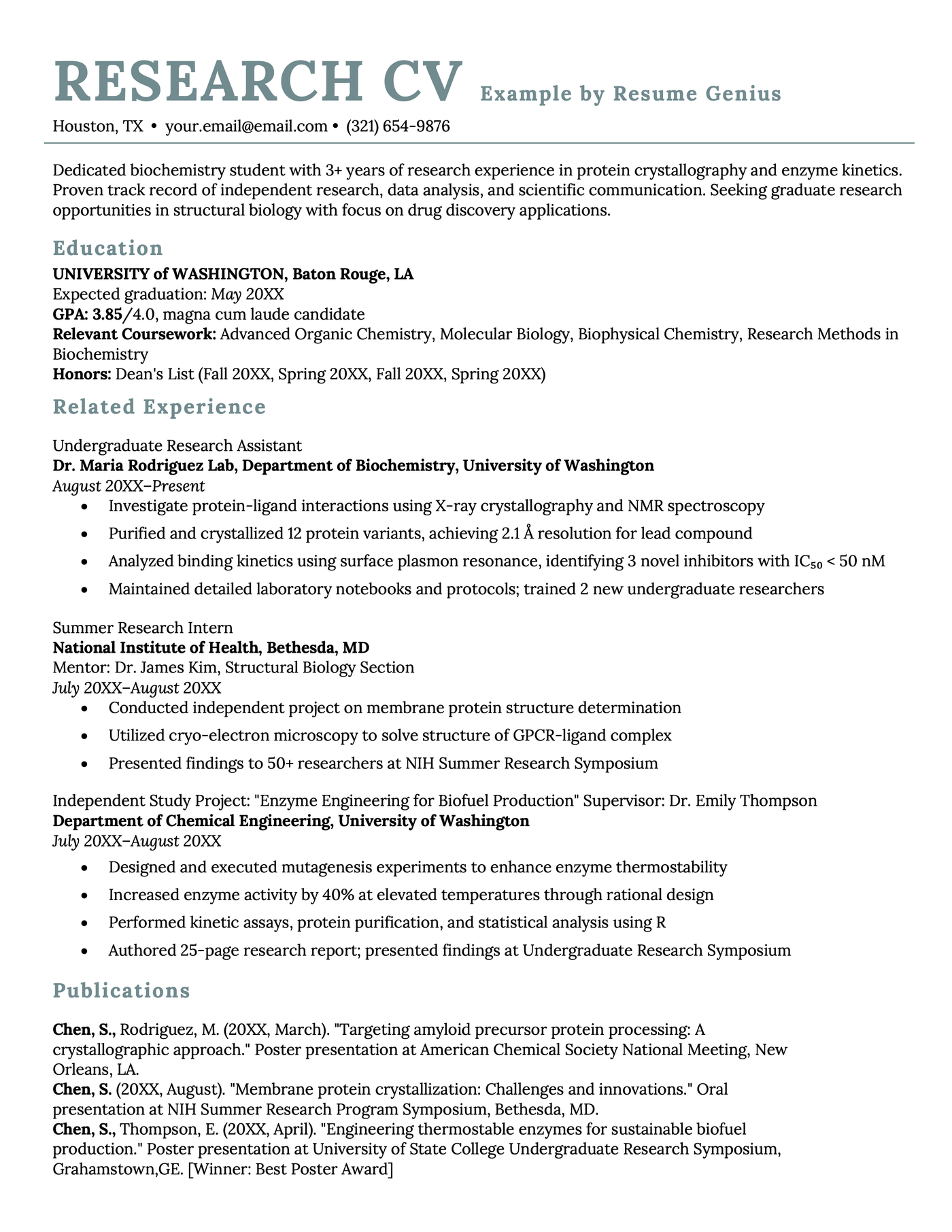
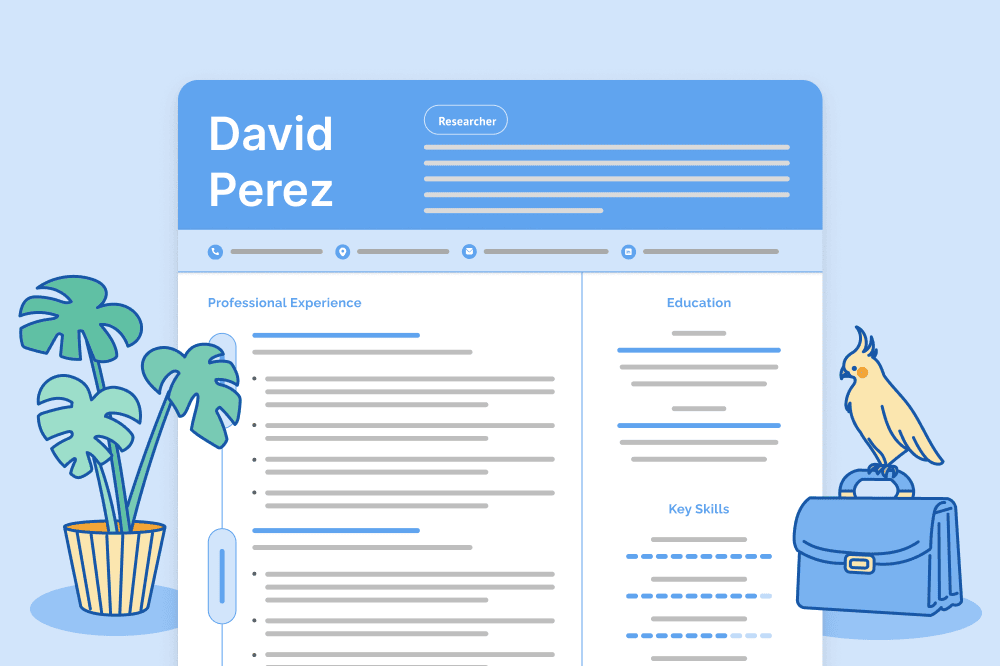
Research CV example
If you’re applying for a research role, include your relevant research projects, conference presentations, publications, and lab work on your CV.
CV template for students
Here’s a student CV template you can use when applying for jobs or internships:
Email | Phone | Address | LinkedIn
Professional Summary
Soon-to-be graduate with [degree] and [# of years] experience. Strong [relevant skills]. Seeking to leverage my [academic background and expertise] to fill [job position] and help achieve [Company Name]’s goals.
Education
Degree Name / Major
University, Location | Start Date – End Date (or Expected Graduation Date)
- List your GPA (if 3.5 and above)
- Display any honors you have, such as making the Dean’s list
- Include any coursework that’s relevant to the job you’re applying to
Relevant Experience
Most Recent Title or Position
Employer Name / Location / Start Year – End Year
- Include a bulleted list of relevant responsibilities and achievements
- Quantify your experience by adding numbers to give the hiring manager a better grasp of your experience
- Be as specific as possible. Use software, tools, or programs names
Previous Title or Position
Employer Name / Location / Start Year – End Year
- Use the past tense of verbs if you’re no longer in this position
- Include at least three bullet points per entry
- Use action verbs instead of phrases like “responsible for” and “duties included”
Skills
- Include a bulleted list of skills gained from college, work, volunteering, or internships
- Prioritize skills that match the job you’re applying for
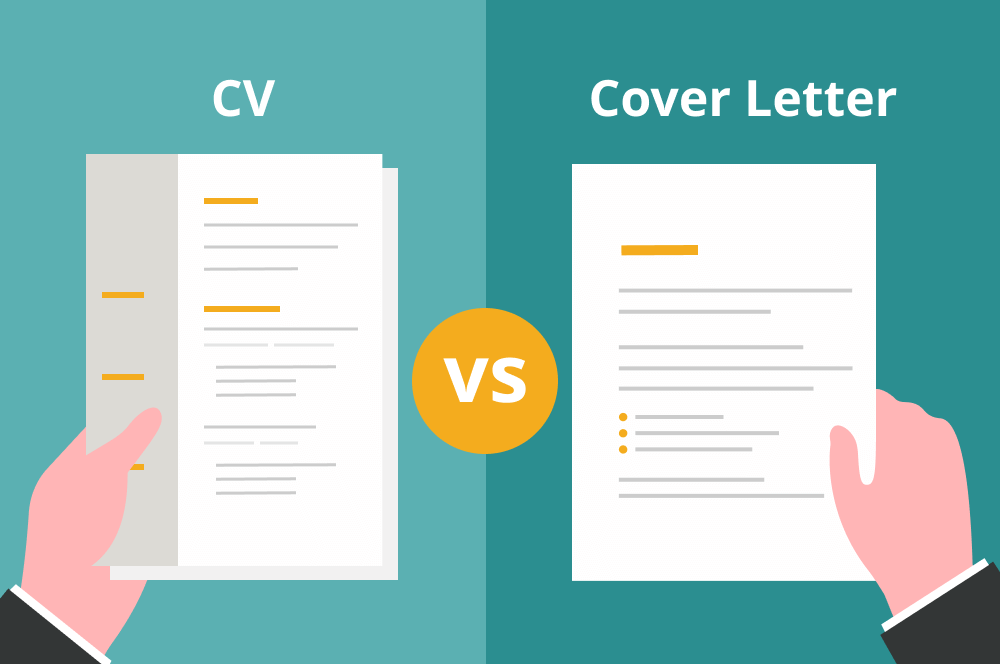
Unsure whether to use a CV or resume? In most cases, CVs are used for academic positions, while resumes are used for jobs outside of academia.
How to write a student CV
Here are some tips to help you start writing your CV.
1. Include the right sections
CVs are flexible, so you can adjust the layout to highlight your strengths (whether that’s academics, extracurriculars, or projects), especially if you lack formal work experience.
Start with the following core sections, then add optional sections that help you showcase your potential
Necessary sections for a student CV
Your CV should always include these core sections:
- Contact information: Name, phone number, email address, LinkedIn profile (if relevant), and city/state.
- Education: Degree, university name, (expected) graduation date, GPA (if 3.5+), relevant coursework, academic honors.
- Experience: Internships, part-time jobs, volunteering, leadership roles.
Optional sections for a student CV
Depending on what you want to emphasize, adding optional sections can strengthen your CV and help it stand out:
- Personal statement: 2–4 sentence introduction highlighting your academic focus, career goals, and key strengths.
- Skills: Technical and role-relevant hard skills.
- Certifications: Licenses, short courses, or certifications that align with your target role.
- Extracurricular activities: Student government, clubs, sports, or event planning roles.
- Projects: Academic/personal/freelance projects that show skills in action.
- Awards and honors: Scholarships, academic awards, or other forms of recognition.
- Publications: Particularly useful for writing or research-heavy fields.
- Languages: Include your proficiency level if you’re multilingual.
2. Expand your education section
As a student, your education is likely your strongest asset, so make sure your education section stands out by listing all of the details relevant to the job, such as:
- Academic honors like cum laude or making the Dean’s list
- Awards or scholarships
- Relevant coursework
- Projects
Here’s a great example of an effective education section for an aspiring journalist:
EDUCATION
Bachelor of Arts in English
New York University | 20XX
Honors: Summa cum laude (GPA: 3.8/4.0)
Dean’s List for four consecutive semesters
Relevant Coursework: Creative Writing, Modern American Literature and Culture, News Writing, Multicultural Writing, Public Affairs Reporting
3. Detail your relevant experience
Instead of a traditional work experience section, create a “relevant experience” section. Include only roles or projects that connect directly to the position you’re applying for.
This format helps you highlight internships, volunteer work, part-time jobs, and academic projects that prove you can do the work.
Quality over quantity: Early-career academics often feel the pressure to amass as many publications or teaching experiences as possible. Instead, focus on fewer but significant contributions that you can speak passionately about.
Dr. Andrew Stapleton of Academia Insider
Under each experience, use bullet points to describe your responsibilities and achievements. Prioritize skills that match the position, and include quantifiable results whenever possible to show scope and impact.
Here’s an example of a relevant experience section:
RELEVANT EXPERIENCE
Marketing Intern
InnoTech, Philadelphia, PA
Summer 20XX
- Assisted in developing and implementing social media strategies, increasing engagement by 15% across platforms
- Conducted market research and competitor analysis, contributing to a successful product launch that exceeded sales targets by 10%
- Created email marketing content, achieving an average open rate of 18%
- Collaborated with cross-functional teams to organize two industry events, each attracting 200+ attendees
Market Entry Strategy for a Sustainable Fashion Brand
International Business Strategy (Class Project)
Spring 20XX
- Led a team of 4 to develop a market entry strategy for a hypothetical eco-friendly fashion startup
- Surveyed 500 potential customers to assess demand and purchasing preferences
- Performed SWOT and PESTEL analyses to identify opportunities and risks in the target market
- Presented the strategy to a panel of industry professionals, receiving a grade of 95% and commendation for actionable recommendations
Consumer Behavior Analysis in E-commerce
Consumer Behavior and Analytics (Class Project)
Fall 20XX
- Analyzed consumer purchasing patterns using data from 10,000 transactions on a major e-commerce platform
- Used statistical analysis and data visualization tools (R and Tableau) to identify key trends and segments
- Developed customer personas and journey maps to guide marketing and UX improvement recommendations
- Findings led to a 15% increase in conversion rate in a simulated A/B test of the proposed changes
4. Include skills from non-work responsibilities
Even if your paid work experience is limited, you’ve likely developed valuable transferable skills through your studies, extracurricular activities, and volunteer experience.
Transferable skills: Highlight any non-academic experience that has equipped you with skills relevant to research, teaching, or service.
Dr. Andrew Stapleton of Academia Insider
Start by reviewing the job description and identifying the skills that you have. Then, list these skills on your CV.
Here are some common skills that can strengthen your CV as a student:
- Microsoft Office Suite (Word, Excel, PowerPoint)
- Google Workspace (Docs, Sheets, Slides)
- Data analysis (Excel, R, SPSS)
- Image editing (Adobe Photoshop, Illustrator, InDesign)
- Statistical analysis
- Negotiation
- Customer service
- Conflict resolution
- Time management
- Project management
- Research skills
- Presentation skills
- Public speaking
From classroom to career

Frequently asked questions about student CVs
Here are the answers to some common questions students have about writing a CV:
Is a resume the same as a CV?
Some people use “resume” and “CV” interchangeably, but in the U.S., a resume is typically one page and tailored for job applications, while a CV is longer, more detailed, and most often used for academic or research positions.
How do I write a CV with no experience?
Here’s how to write a CV with no experience as a student:
Begin with your strengths and education — include your current school, expected graduation date, relevant coursework, academic achievements, and GPA (if 3.5 or higher).
Include volunteer work, extracurriculars, sports teams, clubs, leadership roles, and major school projects. These additions demonstrate qualities like responsibility, teamwork, and commitment — qualities employers value highly.
Add skills you’ve developed through school, activities, or personal projects. For example, communication skills from presentations, organizational skills from managing schoolwork, or technical skills from computer classes or academic projects.
What is a simple CV format?
A simple CV format starts with contact information, followed by a brief 2–3 sentence summary. Then, organize sections by importance:
- Education
- Relevant Experience
- Skills
- Additional relevant sections
Use dark text on a white background, avoid graphics, bright colors, or elaborate formatting (unless you’re applying in a creative field), and save your CV as a PDF to preserve formatting.
Does a CV need a photo?
No. In the United States, Canada, and the United Kingdom, you should not include a photo on your CV unless a job posting specifically requests it.
How long should a CV be?
A CV should be 1–2 pages long. With limited experience, you can easily create a strong one-page CV.
Quality matters more than length: a concise, well-organized one-page CV is stronger than a two-page CV filled with irrelevant information. Employers often scan a CV quickly, so every word counts.
Additional resources
We’ve compiled a list of resources you may find helpful when writing your student CV:
About the Author

14
Years of Experience
193
Articles Written
Nathan Soto is dedicated to providing practical guidance to job seekers, especially people with nonlinear career paths.
Nathan’s articles and career advice have been featured on multiple platforms, including Forbes, MSN, NBC New York, Memphis Business Journal, Newsweek, and Fast Company, offering insights into resume writing, interview preparation, and personal branding.
Nathan graduated from the University of Nevada with a double B.A. in French and Music. In addition to writing, he also works as a Mandarin–English translator.
Click to rate this article
4.5 Average rating







Facebook
Twitter
Linkedin
Pinterest
Reddit
Copy link