


Struggling to get interviews?
Strong communication skills give you the power to influence decisions and drive change. It’s no surprise that employers consistently look for candidates who can effectively share ideas and build strong working relationships.
We’ve compiled 60+ communication skills that actually get noticed, with clear examples of how to present them on your resume and strengthen them over time.
- Communication skills are the ability to exchange information effectively in the workplace, and data shows they’re increasingly in demand as AI handles routine work
- Strong communication skills often decide which qualified candidate gets the job
- Show your communication skills through real examples in your experience section, not by listing them in your skills section
- Copy communication skills keywords directly from the job ad to get past applicant tracking systems (ATS)
Communication skills are a type of soft skill that help you share ideas clearly and connect with others at work. Unlike technical skills tied to specific roles, these abilities transfer across industries and become more valuable as you advance.
In this guide, we break down eight different types of communication skills for your resume and provide examples of how to present them throughout your application.
Types of communication skills for your resume
Communication skills go beyond knowing how to write a professional email. Knowing how to communicate effectively also includes active listening during conflicts, adapting your message for different audiences, facilitating productive discussions, coordinating work across departments, and more.
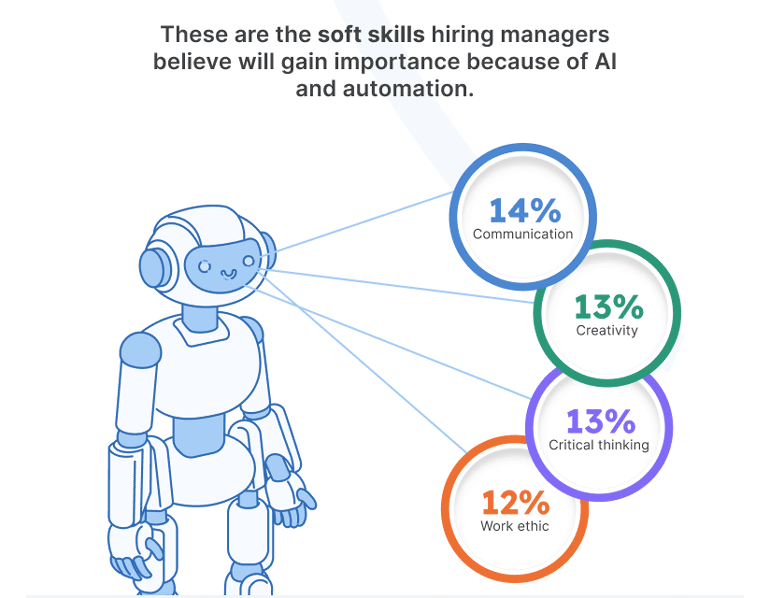
Communication is also becoming more valuable as AI handles routine tasks — while technology excels at data and repetition, human-to-human connection remains irreplaceable.
The majority of surveyed hiring managers identified communication skills as gaining the most importance due to automation.
sets you apart from other qualified applicants.
The eight categories below break down what communication skills actually look like in practice. As you review them, identify the skills you use regularly at work.
Then, for each one, think of a specific example showing when and how you used it effectively.
What this looks like in practice:
- You recognize “negotiation” under Verbal communication skills
- You remember negotiating vendor contracts that saved your company money
- You write: “Negotiated contracts with 5 software vendors, reducing annual costs by $50K while maintaining service levels”
We’ll show you exactly how to structure these bullets in the sections below.
Verbal communication skills
Verbal communication is all about how you connect with audiences through spoken words. These abilities help you present confidently and respond effectively in real-time conversations.
Verbal communication skills
- Presenting: Delivering information to groups with confidence, managing nerves, and handling questions smoothly
- Public speaking: Addressing large audiences effectively while projecting voice and maintaining eye contact
- Storytelling: Using narrative to make points memorable and help audiences connect emotionally with messages
- Persuasion: Convincing others to support ideas by addressing concerns and showing clear benefits
- Negotiation: Reaching mutually beneficial agreements through compromise and understanding what each party values
- Active listening: Fully focusing on what others say before responding, rather than planning replies mid-conversation
- Interviewing: Asking questions that uncover useful information and put the other person at ease
- Asking clarifying questions: Probing for details to avoid misunderstandings before moving forward with decisions
- Debating: Defending positions with logic and evidence while respecting opposing viewpoints
- Conversational skills: Building rapport through natural dialogue that puts others at ease
- Confidence: Speaking with certainty and presence that makes others trust the expertise
- Clarity: Making ideas easy to understand by avoiding jargon and organizing thoughts logically
Written communication skills
To express an idea clearly in writing, you need to choose the right words and structure for your reader. These skills help you adapt everything from casual messages to formal proposals so your meaning comes through.
Written skills
- Editing: Refining drafts for clarity, grammar, and flow before reaching an audience
- Proofreading: Catching errors in spelling, punctuation, and formatting that could undermine credibility
- Grammar: Using correct sentence structure and word choice to ensure professional messaging
- Mastery of tone: Adjusting formality and style to fit different audiences, from executives to clients to teammates
- Adaptability: Switching between writing styles for different contexts, from casual Slack messages to formal reports
- Translation: Converting content between languages accurately while preserving meaning and cultural nuance
- Copywriting: Writing persuasive marketing or sales content that drives action
- Technical writing: Explaining complex topics in accessible language that non-experts can understand
- Proposal writing: Crafting compelling business proposals that win contracts or approval
- Email etiquette: Following professional email conventions like clear subject lines, appropriate greetings, and timely responses
- Content strategy: Planning topics, formats, and publication schedules to meet audience needs
- Social media writing: Creating engaging posts for different platforms that fit character limits and audience expectations
- Documentation writing: Building clear user guides or process docs that help people complete tasks independently
- Report drafting: Summarizing findings or progress in structured formats that highlight key takeaways
Interpersonal skills
Interpersonal skills help you build strong one-on-one relationships at work.
These abilities make it easier to connect with colleagues and create the trust that makes collaboration smoother, even during challenging moments.
Interpersonal skills
- Empathy: Understanding and sharing others’ feelings to build stronger connections and respond appropriately
- Emotional intelligence: Reading and managing emotions in oneself and others to navigate tense situations
- Respect: Treating everyone with dignity regardless of role, background, or agreement level
- Approachability: Making others feel comfortable reaching out with questions, concerns, or ideas
- Friendliness: Creating positive interactions that make people want to work together again
- Trustworthiness: Following through on commitments consistently so people know they can rely on each other
- Conflict resolution: Finding solutions when disagreements arise by addressing root causes rather than symptoms
- Giving & receiving feedback: Sharing and accepting constructive input in ways that strengthen relationships
- Leadership: Guiding teams toward goals by setting clear expectations and removing obstacles
- Diplomacy: Navigating sensitive situations tactfully without compromising positions or offending others
- Patience: Staying calm when progress is slow or when others need extra time to understand
People skills
People skills help you lead and influence groups effectively. These abilities show you can facilitate productive discussions and guide teams toward shared goals while creating environments where everyone can contribute.
People skills
- Leadership: Guiding teams toward goals by setting clear expectations and removing obstacles
- Building psychological safety: Creating space for honest conversation where people feel safe sharing concerns or bad news
- Inclusive communication: Ensuring everyone’s voice is heard by actively inviting input from quieter team members
- Meeting facilitation: Keeping discussions focused and productive by setting agendas and managing time
- Delegation: Assigning tasks to the right people based on strengths and capacity
Teamwork skills
Teamwork skills show you can contribute to group success without creating friction. These abilities help you stay reliable, take ownership, and maintain positive working relationships.
Teamwork skills
- Accountability: Taking ownership of responsibilities and admitting mistakes when they happen
- Reliability: Consistently delivering promised work on time so teammates can plan around contributions
- Cooperation: Working smoothly with others by adapting to different work styles and sharing credit
- Initiative: Starting tasks without being asked when something needs doing
- Flexibility: Adjusting to new roles or priorities when projects shift direction or teammates need support
- Active participation: Contributing ideas and effort in meetings rather than staying silent or disengaged
Collaboration skills
Collaboration skills show you can contribute to group success without creating friction. These abilities help you coordinate effectively across departments and adapt when priorities shift.
Collaboration skills
- Remote teamwork: Staying connected across locations through regular check-ins and clear documentation
- Consensus building: Helping groups reach agreement by identifying common ground and addressing objections
- Cross-functional communication: Coordinating across different departments by translating technical details into relevant context
- Transparent updates: Keeping everyone informed about progress, delays, or changes that affect their work
Digital communication skills
Modern work happens across screens more than conference rooms, and digital platforms require different approaches than face-to-face interaction.
Digital communication skills
- Email and chat professionalism: Maintaining appropriate tone in written messages while being concise and action-oriented
- Video meeting etiquette: Managing camera, audio, and engagement in virtual calls without distracting others
- Asynchronous communication: Exchanging information across time zones without real-time conversation by providing full context upfront
- Message clarity and brevity: Getting to the point quickly in digital formats so people can act on messages immediately
- Presentation tools (PowerPoint, Canva): Creating visual slides that support messages with charts, images, and minimal text
- Online collaboration tools (Slack, Teams, Notion, Google Docs): Using shared platforms to coordinate work and keep information accessible
- Virtual tone awareness: Recognizing how text can be misread without vocal cues and adjusting phrasing accordingly
- Digital etiquette: Following best practices for online interaction like response times, thread management, and notification settings
AI-enhanced communication skills
AI tools are changing how we draft and organize information at work. These emerging skills help you use technology effectively while maintaining clarity and authenticity.
AI-enhanced communication skills
- Prompt writing for AI tools: Crafting clear instructions for AI assistants that specify format, tone, and level of detail
- Reviewing and fact-checking AI-generated drafts: Verifying accuracy before using AI content since models can produce plausible but incorrect information
- Using AI for grammar and clarity improvement: Leveraging tools to polish writing while maintaining authentic voice
- Synthesizing meeting transcripts with AI tools: Extracting key points from recorded discussions to create action items and summaries
- Digital note-taking and summarization: Capturing and condensing information efficiently during meetings or while researching
- Automating routine communications: Setting up templates and workflows for repetitive messages like follow-ups or status updates
- Adapting communication for AI-mediated workflows: Adjusting how information is shared when AI tools are involved in routing or processing
- Managing AI-assisted customer interactions: Overseeing chatbots and automated support systems to ensure quality and intervene when needed
Quick and Easy Resume Generator

Examples of communication skills for different jobs
Communication skills matter across every industry and role level. A customer service representative needs different communication strengths than a software engineer, but both rely on these abilities to succeed.
Here’s how communication skills appear in experience bullets for various positions:
Customer Service Representative
Customer service roles require empathy, clarity, and conflict resolution to handle diverse customer needs effectively.
- Resolved 50+ customer complaints monthly through active listening and personalized solutions, maintaining a 95% satisfaction rating
- Adapted communication style for frustrated customers by staying calm and acknowledging concerns before offering fixes, reducing escalations by 30%
Sales Account Executive
Sales professionals use persuasion, negotiation, and relationship-building to close deals and retain clients.
- Presented product demonstrations to C-suite prospects, addressing objections and customizing messaging based on industry pain points
- Negotiated contract terms with enterprise clients worth $500K+ by identifying mutual priorities and proposing creative solutions
Software Engineer
Even technical roles require clear documentation, collaboration, and the ability to explain complex concepts simply.
- Documented API integration processes in step-by-step guides that reduced onboarding time for new developers by 2 weeks
- Presented technical architecture decisions to non-technical product managers, translating system constraints into business impact
How to demonstrate communication skills on your resume
Now that you know some of the best communication skills for the workplace, it’s time to highlight them on your job application.
Here’s how to put communication skills on a resume like a professional:
Show your communication skills in your experience section
The most effective way to demonstrate communication skills is through concrete examples in your experience section, not by listing them in a separate skills section.
Soft skills like communication need proof, and your experience bullets provide that evidence.
Use this simple formula to show your communication skills: Action + Context + Result
- Action: Start with a strong verb showing what communication skill you used
- Context: Describe who you communicated with and about what
- Result: Quantify the impact when possible
@resumegenius
How to show communication skills on your resume
♬ original sound – Resume Genius
Match job description and requirements
You should always target your resume to match the communication skills in the job description. One role might prioritize “persuasive presentations” while another seeks “conflict resolution” — use their exact keywords to demonstrate you have the specific communication abilities they need.
For example, here’s a sample job description for a role that requires strong communication skills:
“We’re looking for someone who can translate complex technical concepts into clear updates for non-technical stakeholders and facilitate alignment across product, engineering, and marketing teams.”
To effectively target this job description, see how the following candidate targeted their
resume introduction to the skills and experience the employer is looking for:
“Program coordinator who translates technical requirements into stakeholder-friendly updates and facilitates cross-functional alignment between product, engineering, and marketing teams.”
Be concise
No matter if it’s verbal or written communication, people appreciate when you’re able to get your point across in fewer words.
Your cover letter is another great place to show employers you’re able to communicate effectively by editing your writing to remove any hedging, wordy phrasing, or unnecessary details.
Here’s how cutting filler words makes experience bullets clearer and more impactful on your resume:
Too wordy
“Was responsible for helping to write and edit various internal communications materials including newsletters, announcements, and policy updates for distribution to all employees across the organization”
More concise
“Wrote and edited internal newsletters, announcements, and policy updates for 200+ employees”
Choose the right adjectives and action verbs
The language throughout your resume and cover letter reveals how you communicate. Strong word choices demonstrate clarity and professionalism without needing to explicitly claim you’re a “great communicator.”
Picking the right action verbs for your resume is a great way to show exactly what you did: wrote, briefed, presented, negotiated. Avoid vague phrases like “worked on” or “was involved in.”
Below are some communication-related action verbs to consider using on your resume:
Action verbs for communication skills
| Wrote | Corresponded | Summarized |
| Presented | Translated | Collaborated |
| Negotiated | Coordinated | Consulted |
| Facilitated | Mediated | Drafted |
| Briefed | Documented | Reported |
| Interviewed | Persuaded | Explained |
You can also include some resume-appropriate adjectives to describe yourself, such as:
Smart adjectives for communication skills
| Persuasive | Inclusive | Multilingual |
| Articulate | Engaging | Strategic |
| Diplomatic | Professional | Culturally aware |
| Clear | Adaptable | Patient |
| Concise | Attentive | Direct |
| Collaborative | Responsive | Transparent |
How to improve your professional communication skills
Communication skills improve with practice and feedback. Whether you’re strengthening your speaking voice or learning to write tighter emails, the strategies below will help you build confidence and capability.
Join low-pressure practice environments
Real improvement happens when you practice in settings where the stakes are low but the feedback is real. Look for communities where you can experiment, make mistakes, and refine your approach without career consequences.
In-person practice:
- Toastmasters International – Local chapters provide structured environments for practicing public speaking with consistent feedback. Members give prepared speeches, impromptu talks, and constructive evaluations to build confidence over time.
- Campus groups – If you’re a student, you likely have access to dedicated spaces for developing communication skills at no extra cost. Consider debate clubs, Model UN, student government, campus publications, radio broadcasting, theater programs, or orientation leadership.
- Networking events – Professional mixers and industry meetups create natural opportunities to introduce yourself and explain your work. Regular attendance helps you refine your personal pitch and grow comfortable with small talk.
- Community activities – Joining local groups lets you practice communication skills in friendly spaces where growth matters more than perfection. Platforms like Meetup.com list improv classes, language exchange meetups, book clubs, storytelling nights, public speaking groups, and conversation circles near you.
Practice with AI:
You can also sharpen your communication skills by chatting with well-designed AI assistants.
Try using ChatGPT’s voice mode with a prompt like: “I want to practice explaining complex ideas simply. Can you ask me questions about my work and give feedback on my clarity?” Other options include Claude, Gemini, and Perplexity.
Learn from great communicators
Reading and watching skilled communicators helps you internalize techniques you can adapt to your own style. The books and videos below offer frameworks you can apply immediately.
Books worth reading:
- “How to Win Friends and Influence People” by Dale Carnegie — Timeless fundamentals on empathy and persuasion. Carnegie’s principles still work because they’re rooted in genuine respect for others.
- “Crucial Conversations” by Patterson, Grenny, McMillan, and Switzler — A practical framework for handling high-stakes talks when emotions run high and opinions differ.
- “Talk Like TED” by Carmine Gallo — Lessons from top TED speakers on how to open strong, structure your narrative, and hold attention.
- “Made to Stick” by Chip and Dan Heath — Explains why some ideas survive and others disappear, with a simple formula for making your messages memorable.
- “The Charisma Myth” by Olivia Fox Cabane — A science-backed guide to building confidence and presence, even if charisma doesn’t come naturally to you.
Videos to watch:
Public speaking coach Vinh Giang shares a simple framework for structuring thoughts quickly.
The technique prevents rambling and helps you deliver clear messages in interviews, meetings, or answers to unexpected questions.
Stanford’s Matt Abrahams tackles the psychological barriers to clear communication under pressure. His techniques help you stay present instead of overthinking outcomes.
By treating presentations as conversations and embracing a “yes, and” mindset, you can focus on serving your audience.
About the Author

Cort is a writer on the Resume Genius team. With a focus on helping job seekers showcase their strengths with clarity and confidence, he specializes in creating practical resources, from tailored resume samples to step-by-step guides on navigating applications and interviews.
With a background in marketing and communications, Cort has spent years honing his ability to provide straightforward, actionable content designed to help readers quickly find what they need.
Cort graduated from the University of California, Davis with a B.A. in Economics and International Relations.
Click to rate this article
4.8 Average rating