Carpenter Resume Examples and Template
 Written By Conrad BenzContent Manager & Hiring Manager
 Reviewed By Geoffrey ScottSenior Hiring Manager & Career Coach
Conrad Benz is a Content Manager and Hiring Manager at Resume Genius. With nearly a decade of experience as a career services professional, Conrad is passionate about helping people navigate...
A carpenter resume should show more than your ability to produce work—it needs to highlight your precision, reliability, and problem-solving.
Our carpenter resume examples and template include both seasoned carpenters and apprentices, so you can showcase the right skills and experience no matter where you are in your career.
Carpenter Resume Examples by Experience Level
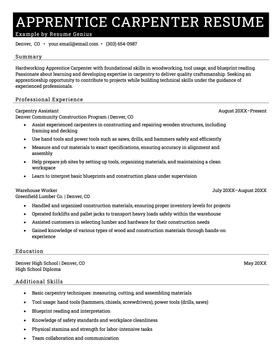
Looking for a different template style? Browse our complete resume template library.
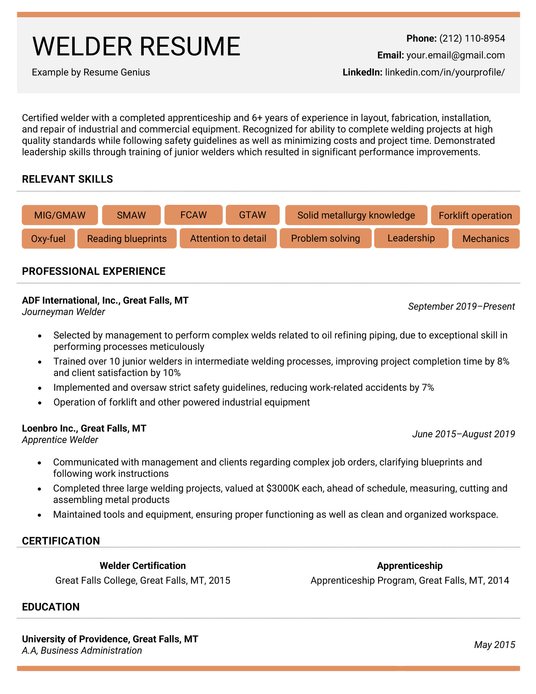
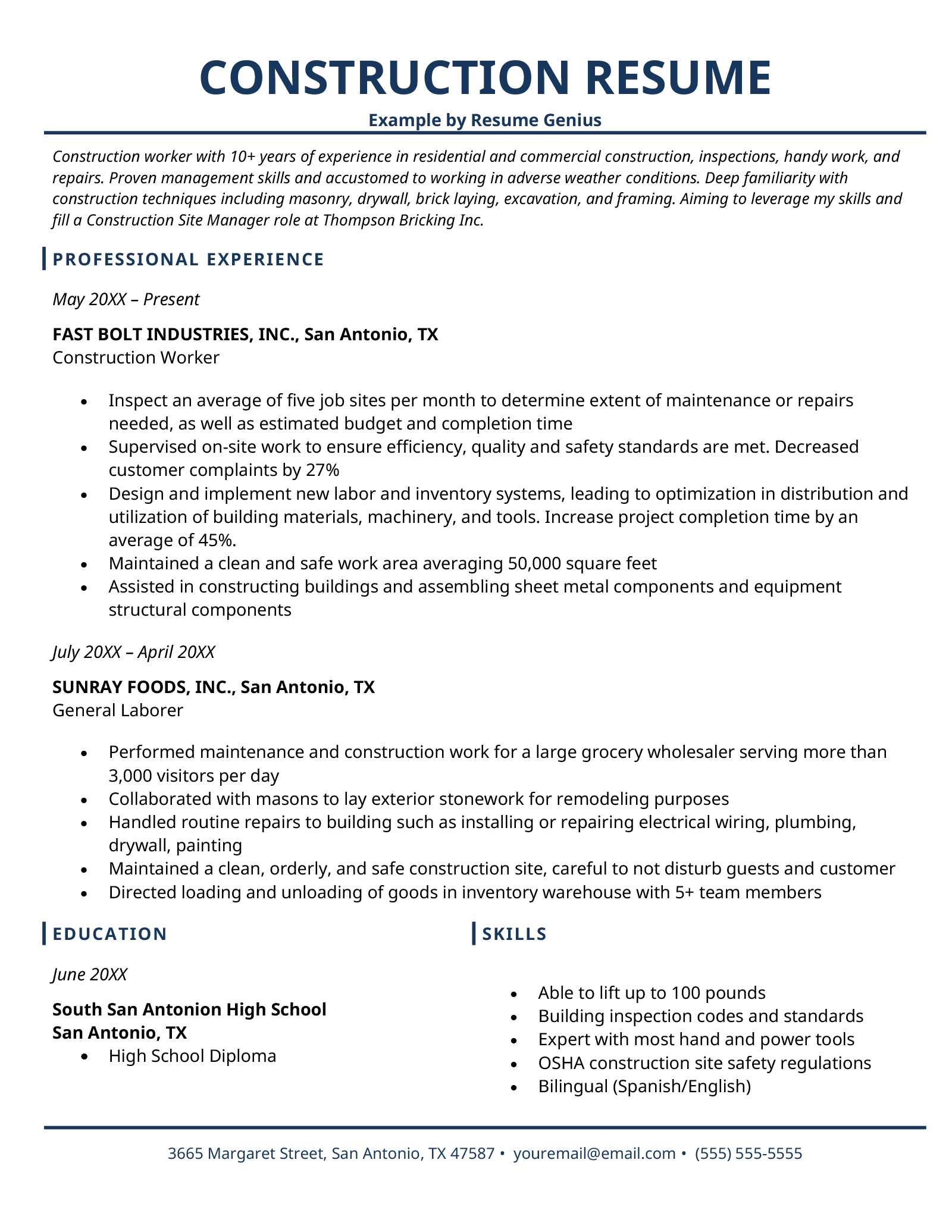
Related Resume Samples
View All Resume Examples
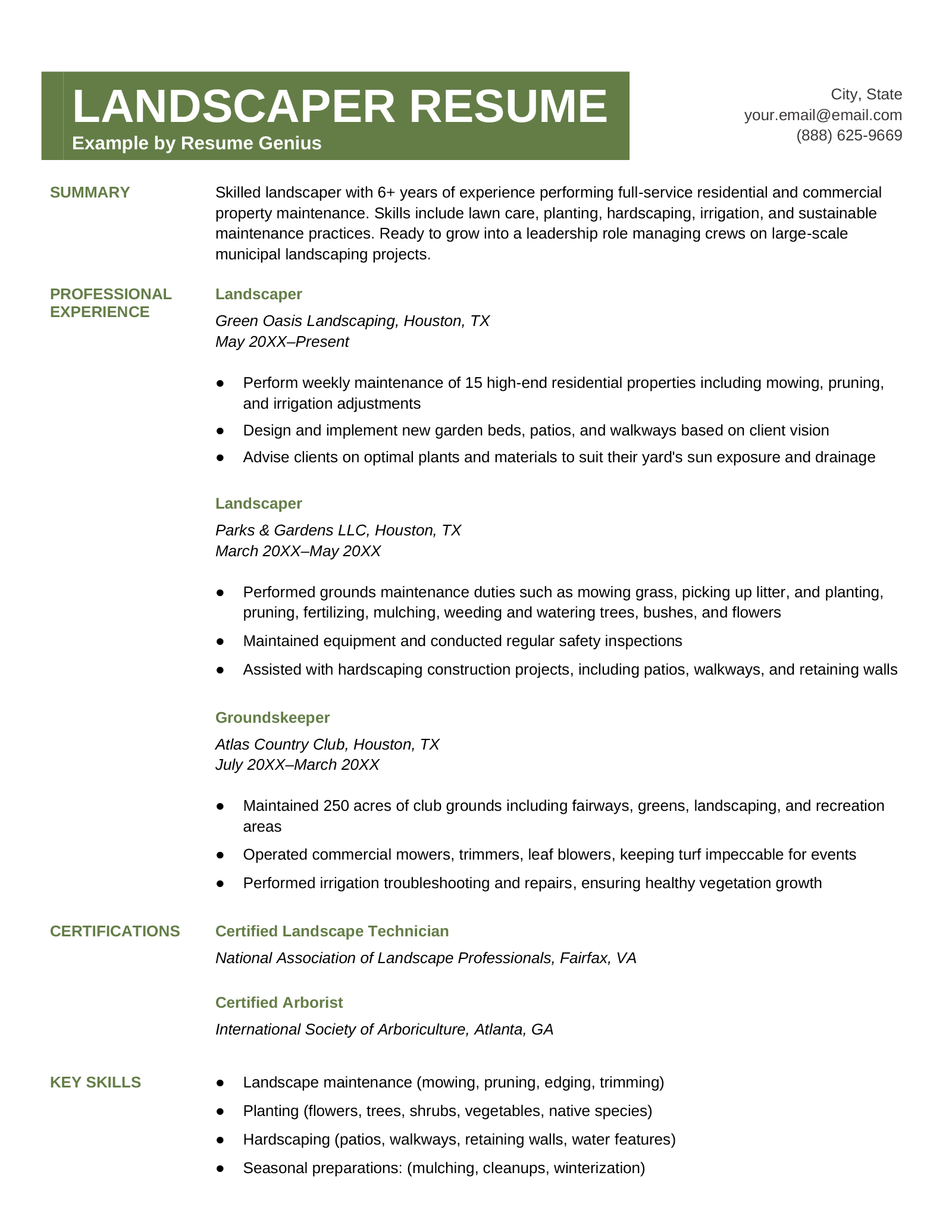
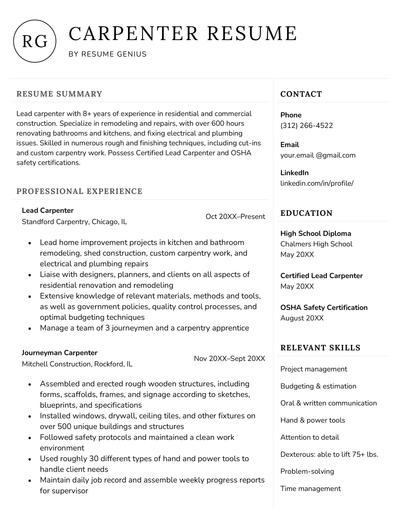
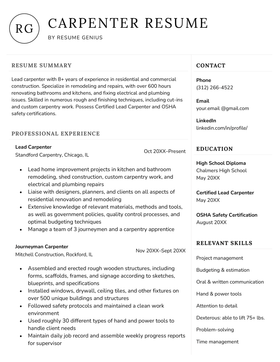
Carpenter resume template
- Project management
- Budgeting & estimation
- Excellent oral and written communication
- Time management
- Complex problem solving
- Hand and power tools
- Decision making
- Attention to detail
- Dexterous: able to lift 75+ pounds
- Lead home improvement projects in kitchen and bathroom remodeling, shed construction, custom carpentry work, and electrical and plumbing repairs
- Liaise with designers, planners, and clients on all aspects of residential renovation and remodeling
- Manage a team of 3 journeymen and a carpentry apprentice
- Extensive knowledge of relevant materials, methods and tools, as well as government policies, quality control processes, and optimal budgeting techniques
- Assembled and erected rough wooden structures, including forms, scaffolds, frames, and signage according to sketches, blueprints, and specifications
- Installed windows, drywall, ceiling tiles, and other fixtures on over 500 unique buildings and structures
- Followed safety protocols and maintained a clean work environment
- Maintain daily job record and assemble weekly progress reports for supervisor
- Used roughly 30 different types of hand and power tools to handle client needs
- OSHA Safety Certification, 20XX
4 professional writing tips for your carpenter resume
With a huge variety of projects and specialties, carpentry is a broad industry that includes many different types of careers. To get the job you want, you’ll need to build your carpenter resume from the foundation up with a specific skill set in mind to convince hiring managers that you’re a good candidate for the job.
Whether you’re an apprentice looking to get your foot in the door or an experienced journeyman, check out our four professional writing tips for help making a carpenter resume that’s sure to impress a hiring manager.
1. Use the job description to your advantage
When searching for carpenter jobs online, ensure you thoroughly review the job description before writing your resume. This is essential because employers typically leave keywords throughout the job description that they want to see in your application.
It’s impossible to know what all of the keywords will be (since they’re discreetly chosen by the hiring manager.) But, rest assured that most of them will be scattered throughout the carpenter job requirements listed online.
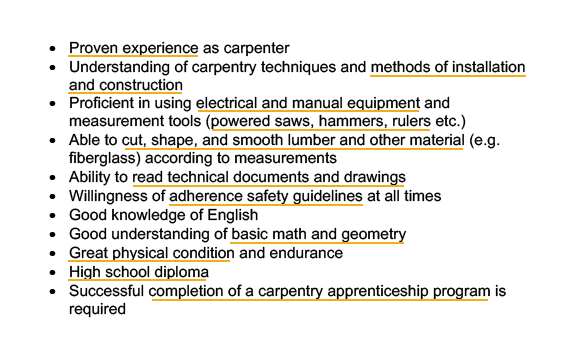
Here’s an example of a carpenter job description, with the keywords highlighted that you should include on your resume:
2. Highlight your skills as a carpenter
Carpentry is a skilled trade, so your resume needs to include the necessary skills that hiring managers will expect from you to get the job done in a proficient and professional manner.
For example:
- Drilling & framing
- Wood carving
- Refinishing & remodeling
- Repairs & maintenance
- Hand & power tools
- Mathematics
- Physical strength & dexterity
3. Highlight your certifications
You don’t need many formal qualifications to be a carpenter, with most people learning on the job or completing an apprenticeship. However, receiving a professional certification can really boost your career prospects as a carpenter, and make you a worthy candidate to a hiring manager.
Several governing organizations offer certifications in carpentry that would be an excellent addition to your resume’s education section.
Here are eight available carpentry certifications that will boost your employability to a hiring manager:
- First Aid, CPR & AED
- OSHA Safety Certification
- Certified Safety Professional (CSP)
- Certified Lead Carpenter (CLC)
- Registered Construction Inspector
- Certified Construction Manager CCM
- Certified Associate Constructor
However, some certifications require you to have some experience to obtain.
For example, the Lead Carpenter Certification (CLC) from the National Association of the Remodeling Industry requires at least five years of experience in the carpentry industry, and two years as a lead carpenter. It teaches the essentials of project management in the field.
Having a CLC certificate tells employers that you can complete projects on time and under budget, thereby increasing profitability.
While employers generally value experience over anything else, if you’re trying to progress in the carpentry field, or further solidify and prove your qualifications, listing certifications on your carpentry resume can give you a significant advantage over other similarly qualified candidates.
4. Quantify your carpenter experience
Finally, when writing a resume, you should find ways to add hard numbers when listing work experience.
Adding numbers to your work experience bullet points will quantify your on-the-job accomplishments, giving hiring managers a clear idea about how you contributed to your employer and a gauge for your previous performance.
Consider the difference between the following two sentences, one with hard numbers and one without:
- Used a variety of tools
- Used 30+ different types of hand and power tools to do remodeling and renovations
The first bullet point is noticeably vague, whereas the second is specific and gives a clear indicator of how many hand and power tools the carpenter has experience with using.
Here are additional examples of how to quantify your carpenter experience:
- Installed windows, drywall, ceiling tiles, and other fixtures on over 500 unique buildings and structures
- Used roughly 30 different types of hand and power tools to handle client needs
- Manage a team of 3 journeymen and a carpentry apprentice
Resume objective examples for a carpenter
Begin your resume with a resume objective statement that gives an overview of your career goals and the skills that distinguish you from other applicants. Check out these examples to help you get started:
Skilled carpenter with a proven track record in both residential and commercial construction. Proficient in a wide range of carpentry techniques, including framing, finishing, cabinetry, and custom woodworking. Seeking a position to apply my proficiency in using a variety of tools, knowledge of construction materials, and commitment to safety in delivering top-notch carpentry work on construction projects.
Experienced carpenter with a specialization in structural and finish carpentry. Accurate and precise in taking measurements and interpreting blueprints to ensure the proper fit and alignment of materials. Seeking a position to contribute my expertise in constructing and repairing wooden structures, as well as my ability to interpret blueprints and collaborate effectively with construction teams.
Detail-oriented carpenter with a proven track record in custom woodworking and carpentry installations. Highly skilled in using a variety of hand and power tools, including saws, drills, routers, and sanders, to achieve precise and high-quality carpentry work. Eager to join a reputable construction company where I can utilize my skills in blueprint reading, project management, and carpentry craftsmanship to deliver high-quality results.
3 resume objective examples for an assistant carpenter
Here are some additional examples of resume objectives for assistant carpenter positions:
Entry-level assistant carpenter with a solid foundation in construction materials handling and tool operation. Proficient in assisting carpenters with the setup and operation of a variety of hand and power tools, ensuring a safe and efficient work environment. Eager to learn and apply carpentry techniques while providing valuable assistance to experienced carpenters in a dynamic construction environment.
Proactive assistant carpenter with hands-on experience in providing support for framing, roofing, and finishing work. Dedicated to maintaining a safe work environment by following safety protocols, handling tools responsibly, and promoting a culture of safety on construction sites. Aiming to contribute my skills in tool operation, material handling, and collaborative teamwork to a carpentry team focused on delivering high-quality construction results.
Eager assistant carpenter with practical experience in assisting with carpentry tasks and construction site operations. Ability to assist in interpreting and implementing project plans, blueprints, and specifications, ensuring accurate execution of carpentry tasks. Seeking a challenging role to build on my knowledge of carpentry tools, materials, and techniques while contributing to the efficient execution of carpentry projects.
Average carpenter salaries in the US
After you’ve written your resume, make sure you use it to apply for jobs within a fair salary range.
The following table includes information from the US Bureau of Labor Statistics’ latest Occupational Employment and Wage Statistics report for 2026. Here are the ten states with the highest salaries for carpenters, as well as the national average for your reference when applying for work.
Top 10 states by average carpenter salary
| State | Salary / Year |
|---|---|
| Hawaii | $87,480 |
| Alaska | $80,460 |
| Illinois | $80,320 |
| Massachusetts | $79,680 |
| Washington | $79,170 |
| California | $78,810 |
| New York | $75,970 |
| New Jersey | $71,990 |
| Oregon | $70,880 |
| Minnesota | $70,320 |
| National Average | $65,630 |
About the Author

Conrad Benz is a Content Manager and Hiring Manager at Resume Genius. With nearly a decade of experience as a career services professional, Conrad is passionate about helping people navigate the job search process and find fulfilling work.
You can find Conrad’s career insights in publications like Typsy, Resume Library, and more.
Conrad graduated with a B.A. in International Relations from Goucher College in Maryland and currently lives in Taipei, Taiwan, where he helps ensure every article on Resume Genius provides job seekers with the information they need to succeed.
If you want to reach Conrad for a quote or media-related inquiry, you can contact him at [conrad] @ [resumegenius.com].


Click to rate this article
4.7 Average rating