Phlebotomist Resume Examples and Writing Tips
 Written By Samuel JohnsSenior Content Editor & Certified Professional Resume Writer
 Reviewed By Conrad BenzContent Manager & Hiring Manager
Samuel Johns
Senior Content Editor & Certified Professional Resume Writer
Samuel Johns is a Senior Content Editor and Certified Professional Resume Writer (CPRW) at Resume Genius. In his 7+ years of experience in the careers space, he has helped hundreds...
We’ve included samples for entry-level technicians, mid-career phlebotomists, and experienced lab professionals, with guidance underneath to refine your resume.
After your resume is done, complement it with a well-written phlebotomist cover letter that links your previous achievements and your future goals.
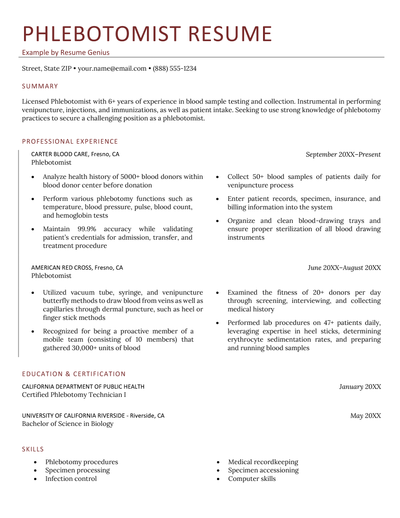

Phlebotomist Resume Examples by Experience Level
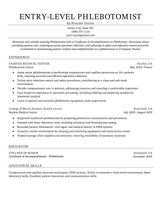
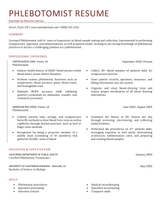
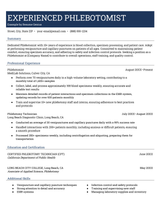
Not the right template design for you? Check out our collection of resume templates for even more choices.
Phlebotomist resume template (text format)
- Phlebotomy procedures
- Specimen processing
- Infection control
- Medical recordkeeping
- Specimen accessioning
- Computer skills
- Analyze health history of 5000+ blood donors within blood donor center before donation
- Perform various phlebotomy functions such as temperature, blood pressure, pulse, blood count, and hemoglobin tests
- Maintain 99.9% accuracy while validating patient’s credentials for admission, transfer, and treatment procedure
- Collect 50+ blood samples of patients daily for venipuncture process
- Enter patient records, specimen, insurance, and billing information into the system
- Organize and clean blood-drawing trays and ensure proper sterilization of all blood-drawing instruments
- Utilized vacuum tube, syringe, and venipuncture butterfly methods to draw blood from veins as well as capillaries through dermal puncture, such as heel or finger stick methods
- Recognized for being a proactive member of a mobile team (consisting of 10 members) that gathered 30,000+ units of blood
- Examined the fitness of 20+ donors per day through screening, interviewing, and collecting medical history
- Performed lab procedures on 47+ patients daily, leveraging expertise in heel sticks, determining erythrocyte sedimentation rates, and preparing and running blood samples
Certified Phlebotomy Technician I | January 20XX
Bachelor of Science in Biology | May 20XX
- Certified Administrative Professional (CAP) – International Association of Administrative Professionals (IAAP), 20XX
- Microsoft Office Specialist (MOS) Certification – Microsoft, 20XX
How to write a phlebotomist resume
To get a job as a phlebotomist, you’ll need an effective resume that will impress employers and show you have the skills and experience they’re looking for. Below are four tips to help you get started.
1. Highlight your skills
As a medical professional, you need to show potential employers that you have the right specialist skills for the job. The best place to outline this knowledge is in a dedicated skills section.
Your resume’s skills section should list your hard skills, such as drawing blood and using phlebotomy tools. If you’re not sure which skills employers are looking for, take a look at the job description for the position you’re applying for. A phlebotomy job description might look like this:

And here is what a skills section that targets those specific skills might look like:
- Venipuncture and capillary puncture techniques
- Specimen collection and processing
- Patient confidentiality
- EMR management
- Phlebotomy equipment operation and maintenance
Here are some other common skills to list on your phlebotomist resume:
- Venipuncture
- Performing blood culture
- Knowledge of medical equipment (tourniquets, vacutainer tubes, and needles and syringes)
- Attention to detail (documentation and following procedures)
- Donor management software systems
- Data management
- Dexterity (arm and hand steadiness)
- Knowledge of anatomy and physiology
- Language proficiency
In addition to the hard skills above, employers will want to see that you have soft skills, like communication techniques and empathy.
Soft skills are best demonstrated through relevant examples in your work experience section and resume summary. Your phlebotomist cover letter is another great place to outline your soft skills.
For example:
- Provided compassionate and empathetic patient care, addressing concerns and easing anxieties for over 20 patients daily, ensuring a positive and comfortable experience
- Provided clear instructions to patients before and after procedures, enhancing their understanding and adherence to medical advice
- Collaborated with a multidisciplinary team of healthcare professionals to coordinate patient care, improving workflow efficiency and reducing wait times by 15%
- Maintained a calm and reassuring demeanor in high-stress situations, successfully handling difficult or anxious patients with professionalism and empathy
2. Highlight key achievements using hard numbers
Your resume needs to clearly communicate your employment history to hiring managers in the experience section.
Just like in the resume samples above, you should list each previous position you’ve held, and explain your main responsibilities and accomplishments in bullet points underneath. Start each sentence with an action verb to center yourself as the “doer” of the action, and make sure to include numbers whenever possible to illustrate your achievements clearly.
Here’s an example of what that should look like:
Phlebotomist
United Blood Bank of Northern California, Sacramento, CA
June 20XX – December 20XX
- Collected blood samples from patients in a high-volume laboratory setting, performing over 50 venipunctures daily
- Verified patient information and specimen requirements before sample collection, ensuring 100% accuracy and compliance with laboratory standards
- Completed 26 hours of education and training on phlebotomy techniques and laboratory technology
3. Write a strong resume introduction
Hospitals receive many job applications for each open position, so your phlebotomist resume should start with a strong resume summary to draw the attention of the hiring manager.
An effective resume summary quickly describes your experience and background, your primary skills and achievements, and your desired outcome for your job search. It’s the first thing that recruiters will see on your resume, and it should make them want to keep reading further.
Here are two examples of resume summaries for a phlebotomy resume:
Certified phlebotomist with 4+ years’ experience in providing empathetic patient care in a clinical setting. Assisted with an average of 47 patients a day in a wide range of age groups. Seeking experience in a hospital setting to continue my growth in providing excellent patient care.
Experienced phlebotomist with a 7-year background in clinical and emergency settings. Expertise in venipuncture and capillary puncture for a diverse patient demographic, averaging 48 procedures per day. Aspiring to bring my strong patient care skills to a hospital environment to further enhance patient satisfaction and care.
4. Include keywords from the job description
Including keywords from the job description helps align your qualifications with what the employer is specifically looking for. Many hiring managers use applicant tracking systems (ATS) to screen resumes, and these systems are designed to prioritize applications that match the job posting’s keywords.
By mirroring terms from the job description, you demonstrate your understanding of the role and show that you have the required skills and experience. This approach not only increases your chances of passing the initial screening but also assures the employer that you’re a strong fit for the position.
Below is a list of common resume keywords we pulled from real phlebotomist job listings:
We analyzed over 1500 real job ads to find the top words and phrases to add to your resume and cover letter.
Data
| Keyword | Percentage | Count |
|---|---|---|
| Specimen collection | 73 | 1111 |
| Phlebotomy certification | 67 | 1015 |
| Customer service | 57 | 864 |
| Specimen processing | 54 | 828 |
| Data entry | 51 | 771 |
| Knowledge of computer systems | 36 | 552 |
| Communication skills | 32 | 486 |
| Laboratory equipment | 32 | 482 |
| Patient care | 25 | 375 |
| Teamwork | 16 | 238 |
Resume examples for different industries
Not sure what your resume should look like? The best way to learn is by taking inspiration from resume examples written by other candidates in your industry.
Average phlebotomist salaries in the US
After you’ve written your resume, make sure you use it to apply for jobs within a fair salary range.
The following table includes information from the US Bureau of Labor Statistics’ latest Occupational Employment and Wage Statistics report for 2026. Here are the ten states with the highest salaries for phlebotomists, as well as the national average for your reference when applying for work.
Top 10 states by average phlebotomist salary
| State | Salary / Year |
|---|---|
| California | $56,600 |
| Massachusetts | $52,540 |
| District of Columbia | $52,070 |
| New York | $51,830 |
| Washington | $51,490 |
| Oregon | $51,060 |
| New Hampshire | $49,330 |
| New Jersey | $49,140 |
| Hawaii | $48,630 |
| Colorado | $48,520 |
| National Average | $45,520 |
About the Author

Samuel Johns is a Senior Content Editor and Certified Professional Resume Writer (CPRW) at Resume Genius. In his 7+ years of experience in the careers space, he has helped hundreds of job seekers craft high-quality resumes and cover letters, ace interviews, and land their dream jobs.
Born and raised in County Durham, England, UK, Samuel graduated with a BA in French from the University of Bristol, England, UK.
Samuel’s job-hunt advice has been published in numerous online outlets, including Dollar Sprout, The Enterprisers Project, and Tech Crunch. Feel free to reach out to Samuel through his LinkedIn if you’d like to collaborate.
Please note, we don’t accept guest posts and won’t reply to such requests.


Click to rate this article
4.9 Average rating