Surgical Tech Resume Examples & Writing Guide
 Written By Lauren MastroniCareer Expert & Senior Digital Content Writer
 Reviewed By Samuel JohnsSenior Content Editor & Certified Professional Resume Writer
Lauren Mastroni is a Senior Digital Content Writer at Resume Genius, where she creates data-driven career content and actionable job search advice. With a background in academic research, she brings...
Reference these samples to guide you in highlighting your experience preparing operating rooms, supporting surgeons during procedures, and ensuring patient safety throughout surgical care.

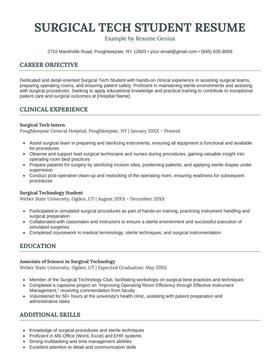
Surgical tech resume examples by experience level
For more options, check out our full range of resume templates.
Related Resume Samples
View All Resume Samples

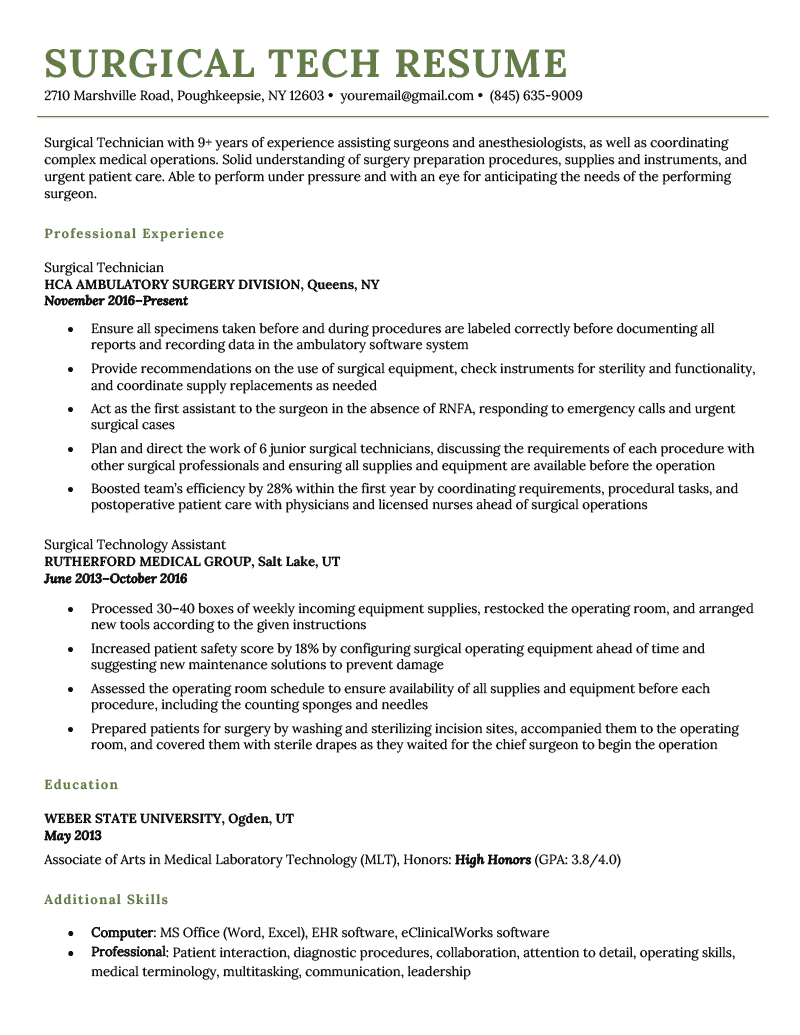
Surgical tech resume template
Surgical Technician with 9+ years of experience assisting surgeons and anesthesiologists, as well as coordinating complex medical operations. Solid understanding of surgery preparation procedures, supplies and instruments, and urgent patient care. Able to perform under pressure and with an eye for anticipating the needs of the performing surgeon.
- Computer: MS Office (Word, Excel), EHR software, eClinicalWorks software
- Professional: Patient interaction, diagnostic procedures, collaboration, attention to detail, operating skills, medical terminology, multitasking, communication, leadership
- Ensure all specimens taken before and during procedures are labeled correctly before documenting all reports and recording data in the ambulatory software system
- Provide recommendations on the use of surgical equipment, check instruments for sterility and functionality, and coordinate supply replacements as needed
- Act as the first assistant to the surgeon in the absence of RNFA, responding to emergency calls and urgent surgical cases
- Plan and direct the work of 6 junior surgical technicians, discussing the requirements of each procedure with other surgical professionals and ensuring all supplies and equipment are available before the operation
- Boosted team’s efficiency by 28% within the first year by coordinating requirements, procedural tasks, and postoperative patient care with physicians and licensed nurses ahead of surgical operations
- Processed 30–40 boxes of weekly incoming equipment supplies, restocked the operating room, and arranged new tools according to the given instructions
- Increased patient safety score by 18% by configuring surgical operating equipment ahead of time and suggesting new maintenance solutions to prevent damage
- Assessed the operating room schedule to ensure availability of all supplies and equipment before each procedure, including the counting sponges and needles
- Prepared patients for surgery by washing and sterilizing incision sites, accompanied them to the operating room, and covered them with sterile drapes as they waited for the chief surgeon to begin the operation
Tips for writing a surgical tech resume
When you’re applying for a job in surgery, your resume is the first opportunity you have to make a great impression. And to catch a hiring manager’s attention, you’ll need to create an impressive surgical tech resume that stands out from the rest.
Below are three tips on how to write a surgical resume that’ll get you noticed and demonstrate your understanding of the role:
1. Write a clear resume objective
Hospital employers are busy people, so they’ll look for surgical tech resumes that stick out instantly and clearly show your qualifications. Identify yourself as an effective surgical technician candidate by writing a strong resume objective.
A resume objective is a concise statement that summarizes your skills, years of experience, education, and career goals.
For example:
Certified surgical technologist with 1 year of internship experience. Currently pursuing my Associate’s degree in Surgical Technology. First Aid and CPR certified. Hoping to become a certified First Assistant and create efficient and safe medical practices at THL Hospital.
2. Showcase your skills
As a surgical technologist, you possess a unique set of skills that are essential for providing quality patient care. So be sure to highlight both your hard and soft skills in the skills section of your resume.
Your primary role is to assist surgeons during surgical procedures, so employers want to know you’re equipped with the right hard skills. Also called technical skills, these abilities are learned from specialized training, coursework in anatomy and physiology, and practical experience working in a medical setting.
Some examples of hard skills include scrubbing in and out of the operating room, setting up surgical equipment, handing instruments to surgeons during surgery, and ensuring operating rooms are clean and sterile.
Here are more hard skills for your surgical tech resume:
- Sterilizing and maintaining surgical instruments
- Preparing patients for surgery
- Assisting surgeons during procedures
- Applying dressings to the incision site
- Manual dexterity
- Monitoring patients’ vital signs during and after surgery
And while your technical skills are essential for performing the day-to-day duties of a surgical tech, it’s your soft skills that’ll make you an asset to head surgeons.
For instance, surgical techs should have excellent attention to detail and be able to work quickly and efficiently under pressure.
Other soft skills for surgical techs include:
- Ability to follow instructions
- Communication skills
- Customer service skills
- Critical thinking
- Interpersonal skills
- People skills
- Problem-solving
- Teamwork
- Time management skills
And instead of simply listing these skills on your resume, try demonstrating to potential employers that you’re well-qualified for the role by providing direct examples of your soft skills in the work experience section of your resume.
For example:
- Prepare the exact amount of appropriate equipment in accordance with the surgeon’s preference each patient’s condition, resulting in and restocking sponges, vials, and needles with 100% accuracy and ensuring smooth operating procedures
3. Quantify your achievements with hard numbers
When writing your resume as a surgical tech, include hard numbers that quantify your experience and skills so hiring managers can see your level of experience and accomplishments.
Some hard numbers for your surgical tech resume might include the:
- number of surgeries you’ve assisted with
- types of procedures you’re comfortable with
- length of a program or certification you completed
- score you received on your surgical tech national certification exam
Including hard numbers on your resume will help show employers that you’re results-driven and have the qualifications necessary to be a successful surgical tech.
Here are two examples of hard numbers (highlighted in bold) from our surgical tech resume sample’s work experience bullet points:
Example of hard numbers on a surgical tech resume
- Processed 30–40 boxes of weekly incoming equipment supplies, restocked the operating room, and arranged new tools according to the given instructions
- Increased patient safety score by 18% by configuring surgical operating equipment ahead of time and suggesting new maintenance solutions to prevent damage
Build your resume in minutes

Average surgical tech salaries in the US
After you’ve written your resume, make sure you use it to apply for jobs within a fair salary range.
The following table includes information from the US Bureau of Labor Statistics’ latest Occupational Employment and Wage Statistics report for 2026. Here are the ten states with the highest salaries for surgical techs, as well as the national average for your reference when applying for work.
Top 10 states by average surgical tech salary
| State | Salary / Year |
|---|---|
| Massachusetts | $83,820 |
| California | $82,810 |
| New York | $81,990 |
| Oregon | $80,990 |
| Alaska | $79,670 |
| Minnesota | $79,670 |
| Washington | $78,400 |
| Connecticut | $76,710 |
| New Jersey | $75,640 |
| Nevada | $74,880 |
| National Average | $68,710 |
About the Author

Lauren Mastroni is a Senior Digital Content Writer at Resume Genius, where she creates data-driven career content and actionable job search advice. With a background in academic research, she brings a research-focused approach to topics like resume writing, interviewing, and career development. Lauren is dedicated to helping job seekers at all stages navigate the hiring process and present themselves more effectively to employers.


Click to rate this article
4.7 Average rating