Medical School Resume Examples & Writing Tips
 Written By Nathan SotoPR Specialist & Certified Professional Resume Writer
 Reviewed By Samuel JohnsSenior Content Editor & Certified Professional Resume Writer
Nathan Soto is dedicated to providing practical guidance to job seekers, especially people with nonlinear career paths. Nathan graduated from the University of Nevada with a double B.A. in French...
Use our med school resume examples and expert writing tips to write a strong resume that shows admissions officers why you should be accepted to your target program.

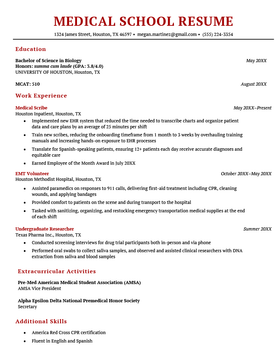
Medical school resume examples
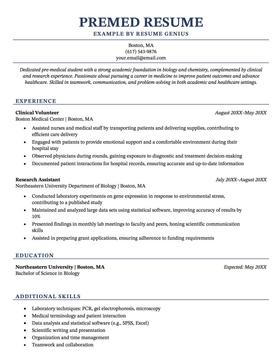
Check out our full library of resume templates for more resume designs in every color.
Related resume samples
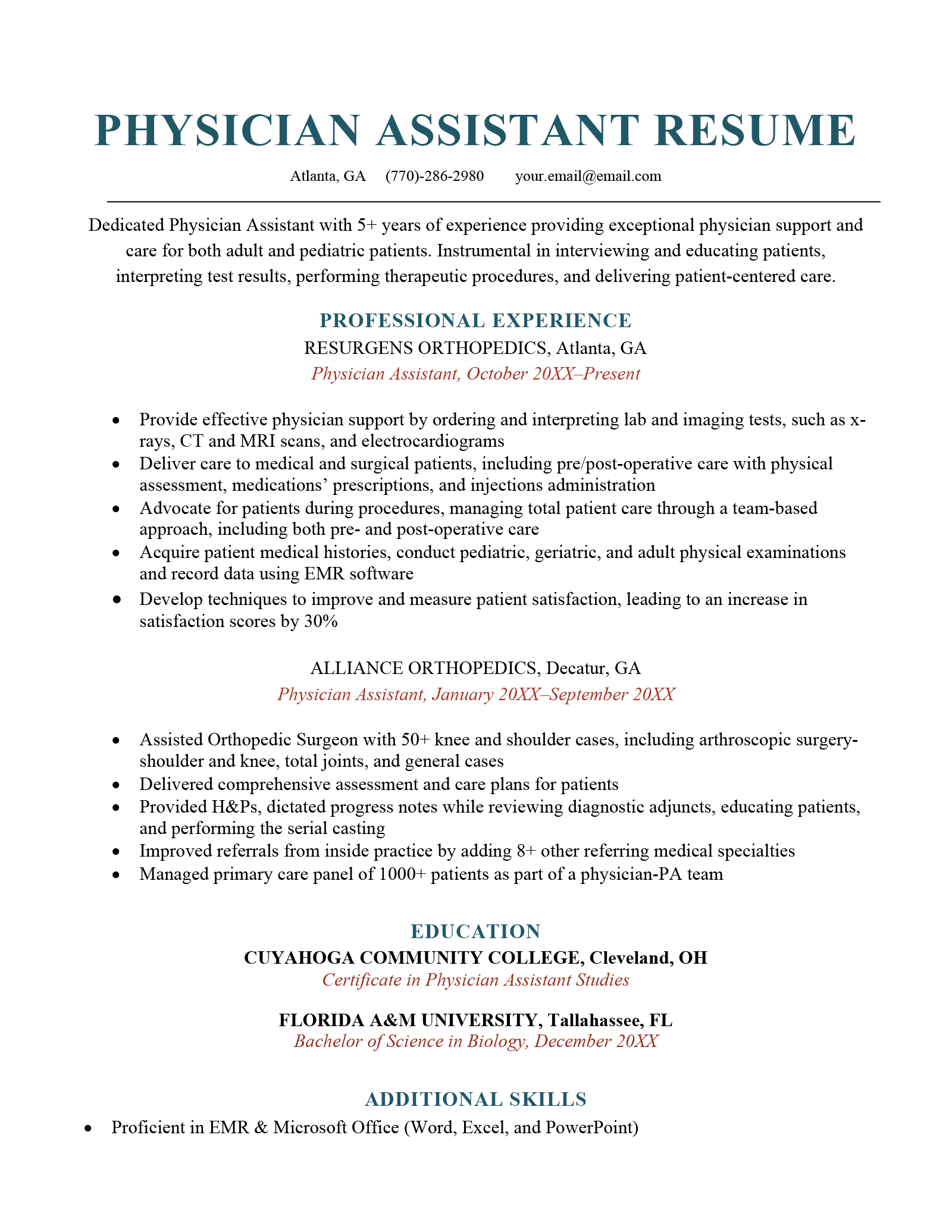
View All Resume Examples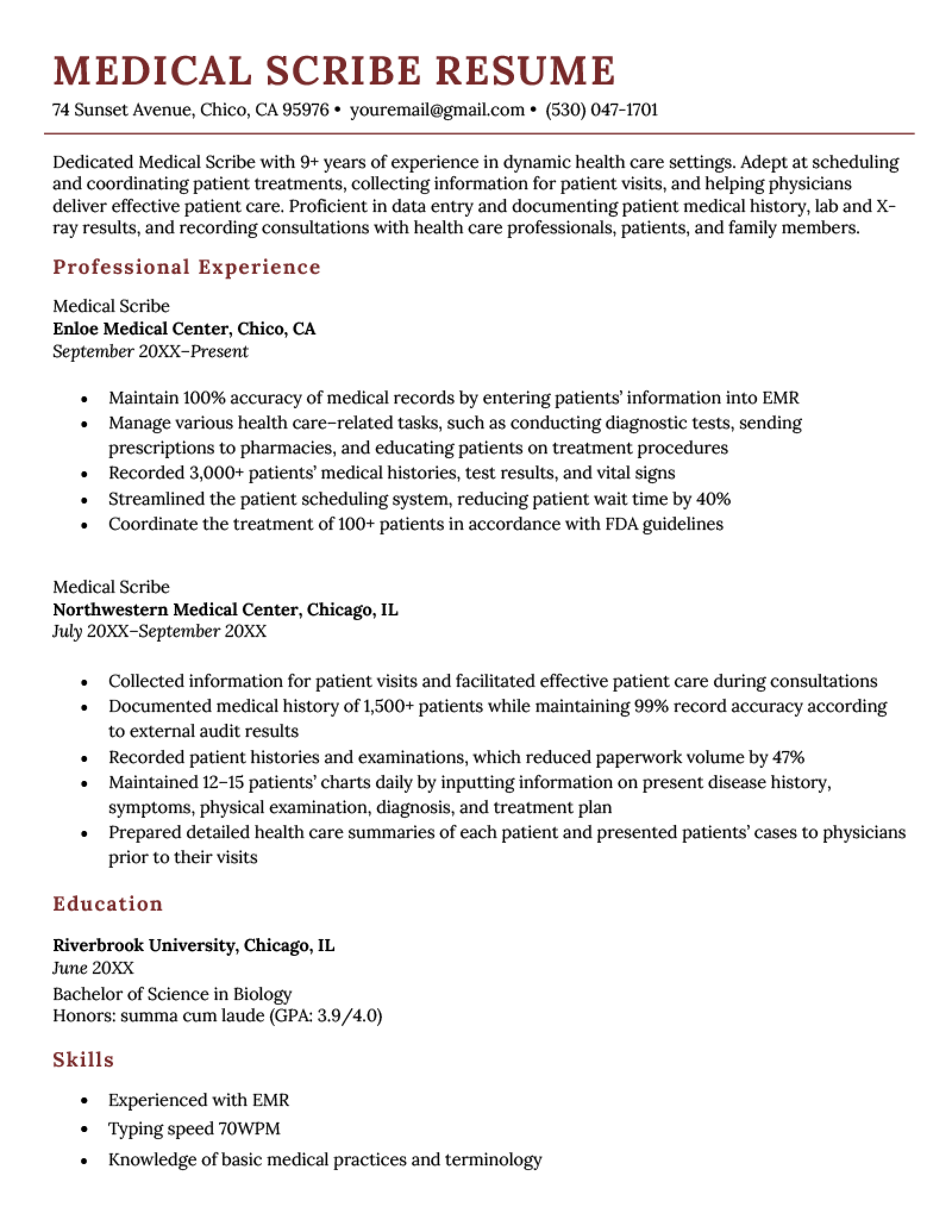


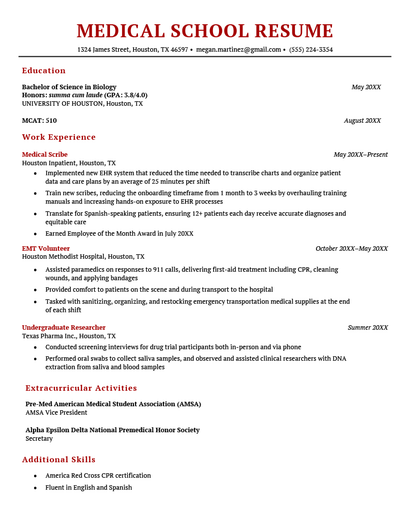
Medical school resume template
[Your Name]
[Your Address], [City, State]
[Your Email Address] | [Your Phone Number]
[LinkedIn Profile] (optional)
Bachelor of Science in Biology
May 20XX
Honors: summa cum laude (GPA: 3.8/4.0)
Resume Genius University
MCAT: 510
August 20XX
Houston Inpatient, Houston TX | May 20XX – Present
- Implemented new EHR system that reduced the time needed to transcribe charts and organize patient data and care plans by an average of 25 minutes per shift
- Train new scribes, reducing the onboarding timeframe from 1 month to 3 weeks by overhauling training manuals and increasing hands-on exposure to EHR processes
- Translate for Spanish-speaking patients, ensuring 12+ patients each day receive accurate diagnoses and equitable care
- Earned Employee of the Month Award in July 20XX
Houston Methodist Hospital, Houston, TX | August 20XX – September 20XX
- Assisted paramedics on responses to 911 calls, delivering first-aid treatment including CPR, cleaning wounds, and applying bandages
- Provided comfort to patients on the scene and during transport to the hospital
- Tasked with sanitizing, organizing, and restocking emergency transportation medical supplies at the end of each shift
- America Red Cross CPR certification
- Fluent in English and Spanish
How to write a resume for medical school
You may not be required to submit a resume as part of your medical school application. However, including a well-written resume can separate you from candidates with similar qualifications and earn you an interview.
Here are 5 tips for writing an ideal medical school resume that shows admissions officers that your skills and interests align with their program’s requirements.
1. Don’t write a resume objective
Usually, the person who reviews your application will quickly scan your resume after poring over your MCAT scores, personal statement essay, and letters of recommendation. So don’t write a resume objective — yet another chunk of text — and expect the reviewer to read it.
Instead, grab the admissions officer’s attention by listing your name and contact information in a resume header, and then go straight into your education and work experience.
When you’re ready to apply for your first medical residency, you’ll need to write a medical CV that does include a summary.
2. Use scannable formatting
Admissions officers should be able to pick out your main qualifications with a quick glance at your resume. Make your skills stand out to the eye by following these professional resume formatting guidelines:
- submit a one-page resume (anything longer is too much reading for a busy application reviewer)
- use bold and italic text in headings to create an easy-to-read structure
- set your resume font size between 10.5 and 12 points so the reviewer can read it without straining their eyes
- set your resume margins in the ½”–2” range, aiming for a perfect balance between blank space and text so the page is filled (but not crammed) with information
3. Showcase your MCAT scores
Yes, your MCAT scores are already listed on your medical school application. But you should still list your scores on your resume to reiterate that you meet your target program’s requirements.
Your MCAT scores should be in your resume’s education section at the top of your resume. (Because you’re not applying for a job, your degree and MCAT scores mean more to the reviewer than your work experience.)
Here’s how an education section on a med school resume should look:
Bachelor of Science in Biology
UNIVERSITY OF HOUSTON, Houston, TX
Graduated May 20XX
Honors: summa cum laude (GPA: 3.8/4.0)
MCAT: 510
August 20XX
4. Quantify your relevant work and research experience
Only list work and research experience that shows you’ll make a great physician on your medical school resume.
For instance, medical school admissions officers aren’t interested in the odd jobs you did to get spending money during high school. However, they will be impressed by your time as an undergraduate clinical research assistant.
Including a resume with your medical school application makes you stand out from a crowd of similarly qualified candidates. So when you write your work experience section, don’t just list your job description. Instead, describe your experience in terms of your accomplishments, using hard numbers to provide context, like this:
- Implemented new EHR system that reduced the time needed to transcribe charts and organize patient data and care plans by an average of 25 minutes per shift
- Train new scribes, reducing the onboarding timeframe from 1 month to 3 weeks by overhauling training manuals and increasing hands-on exposure to EHR processes
- Translate for Spanish-speaking patients, ensuring 12+ patients each day receive accurate diagnoses and equitable care
5. Include extracurricular activities
Most medical schools say they consider applicants regardless of what bachelor’s degree they have. But if you’re applying with an undergraduate degree that has little or nothing to do with the medical field you should still show that your interests point toward you becoming a doctor.
Highlight your relevant hobbies and interests on your medical school resume by creating an extracurricular activities section, and include any university clubs and volunteer activities that show hard and soft skills that will make you a successful doctor.
Here’s an extracurricular activities section that shows medical school application reviewers that the applicant is actively interested in pursuing a medical career:
AMSA Vice President
Pre-Med American Medical Student Association (AMSA)
Secretary
Alpha Epsilon Delta National Premedical Honor Society
Build your resume in minutes

About the Author

Nathan Soto is dedicated to providing practical guidance to job seekers, especially people with nonlinear career paths.
Nathan graduated from the University of Nevada with a double B.A. in French and Music. His articles and career advice have been featured on multiple platforms, offering insights into resume writing, interview preparation, and personal branding.


Click to rate this article
4.6 Average rating