

- IT skills are a hot commodity
- Soft skills are required to succeed in today's workforce
- Being vague when stating your skills could cost you the job
- Upskilling is the key to getting hired
- Skills-based hiring is transforming the way employers find the right candidates
- Conclusion
- Methodology
- Sources
- About Resume Genius
Having the right skills to showcase on your resume or cover letter can significantly increase your chances of success in today’s competitive job market. But it can be challenging to know which skills to focus on when applying for jobs.
To help job seekers understand what types of work-related skills employers are looking for, we surveyed 812 hiring managers across the United States.
- 88% of full-time hiring managers are more likely to focus on hard skills when reading resumes
- When hiring for technical roles, hiring managers prefer applicants with a 75% hard skills to 25% soft skills ratio
- 42% of hiring managers regard IT, software development, data analysis, and project management as the most critical skills for the future job market
- 48% of hiring managers agree that soft skills are essential for potential employees
- 28% believe soft skills are even more important than a candidate’s hard skills for succeeding on the job
- 30% of hiring managers responded that applicants don’t provide concrete, specific evidence for their skills
IT skills are a hot commodity
As technology continues to push boundaries and reshape the way we work, the demand for skilled IT professionals is at an all-time high.
Let’s discuss the key hard skills (abilities learned through schooling or training) that hiring managers most value.
Technical skills are the present and future
The future is in favor of job seekers who master technical skills.
According to our survey data, 42% of hiring managers regard IT, software development, data analysis, and project management as the most critical skills for the future job market.
Notably, the combination of software development, IT (which includes blockchain, cloud computing, artificial intelligence (AI), and cybersecurity management), and web development is considered the most valuable skill set.
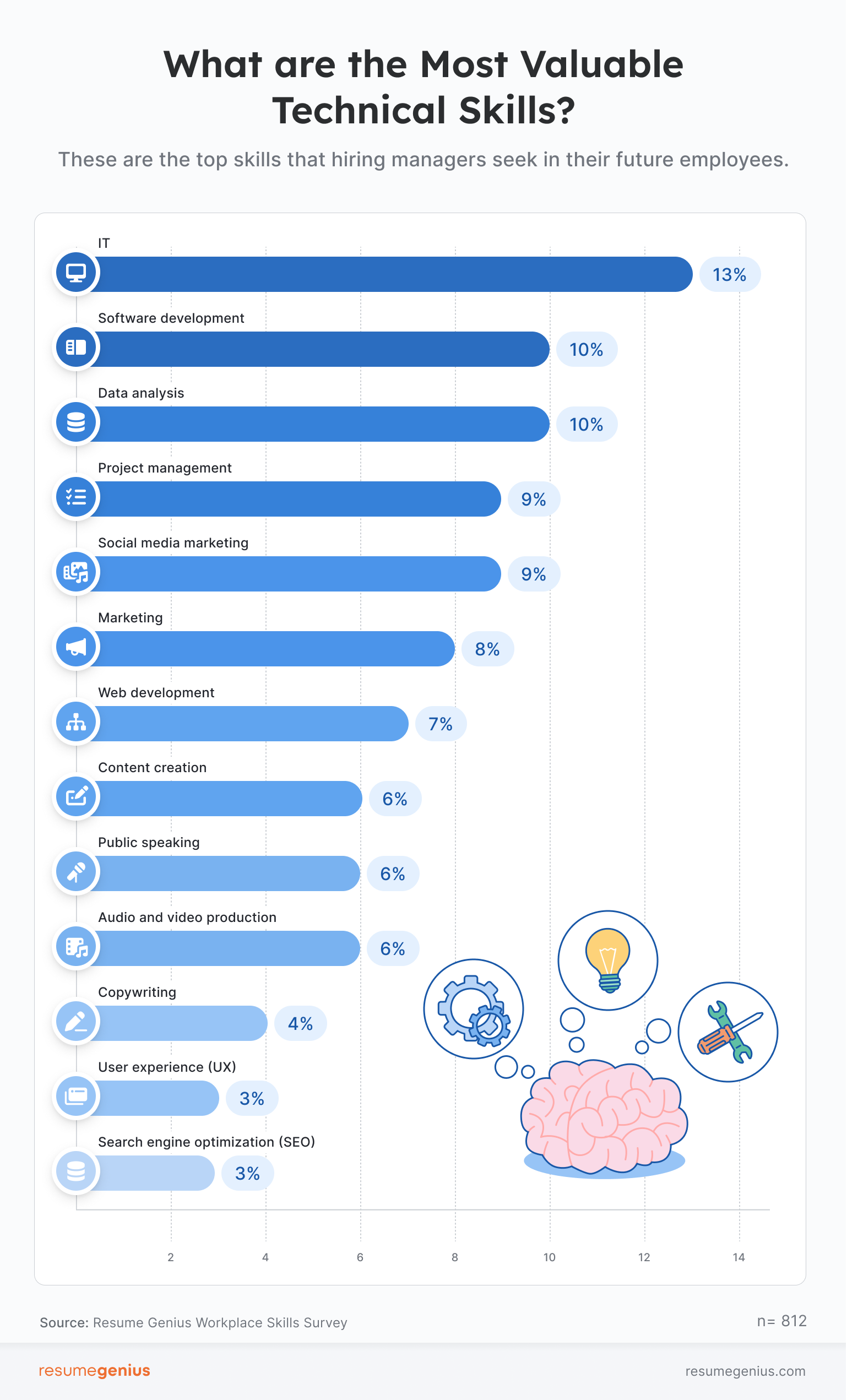
Here’s a percentage breakdown of the top technical abilities hiring managers want in new candidates (from highest to lowest):
- IT — 13%
- Software development — 10%
- Data analysis — 10%
- Project management — 9%
Following closely are these additional hard skills:
- Social media marketing — 9%
- Marketing — 8%
- Web development — 7%
- Content creation — 6%
- Public speaking — 6%
- Audio and video production — 6%
Lastly, these technical skills scored the lowest among hiring managers:
- Copywriting — 4%
- UX — 3%
- Search engine optimization (SEO) — 3%
Adapt to the AI era by showcasing a versatile skillset
As AI continues to impact the job market, hiring managers emphasize that technical skills alone aren’t enough — in fact, having a combination of both soft and hard abilities will become increasingly important for staying competitive. Here’s what employers think:
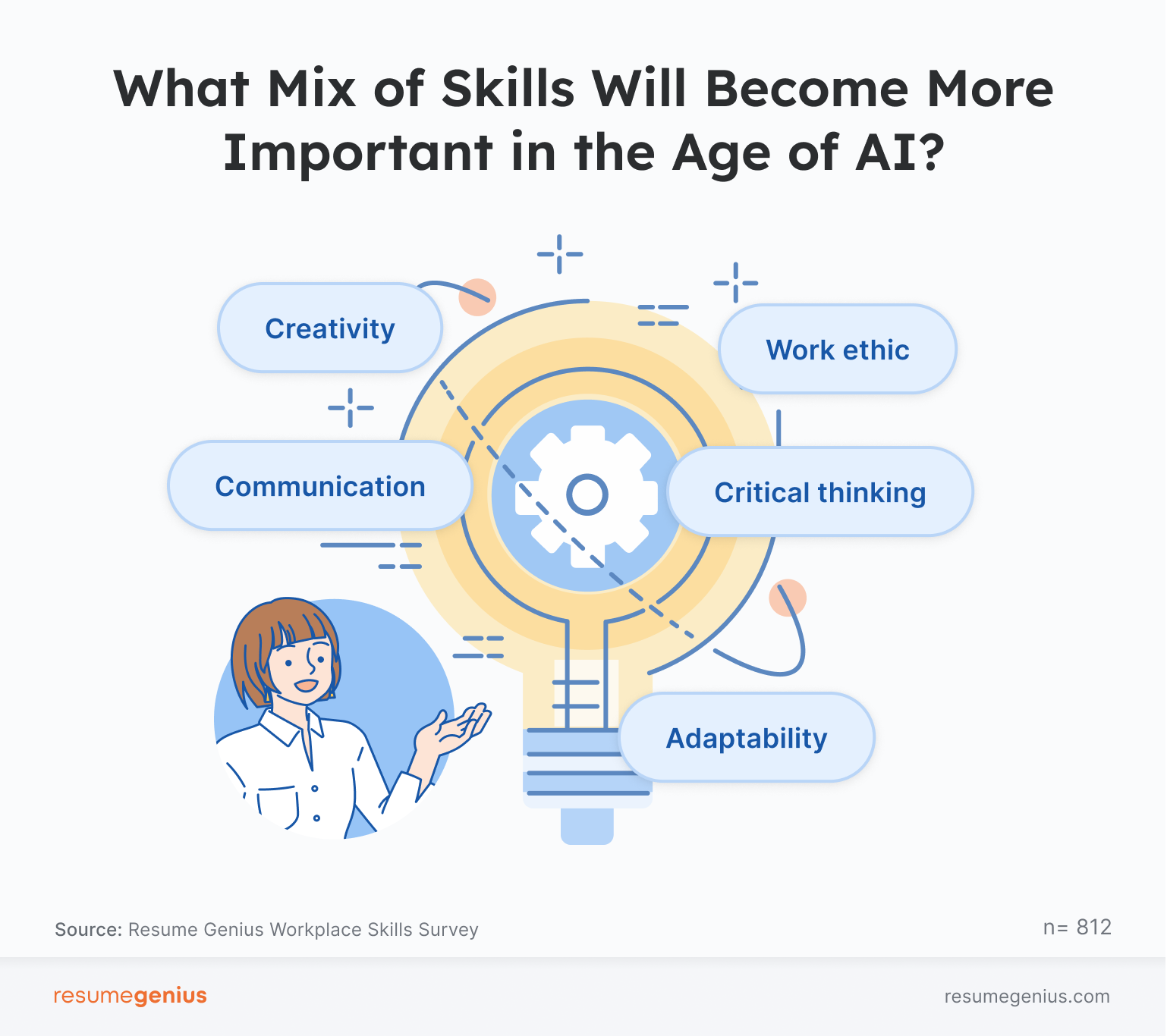
Our research pinpoints the top 5 skills employers highly value in light of the rise of AI and automation:
- Critical thinking
- Creativity
- Adaptability
- Communication skills
- Good work ethic
These findings also reveal varying preferences across different company sizes and roles:
- 88% of full-time hiring managers are more likely to focus on hard skills when reading resumes
- When hiring for technical roles, hiring managers prefer applicants with a 75% hard skills to 25% soft skills ratio
- Large and small companies value hard and soft skills equally for technical roles. However, medium-sized companies are more attached to hard skills exclusively
- Junior team members involved in hiring are more receptive to a 50/50 hard and soft skills balance for technical roles than their senior peers
- Although hiring managers consistently consider both soft and hard skills on resumes, hard skills are still the primary focus when deciding whether a candidate is right for the job
Soft skills are required to succeed in today’s workforce
Core soft skills (qualities that help you relate to others in a professional setting) are increasingly becoming recognized as valuable assets for employees in today’s workplaces, so you should include them when you write a resume and prepare your cover letter.
Our hiring manager survey uncovered several key insights about the significance of soft skills and how they’re tied to on-the-job success:
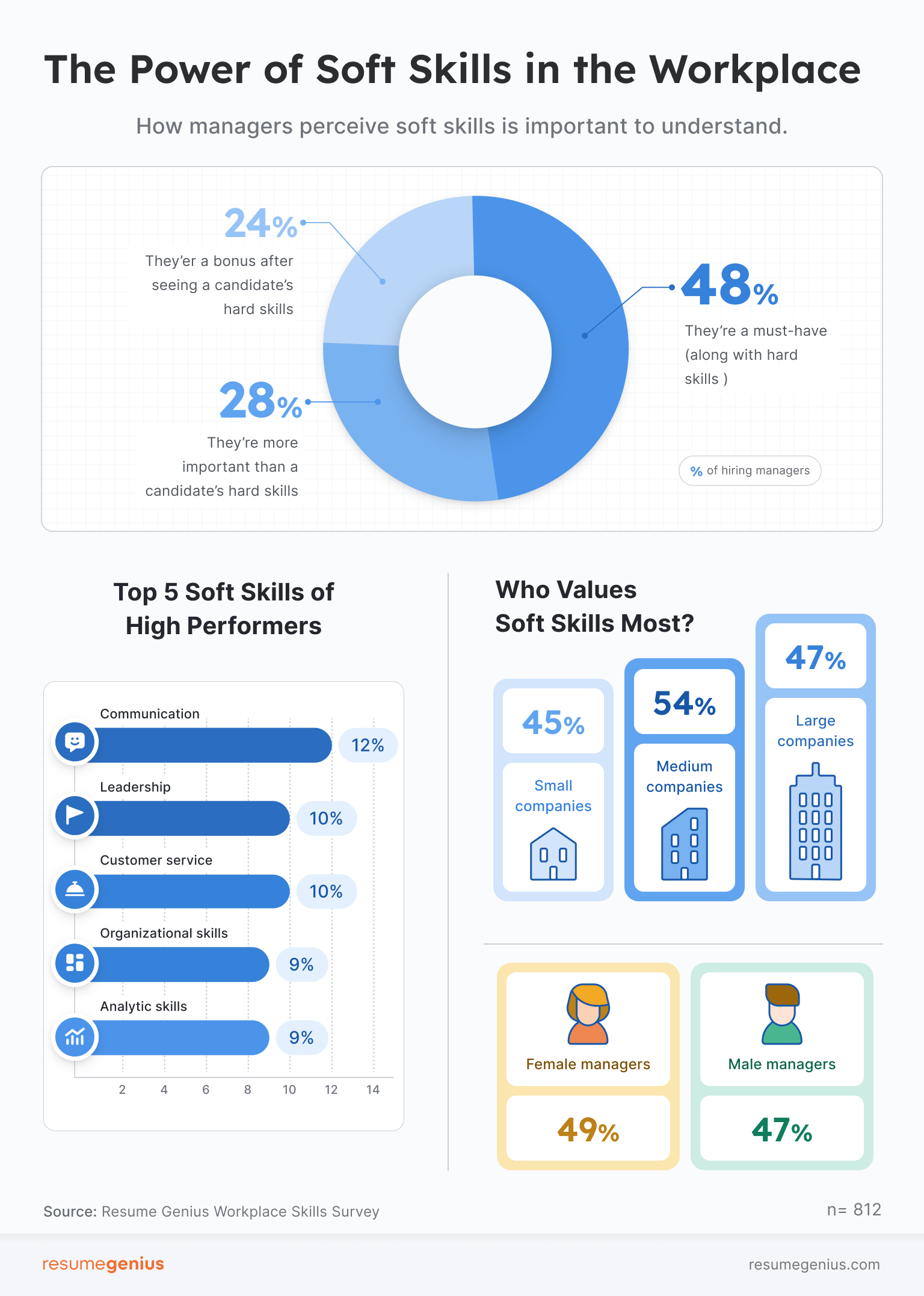
- 48% of hiring managers agree that soft skills are essential for potential employees.
- 28% believe soft skills are even more important than a candidate’s hard skills for succeeding on the job.
- 24% consider soft skills a bonus after seeing a candidate’s hard skills during the hiring process.
The top five soft skills that differentiate the highest performers are:
- Communication — 12%
- Leadership — 10%
- Customer service — 10%
- Organizational skills — 9%
- Analytical skills — 9%
Here are some other statistics:
- 49% of female hiring managers and 47% of male hiring managers think soft skills are necessary for career success
- Medium-sized companies (54%) are more likely to think soft skills are critical to have compared to large and small companies
- 55% of hiring managers would hire a candidate who has excellent soft skills, even if they don’t have all the required hard skills
- 54% of senior team members who hire new employees are more likely to view soft skills as being essential, compared to full-time HR professionals (47%) or junior team members who assist with hiring (47%)
- When hiring for non-technical positions, hiring managers look for an even balance between hard and soft skills
In a 2024 Hiring Trends Report run by Resume Genius, 54% of hiring managers say they believe soft skills are highly important, and 48% would be less likely to hire a candidate if they didn’t possess the soft skills the company is looking for.
Communication skills matter more than ever
We examined which soft skills were most important to hiring managers when choosing a candidate for a role in their organizations, and effective communication was their top choice.
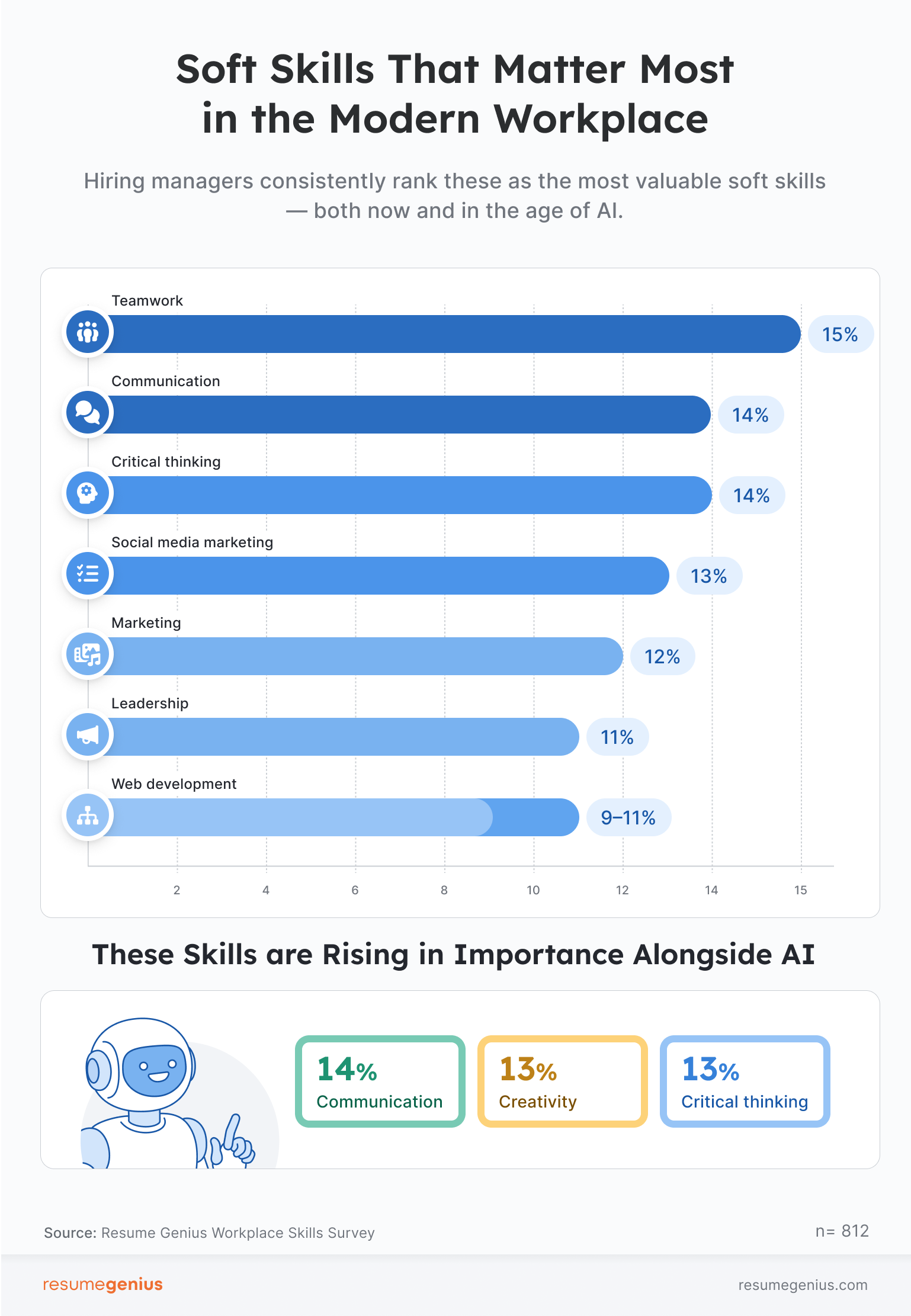
These are the results of our survey:
- Teamwork, communication, and critical thinking form the ideal mix of key transferable skills that hiring managers seek
- Employers identified a combination of communication skills, effective leadership, and excellent time management as the key attributes that set top performers apart from other employees
- 23% of hiring managers want to see both strong communication abilities paired with excellent technical skills in their top performers
Teamwork is crucial in today’s workforce
In a world increasingly shaped by remote and hybrid work arrangements, showcasing your ability to effectively work in a team is key to getting hired and succeeding in your role.
Our report found that excellent teamwork skills are the most sought-after transferable skills that employers seek in potential hires:
Next, hiring managers chose communication and critical thinking as valuable transferable skills.
Have a look below at the survey data:
- Teamwork — 15%
- Communication — 14%
- Critical thinking skills — 14%
- Time management — 10%
- Leadership — 9%
- Computer-related abilities — 9%
- Foreign languages — 6%
- Research — 6%
- Writing skills — 6%
Responsibility is the #1 trait for an ideal job candidate
Employers want to hire individuals who can be trusted to deliver on their commitments and take ownership of their work.
In fact, 20% of hiring managers believe that responsibility is the most important trait a job candidate can have.
Here’s what we uncovered in our findings about the most desired qualities hiring managers want to see in their candidates (assuming they already have the required hard skills):
- Responsible — 20%
- Hardworking — 17%
- Trainable — 17%
- Integrity — 11%
- Self-aware — 10%
- Kind — 10%
- Enthusiasm — 9%
- Curiosity — 7%
Being vague when stating your skills could cost you the job
Hiring managers have seen it all, including resumes that exaggerate or outright lie about a candidate’s skills and experience. Therefore, being specific and honest about your skills and experiences on your resume is key to avoiding any misunderstandings during the hiring process.
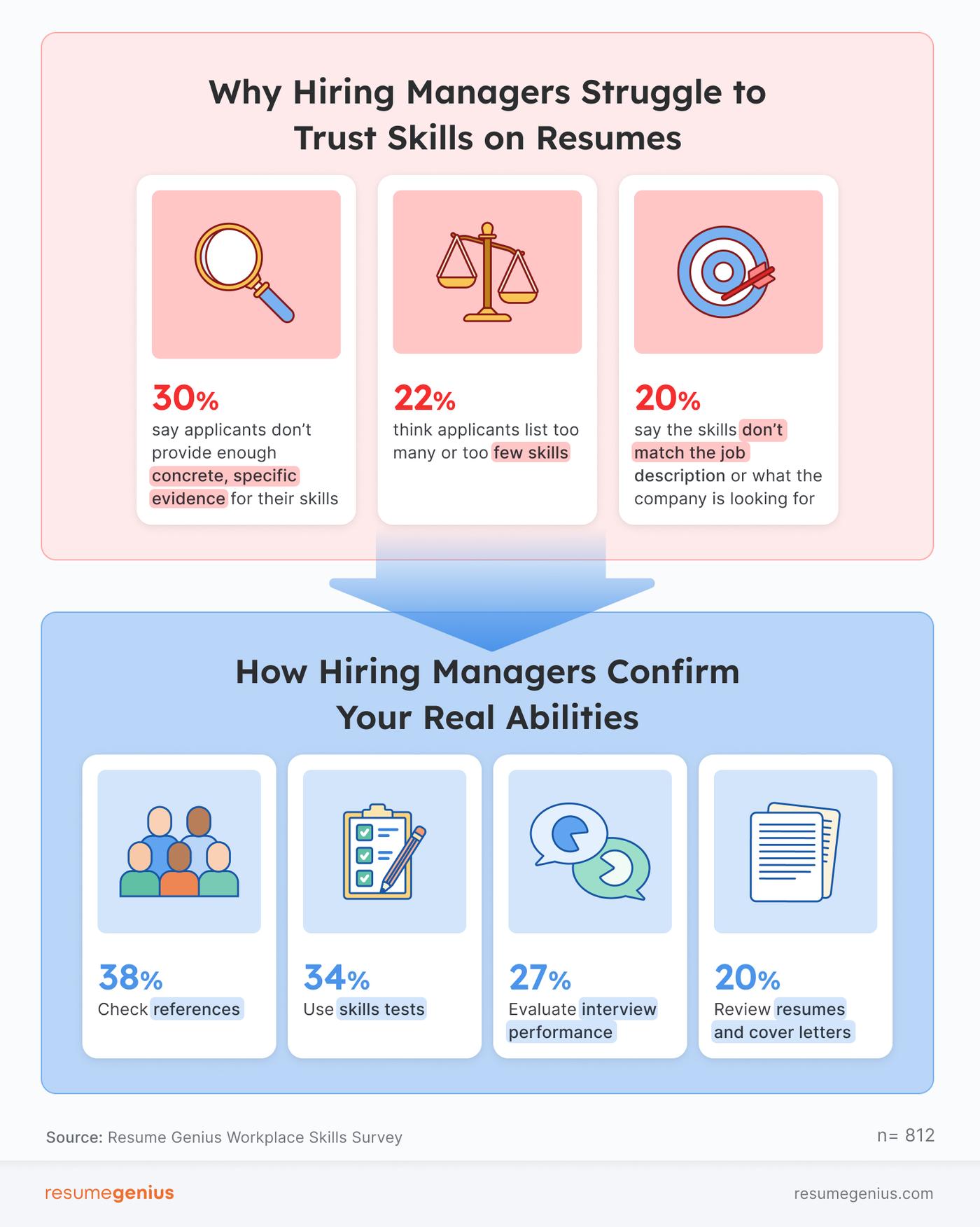
Find the full breakdown below:
- 30% of hiring managers responded that applicants don’t provide concrete, specific evidence for their skills
- 22% of hiring managers think applicants list too many or too few skills on their resumes
- In particular, 33% of senior team members who help with hiring believe applicants list either too many or not enough skills on their resumes
- 20% of hiring managers stated the skills listed on resumes either don’t match the company’s job description or aren’t what the company is looking for
Real-life examples of your skills are what’ll impress hiring managers
When applying for a job, simply listing your skills on your resume isn’t enough. To make a lasting impression, hiring managers want to see how candidates have applied these skills in situations beyond their resumes and cover letters.
Interested in how hiring managers learn what skills you possess? Here’s what we discovered:
- 38% of employers understand an applicant’s skill set based on the job references they provide
- 34% of hiring managers judge applicants according to their performance on skills tests during the application process
- 29% of respondents view their candidates’ interview performance as the biggest indicator that they have the skills they claim
- 27% of employers will look closely at an applicant’s resume and cover letter to get a better idea of their skills
Basically, employers use every method they have to confirm you have the skills they’re looking for before they trust you’re telling the truth on your resume and cover letter.
And for hiring managers? According to Raj Mukherjee, Executive Vice President at Indeed, companies that rely solely on traditional recruitment methods like using resume reviews for interview selection, risk missing out on “exceptional talent” in today’s job market because some candidates:
- have gaps in their work history
- live far away from cities where the jobs are
- are from minority groups
- are women
- are over 50 years old
- don’t have a college degree
Mukherjee suggests that companies should change their hiring practices and look for ways (e.g., skills tests, live auditions, simulations) to attract candidates from these underrepresented groups, instead of just relying on resumes and cover letters.
Upskilling is the key to getting hired
The term “upskilling” refers to the process of gaining new skills or improving existing ones to stay relevant in the job market.
According to our survey, upskilling is highly valued by employers as they seek candidates who aren’t just proficient in their current skill set but are also willing to adapt to new situations and challenges.
Our study reports:
- Male hiring managers (39%) are slightly more likely to reskill or upskill existing employees compared to female hiring managers (35%)
- Junior and senior team members who assist with hiring are more involved with reskilling and upskilling existing employees
How employers are responding to skill gaps
Even with the best recruitment efforts, sometimes finding the ideal candidate with the necessary qualifications and relevant work experience can be difficult. In such cases, employers have to address skill gaps in their workforce.
Here’s what employers have to say about skills gaps in their companies:
- “I prefer to hire employees with the right skills” — 46%
- “I’m willing to reskill or upskill my existing employees” — 36%
- “I’ll hire contractors or freelancers” — 15%
- “My company doesn’t have a skills gap” — 9%
Additionally, our report revealed some other noteworthy findings:
- Small companies are more likely to reskill or upskill existing employees
- Larger-sized companies are more likely to hire contractors to close skills gaps
- 44% of hiring managers close skills gaps by hiring new employees with the right skills or re-skilling/upskilling employees
Skills-based hiring is transforming the way employers find the right candidates
Rather than only evaluating educational qualifications or work experience, companies are now assessing applicants based on their abilities, also known as skills-based hiring.
For instance, Ernst and Young decided to eliminate degree requirements in 2015 for entry-level jobs, opting to use online assessments to evaluate applicants’ qualifications instead.
In our study, 44% of full-time hiring managers think that with the rise of AI and automation, skills-based hiring through skills tests is the most accurate way to determine whether applicants have good digital skills.
Here’s what else we discovered:
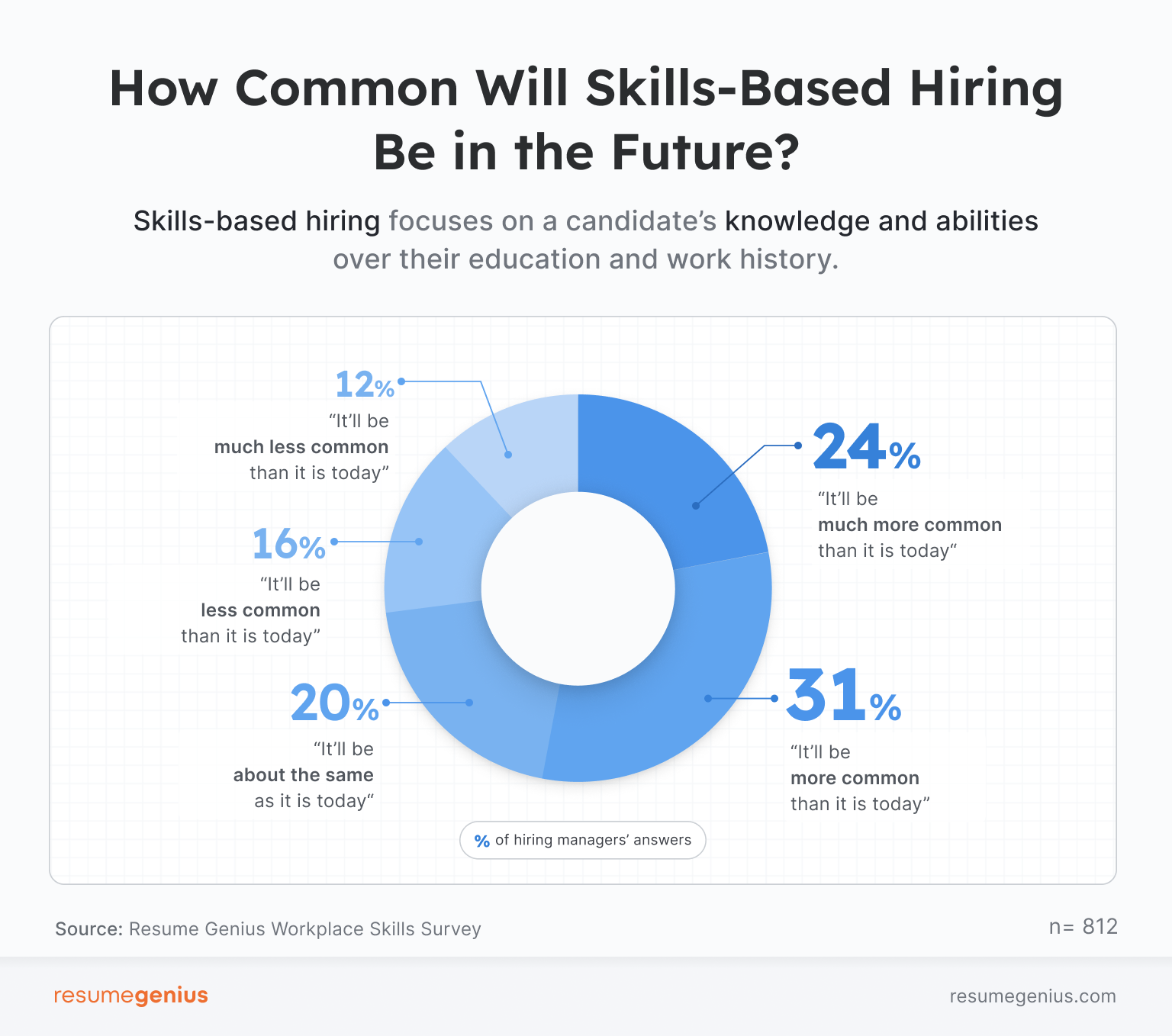
When asked how common skills-based hiring will be in the future, our survey respondents answered:
- “It’ll be much more common than it is today” — 22%
- “It’ll be more common than it is today” — 31%
- “It’ll be about the same as it is today” — 20%
- “It’ll be less common than it is today” — 16%
- “It’ll be much less common than it is today” — 12%
Have a look at what hiring managers believe about skills-based hiring:
- “It’ll become more common because of the increasing use of technology, AI, and automation” — 38%
- “Increased diversity, equity, and inclusion-based policies will remove unconscious bias during skills tests” — 20%
- “People switching careers into our industry will be tested on skills tests rather than work education or work experience” — 17%
- “Remote work is opening up our candidate pool so we need more skills tests to weed out candidates quickly and fairly” — 17%
- “I don’t think we need to do more skills-based hiring in the future” — 9%
Other key takeaways from the study include:
- Large (27%) and medium-sized (27%) companies are more likely to believe that skills-based hiring will become increasingly prevalent in the future than small companies (20%) or unknown organizations (13%)
- 33% of full-time hiring managers are more optimistic about the future of skills-based hiring compared to other team members
- There were no significant differences between men (36%) and women (38%) on the reasons why skills-based hiring will become more common
Conclusion
Our findings show that employers are no longer just scanning resumes for technical skills. They’re prioritizing candidates who can think critically, communicate clearly, and adapt in a fast-changing workplace.
More than half of hiring managers say they’d hire someone with strong soft skills even if they lack some technical experience, and nearly half believe skills-based hiring will become more common.
For job seekers, this means it’s not enough to list popular tools like IT or data analysis. You need to demonstrate how you’ve applied those skills and show traits like responsibility, collaboration, and curiosity. For employers, it’s a reminder that investing in upskilling and evaluating both hard and soft skills can help close talent gaps and build a stronger team.
Whether applying for jobs or making hiring decisions, top performers distinguish themselves by blending technical ability with strong interpersonal skills.
Methodology
This report was based on a survey conducted by Resume Genius in partnership with Pollfish. It launched on March 31, 2023, and targeted 812 professionals from various U.S. regions and company sizes, focusing on skills in the modern workplace.
The study featured a mix of question types, including yes/no questions, scale-based questions related to levels of agreement with a statement, questions allowing the selection of multiple options from a list of potential answers, and open-response questions. For simplicity, survey percentages were rounded to the nearest percentage point, and all analyses were performed in R.
To minimize bias, Pollfish uses Random Device Engagement (RDE) to ensure a fair and organic selection process. For further details on Pollfish’s methodology, please visit their website or contact eduardo@resumegenius.com.
Sources
- American Institutes for Research (AIR), Measuring Skills at Work: Lessons From the Field
- Deloitte, The Skills-based Organization: A New Operating Model for Work and the Workforce
- StandoutCV, Study: Fake Job References and Resume Lies
- Wall Street Journal, Want to Hire Better Amid the ‘Great Realization’? Focus on Skills
About Resume Genius
Since 2009, Resume Genius and its resume builder software have been helping people from all backgrounds and experience levels land their next job faster.
Resume Genius also provides a wide range of free career resources, including customizable resume templates, resume examples for different industries, and resume writing guides, to help job seekers find fulfilling work and reach their career goals.
Resume Genius is led by a team of dedicated career advisors and HR experts and has been featured in The New York Times, Harvard Business Review, Fast Company, CNBC, and USA Today.
For media inquiries, please contact us.
About the Author

Eva Chan is a Senior Digital PR Writer and Communications Lead at Resume Genius. Eva oversees the research and data-led campaigns that reveal key trends in today’s workforce and represents the company in media interviews and press features. Her work focuses on guiding job seekers through today’s job market and helping them present their applications and skills with confidence.