Entry Level Cyber Security Resume Examples & Writing Tips
 Written By Nathan SotoPR Specialist & Certified Professional Resume Writer
 Reviewed By Samuel JohnsSenior Content Editor & Certified Professional Resume Writer
Nathan Soto
PR Specialist & Certified Professional Resume Writer
Nathan Soto is dedicated to providing practical guidance to job seekers, especially people with nonlinear career paths. Nathan graduated from the University of Nevada with a double B.A. in French...
Read our writing tips for step-by-step guidance on making your resume stand out from the rest.

Entry-level cyber security resume examples
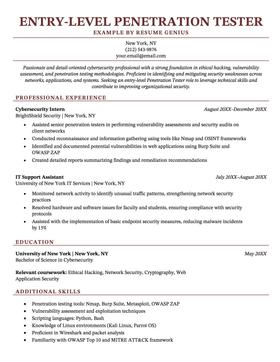
Choose from our full range of professional resume templates in any color.
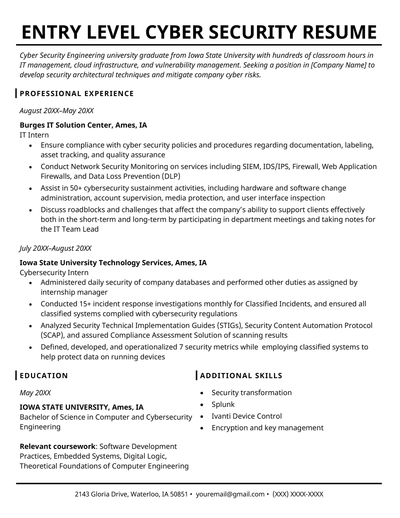
Entry level cyber security resume template
- Security transformation
- Splunk
- Ivanti Device Control
- Encryption and key management
- Ensure compliance with cyber security policies and procedures regarding documentation, labeling, asset tracking, and quality assurance
- Conduct Network Security Monitoring on services including SIEM, IDS/IPS, Firewall, Web Application Firewalls, and Data Loss Prevention (DLP)
- Assist in 50+ cybersecurity processes, including hardware and software change administration, account supervision, media protection, and user interface inspection
- Discuss roadblocks and challenges that affect the company’s ability to support clients effectively both in the short-term and long-term by participating in department meetings and taking notes for the IT Team Lead
- Administered daily security of company databases and performed other duties as assigned by internship manager
- Conducted 15+ incident response investigations monthly for Classified Incidents, and ensured all classified systems complied with cybersecurity regulations
- Analyzed Security Technical Implementation Guides (STIGs), Security Content Automation Protocol (SCAP), and assured Compliance Assessment Solution of scanning results
- Defined, developed, and operationalized 7 security metrics while employing classified systems to help protect data on running devices
How to write an entry level cyber security resume
Read our resume writing advice below to create a professional cybersecurity resume:
1. Highlight your cybersecurity skills
Your new employer wants to know their security systems — or those of their clients — will be in safe hands. To make sure they pick the best candidate, they’ll look at the hard and soft skills you’ve listed on your resume.
Listing your hard skills on your resume concisely explains what you can do for a company. Hard skills (also called technical skills) are abilities and knowledge you’ve gained through training or schooling.
Even if you have little or no experience, you can still list several hard skills you learned on your own or from school. Here are some examples of cybersecurity hard skills you can include:
- Cybersecurity systems: Splunk, Ivanti, NEWT, SCAP
- Technical skills: controls and frameworks, intrusion detection, network security control
- Coding languages: Python, Shell scripting, HTML, JavaScript
You’ll also need to demonstrate your soft skills on your resume, which show how you interact with your teammates and clients. Learning about your soft skills helps employers determine whether you’re detail-oriented and motivated enough to fit a cybersecurity specialist role.
These are examples of soft skills you can put on your cybersecurity resume:
- Problem-solving
- Communication skills
- Collaboration skills
- Attention to detail
- Time management (and other organizational skills)
The best way to showcase your cybersecurity-related soft skills (rather than simply listing them in your skills section) is by highlighting them in your work experience section and explaining how you have these abilities.
Here are some resume bullet point examples where a cybersecurity applicant demonstrates their good communication skills at their previous internship:
Pros
- Collaborated with my university’s IT team in conducting incident response investigations monthly that improved the campus’ security by 80%
- Resolved challenges that affected the company’s security systems and discussed them with my student supervisor
- Effectively communicated with department heads on 20+ multi-department cyber projects during weekly meetings and wrote 25+ reports throughout my internship
2. Create a compelling resume summary
One of the first things an employer sees on a resume is your resume objective. This short section underneath your contact details quickly explains why you’re a good fit for a company’s IT team in 2–4 sentences and encourages employers to continue reading the rest of your application.
Your resume introduction should:
- give the recruiter a clear picture of who you are
- highlight the top skills relating to your target job
- explain how working for this company aligns with your career goals
Here’s an example of a recent graduate’s resume objective for an entry level cybersecurity specialist role:
Data-driven and detail-oriented cybersecurity specialist. Recently graduated from Arizona State University with a bachelor’s degree in Computer Science. Highly proficient in vulnerabilities and risks in networks. Seeking an opportunity at Palo Alto Networks to leverage my knowledge and strengthen the high-security services offered to your clients.
3. Use important cybersecurity keywords
When employers first skim through your entry level cybersecurity resume, they’ll be on the lookout for certain words and phrases that tell them you’re an ideal applicant. Using these cybersecurity keywords throughout your resume objective and skills section shows the recruiter you’re a good candidate and understand the complexities of a cybersecurity specialist role.
Some cybersecurity keywords to include on your resume are:
- Computer science
- Incident responder
- Technical skills
- Vulnerability assessment
- Analysis
- Information security
- Collaboration
Although including a broad range of keywords related to your experience and abilities is important, you’ll get a better response if you tailor your keywords to the job description.
Companies use applicant tracking software (ATS) to select candidates who use matching keywords from their job description, so ensure you write an ATS-friendly resume by adding the right skills for your resume and requirements listed in the job ad. Then, include them on your cybersecurity resume.
4. List your education details prominently
When writing your resume for an entry level cyber security role, list your education details prominently to show employers you’ve learned about the skills and knowledge necessary to do the job. Also, your previous education helps employers see that you’re motivated to pursue a career in this field.
So try listing your:
- degree name
- GPA
- university name
- date of graduation (or date you intend to graduate)
- city and state
- relevant coursework
Adding relevant course on your resume tells employers you’ve learned essential skills and have developed a good foundation to be a junior cybersecurity specialist.
Below is an example of an entry-level cybersecurity resume’s education section:
B.S. in Computer Science
Arizona State University
Relevant coursework: Network Security, Data Encryption, and other relevant topics
Certified in CCNA Security
Build your resume in minutes

How to get a high-paying job in cyber security (video)
Watch cybersecurity expert Sandra Liu’s tips on how to find high-paying jobs in the field:
About the Author

Nathan Soto is dedicated to providing practical guidance to job seekers, especially people with nonlinear career paths.
Nathan graduated from the University of Nevada with a double B.A. in French and Music. His articles and career advice have been featured on multiple platforms, offering insights into resume writing, interview preparation, and personal branding.