

Using bullet points helps you keep your cover letter concise while drawing attention to your most valuable skills, experiences, and accomplishments.
Below, we’ll cover when it makes sense to use bullet points, how to format them effectively, and provide an example and some extra resources to help you land your next job.
When to use bullet points in your cover letter
Bullet points are an effective addition to a cover letter when you want to draw attention to key qualifications without forcing the hiring manager to search through dense paragraphs. They make important information easier to scan and can help your most relevant accomplishments stand out, especially when you’re competing against many other applicants.
Consider using bullet points if you have several impressive achievements, technical skills, certifications, or qualifications that closely match the job requirements.
Adding bullet points to your cover letter makes it easier to skim and more likely that hiring managers will catch the key points you’re trying to convey.
Geoff Scott, Certified Professional Resume Writer (CPRW)
That said, bullet points should complement your cover letter, not replace it. Stick to two to four bullet points and make sure most of your letter is written in paragraph form so you can explain your experience, demonstrate your communication skills, and connect your background to the employer’s needs.
In most cases, one short bulleted list of two to four items is enough to add impact without making the letter feel like a second resume.
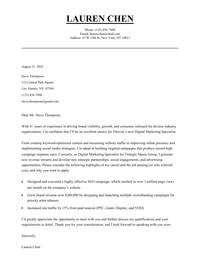
Our cover letter builder can make you a cover letter in as little as 5 minutes. Just pick the template you want, and our software will format everything for you.
Tips to use bullet points effectively in your cover letter
If you want to put bullet points in your cover letter, follow these strategies to make sure each one adds real value:
Tailor your bullet points to the job
Connect your past accomplishments directly to the requirements listed in the job posting.
Unlike your resume bullet points, which stand alone as short achievement statements, your cover letter should frame those achievements in the context of the role you’re applying for. This way, you’ll show the hiring manager why your experience matters for their team and how your results align with the employer’s needs.
For example, if a software engineering role emphasizes Agile development, database management, and custom application design, you could write something like this:
In reviewing your posting, I saw a strong focus on collaborative development and data-driven solutions. Here are a few examples of how my background aligns with those priorities:
- Led a 6-person Agile team, experience that mirrors your emphasis on fast, iterative development and cross-functional collaboration
- Designed a custom web application that streamlined client onboarding, preparing me to build the scalable solutions your team is known for
- Applied data science techniques to uncover customer behavior trends, experience I could leverage to support your product team’s growth strategy
Notice how each bullet:
- Mentions a skill or keyword from the job description
- Shows an accomplishment or application of that skill
- Connects the result directly to the employer’s needs
Highlight your most valuable skills
Bullet points are a great way to show both hard and soft skills that demonstrate your qualifications for the role, particularly ones that may not stand out on your resume or that set you apart from other candidates.
Instead of just listing your skills, use bullet points to demonstrate how you put them into practice. Skill-focused bullets should spotlight your capabilities and approach. For example, how you problem-solve, collaborate, or apply technical knowledge at work.
Eva Chan, Certified Professional Resume Writer (CPRW)
Here’s an example of how to strengthen bullet points on an accountant cover letter by turning a basic skills list into impact-driven statements:
Impactful skills bullets (strong)
Some of the professional skills I rely on most in my work include:
- Maintaining accurate financial records by implementing organized tracking systems and ensuring compliance with regulations
- Managing complex budgets through careful forecasting and continuous monitoring of expenditures
- Performing risk assessments by identifying potential financial challenges early and preparing proactive solutions
- Conducting business strategy reviews by collaborating with leadership to analyze data and guide decision-making
Generic skills list (weak)
My key competencies include, but are not limited to:
- Maintaining financial records
- Managing budgets
- Performing risk assessments
- Conducting business strategy reviews
Include your most relevant professional accomplishments
Use your bullet points to spotlight the accomplishments that make you stand out. Focus on a few highlights most relevant to the job you’re applying for, and connect your past successes to the employer’s future needs.
To make your accomplishment bullet points impactful:
- Start with an action verb (e.g., led, created, increased, designed)
- Include measurable results (percentages, dollar amounts, or number of people impacted)
- Tie the result back to the value you’ll bring to the new role
Here’s an example of bullet points that highlight professional accomplishments on an elementary teacher cover letter:
Some highlights from my current and past teaching experiences include:
- Developed TEKS-compatible health and nutrition activities that improved students’ healthy eating choices, as measured by a 25% increase in lunch program participation
- Established an open-door policy for parent/teacher conferences that boosted meeting attendance by 18% and strengthened family–school communication
- Planned and executed a weekly after-school art class open to all grade 1–3 students, enriching the curriculum and increasing extracurricular participation for 24 students
For help writing bullet points that summarize your professional accomplishments, try using our AI bullet point generator:
Struggling to write your resume? Make clear, achievement-oriented bullet points for your resume in seconds with our free AI bullet point generator.
Use these work-experience bullet points to make a resume that lands you interviews.
Add information that’s not on your resume
Your cover letter is an opportunity to share parts of your story that your resume can’t capture. While a resume lists dates, titles, and achievements, your letter can add the personal and professional context that brings your career path to life.
You can use your bullet points to:
- Explain how you stayed productive during an employment gap
- Show how side projects or volunteer work helped you develop relevant skills
- Highlight professional development, training, or certifications in progress
- Demonstrate involvement in industry communities or thought leadership
For example, you can explain an employment gap in your cover letter by framing it like this:
After my UX designer position ended due to company restructuring, I focused on building new skills and staying active in the field by:
- Completing courses on design thinking and UX writing through Udemy
- Accepting freelance projects to strengthen my technical skills and client management experience
- Attending presentations and workshops hosted by UX Synergies, a Chicago-based UX design organization
Notice how this approach shifts the focus away from the gap itself and toward the growth, learning, and initiative you demonstrated. That’s exactly the kind of context a resume can’t provide, but a cover letter can.
Example cover letter with bullet points
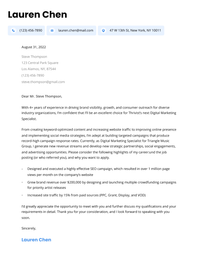
Here’s an example of a cover letter with bullet points for a sales role:
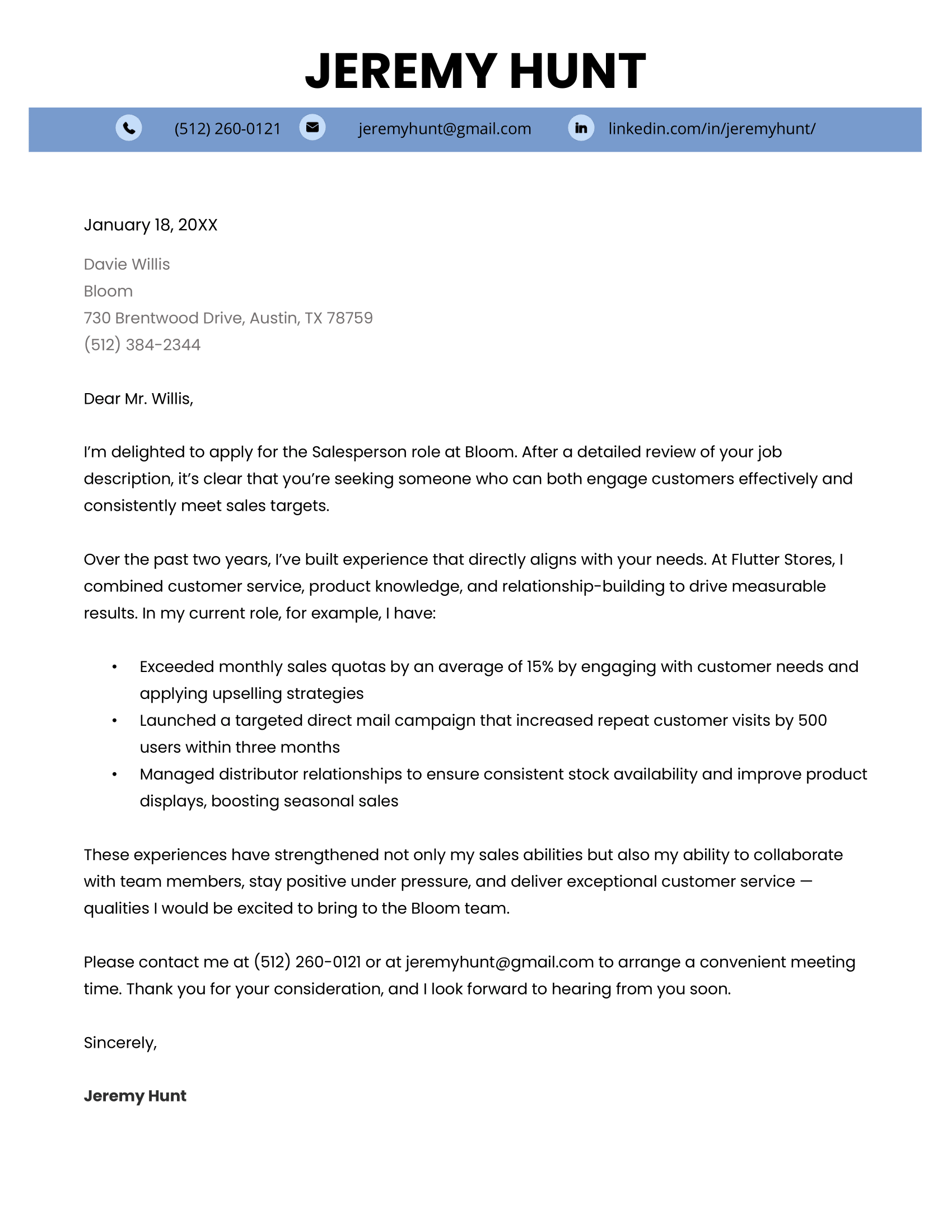
Cover letter template with bullet points
Need a little help getting started? Use this copy-and-paste template to fill in your own information and go from there:
(Hiring manager’s name)
(Company)
(Company address)
(Company phone number)
Dear (Hiring Manager’s Name),
I’m excited to apply for the (Job Title) position at (Company). After reviewing your job description, it’s clear that you’re seeking someone who can (key responsibility or skill from job description).
Over the past (X years), I’ve gained experience that aligns closely with your needs. At (Previous Company Name), I (briefly describe your role and focus). Some of my key achievements include:
- (Achievement #1: Use an action verb + quantifiable result, e.g., “Increased sales by X% through…”)
- (Achievement #2: Another measurable accomplishment, e.g., “Developed a (campaign/project) that resulted in X…”)
- (Achievement #3: Highlight teamwork, process improvement, or skill development, e.g., “Streamlined (process) to improve (metric) by X…”)
These experiences have strengthened not only my (key skill or quality #1) but also my (key skill or quality #2), and I am confident they would enable me to contribute positively to the (Company Name) team.
Please contact me at (phone number) or (email address) to arrange a convenient time to discuss how my background could benefit your team. Thank you for your consideration, and I look forward to speaking with you.
Sincerely,
(Your Name)
More cover letter resources
- How to Write a Cover Letter for a Job in 2026
- Cover Letter Format (Templates and Examples)
- Cover Letter Templates
- Cover Letter Examples for All Job Applications and Situations
Our cover letter builder can make you a cover letter in as little as 5 minutes. Just pick the template you want, and our software will format everything for you.
About the Author

Lauren Mastroni is a Digital Content Writer at Resume Genius, where she creates data-driven career content and actionable job search advice. With a background in academic research, she brings a research-focused approach to topics like resume writing, interviewing, and career development. Lauren is dedicated to helping job seekers at all stages navigate the hiring process and present themselves more effectively to employers.