

Struggling to get interviews?
A well-written resume focuses on strengths that match your target role. This guide helps you showcase the traits that make you the ideal candidate.
Strengths you could add to your resume include:
- Personal strengths, like communication, teamwork, and leadership skills
- Professional strengths, like analytical skills, project management, and computer skills
When you add strengths to your resume, don’t just list them. Instead, provide examples of your strengths being used in a professional environment.
Types of strengths to put on a resume
From personality traits to technical abilities, different types of strengths highlight different aspects of your potential.
Personal strengths
Personal strengths (often referred to as soft skills) reflect how you work and interact with others. These qualities matter most in roles that require teamwork, leadership, or problem solving.
Common personal strengths include:
- Communication
- Adaptability
- Reliability
- Teamwork
- Leadership skills
- Time management
- Work ethic
- Creativity
- Resilience
- Attention to detail
When including personal strengths on your resume, it’s best to show them in action rather than listing them in your skills section. Use your resume summary or work experience bullet points to provide brief, specific examples that demonstrate how these traits have helped you succeed.
Example bullet point:
- Adapted quickly to a new project management system, helping the team reduce delays by 20%
Example resume summary highlighting personal strengths:
Reliable team player with strong communication skills, recognized for streamlining internal workflows and collaboration. Supported a cross-functional project that reduced client response time by 30%.
Professional strengths
Professional strengths are your hard skills (technical skills) that directly impact your job performance. These are measurable abilities you’ve gained through education, training, and experience.
Common professional strengths include:
- Analytical skills
- Project management
- Presentation skills
- Design
- Programming (e.g., Python, JavaScript)
- Copywriting
- Bookkeeping
- CRM tools (e.g., Salesforce, HubSpot)
- Microsoft Excel
- Bilingual or multilingual abilities
- Computer skills
- Language skills
- Customer service skills
- Sales skills
You can list professional strengths in a dedicated skills section for quick visibility, and then elaborate on the key ones in your summary and work experience bullet points to show how you’ve used them.
Example bullet point:
- Improved website traffic by 45% through strategic SEO implementation and keyword optimization
Example summary highlighting key technical skills:
Data-driven marketing specialist with expertise in SEO, Google Analytics, and content management systems like WordPress. Improved organic traffic by 60% in six months through targeted keyword strategies and performance analysis.
Example skills section:
- SEO & keyword research
- Google Analytics & Search Console
- Content management (WordPress, Shopify)
- Project management
- Copywriting & editing
- Time management
- HTML/CSS (basic)
- Adobe Photoshop
- Canva
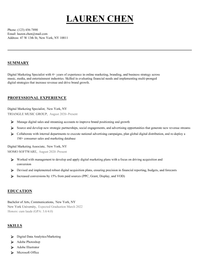
Our resume builder can help you add strengths to your resume quickly. Just pick the template you want, and our software will format everything for you.
How to identify strengths to add to your resume
To identify your strengths, reflect on your past roles, projects, or academic experiences. Think about:
- What tasks you consistently excelled at
- What colleagues or managers praised you for
- What accomplishments you’re most proud of
You can also take a skills assessment or review past performance feedback to spot patterns. If you’re unsure where to start, use our the skills generator (part of our easy resume builder) to discover role-relevant strengths based on your job title and experience level.
Make a high-impact skills section for your resume in seconds with our free software. Simply enter your job title and you’ll be matched with the most impactful skills for your industry.
Use these job-specific skills to make a resume that lands you interviews.
How to present your strengths effectively on your resume
An effective resume reinforces your key strengths across multiple sections so employers can quickly see your value. For best results, tailor each resume to the job and prioritize strengths that directly support the employer’s needs.
1. Highlight them in your resume summary
Your resume summary is one of the first sections a hiring manager reads, so it’s a high-impact spot to highlight your key strengths. Choose one or two strengths that are most relevant to the role and tie each to a clear accomplishment.
Instead of saying you’re a “hard worker” or a “strong communicator,” show how that strength contributed to workplace results. For example:
Results-driven marketing coordinator with strong project management skills and a track record of launching successful campaigns across digital platforms. Increased social media engagement by 50% in six months through targeted content strategies.
2. Demonstrate them in your work experience section
Your work experience section is the best place to show your strengths in action. Instead of listing responsibilities, focus on how your strengths helped you achieve specific results or solve problems. Where possible, connect your skills to measurable outcomes, like this:
- Led a team of five through a product launch, using strong communication and time management skills to deliver the project two weeks ahead of schedule
- Analyzed customer data to identify retention factors, resulting in a new strategy that increased retention by 15% over three quarters
3. List them in your skills section
Your skills section gives employers a quick snapshot of your core strengths. Use this section to list job-relevant technical skills, and match the job description’s language where it makes sense. This helps your resume pass applicant tracking system (ATS) screening and makes your strengths easy to spot.
Here’s an example:
- Google Analytics, Google Ads, Google Search Console
- SEMrush, Ahrefs
- Hootsuite, Mailchimp
- PPC
- Social media marketing
- Email marketing
- HTML & CSS
- Analytical skills
Strengths-focused resume example
Here’s a sample resume that highlights strengths across the summary, work experience, and skills section (with strengths and skills bolded):
jordan.lee@email.com | (555) 123-4567 | San Diego, CA | linkedin.com/in/jordanlee
PROFESSIONAL SUMMARY
Resourceful marketing professional with 5+ years of experience driving brand growth through content strategy, project management, and cross-functional collaboration. Known for strong communication skills and the ability to turn complex data into actionable insights. Successfully led campaigns that boosted web traffic by 60% and increased lead conversions by 25%.
WORK EXPERIENCE
Marketing Specialist
BrightEdge Media | San Diego, CA
Jan 20XX – Present
- Managed end-to-end content campaigns using SEO strategy and data analysis, leading to a 45% increase in organic traffic
- Collaborated with designers and developers, demonstrating teamwork and adaptability in a fast-paced, agency environment
- Used Google Analytics to monitor performance and refine content strategies
Content Coordinator
Vista Group | Remote
May 20XX – Dec 20XX
- Coordinated blog and social media content across multiple platforms, applying content management and copywriting skills
- Used project management tools (Asana, Trello) to track deadlines and ensure timely delivery
- Assisted in brand voice development, contributing creativity and consistency across digital assets.
EDUCATION
B.A. in Communication
University of California, Santa Barbara
Graduated: 20XX
SKILLS
- Content strategy
- SEO & keyword research
- Google Analytics
- Project management
- Copywriting
- Time management
- Collaboration
- Attention to detail
- Adaptability
Strengths-focused resume template (fill-in-the-blank)
Use this fill-in template to highlight your strengths throughout your resume. Paste it into your favorite resume template and fill it in with your own information:
[Your Name]
[Your Email] | [Phone Number] | [City, State] | [LinkedIn Profile or Portfolio Link]
Professional Summary
[Adjective that describes you] [job title] with [X years] of experience in [industry or field]. Known for [strength #1], [strength #2], and [strength #3], with a track record of [brief accomplishment or result]. Seeking to apply [key skill or strength] to help [company/team name] achieve [specific goal].
Work Experience
[Most Recent Job Title]
[Company Name] – [City, State or Remote]
[Month 20XX] – [Month 20XX]
- Applied [technical or personal strength] to [task or responsibility], resulting in [quantifiable result or impact].
- Demonstrated [soft skill or strength] while working on [project or team-related activity].
- Used [tool or method] to [solve a problem or improve a process].
- Contributed to [outcome or success] by leveraging [another strength].
[Previous Job Title]
[Company Name] – [City, State or Remote]
[Month 20XX] – [Month 20XX]
- Supported [team, project, or client] using [strength], leading to [result]
- Coordinated with [departments or stakeholders] to achieve [goal], showcasing [soft skill]
- Improved [process/system/outcome] through [technical skill or strength]
Education
[Degree or Certification] – [Field of Study]
[School Name], [Graduation Year]
Skills
- [Strength or hard skill]
- [Tool or software]
- [Industry-specific skill]
- [Transferable skill]
- [Additional relevant skill]
Add strengths to your resume quickly
Now that you know which strengths to include and how to present them, the next step is presenting them clearly and consistently. Our resume builder takes the guesswork out of writing by helping you highlight your strengths in a clean, professional format.
Just choose a template, fill in your details, and get personalized content suggestions based on your industry and experience level.
Make a resume that
puts your strengths first

About the Author

Lauren Mastroni is a Senior Digital Content Writer at Resume Genius, where she creates data-driven career content and actionable job search advice. With a background in academic research, she brings a research-focused approach to topics like resume writing, interviewing, and career development. Lauren is dedicated to helping job seekers at all stages navigate the hiring process and present themselves more effectively to employers.


Click to rate this article
4.8 Average rating