Travel Nurse Resume Sample
 Written By Nathan SotoPR Specialist & Certified Professional Resume Writer
 Reviewed By Samuel JohnsSenior Content Editor & Certified Professional Resume Writer
Nathan Soto is dedicated to providing practical guidance to job seekers, especially people with nonlinear career paths. Nathan graduated from the University of Nevada with a double B.A. in French...
Download our free travel nurse resume template or use our tips to write your own. Pair your resume with a compelling nursing cover letter to maximize your chances of landing an interview and get where you’re needed faster.

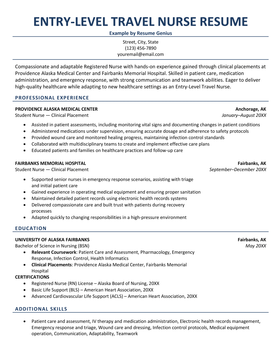
Travel nurse resume examples by experience level
Get started now—make a new resume in minutes or update an existing resume with ease.
Related Resume Samples
View All Resume Examples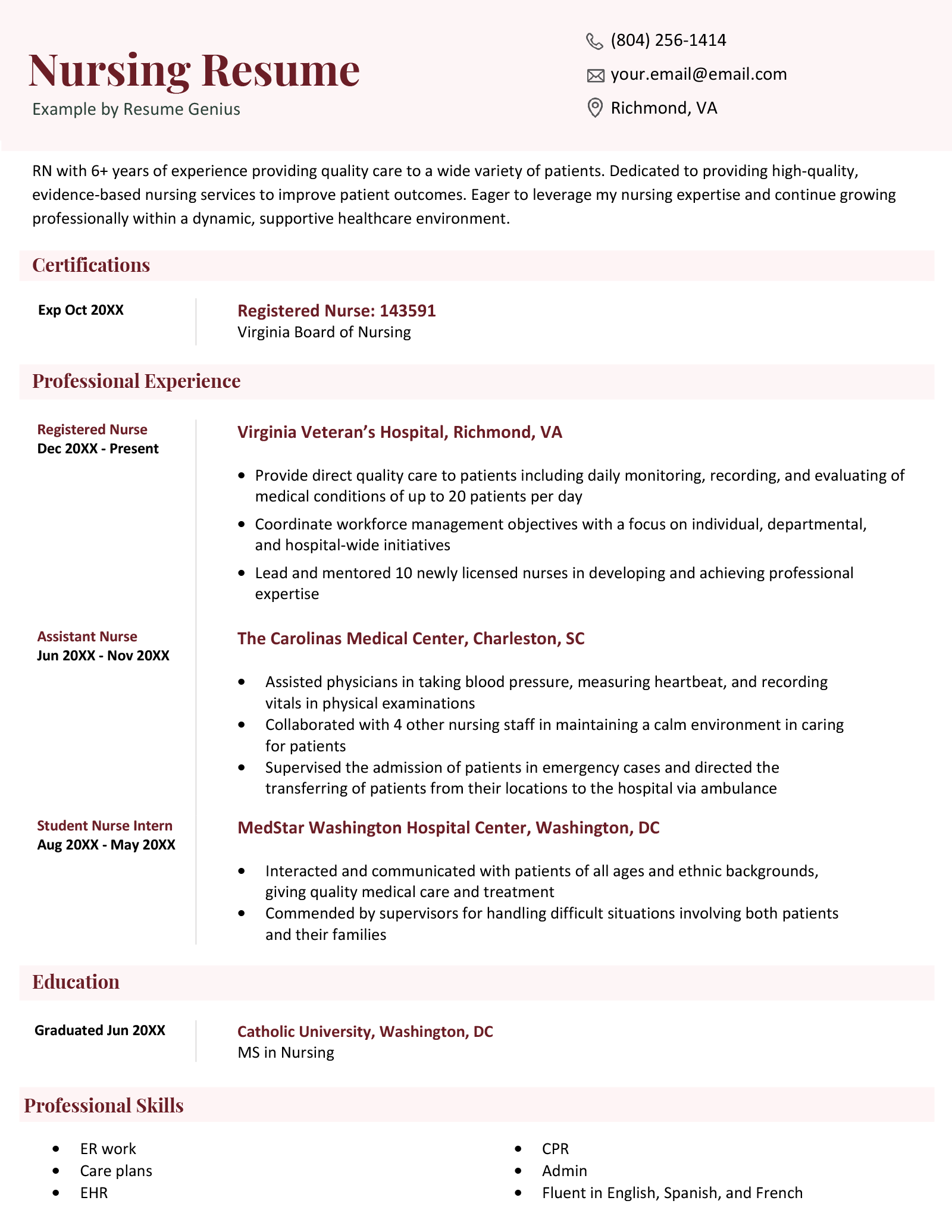
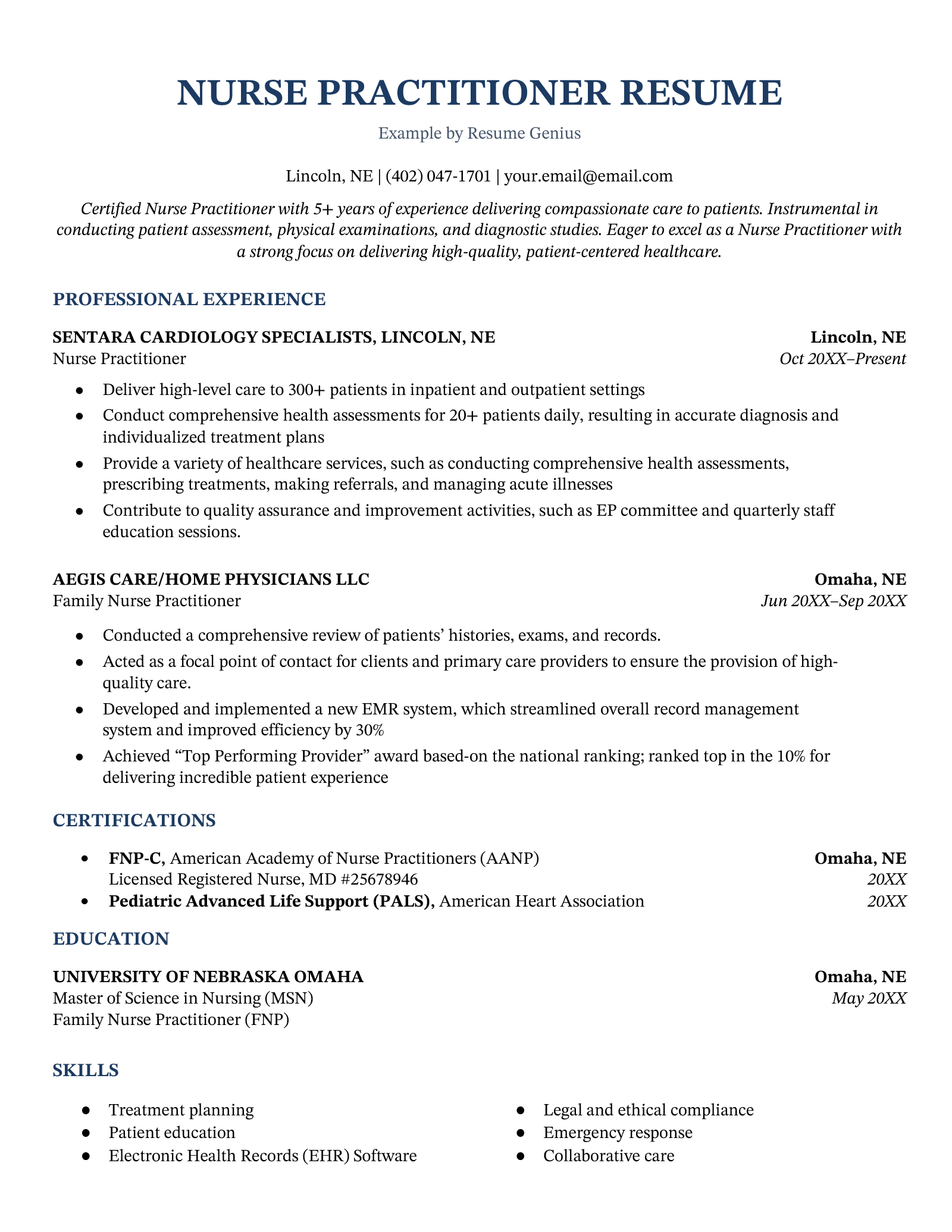
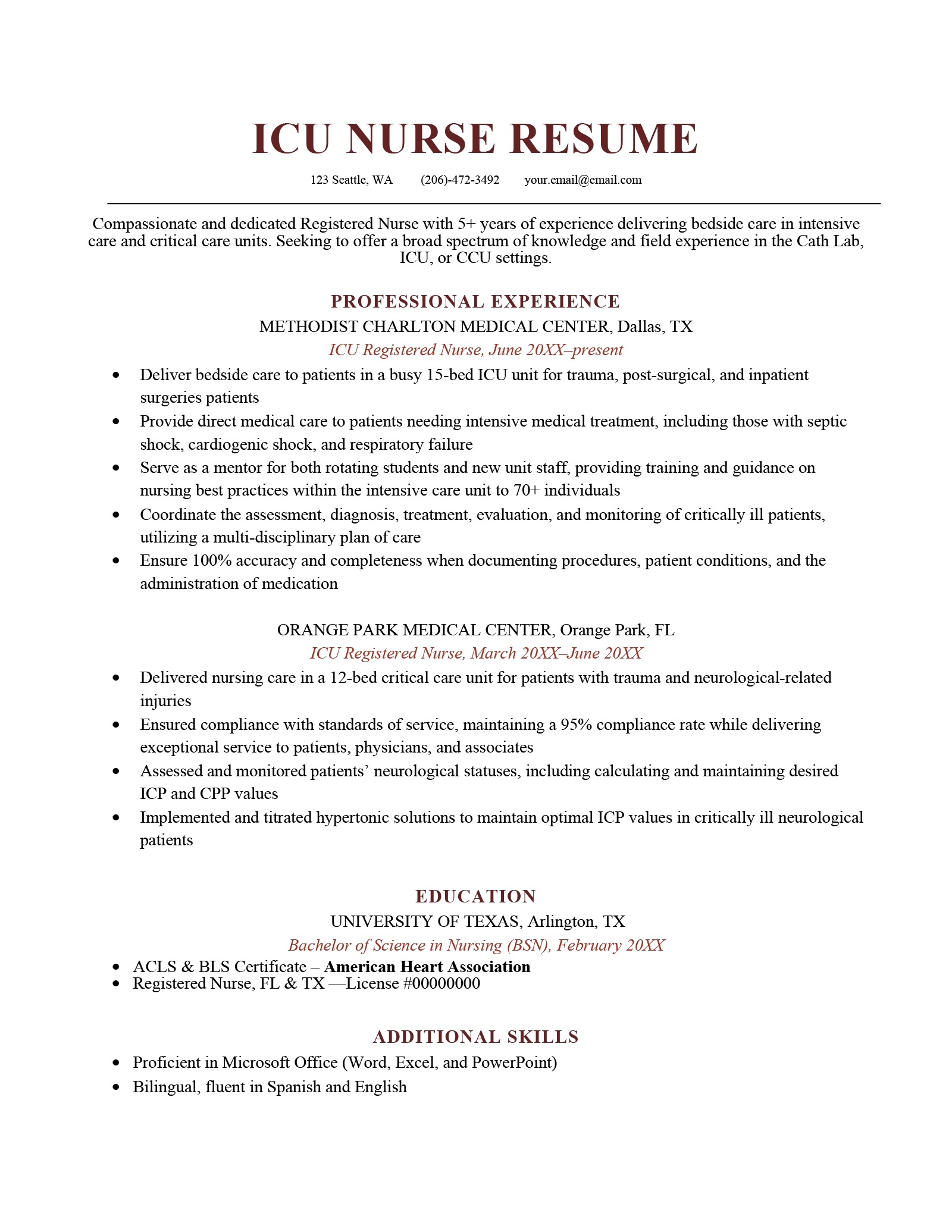
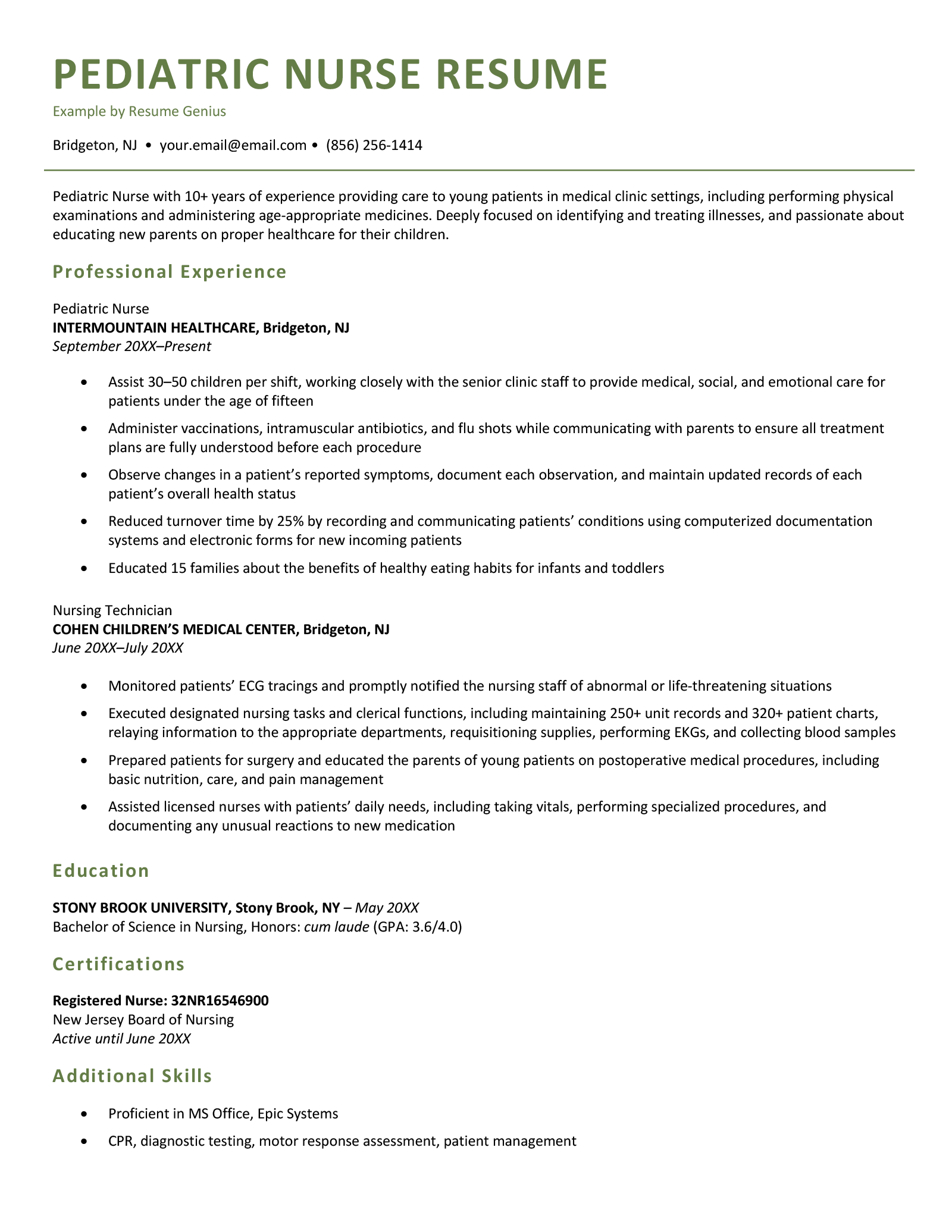
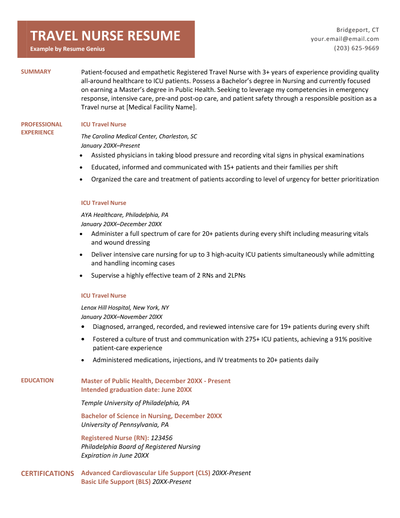
Travel nurse resume template
[Your Address] [City, State]
[Your Email Address] | [Your Phone Number]
[LinkedIn Profile] (optional)
Patient-focused and empathetic Registered Travel Nurse with 3+ years of experience providing quality all-around healthcare to ICU patients. Possess a Bachelor’s degree in Nursing and currently focused on earning a Master’s degree in Public Health. Seeking to leverage my competencies in emergency response, intensive care, pre-and post-op care, and patient safety through a responsible position as a Travel nurse at [Medical Facility Name].
- Assisted physicians in taking blood pressure and recording vital signs in physical examinations
- Educated, informed and communicated with 15+ patients and their families per shift
- Organized the care and treatment of patients according to level of urgency for better prioritization
- Administered a full spectrum of care for 20+ patients during every shift including measuring vitals and wound dressing
- Delivered intensive care nursing for up to 3 high-acuity ICU patients simultaneously while admitting and handling incoming cases
- Supervised a highly effective team of 2 RNs and 2LPNs
Resume Genius University
Bachelor of Science in Nursing
Graduation Date: May 20XX
- Advanced Cardiovascular Life Support (CLS), 20XX–Present
- Basic Life Support (BLS), 20XX–Present
Browse our full library of resume templates for more options.
Pros and cons of being a travel nurse
If you’re still deciding whether to pursue a career as a travel nurse, take a look at this video where Jerine Nicole talks about the pros and cons of the job:
How to write a travel nurse resume
With the high demand for traveling nurses across the country and the unique mobile aspect of your career, it’s only natural to wonder how you can write a strong travel nurse resume that consistently gets you interviews.
Use our writing tips to craft a travel nurse resume that helps you find work where you’re most needed.
Incorporate keywords from the travel nurse job description
Whether you’re answering a travel nurse job posting directly or using staffing agencies like Managed Service Providers (MSP) or Vendor Management Systems (VMS), you’ll still need to include essential resume keywords from the travel nurse job description to optimize your application.
Resume keywords can be found listed in the “desired qualifications” and “responsibilities” sections of a job listing and highlight industry-specific skills employers are looking for.
Include these keywords in your resume summary as well as your work experience section to show employers that you’re qualified for the job.
Here’s an example of how to add relevant keywords to your resume’s experience section:
- Assisted physicians in taking blood pressure and recording vital signs in physical examinations
- Educated, informed and communicated with 15+ patients and their families per shift
The candidate in the example above chose keywords from the job listing when highlighting their past experience to show that they’re capable of filling the open position.
Additionally, with hiring staff as busy as ever to respond to chronic nursing staff shortages, the use of Applicant Tracking Systems (ATS) to filter out potential job candidates is becoming more common to streamline their hiring process.
By incorporating resume keywords, you ensure you have an ATS-friendly resume and reduce the risk of it getting automatically rejected.
There’s no need to customize your resume to every single traveling nurse job description when you’re working with recruiters or agencies who will tailor your general resume when they apply for you. The only exception is when you’re directly applying to a highly desired position.
List your licenses and certifications
As a traveling nurse, you should include all your valid medical licenses and certifications to emphasize your ability to fill different positions in your field of expertise. However, knowing how to list them correctly can be tricky.
Here’s how to list your nursing credentials on your resume according to American Nurses Credentialing Center (ANCC) guidelines:
Licensure
Include the following when listing licensure on your travel nurse resume:
- license type
- licensing state
- license number
- license expiration date
Here’s an example of how to list your licensure as a travel nurse properly on your resume:
Registered Nurse (RN): 123456
Philadelphia Board of Registered Nursing
Expiration in June 20XX
If your license is compact and allows you to practice in multiple states, you should mention this to be considered for more jobs across the country.
Certifications
Follow this format when adding your certifications to your resume:
- certificate name
- name of the awarding institution
- date earned
- certificate expiration date
- certification number (if applicable)
This example demonstrates how to list certifications as a travel nurse on your resume:
Advanced Cardiovascular Life Support (CLS)
20XX
Basic Life Support (BLS)
20XX
Include your nursing licenses and certifications in your education section below your highest degree earned, or in a separate section if you have more than three. This way, they’re clearly visible to hiring managers.
For APRNs (advanced practice registered nurse) or NPs (Nurse Practitioners), be sure to specify where you can practice in a full or restricted capacity without physician supervision in a given state.
Format your resume’s work experience section correctly
When listing work experience on a general RN resume, you should list your most recent positions and your related accomplishments in a simple 3 to 5 bullet point format.
For each entry in your resume’s work experience section, list the following details:
- your title
- your employer and their location
- your dates of employment
- your main responsibilities and achievements
The candidate in the following example listed their most important experience in short, easy-to-read sentences:
ICU Travel Nurse
The Carolina Medical Center, Charleston, SC
January 20XX–December 20XX
- Assisted physicians in taking blood pressure and recording vital signs in physical examinations
- Educated, informed and communicated with 15+ patients and their families per shift
- Organized the care and treatment of patients according to level of urgency for better prioritization
However, using the same format to list all your short missions as a traveling nurse could lead to a cluttered resume, especially if you held many different positions. You can also list your work experience using the following format to show that your experience is a good fit for the position:
- medical facility name and location
- your position or title and employment duration
- facility type (urgent care, nursing home, hospital, etc.)
- trauma Level (level I, II, II)
- total number of beds
- unit type (ICU, ER, PICU, etc)
- unit trauma level
- unit beds
- caseload
- responsibilities and quantified achievements in bullet point format
The candidate in this example has included a more detailed breakdown of their nursing experience, that showcases what type of nursing work they did and how many beds they handled:
ICU Nurse
Lenox Hill Hospital, New York, NY
January 20XX–December 20XX
Facility type: Acute Care Hospital
Teaching facility: No
Unit: ICU
Unit trauma level: 1
Unit beds: 30-34
Caseload: 2
- Diagnosed, arranged, recorded, and reviewed intensive care for 19+ patients during every shift while maintaining a unified holistic strategy that best fits each patient’s needs
- Fostered a culture of trust and communication with 275+ ICU patients, achieving a 91% positive patient-care experience
- Educated, informed and communicated with 15+ patients and their families per shift
- Sterilized and organized 50+ pieces of equipment and medical supplies on a daily basis
As a travel nurse, you can choose to communicate your experience using the simple bullet point format or a more detailed breakdown like the example directly above.
Use your best judgment and select the one with the highest level of readability for your unique situation.
For example, if you’ve worked at many different hospitals in your career, it’s better to provide a more concise overview of each position. However, if you have relatively few positions to list on your resume, provide a detailed breakdown of each one.
If you’re wondering how long your resume should be, a travel nurse resume’s length doesn’t have to be limited to 1 page. If necessary, you can use a two page resume to highlight all the positions you’ve held.
Build your resume in minutes

Average travel nurse salaries in the US
After you’ve written your resume, make sure you use it to apply for jobs within a fair salary range.
The following table includes information from the most recent US Bureau of Labor Statistics’ Occupational Employment and Wage Statistics report for 2026. Here are the ten states with the highest salaries for travel nurses, as well as the national average for your reference when applying for work.
Top 10 states by average nursing salary
| State | Salary / Year |
|---|---|
| California | $150,280 |
| Hawaii | $124,340 |
| Oregon | $123,140 |
| Washington | $121,540 |
| Massachusetts | $117,960 |
| Alaska | $114,870 |
| New York | $113,440 |
| New Jersey | $110,100 |
| District of Columbia | $106,980 |
| Nevada | $105,710 |
| National Average | $101,420 |
About the Author

Nathan Soto is dedicated to providing practical guidance to job seekers, especially people with nonlinear career paths.
Nathan graduated from the University of Nevada with a double B.A. in French and Music. His articles and career advice have been featured on multiple platforms, offering insights into resume writing, interview preparation, and personal branding.


Click to rate this article
4.5 Average rating