14 Medical Resume Examples & Template for 2026
 Written By Lauren MastroniCareer Expert & Digital Content Writer
 Reviewed By Samuel JohnsSenior Content Editor & Certified Professional Resume Writer
Lauren Mastroni is a Digital Content Writer at Resume Genius, where she creates data-driven career content and actionable job search advice. With a background in academic research, she brings a...
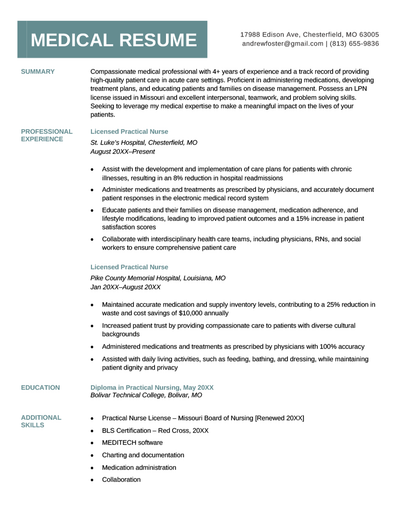

Medical resume examples by experience level
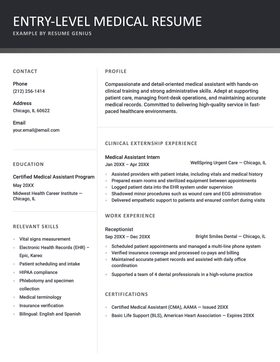
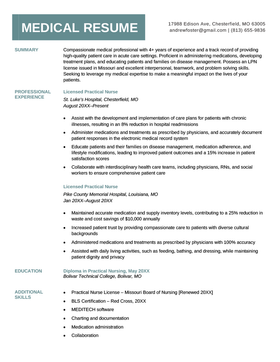
Browse our full collection of resume templates for more design options.
- Medical resume template (text format)
- Medical resume examples for different roles
- Medical school resume
- Respiratory therapist resume
- Phlebotomist resume
- Ultrasound tech resume
- Dialysis technician resume
- Clinical research coordinator resume
- Physical therapy resume
- Medical receptionist resume
- Medical technologist resume
- Optometrist resume
- Medical scribe resume
- Medical billing and coding resume
- How to write a medical resume
- Frequently asked questions about writing a medical resume
Medical resume template (text format)
[Your Email Address] • [Your Phone Number] • [City, State] • [LinkedIn Profile] (optional)
Professional Summary
[1–3 sentences highlighting your experience, credentials, and key strengths. Mention your career goals and the value you bring to a healthcare team.]
Example:
Motivated and compassionate medical professional with [X] years of experience in [setting, e.g., urgent care, family practice, etc.]. Skilled in [key skills or procedures], with a strong commitment to delivering high-quality patient care.
Work Experience
[Most Recent Job Title]
[Company Name] — [City, State]
[Start Date] – [End Date/Present]
- [Responsibility or task performed]
- [Responsibility or task performed]
- [Achievement or metric if available]
- [Tool, software, or procedure used]
[Prior Job Title]
[Company Name] — [City, State]
[Start Date] – [End Date]
- [Responsibility or task performed]
- [Responsibility or task performed]
- [Achievement or contribution]
Education
[ Most Recent Degree]
[School Name] — [City, State]
[Graduation Month + Year]
- [Relevant coursework or achievements]
- [GPA if 3.5+ or Dean’s List if applicable]
[Previous Degree or Diploma]
[School Name] — [City, State]
[Graduation Month + Year]
Certifications
[Certification Name] — [Issuing Organization], Expires: [Year]
[Certification Name] — [Issuing Organization], Expires: [Year]
Example: Certified Medical Assistant (AAMA) — Issued 20XX
Skills
- [Skill 1 (e.g., Vital Signs Monitoring)]
- [Skill 2 (e.g., Electronic Health Records – Epic, Cerner)]
- [Skill 3 (e.g., Phlebotomy)]
- [Skill 4 (e.g., Insurance Verification)]
- [Skill 5 (e.g., Bilingual – English/Spanish)]
- [Skill 6 (e.g., HIPAA Compliance)]
Optional Sections
Languages
[Language Name – proficiency level]
Awarding Institute Name (if applicable)
Volunteer Experience
[Role] — [Organization Name], [Location]
[Month, Year] – [Month, Year]
[Task or impact]
Professional Affiliations
[Organization Name] — [Member Since Year]
Medical resume examples for different roles
Browse our collection of medical resume examples tailored for various specialized roles. Each example shows how to highlight the skills, certifications, and experience employers look for in that specific field.
Medical school resume
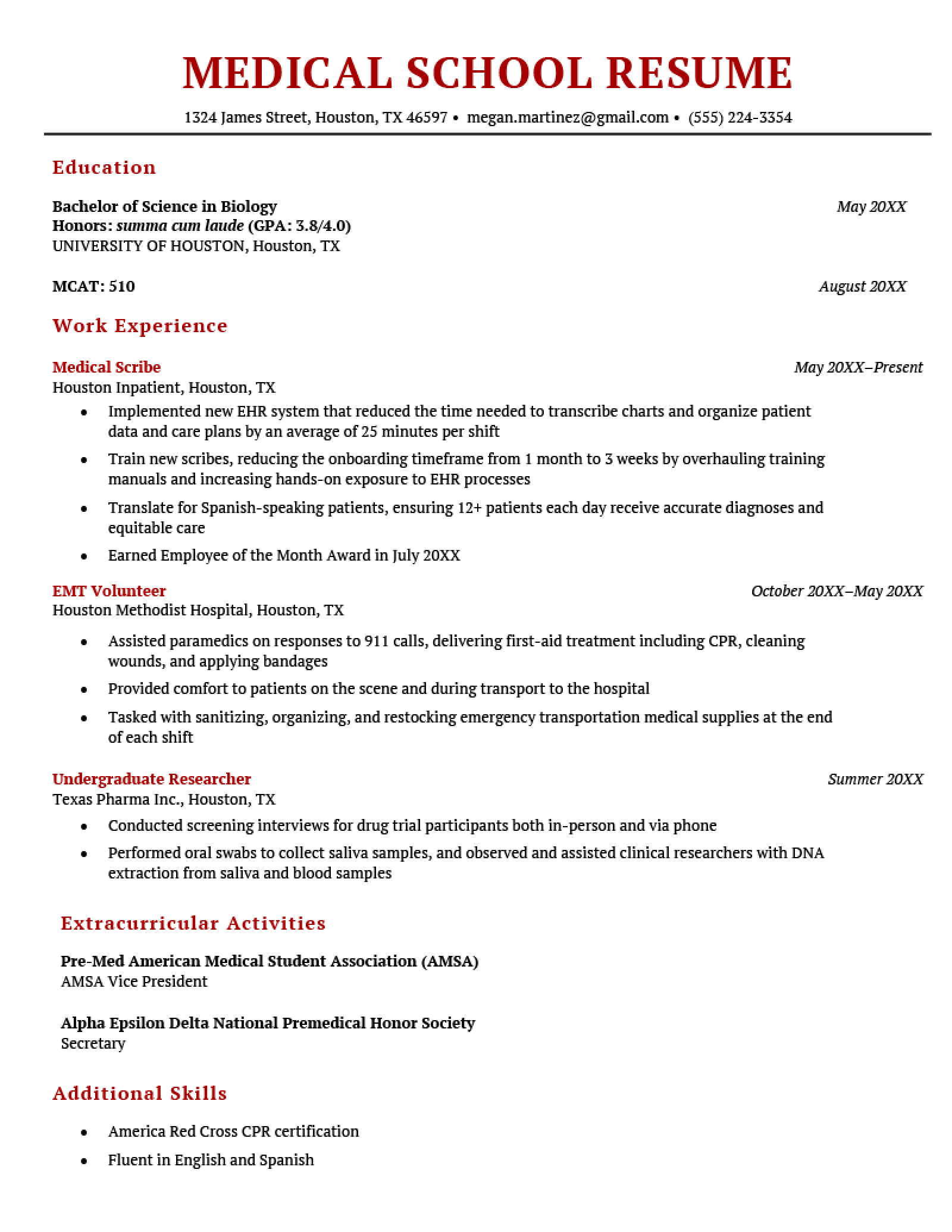
Why this example works
- MCAT score: Listing your MCAT score in the education section near the top of your resume ensures it’s immediately visible to admissions committee members.
- Relevant experience: Including relevant medical experience, whether it’s work-related or not, demonstrates your medical knowledge.
Respiratory therapist resume
Why this example works
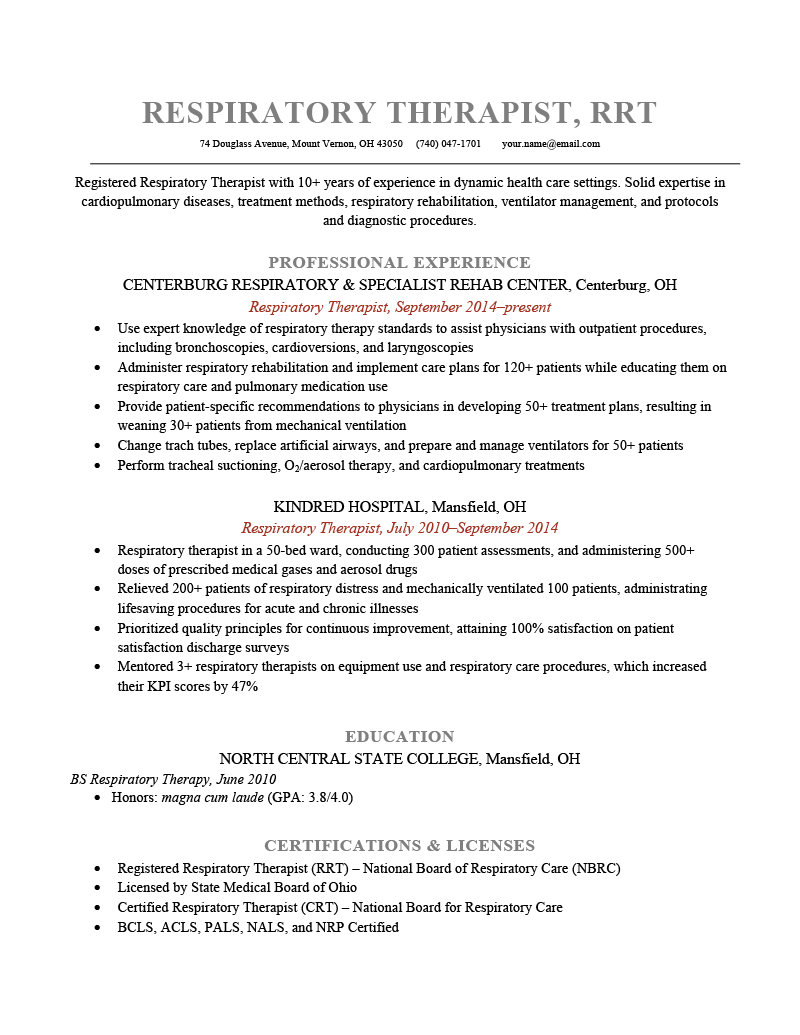
- Certifications and licenses: At this stage in your medical career, you’ve probably acquired one or more professional certifications. Listing them in a dedicated certifications section makes sure they’re not overlooked.
- Concise education section: An experienced applicant, keeping the education section brief — limited to essential details — allows more room to highlight professional accomplishments.
Phlebotomist resume
Why this example works
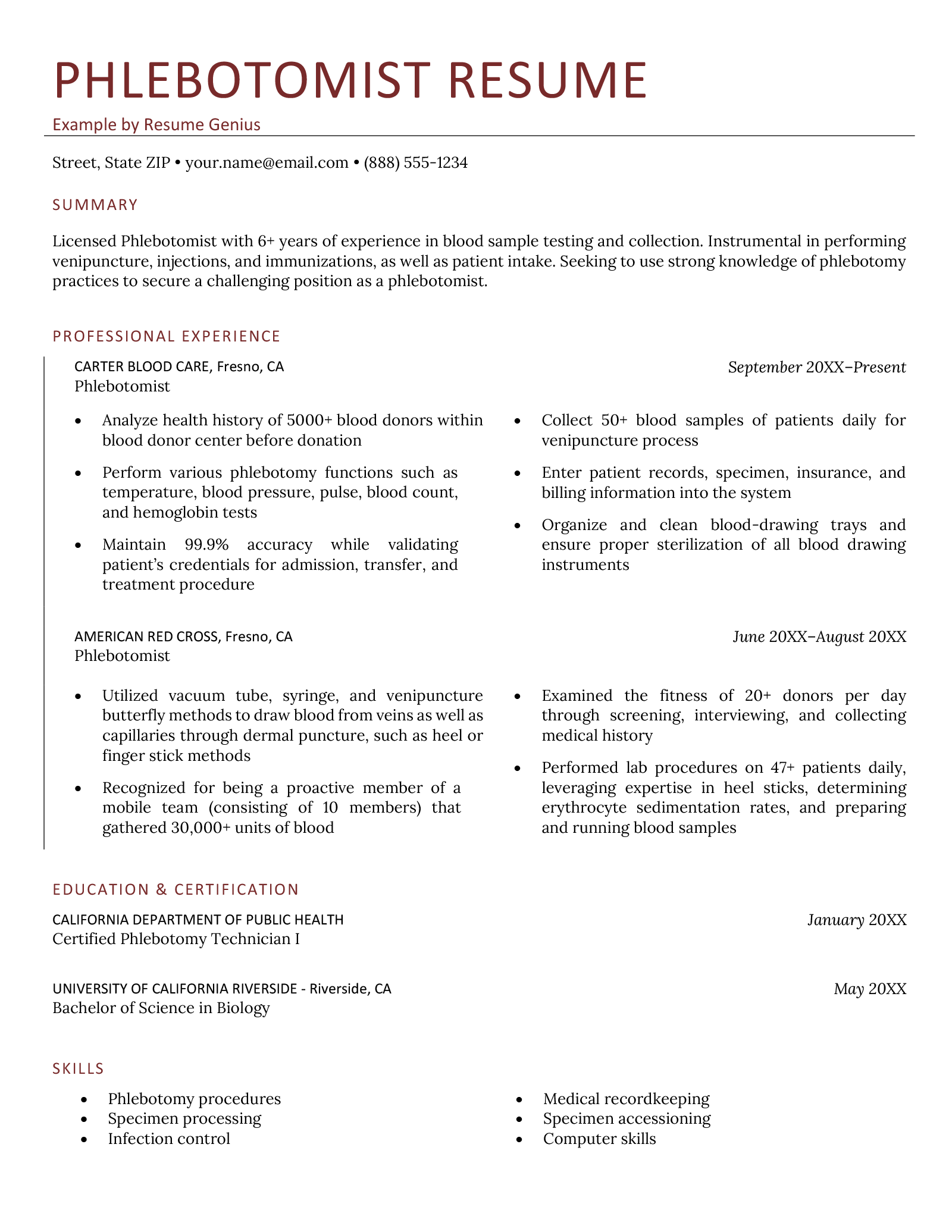
- Hard skills: The skills section focuses on the applicant’s technical skills, the key qualifications employers look for on a phlebotomist resume.
Ultrasound tech resume
Why this example works
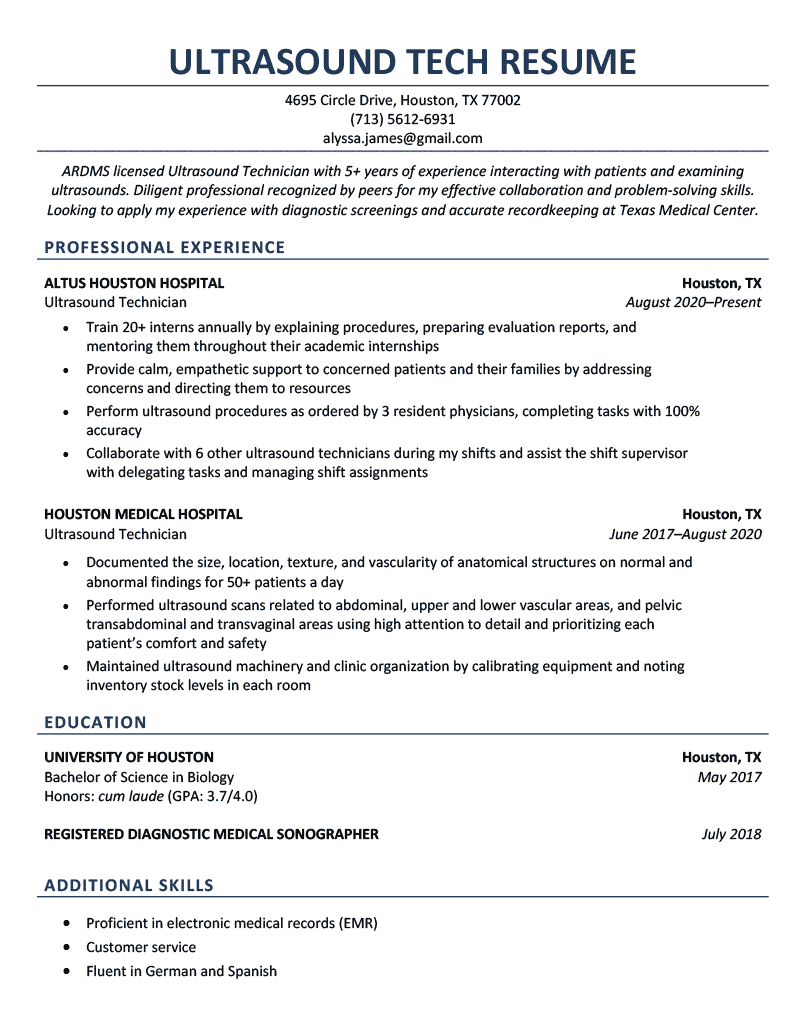
- Effective work experience section: Each bullet point starts with a strong action verb and includes specific, measurable responsibilities, such as training interns and assisting multiple physicians, showcasing both technical expertise and teamwork skills.
Dialysis technician resume
Why this example works
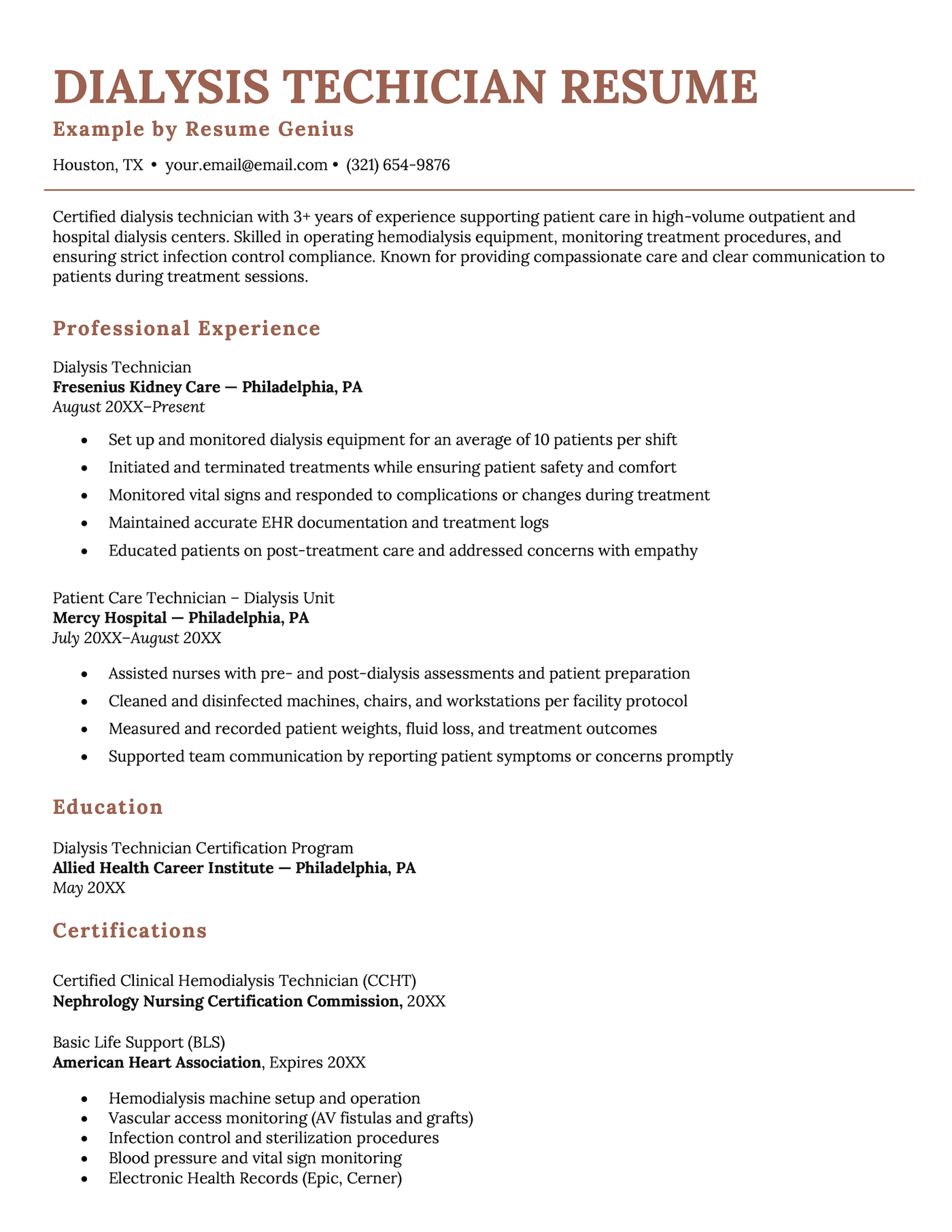
- Highlights soft and hard skills: Alongside technical skills, this resume emphasizes soft skills like empathy, communication, and teamwork, which are important qualities for building patient trust.
Clinical research coordinator resume
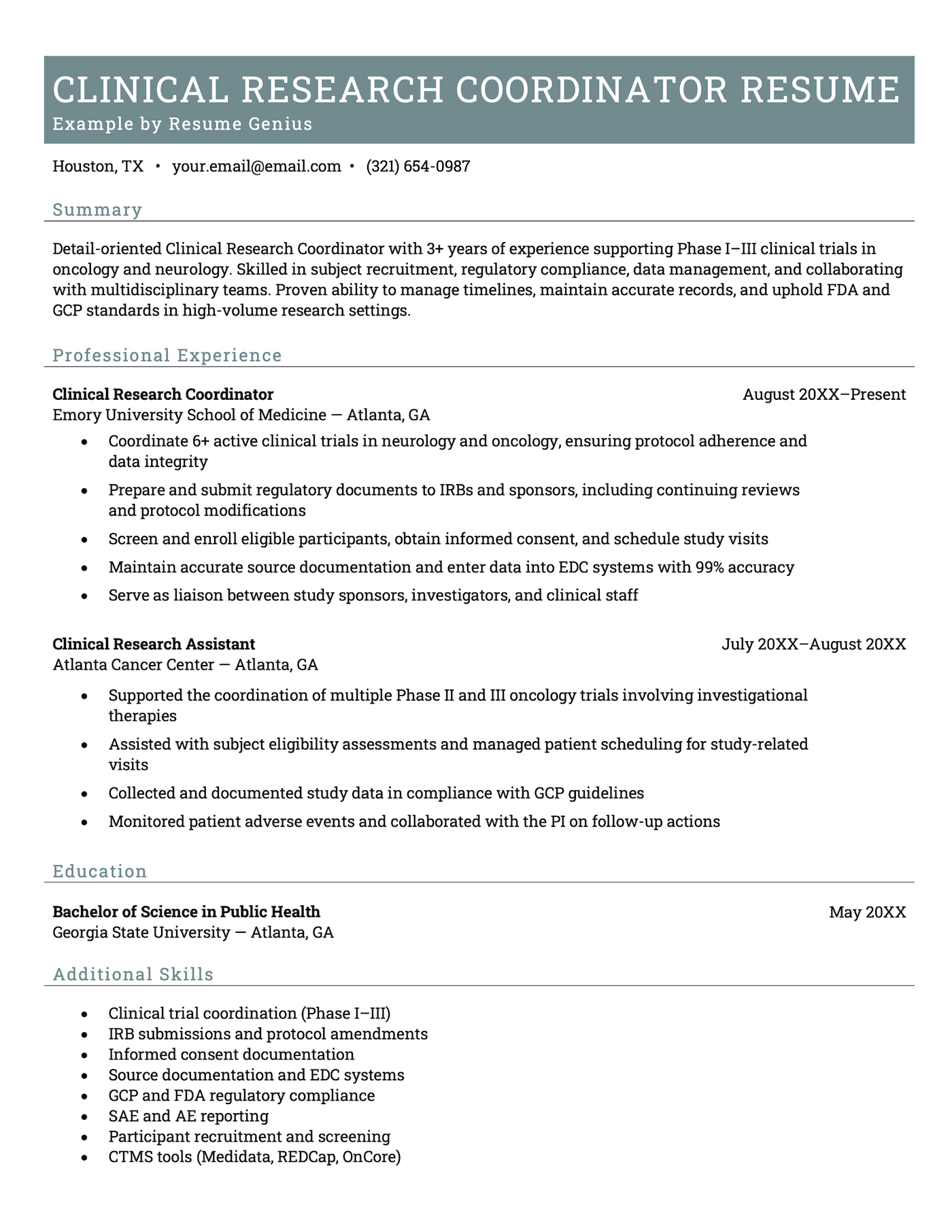
Why this example works
- Targeted summary: The professional summary clearly communicates the candidate’s experience level, specialty, and core strengths, allowing employers to quickly assess their fit for the role.
Physical therapy resume
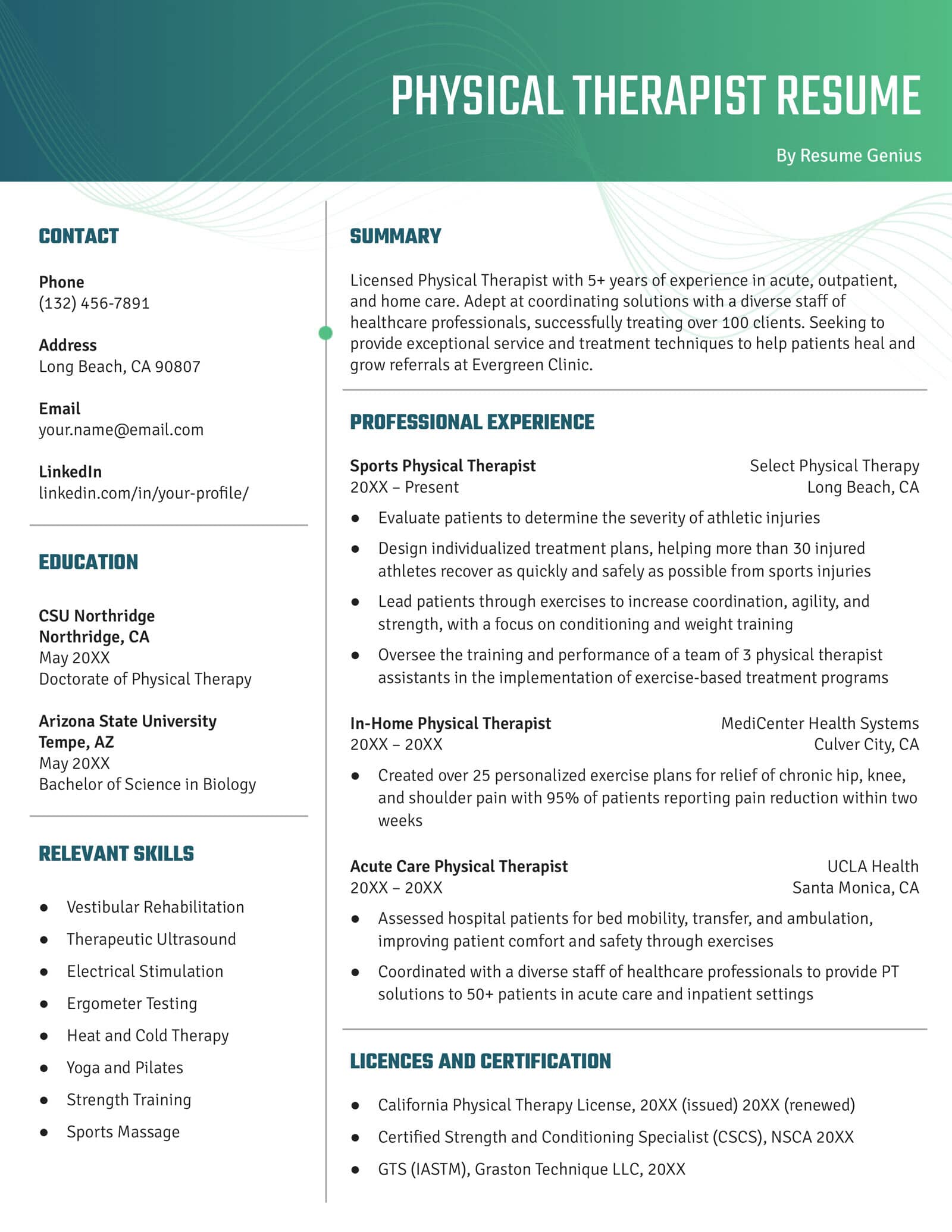
Why this example works
- Shows specialization: This applicant has transitioned into a sports therapist role and uses the experience and skills sections to highlight their expertise in this specialty.
Medical receptionist resume
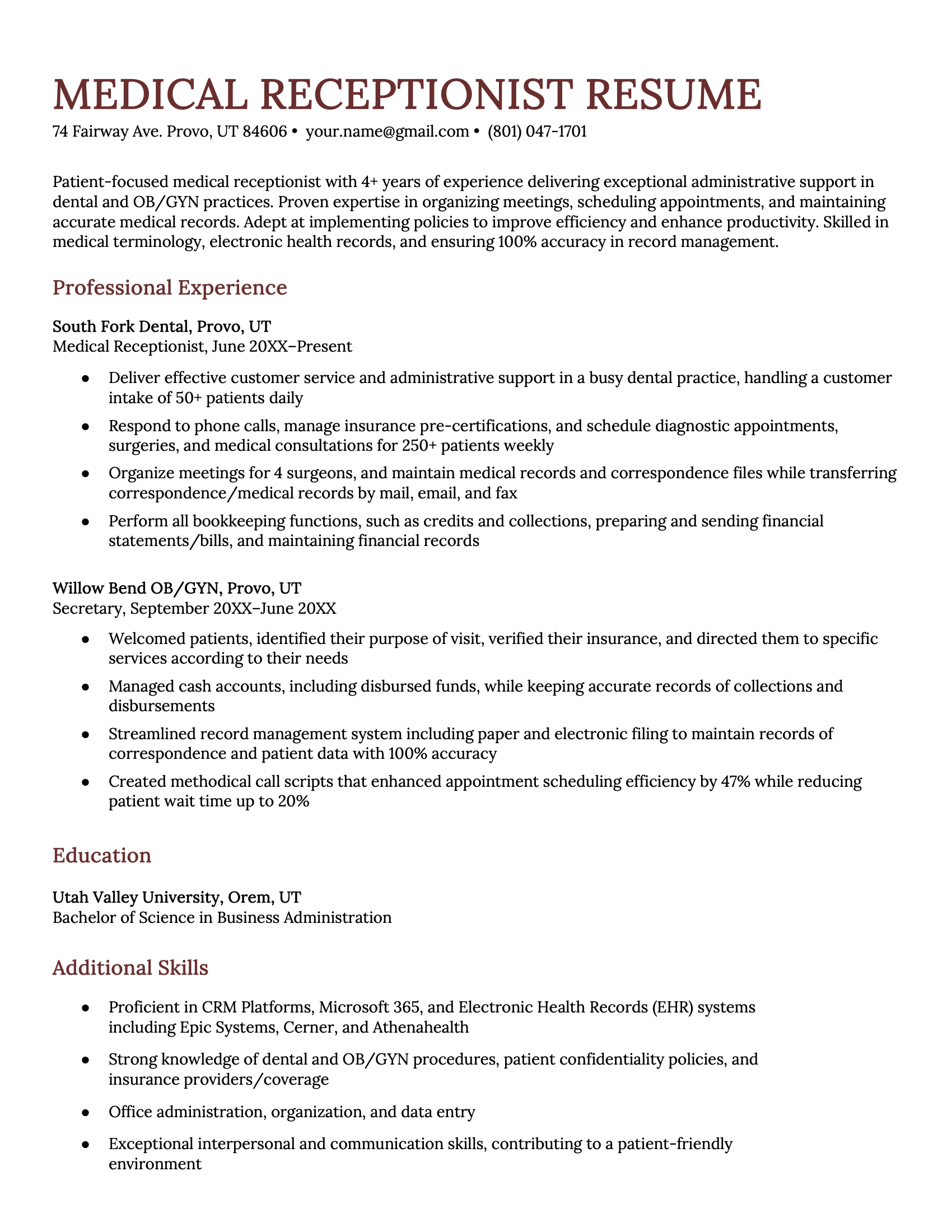
Why this example works
- Administrative skills: The applicant incorporates administration-related keywords throughout their resume to show strong organizational skills and attention to detail, key qualities for medical receptionists.
Medical technologist resume
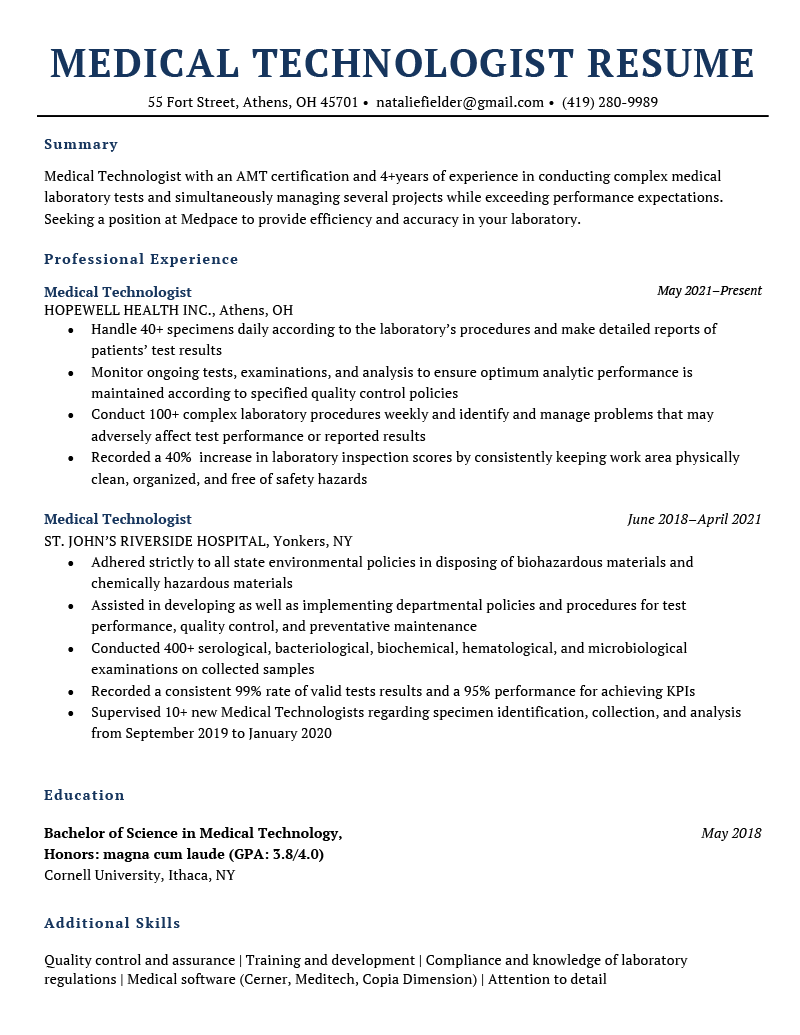
Why this example works
- Hard numbers: The applicant quantifies their achievements using numbers and percentages, clearly illustrating the impact of their work and helping hiring managers understand what they’d be capable of if hired.
Optometrist resume
Why this example works
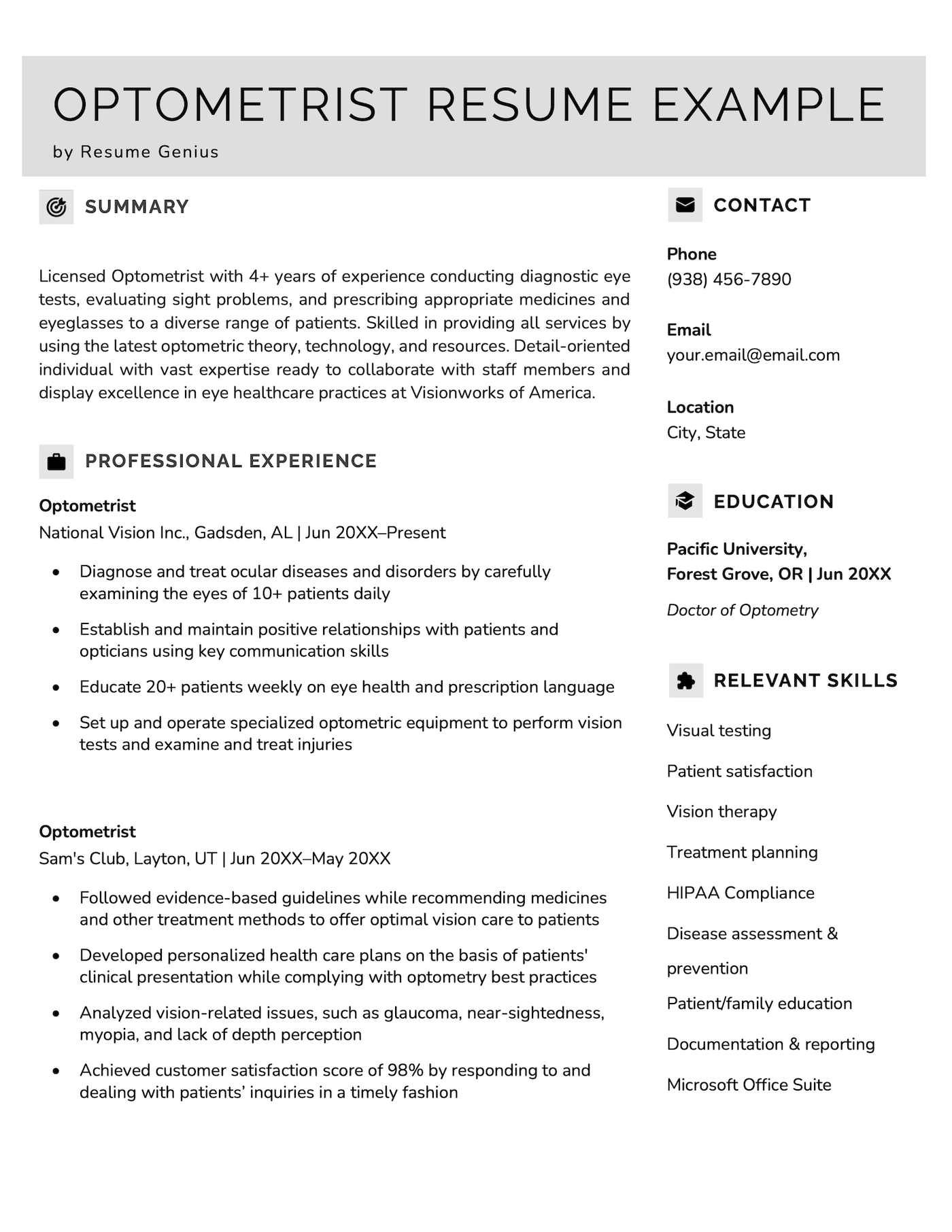
- Strong introduction: The resume introduction above summarizes this optometrist’s experience, key skills, and professional qualifications. Including the most important information upfront ensures hiring managers quickly understand your qualifications and are compelled to keep reading.
Medical scribe resume
Why this example works
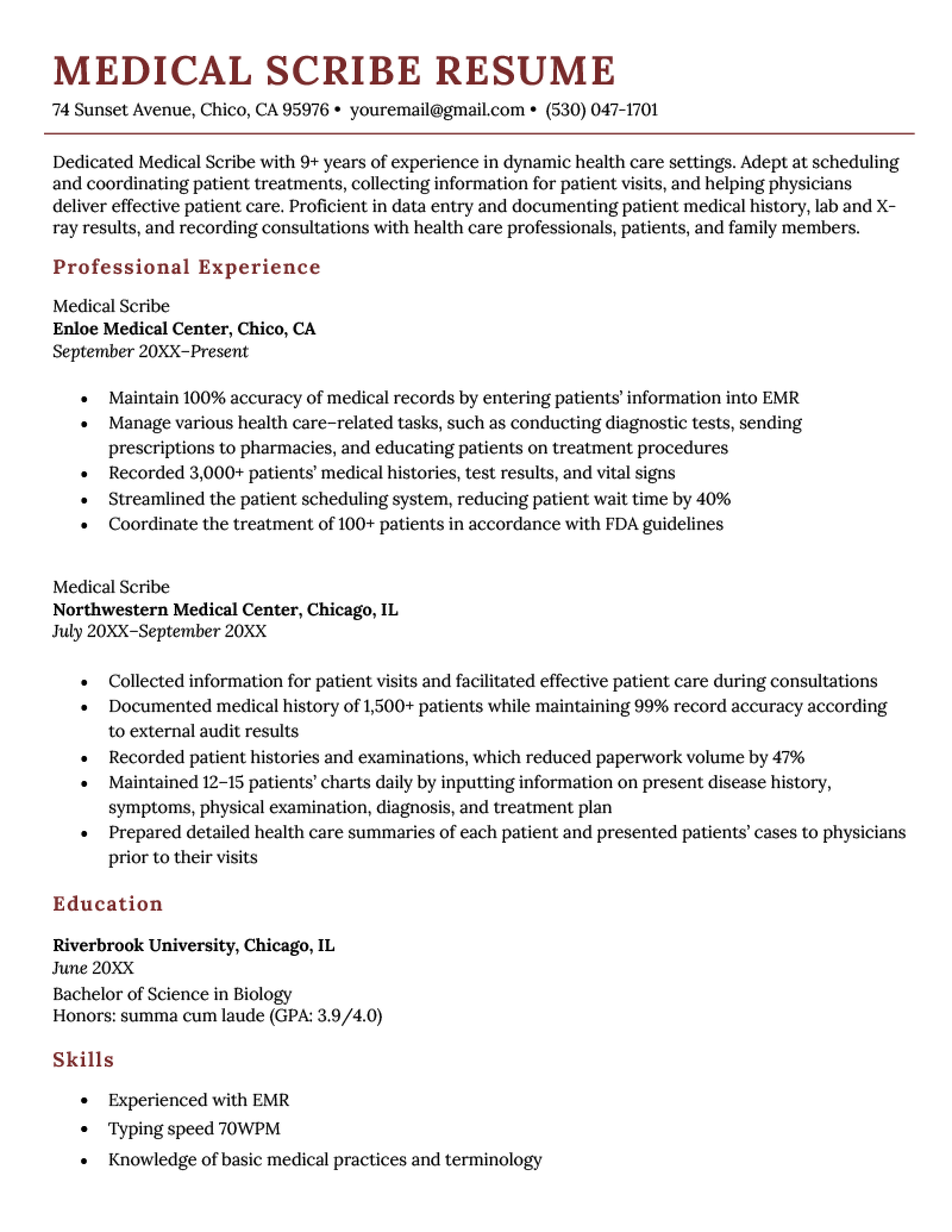
- Attention to detail: Accuracy is essential for a medical scribe, and this applicant highlights their ability to maintain precise records in their resume’s work experience section.
Medical billing and coding resume
Why this example works
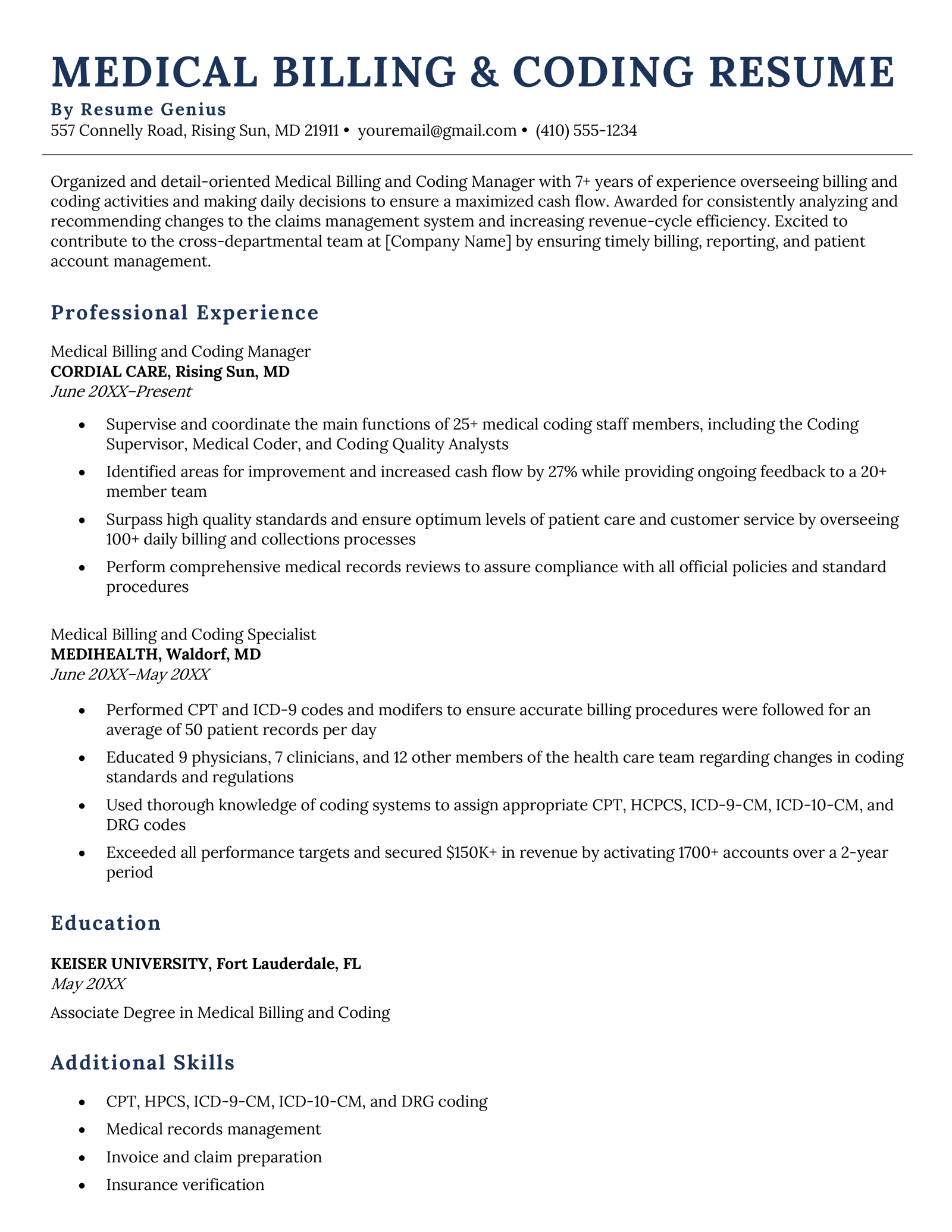
- Technical skills: The resume highlights the applicant’s technical expertise by both relevant competencies in the skills section and reinforcing them with real-world examples in the work experience section.
How to write a medical resume
Employers need to see that you have the medical expertise and knowledge necessary to deliver safe, compassionate, and high-quality patient care. You can prove your expertise with a well-written medical resume.
Dr. Ryan C. Warner, Clinical Psychologist and Founder & CEO of RC Warner Consulting, explains what he looks for in a resume:
This is a personal choice, but I prefer a more formal resume or CV. Regardless of the style, make sure to emphasize the impact you’ve had in each role, not just listing job descriptions.
— Dr. Warner
Here are some practical tips for writing a medical resume that shows you’re fully qualified for the job:
1. Summarize your qualifications and goals
Your medical resume should open with a concise, tailored statement that immediately shows employers why you’re a strong fit for the job.
A resume summary is ideal if you already have some experience in the medical field. Summaries highlight your qualifications, key skills, and notable accomplishments, serving as a snapshot of your professional background and value.
Certified Medical Assistant with 4+ years of experience supporting fast-paced family practices. Skilled in patient intake, EHR management, and clinical procedures. Recognized for strong communication skills and compassionate care.
A resume objective, on the other hand, is better suited for entry-level candidates, recent graduates, or professionals transitioning into healthcare. Instead of focusing on past experience, an objective emphasizes your career goals and how you plan to contribute in the role.
Recent graduate of a Certified Nursing Assistant (CNA) program seeking an entry-level role in a long-term care facility. Eager to apply my training and passion for patient support to deliver high-quality, hands-on care.
2. Show the scope of your experience
In healthcare, numbers matter. Whether you’ve worked in a small clinic or a busy hospital, quantifying your experience, like how many patients you’ve helped or procedures you supported, gives employers valuable context.
In your work experience section, add numbers to your bullet points wherever possible, like this:
- Monitored vitals and managed care for 15+ surgical patients daily
- Delivered bilingual support to families in a pediatric care setting
- Coordinated treatment plans in a 200-patient oncology clinic
3. Highlight your education and training
Whether you’re new to the field or an experienced professional, your education and certifications are key to getting hired. In your education section, include the name of your program, the school, and your completion date. Then, list any active certifications to show you’re job-ready.
Diploma in Medical Assisting
HealthTech Institute — Tampa, FL
Completed: June 20XX
Certified Medical Assistant (CMA)
American Association of Medical Assistants (AAMA)
Issued: July 20XX
Basic Life Support (BLS)
American Heart Association
Expires: June 20XX
If you have multiple certifications, you can make a separate certifications section to keep them organized:
Certified Clinical Medical Assistant (CCMA)
National Healthcareer Association (NHA)
Issued: May 20XX
Basic Life Support (BLS)
American Heart Association
Expires: June 20XX
Electrocardiogram (EKG) Technician Certification
National Performance Specialists (NPS)
Issued: April 20XX
Phlebotomy Technician (CPT)
National Phlebotomy Association
Expires: March 20XX
4. Showcase key skills the employer is looking for
Your skills section should be tailored to each job you apply for. Start by reviewing the job description and identifying the most important qualifications. Then, match those keywords to your own experience and list the most relevant ones at the top of your skills section.
Focus on hard skills in your skills section, and demonstrate how you’ve applied them in your work experience section. Soft skills, like communication or teamwork, shouldn’t appear in your skills section. Instead, weave them into your bullet points to show how you’ve used them in real situations.
Hard skill:
- Documented patient vitals and input data into Epic EHR with 100% accuracy across 200+ patient records
Soft skill:
- Collaborated with a team of 5 nurses to streamline daily rounds and improve patient response times by 20%
Hard + soft skill:
- Educated patients on post-treatment care while managing intake for 30+ daily walk-ins in a high-volume clinic
Frequently asked questions about writing a medical resume
Get quick answers to the most common questions about writing a medical resume:
What is the best medical resume format?
The best format for a medical resume is the reverse-chronological resume format. This layout puts your most recent experience first, showing your career progression and making your resume easy for hiring managers and applicant tracking systems (ATS) to scan.
A reverse-chronological medical resume typically includes:
- A resume summary or objective
- A skills section focused on technical abilities
- Work experience (listed from most recent to oldest)
- Education
- Certifications and licenses
Avoid functional or overly creative layouts, as they can confuse ATS software and bury important details like licenses or clinical experience. To make sure your resume is ATS-friendly, use our free ATS resume scanner tool.
Do I need a resume or a CV for the medical field?
It depends on the type of job you’re applying for.
If you’re pursuing clinical or administrative roles, like medical assistant, nurse, technician, or office coordinator, you’ll typically need a resume. Resumes are generally one page and focus on your most relevant skills and experience.
If you’re applying for academic, research, or physician-level positions, especially within hospitals, universities, or international organizations, you’ll likely need an academic CV. CVs are more comprehensive, covering your full academic history, research, publications, and presentations.
When in doubt, check the job listing. Most U.S.-based healthcare roles outside academia will ask for a resume.
How long should a medical resume be?
A medical resume should generally be one page long. Employers often review dozens of applications for each opening, so keeping your resume concise and easy to scan is essential.
Focus on the most relevant information: your certifications, technical skills, education, and recent experience. If you have a longer work history, prioritize the roles and achievements most applicable to the job you’re applying for.
Build your resume in minutes

About the Author

Lauren Mastroni is a Digital Content Writer at Resume Genius, where she creates data-driven career content and actionable job search advice. With a background in academic research, she brings a research-focused approach to topics like resume writing, interviewing, and career development. Lauren is dedicated to helping job seekers at all stages navigate the hiring process and present themselves more effectively to employers.


Click to rate this article
4.9 Average rating